
By Raúl Peñaranda, Brújula Digital:
The legal proceedings stemmed from political and judicial conflicts, and both exiles and political prisoners view the electoral change as an opportunity to be tried with legal guarantees and return to Bolivia with the hope of a more impartial justice system.
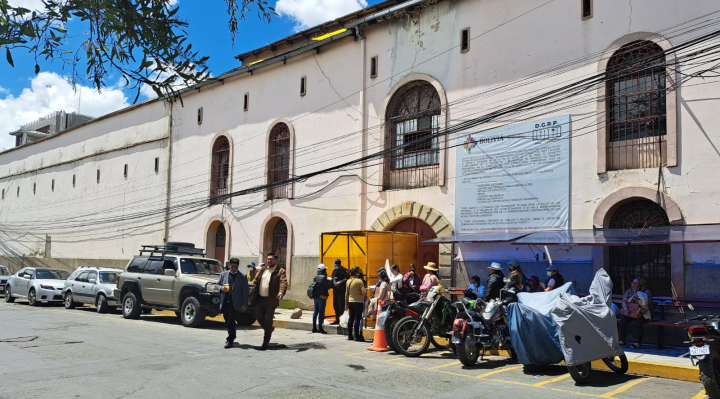
San Pedro prison in La Paz. Photo: Social Media.
Around a thousand exiles —including ministers from Gonzalo Sánchez de Lozada’s cabinet who left the country after Evo Morales’ government began legal action against them— hope to return after Sunday’s elections. Some have been abroad since 2003, when Sánchez de Lozada’s second term ended.
Alongside them, roughly 200 political prisoners accused over the 2019 repression also await an electoral shift that could lead to their release, either through annulment of their cases or a general amnesty.
The list of political prisoners is headed by former president Jeanine Añez, Santa Cruz governor Luis Fernando Camacho, and former Potosí civic leader Marco Pumari, all accused of a supposed coup d’état that never occurred.
Exiles living in cities like Lima, Madrid, and Washington closely follow the electoral process, which could end with an opposition victory over MAS-aligned candidates.
Officials from Sánchez de Lozada’s 2002–2003 government were accused by prosecutors under Morales of various crimes, particularly ministers who signed a decree authorizing the armed forces to act against protests over a possible gas sale to Chile. That military and police repression left 67 dead.
The ministers’ defense argued that they only authorized military deployment, not killings, but Morales’ government still pursued charges. While some military chiefs were imprisoned for years, most managed to leave the country and rebuild their lives abroad, albeit at great personal cost.
In an interview with Iván Ramos for Periodismo que Cuenta, former minister Hugo Carvajal —now under asylum with the Spanish NGO ACCEM— said the country’s turnaround depends on cleansing the judiciary. He stressed his exile was the result of a “politically manipulated” case: “I’m not avoiding trial, but I want an independent court, free of manipulation and pressure. Democracy must go hand in hand with deep judicial reform to restore credibility and open the doors for the return of thousands of exiles.”
Carvajal warned that Evo Morales “is not defeated” and could refocus his influence on local elections, “seeking territorial control of governorships and municipalities.”
The government of Luis Arce has also targeted others, such as former La Paz mayor Luis Revilla, accused of overpricing the PumaKatari buses and living in Brazil since 2022. In his interview with Ramos, Revilla said his return depends on deep judicial reform: “It’s not about nullifying cases, but about considering the evidence, rebuttals, and documents proving our innocence. We want trials to be conducted in strict legality and with real guarantees.”
Revilla warned that Bolivia’s crisis is not only economic, but also institutional and moral: “We must rebuild the institutions that have collapsed in recent years.” He said he has stabilized financially through affordable housing projects but acknowledged the personal cost: “I left behind my eldest daughter and my mother in Bolivia. This is a painful uprooting shared by thousands of compatriots.”
Carvajal and Revilla agree that August 17 will decide not only the next government but also whether hundreds of Bolivians scattered around the world can return home knowing they will be heard and judged under due process.
BD/RPU
Por Raúl Peñaranda U., Brújula Digital:
Los procesos legales fueron consecuencia de conflictos políticos y judiciales, y tanto exiliados como presos políticos ven en el cambio electoral una oportunidad para ser juzgados con garantías legales y volver a Bolivia con la esperanza de una justicia más imparcial.
El penal de San Pedro, en La Paz. Foto: RR.SS.
Unos mil exiliados, entre otros los ministros del gabinete de Gonzalo Sánchez de Lozada que tuvieron que salir del país una vez que el gobierno de Evo Morales inició un proceso contra ellos, tienen esperanzas de volver a Bolivia tras las elecciones de este domingo. Algunos están fuera desde 2003, cuando cayó el segundo gobierno de Sánchez de Lozada.
Junto con ellos, alrededor de 200 presos políticos, acusados por los hechos de represión de 2019, también aguardan esperanzados un cambio electoral que les permita avizorar su liberación, ya sea mediante la anulación de sus procesos o una amnistía general.
La lista de presos políticos están encabezados por la expresidenta Jeanine Añez, el gobernador de Santa Cruz, Luis Fernando Camacho, y el exdirigente cívico potosino Marco Pumari. Los tres están acusados de un supuesto golpe de Estado que nunca existió.
Entre los exiliados están quienes viven en ciudades como Lima, Madrid y Washington; ellos también siguen atentamente los resultados del proceso electoral, que podría concluir con una victoria de los candidatos opositores sobre los que representan a la órbita del MAS.
Autoridades de la gestión del segundo gobierno de Sánchez de Lozada (2002-2203) han sido acusadas por fiscales durante el gobierno de Evo de distintos delitos. Los que fueron ministros, por haber firmado un decreto supremo que autorizaba a las FFAA actuar contra las protestas que se produjeron por la posible venta del gas a Chile. En la represión policial y militar que se produjo murieron 67 personas.
La defensa de los ministros indicó que estos solamente habían autorizado la actuación de las FFAA, no que personas fueran asesinadas, pero el gobierno de Morales inició de todas maneras los procesos legales. Algunos acusados, sobre todo jefes militares, fueron detenidos durante años, pero la mayoría logró salir del país. Desde entonces han logrado rehacer sus vidas en el exterior, pero con alto costo personal.
Entrevistado por Iván Ramos, del programa Periodismo que Cuenta, de Sucre, el exministro Hugo Carvajal afirma en que el cambio de rumbo del país pasa por sanear la justicia. Bajo asilo promovido por la ONG Asociación Comisión Católica Española de Migraciones (ACCEM), reafirma que su salida fue consecuencia de un proceso judicial “manipulado políticamente”.
“No eludo un proceso, pero quiero un tribunal independiente, sin amaño ni presión. La democracia debe ir de la mano con una profunda reforma judicial, que devuelva credibilidad a las instituciones y abra las puertas para el regreso de miles de exiliados”, sostiene.
Carvajal advierte que el expresidente Evo Morales “no está derrotado” y que podría reorientar su influencia hacia las elecciones subnacionales, “buscando control territorial en gobernaciones y municipios”.
Ha habido también otros acusados, esta vez por el gobierno de Luis Arce, como el exalcalde de La Paz, Luis Revilla, sindicado de por el presunto sobreprecio de los buses PumaKatari y quien vive en Brasil desde 2022.
Ramos conversó con él, quien afirmó que su regreso depende de una reforma profunda en la administración de justicia: “No se trata de anular casos, sino de que se consideren las pruebas, los descargos y los documentos que tenemos para demostrar nuestra inocencia. Queremos que los procesos se lleven en estricta legalidad y con garantías reales”, señaló.
Revilla advirtió que la crisis que vive el país no es solo económica, sino también institucional y moral: “Es necesario reconstruir las instituciones que se han venido abajo estos últimos años”.
Aseguró en la entrevista que ha podido estabilizarse económicamente llevando adelante proyectos de vivienda popular, pero reconoce el costo humano: “Dejé a mi hija mayor y a mi madre en Bolivia. Es un desarraigo muy duro que comparten miles de compatriotas”.
Carvajal y Revilla coinciden en que el 17 de agosto no solo se define un gobierno, sino también la posibilidad de que cientos de bolivianos dispersos por el mundo puedan volver a pisar su tierra con la certeza de que serán escuchados y juzgados bajo el marco del debido proceso.
BD/RPU

 Bolivian Thoughts | Pensamientos Bolivianos (Bilingual/Bilingüe)