
By Entorno, Brujula Digital:
In the mining center of Tipuani, Chinese investors remain distant and difficult to locate. Their silent presence is transforming the region, raising questions, tensions, and a growing sense of division
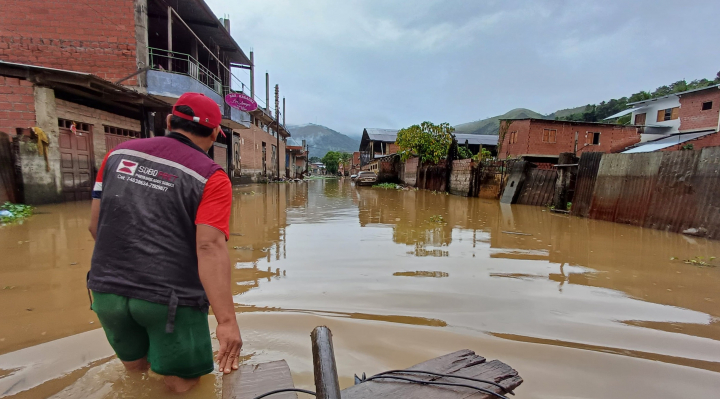
Fidel Véliz, a victim of the disaster, tries to enter his house through the contaminated water. Photo: Entorno
The water reaches his chest, some days his neck. Fidel Véliz, a 36-year-old veterinarian, hesitates before stepping into the stagnant, murky water that now covers what used to be his street. His house is underwater. His cats, now living on the roof, are the only reason he returns every other day—with food, affection, and memories of a life he lost.
This scene unfolds in Tipuani, a gold-rich town located eight hours from Bolivia’s capital, La Paz. Formerly nicknamed the “Gold Capital,” Tipuani has been overwhelmed by uncontrolled mining operations, most of them run by Bolivian cooperatives backed by foreign capital, primarily Chinese.
Torrential rains and the reckless redirection of the Tipuani River by miners have flooded neighborhoods, destroyed homes, and collapsed infrastructure. More than 70% of the town’s 7,600 residents have been affected.
Locals say they are drowning due to government negligence, environmental devastation, and the consequences of a chaotic mining system that benefits foreign investors far more than local residents.
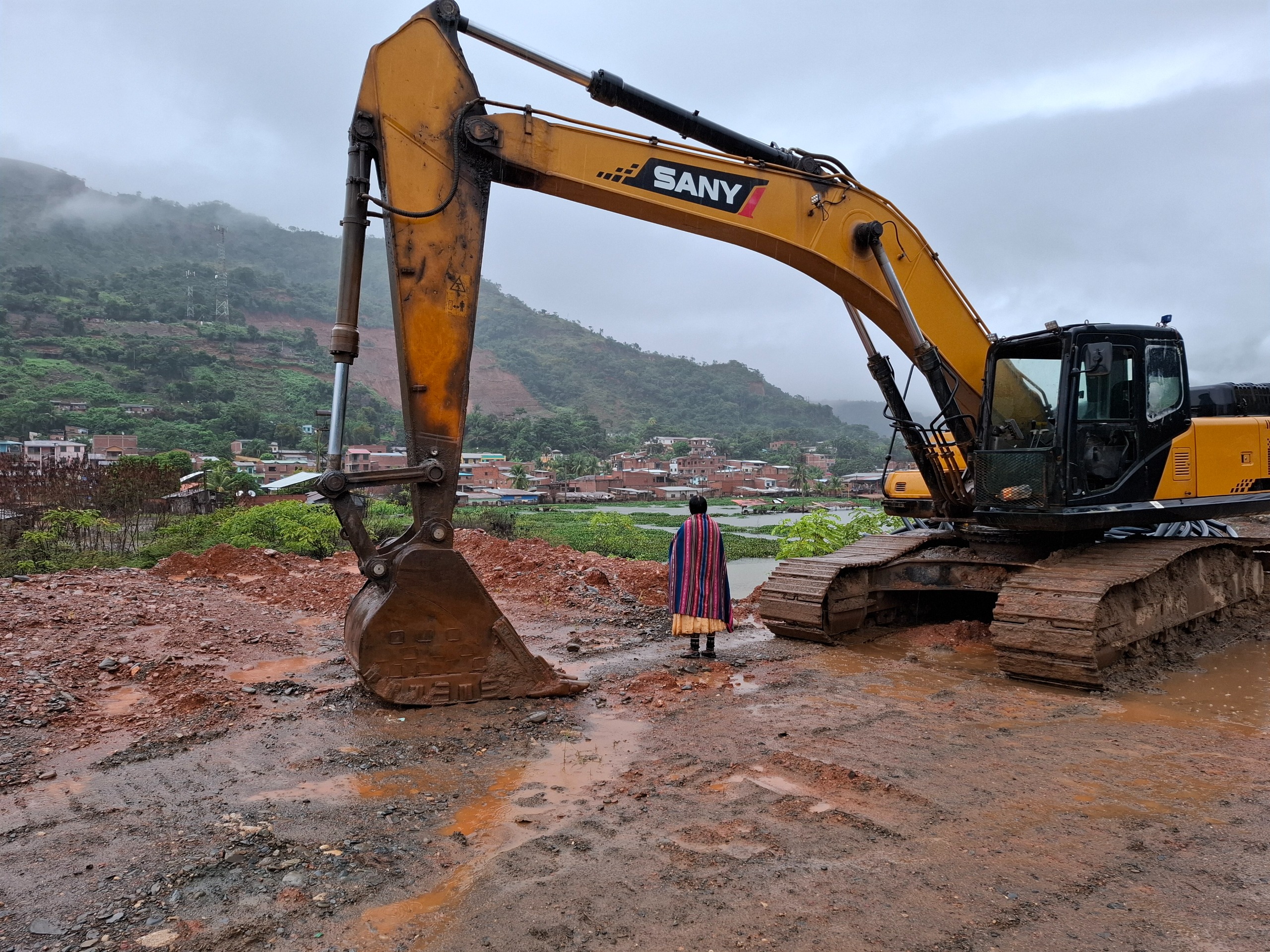 A woman looks over Tipuani, still flooded months after heavy rains caused the local river to overflow.
Photo: Sergio Mendoza
“We live in a sewer”
One morning this January, the river overflowed without warning. Within minutes, adobe homes collapsed, businesses were swept away, and some residents lost their lives.
“Last year, my house, my business, everything I had collapsed,” says Roger Viadez, president of Tipuani’s Central Neighborhood. He managed to evacuate his family seconds before the walls gave way. He spent two months sleeping in the town square.
He rebuilt his home with bank loans, only to see it flooded again months later. “It’s infuriating to live like this. Local and national authorities are clearly aware of this situation, but no one does anything effective,” he told Entorno.
Viadez now floats through a toxic soup of river water and sewage on a raft made of a table, ropes, and foam blocks. The water isn’t just from the river—it’s mixed with sewage. Tipuani has no sewer system, so when it rains, wastewater returns to the city. “We’re living on top of shit, and many people are already getting sick,” he says.
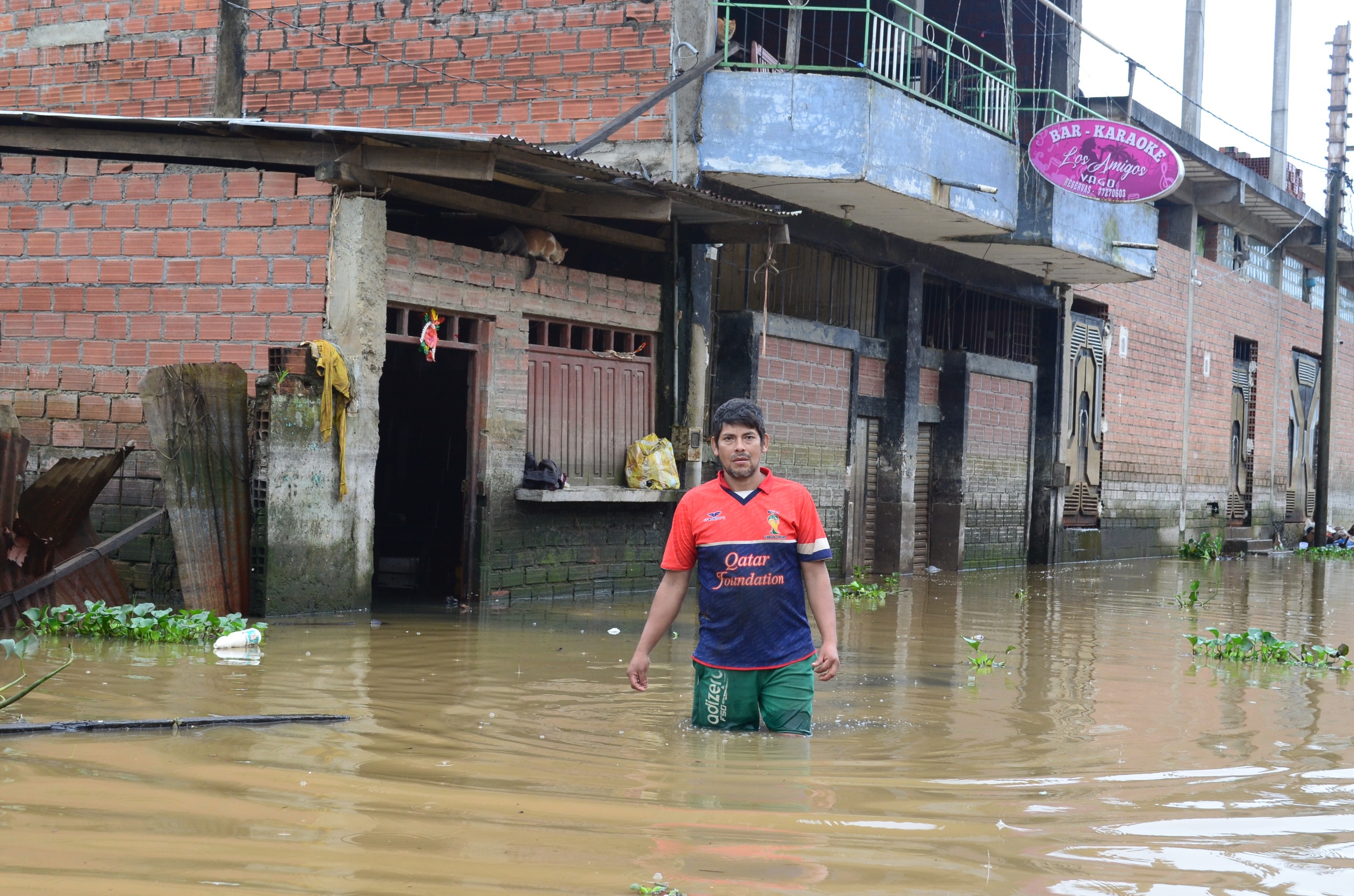 Fidel Véliz is one of the victims of the Tipuani floods. His home was completely inundated. Photo: Sergio Mendoza
A foreign hand in the ruins
Tipuani is home to about 15 registered gold mining cooperatives. But residents point to six in particular that have partnered with foreign investors—mostly Chinese, but also Colombian and German. These often informal partnerships are blamed for some of the worst environmental damage.
“The Chinese companies make internal agreements with Bolivian cooperatives, sometimes for five, seven, or ten years,” says Rufino Chambi, president of Tipuani’s neighborhood councils. “But if the venture fails, they (the Chinese) break the deal.”
According to Chambi, these investors take about 70% of the gold profits, leaving only 30% for the Bolivian side. “They’ve been here almost four years; I think they should leave something behind, at least a paved avenue or a major project,” he tells Entorno.
Viadez, president of the Central Neighborhood, adds that these aren’t even formally established companies. “They claim to be businesses, but they’re not registered and don’t contribute to the state. They just come to take the gold and ship it to their country,” he says.
Heavy machinery—excavators, dump trucks, and backhoes—roar day and night just steps from residents’ homes.
The massive amount of sediment has raised the riverbed to the same level as the town. Now, every time it rains, the river not only overflows but pours directly into Tipuani’s streets.
Along the road, several mining exploration sites can be seen. Only a few Chinese individuals are visible in the work camps. Most are investors who isolate themselves from the local community, reinforcing the feeling of a distant and opaque foreign presence in this Bolivian mining region.
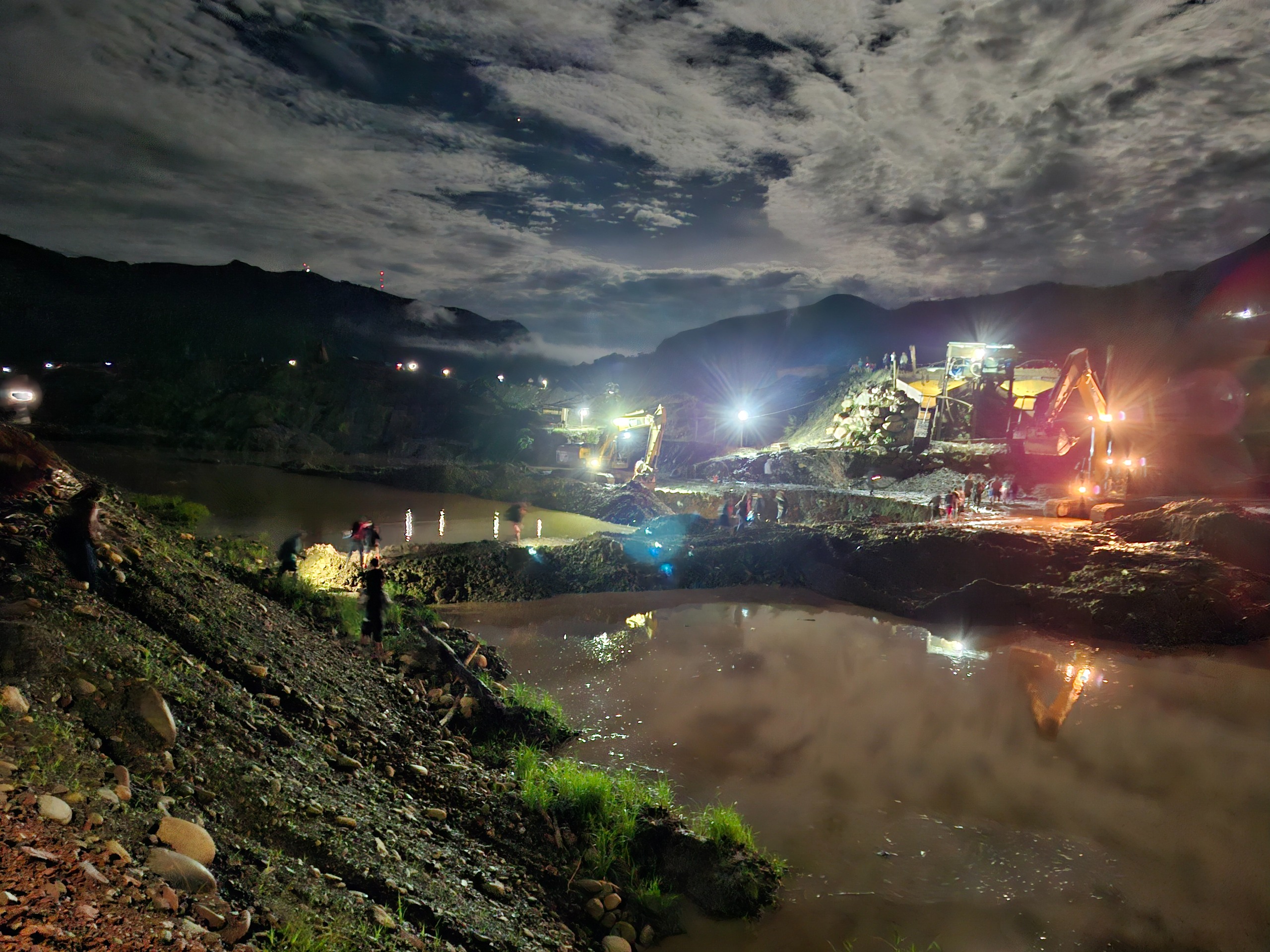 Mining operations continue day and night in Tipuani. Photo: Sergio Mendoza.
Rising waters, rising frustration
Tipuani’s residents have begun to react. One recent weekend, members of the town’s Civic Committee and Social Oversight Commission tried to confront a new mining company, Lin Qin SRL, but the company canceled the meeting at the last minute. “People are tired of being ignored,” says local leader Gimena Pérez. “We’re not against mining, but it has to be responsible.”
Pérez, like many others, lost her home in the floods. She points to submerged cars and collapsed houses. “We’re not going to live off gold, and future generations need to understand that.”
In May, a 17-year-old boy died when his vehicle plunged into an abandoned mining pit. “That wasn’t the road,” his aunt, Norma Espejo, says sadly. “The crash was the cooperatives’ fault. We’ve been fighting them for years.”
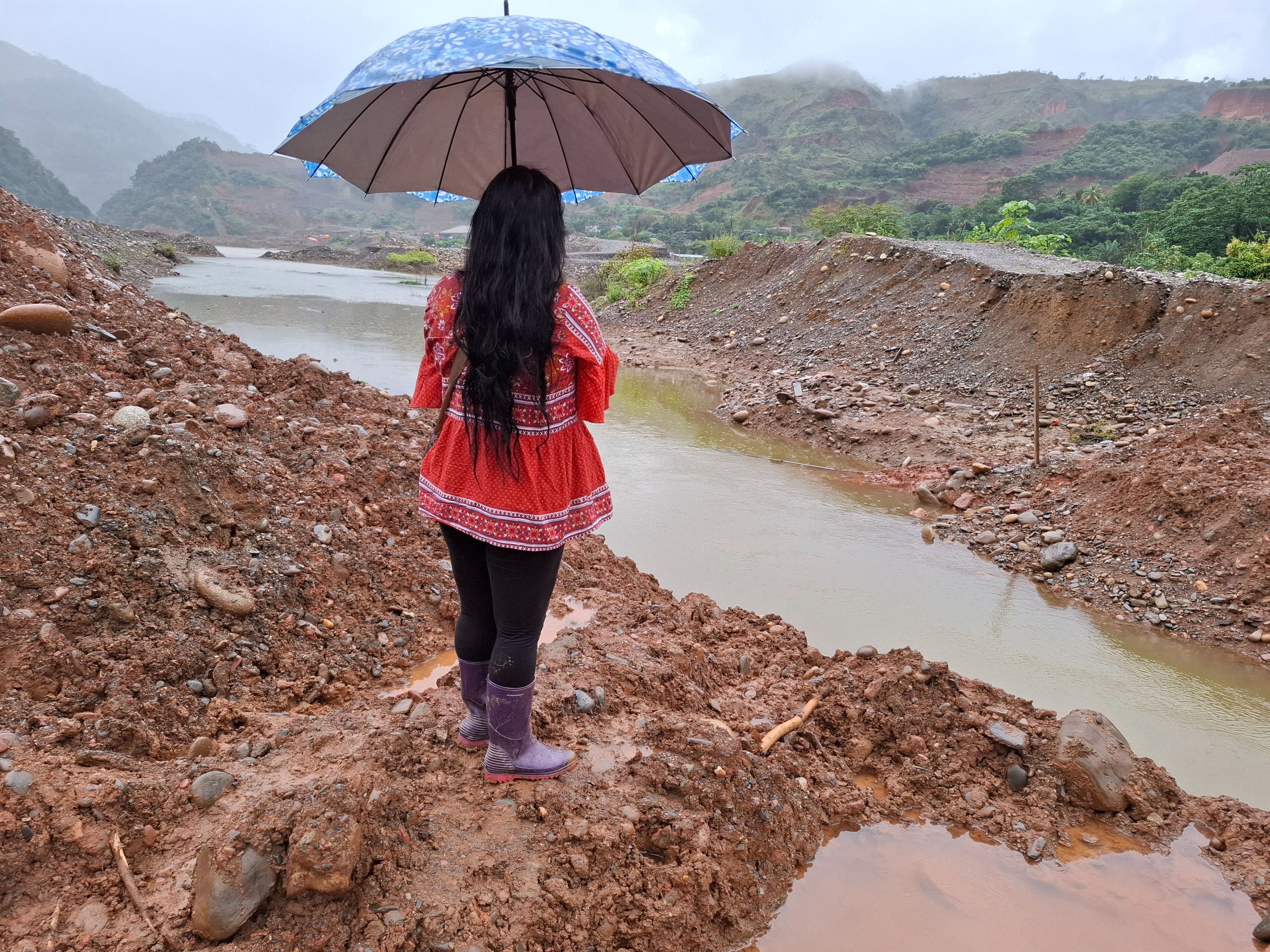 Gimena Pérez, member of Tipuani’s Social Oversight Commission, observes the destruction left behind by irresponsible mining. Photo: Entorno
Chinese investors
Tipuani’s mayor, Fernando Vera, confirmed there are 15 registered cooperatives in the area. But he said that behind them are at least six major foreign investors, most of them Chinese.
“They come, work, and leave. We ask for their work plans, but they almost never follow them. And when we try to intervene, the townspeople themselves defend them,” Vera told Entorno.
Vera, a cooperative member and businessman, says he’s tried to enforce the law but gets little support. “It’s like swimming against the current.”
The city has spent nearly $75,000 on emergency water pumping, but the flooding continues. The giant mining ponds have become constant sources of seepage. One bridge has already been swept away.
Gold and ruins
Tipuani’s residents aren’t asking for mining to stop—they depend on it. Nearly 90% of the population relies on gold extraction to survive. What they demand is regulation, accountability, and basic infrastructure. “We just want them to fill the pits and not leave open wounds,” says Viadez.
As the Civic Committee walks through what used to be neighborhoods, a jeep speeds by. Four young Chinese men watch from behind tinted windows. They are rarely seen at the mines.
Ironically, locals say that even some of the houses rented by those Chinese have flooded.
Photographing the mines is nearly impossible. Workers rush to stop anyone. But the damage is visible everywhere: submerged homes, blocked roads, and residents left to fend for themselves as the waters rise.
Véliz, the veterinarian, has sent his partner and son to La Paz. He now sleeps in the ruins of a damaged but not destroyed technical institute. “I stayed to take care of the cats. They’re all I have left here,” he says.
BD/
Por Entorno, Brújula Digital:
En el centro minero de Tipuani, los inversores chinos permanecen distantes y son difíciles de localizar. Su presencia silenciosa está transformando la región, suscitando preguntas, tensiones y una sensación de división cada vez más profunda
Fidel Véliz, damnificado, intenta ingresar a su casa en medio del agua contaminada. Foto: Entorno
El agua le llega al pecho, algunos días al cuello. Fidel Veliz, veterinario de 36 años, duda antes de dar un paso por el agua turbia y estancada que ahora cubre lo que antes era su calle. Su casa está bajo el agua. Sus gatos, que ahora viven en el techo, son la única razón por la que regresa día por medio, con comida, afecto y recuerdos de la vida que perdió.
Esta escena se desarrolla en Tipuani, un pueblo rico en oro situado a ocho horas de la capital de Bolivia, La Paz. Antiguamente apodada la “Capital del Oro”, Tipuani se ha visto desbordada por explotaciones mineras sin control, la mayoría dirigidas por cooperativas bolivianas respaldadas por capital extranjero, principalmente chino.
Las lluvias torrenciales y el redireccionamiento imprudente del río Tipuani por parte de los mineros han sumergido barrios, destruido casas y derrumbado infraestructuras. Más del 70 % de los 7600 habitantes de la ciudad se han visto afectados.
Los lugareños dicen que están ahogándose por la negligencia del gobierno, la devastación ambiental y las consecuencias de un caótico sistema minero que beneficia mucho más a los inversores extranjeros que a los residentes locales.
Una mujer observa Tipuani, todavía anegada meses después de que las fuertes lluvias provocaran el desbordamiento del río local.
Foto: Sergio Mendoza
“Vivimos en una cloaca”
Una mañana de enero de este año, el río se desbordó sin previo aviso. En cuestión de minutos, las casas de adobe se derrumbaron, los comercios fueron arrasados y algunos residentes perdieron la vida.
“El año pasado se ha caído mi casa, mi negocio, todo lo que tenía”, relata Roger Viadez, presidente de Barrio Central de Tipuani. Consiguió evacuar a su familia segundos antes de que cedieran los muros. Pasó dos meses durmiendo en la plaza del pueblo.
Reconstruyó su casa con préstamos bancarios, solo para verla inundarse de nuevo meses después. “Da mucha bronca estar así. Esta situación claramente es conocida por autoridades locales y nacionales, pero nadie hace nada efectivo”, explica a Entorno.
Viadez navega ahora por un caldo tóxico de agua de río y aguas residuales en una balsa hecha con una mesa, cuerdas y bloques de espuma. El agua no es solo de río, sino que está mezclada con aguas residuales. Tipuani no tiene sistema de alcantarillado, así que, cuando llueve, las aguas residuales vuelven a la ciudad. “Estamos viviendo sobre la mierda, mucha gente incluso ya está enfermando”, dice.
Fidel Véliz es uno de los damnificados de las inundaciones en Tipuani. Su casa quedó totalmente inundada. Foto: Sergio Mendoza
Una mano extranjera en las ruinas
Tipuani alberga unas 15 cooperativas mineras de oro registradas. Pero los residentes señalan seis en particular que se han asociado con inversores extranjeros, en su mayoría chinos, pero también colombianos y alemanes. A estas asociaciones, a menudo informales, se les atribuyen algunos de los peores daños medioambientales.
“Las empresas chinas hacen un convenio (interno) con las cooperativas bolivianas, a veces por cinco, siete o diez años”, dice Rufino Chambi, presidente de las juntas vecinales de Tipuani. “Pero si la actividad fracasa, ellos (chinos) rompen el convenio”.
Según Chambi, estos inversores se llevan aproximadamente el 70 % de los beneficios del oro, dejando solo el 30 % para la parte boliviana. “Llevan aquí casi cuatro años, creo que deberían dejar algo, al menos una avenida cementada o una obra grande”, comenta a Entorno.
Viadez, presidente de Barrio Central de Tipuani, añade que ni siquiera son empresas constituidas. “Dicen ser empresas, pero no están registradas ni aportan al Estado. Solo vienen a sacar el oro y se lo llevan a su país”, declara.
Maquinaria pesada, excavadoras, volquetes y retroexcavadoras rugen día y noche a pocos pasos de las casas de los residentes.
La enorme cantidad de sedimentos ha elevado el lecho del río a la misma altura que la ciudad. Ahora, cada vez que llueve, el río no solo se desborda, sino que desemboca directamente en las calles de Tipuani.
A lo largo del camino, se divisan varios yacimientos de exploración minera. Solo se ven unos pocos chinos en los campamentos de trabajo. La mayoría son inversores que se aíslan de la comunidad local, reforzando la sensación de una presencia extranjera distante y poco transparente en esta región minera boliviana.
La actividad minera trabaja día y noche en Tipuani. Foto: Sergio Mendoza.
Aguas que suben, frustración que aumenta
Los habitantes de Tipuani han empezado a reaccionar. Un fin de semana reciente, miembros del Comité Cívico y de la Comisión de Control Social de la ciudad intentaron enfrentarse a una nueva empresa minera, Lin Qin SRL, pero la empresa canceló la reunión a último momento. “La gente está cansada de que la ignoren”, afirma Gimena Pérez, dirigente local. “No estamos en contra de la minería, pero tiene que ser responsable”.
Pérez, como muchos otros, perdió su casa en las inundaciones, y señaló coches sumergidos y casas derruidas. “De oro no vamos a vivir, y eso las generaciones futuras tienen que entenderlo”.
En mayo, un joven de 17 años murió cuando su vehículo se precipitó a un pozo minero abandonado. “Por aquí no era el camino”, relata con tristeza su tía Norma Espejo. “Ese vuelco del auto es culpa de las cooperativas. Ya llevamos años peleando con las cooperativas”.
Gimena Pérez, integrante de la Comisión de Control Social de Tipuani, observa la destrucción que deja la actividad minera irresponsable. Foto: Entorno
Inversionistas chinos
El alcalde de Tipuani, Fernando Vera, confirmó que hay 15 cooperativas registradas en la zona. Pero dijo que, detrás de ellas, hay al menos seis grandes inversores extranjeros, la mayoría chinos.
“Vienen, trabajan y se van. Pedimos sus planes de trabajo, pero casi nunca los cumplen. Y, cuando queremos intervenir, el pueblo mismo las defiende”, dice Vera a Entorno.
Vera, cooperativista y empresario, afirma que ha intentado hacer cumplir la ley, pero recibe poco apoyo. “Es como nadar contra la corriente”.
La ciudad ha gastado casi 75.000 dólares en bombeos de emergencia, pero el agua sigue llegando. Los gigantescos estanques mineros se han convertido en fuentes constantes de filtraciones. Un puente ya ha sido arrasado.
Oro y ruinas
Los habitantes de Tipuani no piden que cese la minería; dependen de ella. Casi el 90 % de la población depende de la extracción de oro para sobrevivir. Lo que exigen es regulación, responsabilidad e infraestructuras básicas. “Solo queremos que llenen las pozas y no dejen heridas abiertas”, dice Viadez.
Mientras el Comité Cívico camina por lo que antes eran barrios, un jeep pasa a toda velocidad. Cuatro jóvenes chinos observan desde detrás de los cristales polarizados. Rara vez se los ve en las minas.
Ironías del destino: las casas alquiladas por algunos de esos chinos se han inundado, dicen los lugareños.
Fotografiar las minas es casi imposible. Los trabajadores se apresuran a intervenir. Pero los daños son visibles en todas partes: casas sumergidas, carreteras bloqueadas y residentes abandonados a su suerte ante la crecida de las aguas.
Veliz, el veterinario, ha enviado a su pareja y a su hijo a La Paz. Ahora duerme en las ruinas de un instituto técnico que resultó dañado, pero no destruido. “Me quedé para cuidar de los gatos. Son lo único que me queda aquí”, dice.
BD/

 Bolivian Thoughts | Pensamientos Bolivianos (Bilingual/Bilingüe)