
By Luis Fernando Romero Torrejón, Eju.tv:
A few weeks ago, the International Monetary Fund (IMF) published the following statement on its official website: “On May 2, 2025, the Executive Board of the International Monetary Fund concluded the consideration of the 2025 Article IV Staff Report for Bolivia. The authorities need more time to consider the publication of the report prepared for the Board’s review, and a final decision is expected within 28 days from the date of the Board’s consideration. The last Executive Board Consultation under Article IV was on May 2, 2025.”
This has sparked much controversy, as it is believed that the government has expressly requested the IMF not to publish this report, which theoretically—and in the best-case scenario—should be made public this coming May 30, 2025. The report is expected to reveal negative macroeconomic projections that would be politically unfavorable for the current government, which is in the midst of an electoral campaign for the national elections.
However, we conducted a brief investigation to determine which macroeconomic variables are worrying the government—or at least what the latest projections or estimates from the IMF are regarding the Bolivian economy.
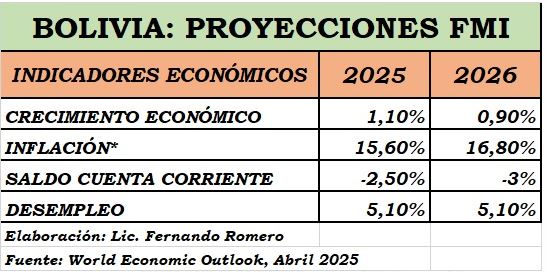
According to data obtained from the IMF, the organization projects that Bolivia will experience economic growth of only 1.1% in 2025—the lowest in all of Latin America and the Caribbean—below the regional average of 2.4%. Countries like Haiti (-1%), Venezuela (-0.4%), and Mexico (-0.3%) are expected to experience economic contraction this year. Bolivia is projected to slow down even further in 2026, with growth of just 0.9%.
As for inflation, it was initially projected at 15.6% annually for 2025, with a recent slight adjustment to 15.1%. However, according to the IMF, Bolivia will be the fourth most inflationary economy in the region, after Venezuela (254.4%), Haiti (29.7%), and Argentina (20%). For 2026, annual inflation is expected to reach 16.8%, while the regional average is only 4.4%.
The IMF projects that Bolivia will have a current account balance of -2.5% of GDP in 2025, increasing slightly to -3% in 2026. Regarding unemployment, the organization projects a rate of 5.1% for both 2025 and 2026.
The truth is that this upcoming IMF report will not be favorable for our economy or for the government. It will only reaffirm that our country is in a very bad state—and could get worse—especially in a volatile environment marked by high economic and political uncertainty during an election year. This is already reflected in the rise of the dollar and prices of basic goods, leading to a more devalued currency.
In fact, the IMF’s economic growth projections are above the 3.71% planned by the government for 2025. Regarding inflation, the IMF’s projection is more than double the 7.5% forecast in the 2025 General State Budget (PGE). However, we consider even the IMF figure to be low; given the current price increase trend, inflation could reach as high as 25% to 30% annually, based on official data. As for the fiscal deficit, it was determined to be 10% of GDP in 2024, with a current account deficit of 4%. The IMF projects a lower deficit for both 2025 and 2026, though their estimates appear somewhat disconnected from the financial reality of the country’s public sector.
In conclusion, this new IMF report will only further confirm what everyone already knows—that Bolivia faces serious macroeconomic problems, especially fiscal, monetary, trade, and exchange rate issues, along with rising public debt and depleted international reserves (RIN), which have led to a stagnant or low-dynamism economy, higher inflation, fuel shortages, an expensive dollar, and a devalued currency.
The solution to stabilize the economy and pull it out of crisis lies in implementing structural, adjustment, or shock measures focused mainly on achieving fiscal balance. This is a crucial task for the next government, as the current administration has focused, as observed, only on implementing palliative measures in an attempt to reach the upcoming August elections with some degree of breathing room.
Por Luis Fernando Romero Torrejón, Eju.tv:
Hace unas semanas atrás, el Fondo Monetario Internacional (FMI), ha comunicado lo siguiente en su página oficial: “El 2 de mayo de 2025, el Directorio Ejecutivo del Fondo Monetario Internacional concluyó la consideración del Informe del Personal del Artículo IV de 2025 para Bolivia. Las autoridades necesitan más tiempo para considerar la publicación del informe preparado para su consideración por el Directorio, y se espera una decisión final dentro de los 28 días siguientes a la fecha de consideración del Directorio. La última Consulta del Directorio Ejecutivo del Artículo IV fue el 2 de mayo de 2025.
Lo anterior ha generado mucha polémica, ya que se considera que el gobierno ha solicitado expresamente al FMI no publicar este informe, y que en teoría y en el mejor de los casos debería ser público este próximo 30 de mayo de 2025, revelándose proyecciones macroeconómicas negativas y poco favorables políticamente para el actual gobierno que esta en plena campaña electoral para las elecciones nacionales.
Sin embargo, realizamos una pequeña investigación para determinar que variables macroeconómicas preocupan al gobierno o al menos cuales son las últimas proyecciones o estimaciones por parte del FMI para la economía boliviana.
De acuerdo a los datos obtenidos del FMI, este organismo proyecta que BOLIVIA tendrá un crecimiento económico para este 2025 de apenas un 1,1%, el más bajo de toda Latinoamérica y el Caribe, por debajo del promedio regional (2,4%). Países como Haití (-1%), Venezuela (-0,4%) y México (-0,3%) tendrán un decrecimiento económico en esta gestión. Se proyecta que nuestro país tenga una desaceleración el 2026, con un crecimiento de solo el 0,9%.
Respecto a la inflación para este 2025 en primera instancia se proyectó un 15,6% anual, recientemente hubo un leve ajuste al 15,1%. Sin embargo, de acuerdo al FMI, Bolivia será la 4ta economía más inflacionaria de toda la región, después de Venezuela (254,4%), Haití (29,7%) y Argentina (20%). Para el 2026 se estima que nuestra inflación anual llegue al 16,8%, mientras que la región solo en promedio al 4,4%.
El FMI proyecta que para este 2025, nuestro país tenga un saldo en cuenta corriente del -2,5% del PIB, y el 2026, un poco más, se llegará al -3%. A lo que se refiere el desempleo, este organismo proyecta que Bolivia el 2025 tendrá un indicador del 5,1% tanto para el 2025 y 2026.
Lo cierto, es que con este informe del FMI que pronto saldrá a la luz, no será favorable para nuestra economía ni para el gobierno, y solo será la ratificación de que nuestro país está muy mal, y que puede estar peor, más en un escenario muy volátil y rodeado por una alta incertidumbre, tanto en lo económico y político, más en un año electoral, que se reflejo en la suba del dólar y de los precios de los productos básicos, dando lugar a una moneda mas devaluada.
De hecho, las proyecciones del FMI, en cuanto al crecimiento económico, están por encima del 3,71% planificado por el gobierno para este 2025. En cuanto a la inflación, la proyección de este organismo es más del doble del PGE 2025 (7,5%), sin embargo, consideramos que la misma es baja, la misma, dada la tendencia de suba de precios, podría llegar hasta un 25 a 30% anual, con datos oficiales. En cuanto al déficit fiscal, se determino que fue del 10% del PIB, y su déficit corriente del 4% en el 2024. El FMI proyecta uno más bajo tanto para el año 2025 y 2026, estando sus proyecciones algo lejos de la realidad financiera del sector público del país.
Finalizando, este nuevo informe del FMI solo develará nuevamente lo que todos sabemos, que Bolivia tiene serios problemas macroeconómicos, sobre todo fiscales, monetarios, comerciales, cambiarios, endeudamiento público, RIN desgastadas, que dieron lugar a una economía estancada o con bajo dinamismo, mayor inflación, menos carburantes, un dólar caro y con una devaluación en su moneda.
Donde la solución para estabilizar la economía y sacarla de la crisis, es la aplicación de medidas estructurales, de reajuste o de shock enfocadas sobre todo a buscar un equilibrio fiscal. Tarea crucial del nuevo gobierno, ya que el actual solo se aboco, según se observó, a la implementación de medias paliativas en búsqueda de llegar con algo de oxigeno a las elecciones de agosto próximo.
https://eju.tv/2025/05/bolivia-los-datos-del-fmi-que-no-se-quiere-que-se-revelen/

 Bolivian Thoughts | Pensamientos Bolivianos (Bilingual/Bilingüe)