
By Hugo Siles Espada, Brújula Digital:
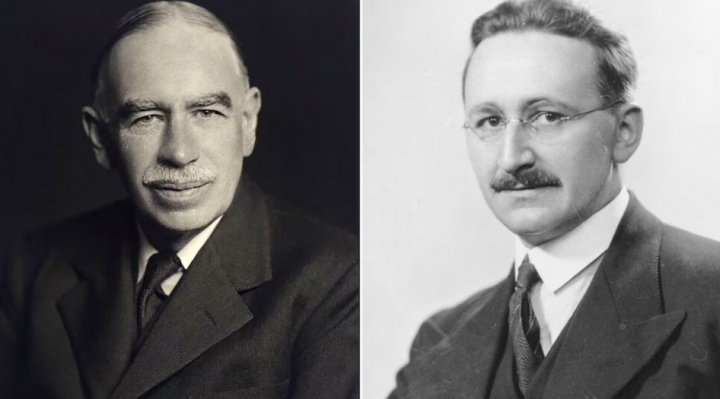
John Maynard Keynes (left) & Friedrich Hayek
This coming August 17, Bolivia will not only elect a new president, but also its economic future. The country faces a historic crossroads: will it continue with the statist model that has dominated the last two decades, return to the free market approach of the 1990s, or seek a balance between the two? This is the debate that currently divides the 10 presidential pre-candidates and revives the classic battle between John Maynard Keynes and Friedrich Hayek.
Two Decades, Two Models
Bolivia has experienced two opposing economic cycles over the past 40 years:
The Neoliberal Experiment (1985–2006)
Privatizations, trade liberalization, and deregulation under the logic of Supreme Decree 21060. Moderate growth (an annual average of 4.2%), but with high inequality. It was a time of macroeconomic stability, but also of social exclusion.
The Statist Era (2006–2025)
Nationalizations, price controls (fuel, wages, credit), and State expansion. Poverty reduction (from 60% to 37%), but with a recent crisis (GDP decline since 2015). The model showed social progress, but low productivity. Since 2014, it has registered fiscal and trade deficits following the end of the commodity boom.
The Current Dilemma: State or Market?
Statism’s defenders (such as MAS and Andrónico Rodríguez, Eduardo Del Castillo, Eva Copa) argue: without state control, prices would skyrocket and social gains would be lost. Example: freezing the price of gasoline prevented protests but costs over $2 billion in annual subsidies.
Liberals (Jorge Quiroga, Jaime Dunn, Antonio Saravia) counter: the State can’t keep spending more than it takes in. “The fiscal deficit (8.5% of GDP) is unsustainable.” They propose easing price controls on goods and services, labor market flexibility, opening up exports, and attracting private investment.
The Third Way (Manfred Reyes Villa, Samuel Doria Medina, Rodrigo Paz) seeks a mix: neither an omnipresent State nor a savage market. Smart regulations are needed.
What Could Happen in 2025?
If statism wins: subsidies and controls will continue, but with the risk of larger fiscal and trade deficits, high depreciation of the boliviano, and inflation. Low GDP growth, low private investment, and high informality.
If free market wins: an initial economic adjustment (price increases), but potential medium-term recovery. Liberalization of prices for goods and services, managed exchange rate float, fuel price adjustments. GDP growth initially low, then moderate. Increased private investment. Openness to external markets.
If the Third Way wins: social policies with clear rules for investors. The challenge: avoiding the gray zones that led to crises in Argentina or Ecuador.
The Final Word
“Bolivia is neither purely Keynes nor purely Hayek. It needs a model tailored to itself,” economist Armando Méndez once stated. As the candidates prepare for debate, one thing is clear: the election outcome will determine not only who governs, but also what kind of economy Bolivians will inherit for the next 20 years.
What do you think? Should Bolivia maintain state control of the economy? Or is it time to give the market more space?
Hugo Siles is an economist and social communicator.
Por Hugo Siles Espada, Brújula Digital:
[Si quiere escuchar el resumen, use este link, gracias]
John Maynard Keynes (izq.) y Friedrich Hayek
El 17 de agosto próximo, Bolivia no solo elegirá un nuevo presidente, sino también su futuro económico. El país enfrenta una encrucijada histórica: ¿continuará con el modelo estatista que dominó las últimas dos décadas, volverá al libre mercado de los años 90 o buscará un equilibrio entre ambos? Este es el debate que hoy divide a los aún 10 precandidatos presidenciales y que revive la clásica batalla entre John Maynard Keynes y Friedrich Hayek.
Dos décadas, dos Modelos
Bolivia ha vivido dos ciclos económicos opuestos en los últimos 40 años:
El experimento neoliberal (1985-2006)
Privatizaciones, apertura comercial y desregulación bajo la lógica del Decreto Supremo 21060. Crecimiento moderado (4.2% anual en promedio), pero con alta desigualdad. Fue una época de estabilidad macroeconómica, pero también de exclusión social.
La era estatista (2006-2025)
Nacionalizaciones, control de precios (gasolina, salarios, créditos) y expansión del Estado. Reducción de la pobreza (del 60% al 37%), pero con crisis reciente (caída del PIB desde 2015). El modelo mostró avances sociales, pero baja productividad. El modelo a partir de 2014 registró déficit fiscal y comercial tras el boom de precios de las materias primas.
El dilema actual: ¿Estado o mercado?
Los defensores del estatismo (como el MAS y Andrónico Rodríguez, Eduardo Del Castillo, Eva Copa) argumentan: Sin control estatal, los precios se dispararían y se perderían los logros sociales. Ejemplo: El congelamiento del precio de la gasolina evitó protestas, pero cuesta más de 2.000 millones de dólares en subsidios anuales.
Los liberales (Jorge Quiroga, Jaime Dunn, Antonio Saravia) contraatacan: El Estado no puede seguir gastando más de lo que tiene. “El déficit fiscal (8,5% del PIB) es insostenible”. Proponen flexibilizar los precios de bienes y servicios, el mercado laboral, abrir exportaciones y atraer inversión privada.
La Tercera Vía (Manfred Reyes Villa, Samuel Doria Medina, Rodrigo Paz) buscan un mix: Ni Estado omnipresente ni mercado salvaje. Necesitamos regulaciones inteligentes.
¿Qué puede pasar en 2025?
Si gana el estatismo: Continuarán los subsidios y controles, pero con riesgo de mayor déficits fiscal y comercial y alta depreciación del boliviano e inflación. Baja tasa de crecimiento del PIB, baja inversión privada y alta informalidad.
Si gana el libre mercado: Ajuste económico inicial (alza de precios), pero posible reactivación a mediano plazo. Liberación de precios de bienes y servicios, flotación cambiaria administrada, ajuste de precios de hidrocarburos. Tasa de crecimiento del PIB baja al principio y moderada después. Mayor inversión privada. Apertura del mercado exterior.
Si gana la Tercera Vía: Políticas sociales con reglas claras para inversionistas. El desafío: evitar los grises que llevaron a crisis en Argentina o Ecuador.
La palabra final
“Bolivia no es ni Keynes ni Hayek puros. Necesita un modelo a su medida”, sentenció tiempo atrás el economista Armando Méndez. Mientras los candidatos se alistan para el debate, una cosa es clara: el resultado de las elecciones definirá no solo quién gobernará, sino también qué tipo de economía heredarán los bolivianos para los próximos 20 años.
¿Usted qué opina? ¿Debe Bolivia mantener el control estatal de la economía? ¿O es hora de dar más espacio al mercado?
Hugo Siles es economista y comunicador social.

 Bolivian Thoughts | Pensamientos Bolivianos (Bilingual/Bilingüe)