
By Brújula Digital:
Cañahua curbs rural exodus in Bolivia. In the Altiplano, this resilient grain brings hope to farmers like Nico Mamani. Although its profitability is still low ($1.40 per kilo), its adaptation to the climate and nutritional value drive its cultivation.
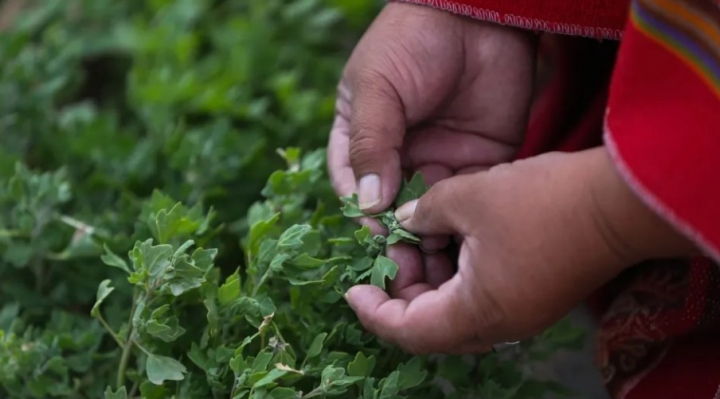
A woman handles a cañahua plant/EFE/Luis Gandarillas
At more than 3,800 meters above sea level, in the Bolivian Altiplano, agriculture faces a constant threat: prolonged drought and the loss of water sources, such as Lake Poopó, which has disappeared in recent years.
In this context, cañahua, an Andean grain little known outside the region, presents itself as a viable alternative for farmers who still hold on to their land. So notes a report published by El País of Spain.
Nico Mamani, a young agronomist and producer from the municipality of Ayo Ayo, is one of the few who has decided to stay in the countryside. “A few years ago, a friend of mine told me: ‘If this year’s harvest doesn’t work, I’ll have to go to the city to find work,’” Mamani recalls, as quoted by El País. At 31 years old, Mamani bet on a different crop: cañahua, an Andean pseudocereal that grows faster than quinoa and better withstands drought conditions.
According to the report, in Ayo Ayo most farmers plant potatoes, fava beans, barley or quinoa. However, since 2019, Mamani has chosen to dedicate part of his land to cañahua.
“My idea was that, with a more resilient crop, the harvest would be good every year and that our children wouldn’t have to migrate,” explains the farmer, who now chairs the local association of grain producers.
Cañahua, like quinoa, has a long history in the Andes, but its cultivation declined drastically starting in the 1950s. “People began migrating to the cities, and knowledge and the benefits of cañahua were not passed on to the younger generations,” says Trigidia Jiménez, president of the National Cañahua Network of Bolivia, in statements cited by El País.
Moreover, adds the newspaper, the grain didn’t have an established market, so it was used almost exclusively for personal consumption, mainly as pito (a type of flavored, precooked flour).
The resurgence of cañahua is largely due to the work of Jiménez, who—according to El País—directly supported the producers of Ayo Ayo by purchasing their harvest at above-market prices. The National Cañahua Network also provided certified seeds and tools and collaborates with research programs led by the National Institute of Agricultural and Forestry Innovation.
Although income from cañahua is still not high—about $1.40 per kilo, the report specifies—prices are stable, which is an advantage compared to other crops. In Mamani’s words, “the harvest of this Andean grain rarely fails, and that guarantees us income every year.”
El País also points out that the real challenge lies in improving yields and positioning the grain in the urban market. To that end, some producers are already transforming cañahua into products like bread, pancake mixes, and energy bars. Trigidia Jiménez, for example, has succeeded in getting some of these products included in the state subsidy program for pregnant and breastfeeding women.
However, the report adds, there are still few young people who are encouraged to stay in the countryside. Many farming families, like the sisters Justina and Eugenia Clotilde Layme Quispe, aged 72 and 74, say their children work in textile workshops in Argentina. “There’s this belief that you’ll have a better life if you go to the city or abroad, but often the conditions are worse,” says Mamani.
Even so, the young agronomist remains hopeful. “It’s a challenge. To make this resilient crop also a source of good income and for the children, in a few years, to inherit their parents’ land with the certainty that this product really works,” he concludes. For Trigidia Jiménez, also quoted by El País, the path is clear: continue promoting cañahua in the cities. “I’ve always defended the idea that everyone wins with this crop: consumers, because it’s more nutritious than most cereals, and producers, because of its resistance to climate change.”
BD/RPU
Por Brújula Digital:
La cañahua frena el éxodo rural en Bolivia. En el Altiplano, este grano resistente da esperanza a campesinos como Nico Mamani. Aunque su rentabilidad aún es baja (1,4 dólares por kilo), su adaptación al clima y valor nutricional impulsan su cultivo.
Una mujer manipula una planta de cañahua/EFE/Luis Gandarillas
A más de 3.800 metros sobre el nivel del mar, en el Altiplano boliviano, la agricultura se enfrenta a una amenaza constante: la sequía prolongada y la pérdida de fuentes de agua, como el lago Poopó, que ha desaparecido en los últimos años.
En este contexto, la cañahua, un grano andino poco conocido fuera de la región, se presenta como una alternativa viable para los campesinos que aún resisten en sus tierras. Así lo señala un reportaje publicado por El País de España.
Nico Mamani, un joven agrónomo y productor del municipio de Ayo Ayo, es uno de los pocos que ha decidido quedarse en el campo. “Hace unos años, un compañero mío me dijo: ‘Si este año, la cosecha no da, tendré que irme a la ciudad a buscar trabajo’”, recuerda Mamani, citado por El País. A sus 31 años, Mamani apostó por un cultivo distinto: la cañahua, un pseudocereal andino que crece más rápido que la quinua y soporta mejor las condiciones de sequía.
Según el reportaje, en Ayo Ayo la mayoría de los campesinos siembra papa, haba, cebada o quinua. Sin embargo, desde 2019, Mamani decidió dedicar parte de sus parcelas a la cañahua.
“Mi idea era que, con un cultivo más resistente, la cosecha sea buena cada año y que nuestros hijos no tengan que migrar”, explica el agricultor, que ahora preside la asociación local de productores del grano.
La cañahua, como la quinua, tiene una larga historia en los Andes, pero su cultivo se redujo drásticamente a partir de los años 50. “La gente comenzó a emigrar a la ciudad y no se transmitían los conocimientos y los beneficios de la cañahua a los más jóvenes”, señala Trigidia Jiménez, presidenta de la Red Nacional de Cañahua de Bolivia, en declaraciones recogidas por El País.
Además, agrega el diario, el grano no tenía un mercado establecido, por lo que se destinaba casi exclusivamente al autoconsumo, principalmente como pito (harina precocida y saborizada).
El resurgimiento de la cañahua se debe en buena parte al trabajo de Jiménez, quien –según cuenta El País– apoyó directamente a los productores de Ayo Ayo, comprándoles su cosecha a un precio mayor al del mercado. La Red Nacional de Cañahua también proporcionó semillas certificadas y herramientas, y colabora con programas de investigación liderados por el Instituto Nacional de Innovación Agropecuaria y Forestal.
Pese a que los ingresos por cañahua todavía no son altos –alrededor de 1,4 dólares por kilo, precisa el reportaje– los precios son estables, lo que representa una ventaja frente a otros cultivos. En palabras de Mamani, “la cosecha del grano andino falla muy pocas veces, y eso nos asegura ingresos cada año”.
El País también señala que el verdadero desafío está en mejorar los rendimientos y posicionar el grano en el mercado urbano. Para ello, algunos productores ya están transformando la cañahua en productos como panes, premezclas para panqueques y barras energéticas. Trigidia Jiménez, por ejemplo, ha logrado que algunos de estos productos formen parte del subsidio estatal para mujeres embarazadas y lactantes.
Sin embargo, agrega el reportaje, todavía son pocos los jóvenes que se animan a quedarse en el campo. Muchas familias campesinas, como las hermanas Justina y Eugenia Clotilde Layme Quispe, de 72 y 74 años, cuentan que sus hijos trabajan en talleres textiles en Argentina. “Hay esa creencia de que uno tendrá una vida mejor si se va a la ciudad o al extranjero, pero muchas veces las condiciones son peores”, afirma Mamani.
Aun así, el joven agrónomo mantiene la esperanza. “Es un reto. Conseguir que este cultivo resistente también sea fuente de buenos ingresos y que, en unos años, los hijos hereden las tierras de sus padres con la certeza de que este producto sí funciona”, concluye. Para Trigidia Jiménez, citada también por El País, el camino está claro: seguir promoviendo la cañahua en las ciudades. “Siempre he defendido la idea de que todo el mundo gana con este cultivo: los consumidores, porque es más nutritivo que la mayoría de los cereales, y los productores, por su resistencia al cambio climático”.
BD/RPU

 Bolivian Thoughts | Pensamientos Bolivianos (Bilingual/Bilingüe)