
By Gina Baldivieso / EFE, Vision 360:
“Awayus,” Indigenous Life-Carrying Textiles, Regain Value in Bolivia
“Memories of the awayu and llijlla: protectors and carriers of life” is the title of the exhibition inaugurated at the National Museum of Ethnography and Folklore (Musef) in La Paz.
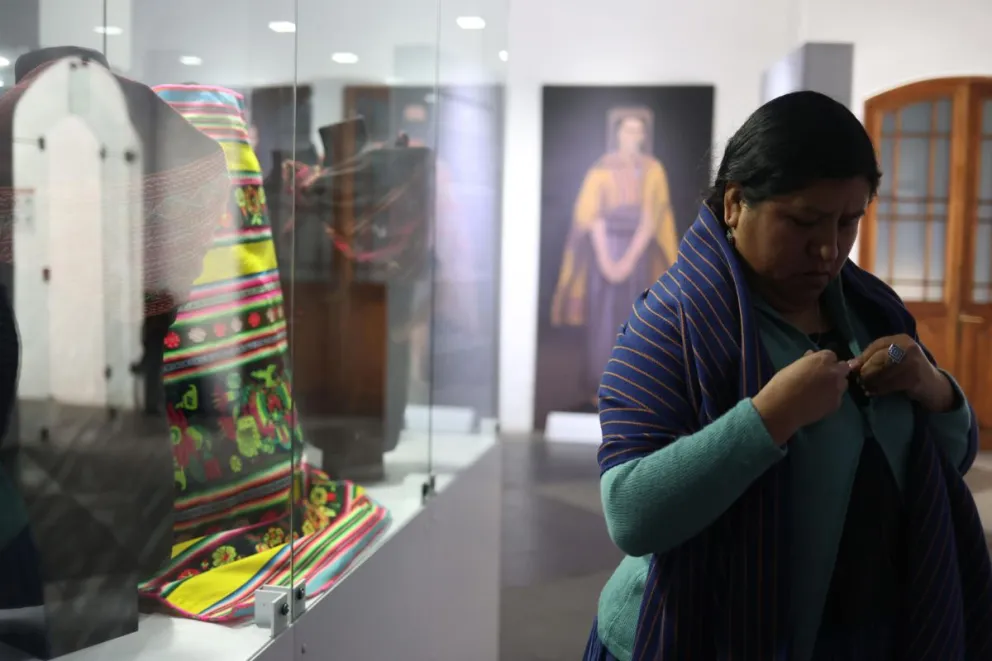
The director of the Museum of Ethnography and Folklore (Musef), Elvira Espejo, during a tour of an exhibition at Musef in La Paz (Bolivia). Photo: EFE
The transition of “awayus” or aguayos, the indigenous textiles, from the archaeological period through colonial times to the present is explored in an exhibition in Bolivia that also seeks to revalue the science and ritual behind the making of these woven pieces considered carriers of life.
“Memories of the awayu and llijlla: protectors and carriers of life” is the name of the exhibition inaugurated at the National Museum of Ethnography and Folklore (Musef) in La Paz, curated by its director, the indigenous visual artist and poet Elvira Espejo, and the Aymara researcher Edwin Usquiano.
Espejo told EFE that it was very “important” for Musef to organize the exhibition “to recover and revalue the memory, science, and technology of the aguayos,” ‘awayus’ in Aymara and ‘llijllas’ in Quechua, which are not just ancestral garments, but “living books” that preserve this knowledge and wisdom.
“For example, to extract an iconography is a beautiful mathematical development because we can understand how the warps and wefts are counted. Many times, academics, with an external perspective, don’t see it because they don’t weave,” so they often stop at a “superficial description” of the piece, said Espejo, who is also a weaver.
She emphasized that this textile is also considered a “constant carrier of lives,” since men and women use it to carry agricultural products or ‘wawas’—small children in Quechua—and it is also used during childbirth.
Musef’s intention is to help bring the ancestral scientific and technological knowledge embedded in the process of making these textiles, along with their history, linguistics, and identity, to new generations, she added.
The exhibition is presented in three parts with around thirty cultural items, including replicas of textiles dating from 1420, originals from 1700 to 1900, and contemporary ones, along with paintings by students from the Public University of El Alto (UPEA) depicting older ‘awayus’ and their uses.
Ancestral Weaving and ‘Fast Fashion’
The tour begins in the archaeological era with the ‘aqhullas’ and the ‘llaqhutas,’ explained Usquiano, who is also a curator at Musef.
The ‘aqhulla’ is a one-piece textile used by women to cover their backs, carry babies, or transport food or instruments, made from camelid fiber and natural dyes, he said.
Worn by men, the ‘llaqhuta’ consists of two pieces joined in the center, also made of camelid fiber, and covers other garments like a cape.
There is also the ‘iskayu,’ so named because iskay means two in Quechua, and it is made from the joining of two pieces, according to Usquiano.
This textile was also used during colonial times, when the ‘mantiyus’ emerged, woven with one dark and one light color.
The curator noted that during that period, pieces with figures were used for ritual and ceremonial acts, while those for everyday use should not feature iconography—something that was revisited during the republican era with aguayos featuring “larger figures.”
The contemporary part of the exhibition presents current uses of the aguayo, such as the horizontal way women carry loads; the diagonal way men use it during festive, ritual, or daily events; or tied at the waist for festivities.
Also featured is a ‘kimsa khallu,’ a textile made from three pieces with bright colors and large figures.
The experts reflected on how industrial advancement also led to greater use of acrylic threads in these textiles, to the detriment of organic fibers.
Espejo criticized that society now consumes so-called ‘fast fashion,’ a “very accelerated fashion” with “very cheap artificial Chinese fabrics,” while organic fibers even offer health benefits.
Usquiano pointed out that textiles made from acrylic threads lack the ‘qamasa’ (energy) and ‘ajayu’ (soul) that master weavers infuse into a piece made with organic fibers, almost as a ritual—asking permission from nature’s protective spirits so that the outcome will be good.
Por Gina Baldivieso / EFE, Vision 360:
Los “awayus”, los textiles indígenas transportadores de vida se revalorizan en Bolivia
“Memorias del awayu y llijlla: protectoras y transportadoras de la vida” es el nombre de la exposición inaugurada en el Museo Nacional de Etnografía y Folclore (Musef) en La Paz.
La directora del Museo de Etnografía y folclore (Musef), Elvira Espejo, durante un recorrido por una exposición en el Musef en La Paz (Bolivia). Foto: EFE
La transición de los “awayus” o aguayos, los textiles indígenas, desde el periodo arqueológico, pasando por la colonia hasta la actualidad se exploran en una muestra en Bolivia que también busca revalorizar la ciencia y ritualidad que hay detrás de la elaboración de esas piezas tejidas consideradas transportadoras de vida.
‘Memorias del awayu y llijlla: protectoras y transportadoras de la vida’ es el nombre de la exposición inaugurada en el Museo Nacional de Etnografía y Folclore (Musef) en La Paz, bajo la curaduría de su directora, la artista plástica y poeta indígena Elvira Espejo, y el investigador aimara Edwin Usquiano.
Espejo dijo a EFE que para el Musef fue muy “importante” gestar la exposición “para una recuperación y revalorización de la memoria, la ciencia y la tecnología de los aguayos”, ‘awayus’ en aimara y ‘llijllas’ en quechua, que no son meras prendas ancestrales, sino que son “libros vivos” que guardan estos saberes y conocimientos.
“Por ejemplo, para sacar una iconografía es un desarrollo matemático muy lindo porque podemos entender cómo se cuentan las urdimbres, las tramas. Muchas veces los académicos, con un ojo externo, no lo ven porque no tejen”, por lo que suelen quedarse en una “descripción superficial” de la pieza, señaló Espejo, quien también es tejedora.
Resaltó que este textil también es considerado una “transportadora constante de las vidas”, pues en ella hombres y mujeres llevan productos agrícolas o a las ‘wawas’, como se llama a los niños pequeños en quechua, y además se utilizan en los partos.
La intención del Musef es ayudar a que los conocimientos científicos y tecnológicos ancestrales existentes en el proceso de elaboración de estos textiles, su historia, lingüística e identidad lleguen a las nuevas generaciones, agregó.
La exposición se presenta en tres partes con una treintena de bienes culturales, incluidas réplicas de textiles que datan de 1420, otros originales de los años 1700 a 1900 y otros de la época actual, además de cuadros pintados por estudiantes de la Universidad Pública de El Alto (UPEA) de ‘awayus’ más antiguos y sus usos.
Tejido ancestral y ‘fast fashion’
El recorrido se inicia en la época arqueológica, con las ‘aqhullas’ y las ‘llaqhutas’, explicó a EFE Usquiano, quien también es curador del Musef.
La ‘aqhulla’ es un textil de una sola pieza que usaban las mujeres para cubrirse la espalda, cargar bebés o transportar alimentos o instrumentos, hecha de fibra de camélido con colores naturales, indicó.
Vestida por los hombres, la ‘llaqhuta’ consta de dos piezas unidas en el centro, también de fibra de camélido, y cubre a modo de capa las otras prendas.
También está el ‘iskayu’, llamado así porque iskay es dos en quechua y está compuesto por la unión de dos piezas, según Usquiano.
Este textil también se usó durante la colonia, cuando además aparecieron los ‘mantiyus’, que se tejían con un color oscuro y uno claro.
El curador precisó que en esa época, las piezas con figuras se usaban en actos rituales y ceremoniales, mientras que las de uso cotidiano no debían llevar iconografías, algo que se retomó durante la república con aguayos con figuras “más grandes”.
La parte contemporánea de la muestra presenta los usos actuales del aguayo, como el horizontal que emplean las mujeres para llevar alguna carga; el diagonal usado por los hombres en eventos festivos, rituales o cotidianos; o en la cintura, también para festividades.
También se luce un ‘kimsa khallu’, un textil elaborado con tres piezas y con colores vivos y figuras grandes.
Los expertos reflexionaron sobre cómo el avance industrial supuso también un mayor uso de hilos acrílicos para estos tejidos en desmedro de las fibras orgánicas.
Espejo cuestionó que actualmente la sociedad consume la llamada ‘fast fashion’, una “moda muy acelerada” con “telas artificiales chinas muy baratas”, mientras que las fibras orgánicas tienen beneficios incluso para la salud.
Usquiano señaló que los textiles de hilos acrílicos carecen de la ‘qamasa’ (energía) y el ‘ajayu’ (alma) que ponen las maestras tejedoras en lo que es casi un ritual para elaborar una pieza con fibras orgánicas, pidiendo permiso a los espíritus protectores de la naturaleza para que el resultado sea bueno.

 Bolivian Thoughts | Pensamientos Bolivianos (Bilingual/Bilingüe)