
By Marco Antonio Belmonte, Vision 360:
Target the international market
Since 2006, the company has been manufacturing plastic roofing sheets, swimming pools, hot tubs, and sanitary ware. It provides assistance to mining and oil companies and will export from Hong Kong.
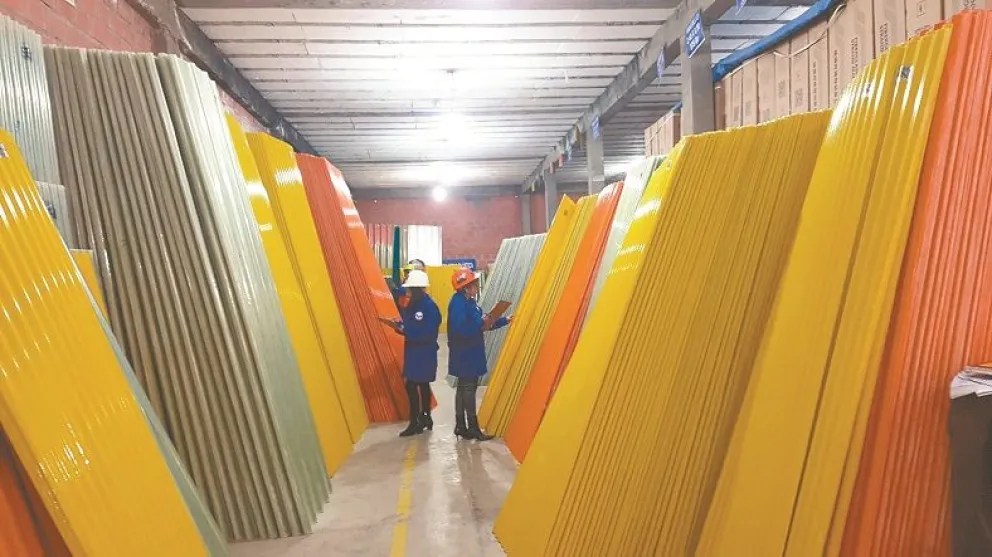
Workers oversee the production of roofing sheets. Photo: Cóndor
Operating since 2006, the dream that began as Edwin Quisbert Alarcón’s thesis project has become a leading company in the manufacturing of plastic roofing sheets and other products. Now, it has taken a major step by becoming the first Bolivian company to open a branch in Hong Kong to export to Europe and other markets. It is also planning to establish itself in Shanghai soon.
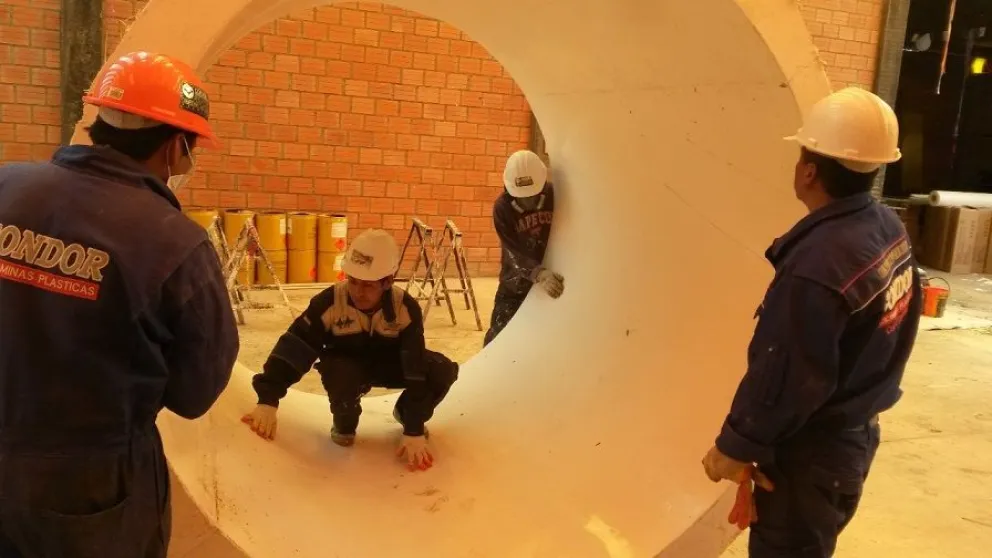
The International Franchise Company Cóndor SRL, with innovative designs in the field of corrugated sheets, plastic pipes, and hydromassages, is among the most successful companies in Bolivia and is now achieving international prominence.
Cóndor has 7 production lines: plastic corrugated sheets, molded hydromassage structures, recycling, plastic pipes, water tanks, portable toilets, and consulting for mining and oil companies.
Edwin Quisbert Alarcón, general manager of the company, shared in an interview with Visión 360 that the idea of manufacturing plastic corrugated sheets originated from a bachelor’s thesis in the Audit program at Universidad de La Salle. This led to the start of production in 2006 with a single model, color, and size of 1.80 meters.
The first market was the city of Puno, and as the brand gained recognition, the company expanded production to include plastic corrugated sheets in sizes of 2.15 meters, 2.40 meters, and 3 meters. They then entered the markets of Oruro, Potosí, La Paz, and Tarija, eventually achieving nationwide presence.
Initially, production was done manually and artisanally. However, the company later developed its own 54-meter-long machinery and expanded to manufacture fiberglass pools, hydromassage tubs, and water tanks, thanks to knowledge transfer from raw material suppliers.
Additionally, the company began offering technical consulting services, with the support of specialists from the United States, Mexico, Brazil, and Chile, to mining and oil companies. They also started producing domes and corrosion-resistant products for these industries.
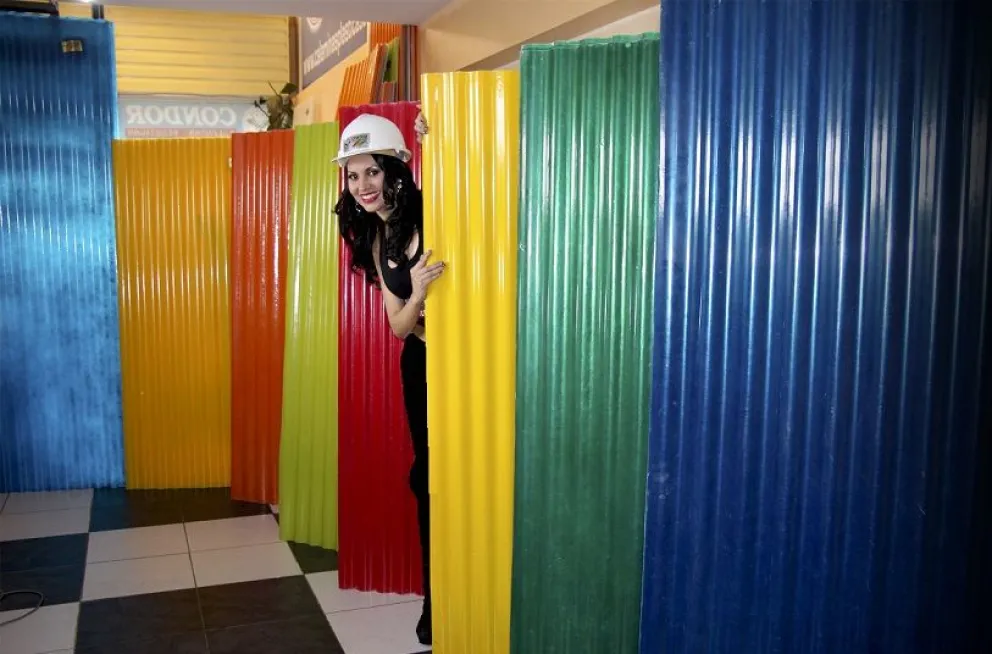
Currently, the company has at least seven production lines in its factory.
1.- Plastic corrugated sheet production line.
2.- Molding line for tanks, pools, and hot tubs.
3.- Recycling line to produce its own raw materials.
4.- Manufacturing line for poly tubes used in micro-irrigation and agribusiness.
5.- Production line for polyethylene water tanks.
6.- Production and rental line for portable toilets for public events.
7.- Technical and logistical consulting in corrosion-resistant solutions for mining and oil companies.
Continuous work and product quality led to internationalization and the decision to establish a branch in Hong Kong.
Quisbert explains that, thanks to the advice of his son—who studied International Business at the School of Production and Competitiveness (EPC) of the Bolivian Catholic University (UCB) and at West Virginia University in the United States (USA)—he made the decision to expand the company internationally.
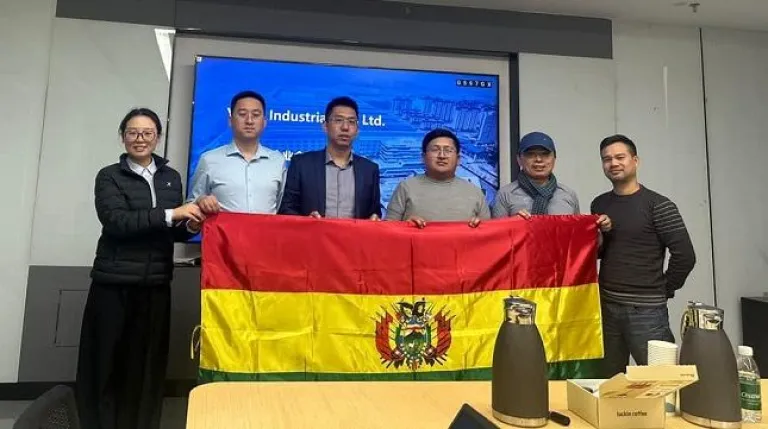
Last year, legal procedures began, and they successfully obtained the license to open their first branch outside the country.
“The objective of this branch is to interact from Bolivia, through Hong Kong, to export our products worldwide. Likewise, to attract investments that will bring new technology to Bolivia,” emphasized Quisbert.
The licenses were obtained in January, and the company is ready to operate from this international financial center.
In this way, he said that they will meet foreign demand, as they already have requests from South Africa and Central America, given that the company’s products rival materials produced in other countries.

According to the portal The Observatory of Economic Complexity, in 2023 Hong Kong was the 39th largest economy in the world in terms of GDP, the 38th in total exports, the 9th in total imports, and the 25th largest economy in terms of GDP per capita.
Shanghai in the spotlight
The dream of the International Franchise Company Cóndor SRL does not end in that special administrative region of China, but rather has its sights set on the international trade center of Shanghai.
“The corresponding procedures have been initiated to open another branch in that city; there, it takes six months, and this is the company’s other expansion strategy,” Quisbert emphasized.
According to the Bolivian Institute of Foreign Trade (IBCE), since China opened its economy to the market in the 1970s, it has been growing at a significant pace to become the second-largest economy in the world.
Productivity is mainly supported by industry, which accounts for nearly 50% of China’s GDP, with sectors as diverse as metal processing, machinery assembly, weapon manufacturing, textiles, automobiles, electronic and telecommunications equipment, and, finally, a very wide range of consumer products.
According to Quisbert, Bolivia has much production potential and, in his case, due to the experience gained with the company internationally, he maintains constant contact with various companies.
Abroad, he said, there are opportunities to invest in the country, but regulation and politics put brakes on it. He mentioned that today there is a lot of talk about the gas running out, but the country has electricity surpluses that can be exported to generate revenues that could even exceed those from hydrocarbons.
“There are businessmen abroad who can invest one billion, 1.5 billion dollars, there are investors,” he emphasized.
The company aims to manufacture electric buses for Bolivia
The opportunity to reach Hong Kong and open a branch has allowed the International Franchise Company Cóndor SRL to make international contacts with investors. Thus, the company’s next step is to manufacture electric buses for passenger transportation.
Its manager, Edwin Quisbert Alarcón, reported that they are in negotiations with foreign businessmen to execute an investment of at least 20 million dollars and become the first Bolivian industry to launch these electric vehicles to the market.
He even mentioned that the idea is for the company to be able to manufacture its own lithium battery, as currently, this final product is only obtained in foreign countries.
He explained that the vehicles they plan to produce are designed for passenger transportation, and the goal is for them to have a range of 300 kilometers.
With the technology that will be implemented, the plan is to take advantage of the downhill routes in the city of La Paz to recharge the batteries.
“On the downhill routes, the vehicles will have the option of self-charging the batteries, which will increase their range. With the technology, the use of the battery becomes more efficient. As a result, the vehicles will have zero costs in fuel and lubricants,” said the businessman.
For Quisbert, this is the answer to the current situation in which the country faces a shortage of diesel and gasoline, because it will also achieve significant savings in fuel imports and subsidies.
“With this, buses can be made available at low cost; for example, the PumaKatari is a good service, but it receives a subsidy and requires maintenance. With electric transportation, the costs would be halved; the same goes for the municipal buses of El Alto, which have very high costs due to fuel and maintenance,” he pointed out.
According to Quisbert, the company works with carbon fiber and this material will be used in the manufacturing of these vehicles.
He added that the Bolivian regulations and standards are being evaluated, and notes have been sent to the competent authorities. Based on that, the next steps will be taken, and the provisions will be followed.
Additionally, in the coming months, the arrival of parts from abroad is expected for testing, as the cars must adapt to the geographical conditions and atmospheric pressure of the city of La Paz.
“Our schedule sets that by June, the vehicle model should be ready, and the final tests will be in August or September. It will be a product purely made in Bolivia,” said the manager of the International Franchise Company Cóndor SRL.
Bolivia has immense lithium reserves, but after more than 10 years of exploitation, no significant progress has been made, and the decision has been made to change technology to obtain the raw material for the production of lithium carbonate through the direct extraction method. Additionally, millions of dollars are spent on fuel imports.
Por Marco Antonio Belmonte, Vision 360:
Mira al mercado internacional
Desde 2006 la empresa fabrica calaminas plásticas, piscinas, hidromasajes, sanitarios. Brinda asistencia a mineras y petroleras y exportará desde Hong Kong.
Trabajadores realizan un control a la producción de calaminas. Foto: Cóndor
Opera desde 2006. Aquel sueño que nació como un proyecto de tesis de Edwin Quisbert Alarcón, hoy es una empresa líder en la fabricación de calaminas plásticas y otros productos, la que ahora ha dado el gran salto al convertirse en la primera compañía en abrir una sucursal en Hong Kong para exportar a Europa y a otros mercados. Pronto prevé instalarse en Shanghái.
La Compañía Internacional de Franquicias Cóndor SRL, con innovadores diseños en el rubro de las calaminas, politubos e hidromasajes, se ubica entre las empresas más exitosas de Bolivia y ahora alcanza trascendencia internacional.
7 líneas de producción tiene Cóndor: calaminas plásticas, moldeados para hidromasajes, reciclaje, politubos, tanques de agua, sanitarios portatiles, asesoramiento para empresas mineras y petroleras.
Edwin Quisbert Alarcón, gerente general de la empresa, en una entrevista con Visión 360, contó que la idea de fabricar calaminas plásticas nació en una tesis de licenciatura en la carrera de Auditoría en la Universidad de La Salle y es por eso que en 2006 se comienza con la producción de estos productos, pero en un solo modelo, color y tamaño de 1,80 metros.
El primer mercado fue la ciudad de Puno y, a medida que la marca se hizo más conocida, se inició la fabricación de calaminas plásticas de 2,15 metros, 2,40 y tres metros. Se ingresó al mercado de las ciudades de Oruro, Potosí, La Paz, Tarija y hoy tienen presencia nacional.
En principio, el sistema de trabajo era manual y artesanal, pero luego la empresa diseñó su propia maquinaria que mide 54 metros de largo, y comenzó a fabricar piscinas, hidromasajes, tanques de agua con fibra de vidrio, gracias a la transferencia de conocimiento de los proveedores de materia prima.
La empresa también empezó a prestar asesoramiento técnico, con el apoyo de especialistas estadounidenses, mexicanos, brasileños, chilenos, a empresas mineras y petroleras, y la producción de domos y productos anticorrosivos para esta industria.
En la actualidad, la compañía cuenta con al menos siete líneas de producción en su fábrica.
1.- Línea de calaminas plásticas.
2.- Línea de moldeados, para tanques, piscinas, hidromasajes.
3.- Línea de reciclaje para producir materia prima propia.
4.- Línea de fabricación de politubos para microrriego y agroindustria.
5.- Línea de producción de tanques de agua de polietileno.
6.- Línea de producción y alquiler de sanitarios portátiles para eventos públicos.
7.- Asesoramiento técnico y logístico en líneas de corrosión para empresas mineras y petroleras.
El trabajo continuo y la calidad del producto lo llevaron a internacionalizarse y buscar una sucursal en Hong Kong.
Quisbert cuenta que, gracias al asesoramiento de su hijo, que estudió Negocios Internacionales en la Escuela de la Producción y la Competitividad (EPC) de la Universidad Católica Boliviana (UCB) y la Universidad de West Virginia, en Estados Unidos (EEUU), tomó la decisión de expandir la empresa a nivel internacional.
De esa manera, el año pasado se iniciaron los trámites legales y se ha logrado obtener la licencia para abrir su primera sucursal fuera del país.
“El objetivo de esta sucursal es poder interactuar desde Bolivia, mediante Hong Kong, para sacar nuestros productos de exportación al mundo. Así también captar inversiones para que se pueda traer a Bolivia nueva tecnología”, resaltó Quisbert.
Se obtuvieron las licencias en enero y la compañía está lista para operar desde ese centro financiero internacional.
De esta forma, dijo que se va a cubrir la demanda del exterior, porque ya tienen requerimientos en Sudáfrica y Centroamérica, debido a que los productos de la empresa no tienen nada que envidiar a los materiales elaborados en otros países.
De acuerdo con el portal The Observatory of Economic Complexity, en 2023 Hong Kong fue la economía número 39 del mundo en términos de PIB, el número 38 en exportaciones totales, el número nueve en importaciones totales, la economía número 25 en cuanto a PIB per cápita.
Shanghái en la mira
El sueño de la Compañía Internacional de Franquicias Cóndor SRL no termina en esa región china con administración especial, sino tiene la mira puesta en el centro internacional de comercio Shanghái.
“Se han iniciado los trámites correspondientes para abrir otra sucursal en esa ciudad; allá esto dura seis meses y es la otra estrategia de expansión de la empresa”, destacó Quisbert.
De acuerdo con el Instituto Boliviano de Comercio Exterior (IBCE), desde la apertura de la economía china al mercado, en la década de los años 70, esta ha venido creciendo con un importante ritmo hasta convertirse en la segunda economía mundial.
La productividad está apoyada principalmente en la industria, la cual representa casi el 50% del PIB chino, con sectores tan variados como el procesamiento de metales; ensamblaje de maquinaria; fabricación de armamento; textiles; automóviles; equipos electrónicos y de telecomunicaciones; y, finalmente una muy amplia gama de productos de consumo general.
Según Quisbert, Bolivia tiene mucho potencial productivo y que, en su caso, por la experiencia que ha ganado con la empresa a nivel internacional, mantiene un constante contacto con varias empresas.
En el exterior, dijo, hay oportunidades para invertir en el país, pero la regulación y la política ponen frenos. Dijo que hoy se habla mucho de que el gas se acaba, pero el país tiene excedentes de energía eléctrica que puede exportar para generar ingresos que incluso pueden superar a los de los hidrocarburos.
“Hay empresarios en el exterior que pueden invertir mil millones, 1.500 millones de dólares, hay inversionistas”, recalcó.
La empresa apunta a fabricar buses eléctricos para Bolivia
La oportunidad de llegar a Honk Kong y abrir una sucursal ha permitido a la Compañía Internacional de Franquicias Cóndor SRL realizar contactos internacionales con inversionistas. Es así que el próximo paso de la empresa es fabricar buses eléctricos para el transporte de pasajeros.
Su gerente, Edwin Quisbert Alarcón, informó que están en negociaciones con empresarios del exterior para ejecutar una inversión de al menos 20 millones de dólares y ser la primera industria boliviana en lanzar al mercado estos vehículos eléctricos.
Incluso, dijo que la idea es que la empresa pueda fabricar su propia batería de litio, ya que actualmente solo en países del exterior se obtiene este producto final.
Explicó que los vehículos que se piensa producir están diseñados para el transporte de pasajeros y la idea es que tengan una autonomía de 300 kilómetros.
Con la tecnología que se implementará, se está pensando en aprovechar las bajadas de la ciudad de La Paz para recargar las baterías.
“En las bajadas, los vehículos tendrán la opción de autorrecarga de baterías, con lo cual aumentará su nivel de autonomía. Con la tecnología el uso de la batería se vuelve más eficiente. Con esto los vehículos tendrán cero costos en combustibles y lubricantes”, dijo el empresario.
Para Quisbert esta es la respuesta a la actual coyuntura en la que el país enfrenta una escasez de diésel y gasolina, porque además se alcanzará un importante ahorro en la importación de carburantes y en la subvención.
“Con esto se puede disponer de buses a bajo costo; por ejemplo, el PumaKatari es un buen servicio, pero recibe una subvención y necesita de mantenimiento. Con un transporte eléctrico, los costos bajarían a la mitad; lo mismo los buses municipales de El Alto tienen costos muy altos por el combustible y mantenimiento”, apuntó.
De acuerdo con Quisbert la empresa trabaja con fibra de carbono y se aprovechará este material en la fabricación de estos vehículos.
Añadió que se está evaluando la regulación y normativa boliviana y se han enviado notas a las autoridades competentes. En función de eso se darán los próximos pasos y se cumplirán las disposiciones.
Además, para los próximos meses se espera la llegada de piezas del exterior para realizar testeos, porque los autos deben adaptarse a las condiciones geográficas y presión atmosférica de la ciudad de La Paz.
“Nuestro cronograma establece que para junio ya se tendría el modelo de vehículo y las pruebas finales serán en agosto o septiembre. Va ser un producto netamente made in Bolivia”, adelantó el gerente de la Compañía Internacional de Franquicias Cóndor SRL.
Bolivia posee inmensas reservas de litio, pero tras más de 10 años de explotación no se logró dar el salto y se ha optado por cambiar de tecnología para obtener la materia prima para la elaboración de carbonato de litio, mediante el método de extracción directa. Además, se gastan millones de dólares en importar carburantes.

 Bolivian Thoughts | Pensamientos Bolivianos (Bilingual/Bilingüe)