Por International Atomic Energy Agency:
Glaciares con tiempo prestado: Capturando datos del hielo que desaparece en Bolivia

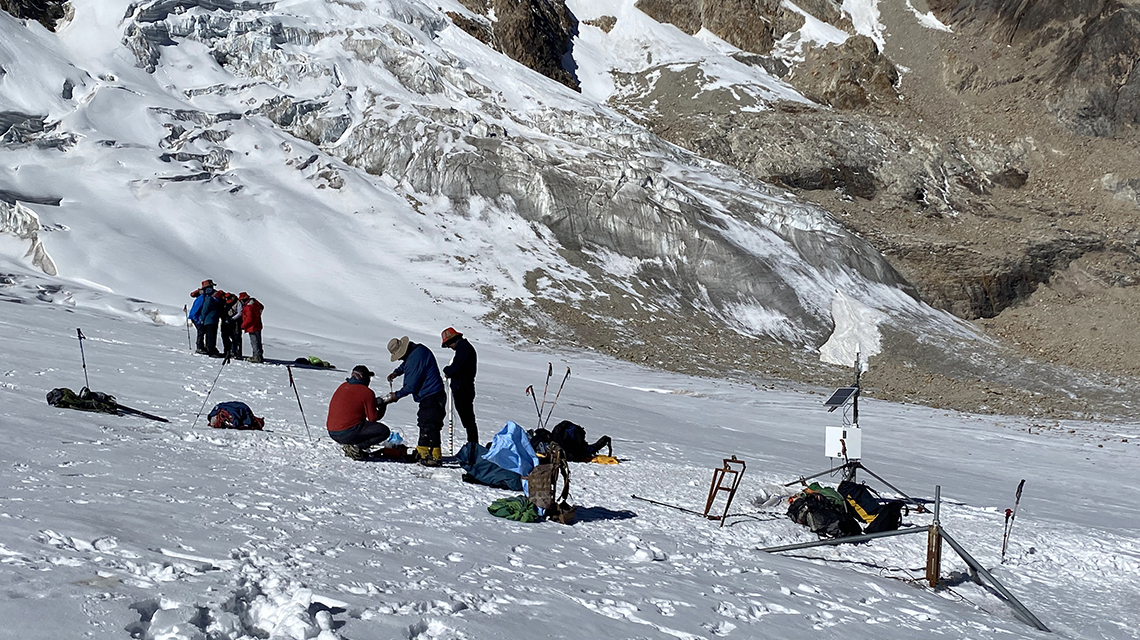
Cada año, el glaciar Huayna Potosí en Bolivia continúa adelgazándose y retrocediendo cuesta arriba. Con el apoyo de la FAO y el OIEA a través del Centro Conjunto FAO/OIEA y el programa de cooperación técnica del OIEA, los científicos están instalando sensores para monitorear la acumulación y el derretimiento de la nieve. Estos conocimientos ayudan a los agricultores y a los responsables de políticas a mitigar el impacto del retroceso glaciar en la disponibilidad de agua. (Foto: G. Dercon/OIEA)
A 5.100 metros sobre el nivel del mar, el aire alrededor del glaciar Huayna Potosí en Bolivia es delgado y quebradizo por la altitud. El viento se desplaza sobre el hielo en largos y deliberados trazos, dando forma a un paisaje atrapado entre la resistencia y la erosión. Hace frío, pero no siempre hiela a lo largo de la ladera de la montaña.
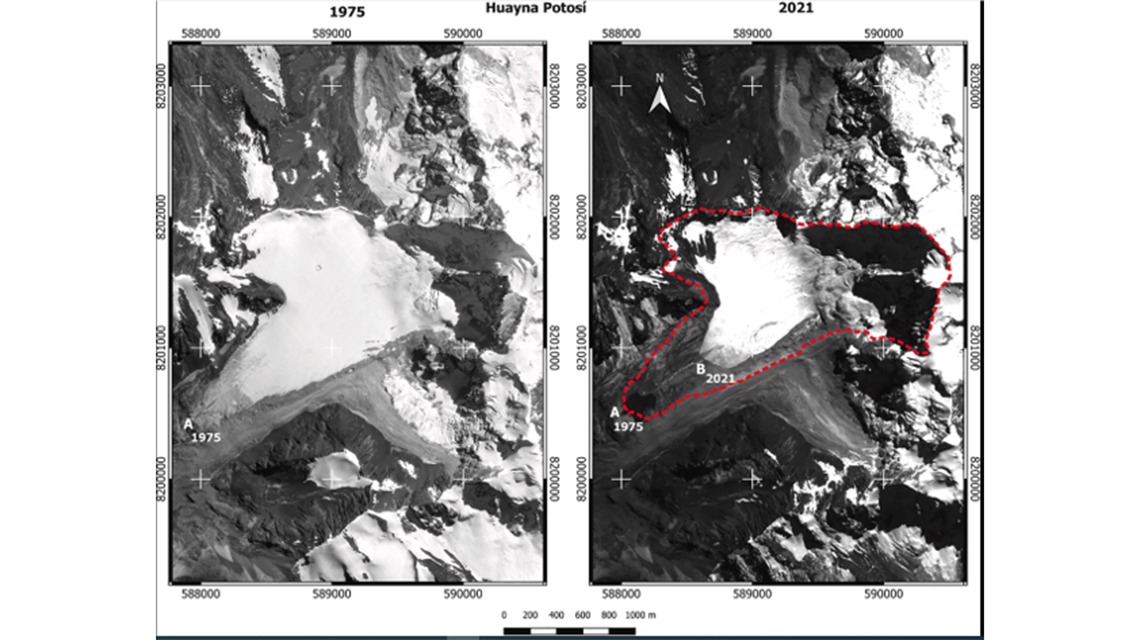
Donde antes el valle estaba lleno de grueso hielo azul, ahora sobresale la roca desnuda como un hueso expuesto. Año tras año, el glaciar occidental del Huayna Potosí se adelgaza y retrocede cuesta arriba a una tasa anual de aproximadamente 24 metros. A su paso, deja atrás piedras dispersas y una laguna de deshielo, un cuerpo de agua que no existía en 1975 y que marca los límites que alguna vez tuvo el glaciar.
Aquí, un equipo de científicos de los Andes y el Himalaya—representando a Argentina, Bolivia, Chile, China, Ecuador y Nepal—se despierta antes del amanecer para comenzar su ascenso, sabiendo que deben regresar antes del anochecer, cuando aumenta el riesgo de accidentes. La altitud dificulta la respiración, obligándolos a moverse lentamente y con cautela. Caminan en fila india, con cuidado de evitar grietas ocultas que podrían tragarse a una persona por completo. En el centro del glaciar, instalan una máquina, un conjunto de paneles y cables, para descifrar pacientemente el silencio de las montañas.
Su trabajo cuenta con el apoyo técnico de la Organización de las Naciones Unidas para la Alimentación y la Agricultura (FAO) y del Organismo Internacional de Energía Atómica (OIEA) a través del Centro Conjunto FAO/OIEA de Técnicas Nucleares en Alimentación y Agricultura, una asociación única entre la FAO y el OIEA, además de respaldo logístico y financiero mediante el programa de cooperación técnica del OIEA.
Este sensor de neutrones de rayos cósmicos, uno de los dos instalados meticulosamente por el equipo en el glaciar, mide de manera sencilla, rápida y continua cuánta agua se acumula en la superficie del glaciar en forma de nieve. Esta nieve mantiene vivo al glaciar. Cada lectura es una instantánea de su existencia menguante.
El deshielo no solo significa paisajes que desaparecen; es una señal de trastornos para quienes dependen de su agua. Los datos que los científicos están recopilando de estos glaciares de gran altitud ayudan a prever los efectos en cascada de la pérdida de hielo sobre los ecosistemas y las comunidades locales, con el fin de encontrar formas de adaptación.
El dispositivo permanecerá mucho después de que los científicos desciendan, transmitiendo señales más allá de las montañas vía satélite—una memoria digital que preserva información sobre lo que el hielo ya no puede retener.
“El retroceso glaciar actual funciona como un termómetro de los cambios climáticos acelerados, con su rápido ritmo indicando la urgencia del aumento de las temperaturas globales”, dice Gerd Dercon, jefe del Laboratorio de Gestión de Suelos y Aguas y Nutrición de Cultivos del Centro Conjunto FAO/OIEA. “A medida que el hielo se derrite y se vuelve a congelar, revela no solo los cambios en el clima, sino también las frágiles dependencias que la civilización humana tiene con estos reservorios congelados”.
En los valles abajo, cientos de miles de personas dependen del agua del glaciar. Llamas y alpacas pastan en los fértiles pastizales, alimentados por el deshielo estacional que ha dado forma a este ecosistema de gran altitud durante siglos. Los agricultores también dependen de él para regar sus cultivos y alimentar su ganado, mientras que un millón de habitantes de El Alto, una ciudad cercana a la capital boliviana, La Paz, lo utilizan como fuente de agua potable.
Durante generaciones, estos campos de hielo han servido como un contrato no escrito entre la montaña y quienes viven a su sombra, liberando agua a un ritmo que permitía la vida. Ahora, ese contrato se está rompiendo.
Las razones son claras. El aumento de las temperaturas globales está derritiendo los glaciares en todo el mundo, pero aquí en Bolivia, la crisis se está acelerando. Sedimentos de áreas sin hielo son transportados por fuertes vientos y depositados sobre el glaciar, oscureciendo su superficie e incrementando la absorción de calor.
Al analizar los sedimentos liberados de las áreas ahora expuestas por el deshielo glaciar y su acumulación en lagos y embalses, los científicos no solo están rastreando el efecto del retroceso del hielo en la distribución de sedimentos, sino que también están descubriendo cambios ambientales más amplios. Estos cambios impulsados por el clima pueden afectar la fertilidad del suelo, la calidad del agua y la composición química del agua.
Los patrones climáticos cíclicos como El Niño amplifican el calentamiento, provocando cambios erráticos en las precipitaciones y un derretimiento acelerado. Los científicos predicen que si estas tendencias continúan, el glaciar occidental del Huayna Potosí—vital para el agua potable y alguna vez considerado eterno por los locales—podría desaparecer por completo en veinte años.
“Detener el retroceso del glaciar no será posible”, dice Dercon. “Pero tenemos que capturar el agua de varias maneras”. En Bolivia, las comunidades han construido más embalses, incluidos algunos más pequeños, han dragado algunos antiguos y han elevado los muros de las represas. También es necesario trabajar la tierra de manera diferente, modelándola para retener agua en lugar de drenarla, enseñando al suelo a absorber. En esto, la reforestación con árboles nativos y la reducción del sobrepastoreo de llamas y ganado son cambios fundamentales para sostener suelos saludables y regenerar la tierra.
Sensibilizar a los tomadores de decisiones y movilizar recursos para enfrentar los cambios venideros es el primer paso crucial y un resultado importante de estas expediciones. También lo es el establecimiento de una red internacional de monitoreo, a lo largo de los Andes y el Himalaya. Esta red ha proporcionado información sobre cómo las áreas del mundo cubiertas de hielo (conocidas como la “criósfera”) están siendo afectadas por el cambio climático y cómo el retroceso de los glaciares afecta también a quienes viven aguas abajo.
Lo que es seguro es que estos glaciares, alguna vez considerados inamovibles, están desapareciendo más rápido de lo previsto.
Ahora es el momento de conservar lo que queda. Instituciones gubernamentales y agricultores del altiplano boliviano están tratando de capturar el agua liberada a través de embalses y represas, para contar con una mayor capacidad de almacenamiento. Además, se están desarrollando nuevos acuerdos sobre el uso del agua, garantizando que no haya conflictos en el futuro.
Trabajando con gobiernos y agricultores para derivar soluciones a partir de los datos recopilados en los glaciares, los científicos capacitados por la FAO y el OIEA a través del Centro Conjunto FAO/OIEA y su programa de cooperación técnica ayudan a crear conciencia y encontrar soluciones para un mundo que algún día podría quedarse sin glaciares.
Esta historia fue publicada originalmente por la FAO para el primer Día Mundial de los Glaciares el 21 de marzo de 2025.
By International Atomic Energy Agency:
Glaciers on Borrowed Time: Capturing Data from Vanishing Ice in Bolivia
Every year, Bolivia’s Huayna Potosí Glacier continues to thin and retreat upslope. With support from FAO and IAEA through the Joint FAO/IAEA Centre and the IAEA technical cooperation programme, scientists are installing sensors to monitor snow accumulation and its melting. These insights help farmers and policymakers mitigate the impact of glacier retreat on water availability. (Photo: G. Dercon/IAEA)
At 5,100 meters above sea level, the air around Bolivia’s Huayna Potosí glacier is thin, brittle with altitude. The wind moves over the ice in long, deliberate strokes, shaping a landscape caught between endurance and erosion. It is cold but not always freezing along the mountainside.
Where thick blue ice once filled the valley, bare rock now juts out like exposed bone. Year by year, the Western Huayna Potosí Glacier thins and retreats upslope at an annual rate of approximately 24 meters. In its wake, it leaves behind scattered stones and a meltwater lake, a body of water that did not exist in 1975, marking the glacier’s former boundaries.
Here, a team of scientists from the Andes and the Himalayas—representing Argentina, Bolivia, Chile, China, Ecuador and Nepal—wake before dawn to begin their ascent, knowing they must return before dark when the risk of accidents increases. The altitude makes breathing difficult, forcing them to move slowly, deliberately. They walk in single file, careful to avoid hidden crevasses that could swallow a person whole. At the centre of the glacier, they install a machine, an assemblage of panels and wires, to patiently decode the silence of the mountains.
Their work is supported technically by the Food and Agriculture Organization of the United Nations (FAO) and International Atomic Energy Agency (IAEA) through the Joint FAO/IAEA Centre of Nuclear Techniques in Food and Agriculture, a unique partnership between the FAO and the IAEA, including logistically and financially by the IAEA’s technical cooperation programme.
This cosmic ray neutron sensor is one of the two sensors, painstakingly installed by the team on the glacier, measures easily, quickly and continuously how much water is accumulated on top of the glacier in the form of snow. This snow keeps the glacier alive. Each reading is a snapshot of the glacier’s diminishing existence.
The shrinking ice means more than just disappearing landscapes—it signals upheaval for those who rely on its water. The data that the scientists are collecting from these high-altitude glaciers is helping researchers predict the cascading effects of ice loss on ecosystems and local communities in order to find ways to adapt.
The device will stay long after the scientists descend, transmitting signals beyond the mountains via satellite—a digital memory preserving information about what the ice can no longer hold.
“Current glacial retreat now functions as a thermometer of accelerating climate shifts, with its rapid pace signalling the urgency of rising global temperatures,” says Gerd Dercon, Head of the Soil and Water Management and Crop Nutrition Laboratory of the Joint FAO/IAEA Centre. “As the ice melts and refreezes, it reveals not only the changes in climate but also the fragile dependencies human civilization has on these frozen reservoirs.”
In the valleys below, hundreds of thousands of people depend on the glacier’s water. Llamas and alpacas graze in the fertile grasslands, their pastures fed by the seasonal meltwater that has shaped this high-altitude ecosystem for centuries. Farmers equally rely on it to irrigate their crops and feed their livestock, while one million inhabitants of El Alto, a city close to Bolivia’s capital La Paz, depend on it for drinking water.
For generations, these ice fields have served as an unspoken contract between the mountain and those who live in its shadow, releasing water at a pace that allowed life to flourish. Now, that contract is breaking.
The reasons are clear. Rising global temperatures are melting glaciers around the world, but here in Bolivia, the crisis is accelerating. Sediments from ice-free areas are transported by strong winds and deposited onto the glacier, darkening its surface and increasing heat absorption.
By analysing sediments released from areas now exposed by glacial melt and accumulating in lakes and reservoirs, scientists are not only tracking the effect of the retreat of the ice on sediment distribution but also uncovering broader environmental shifts. These climate-driven changes may impact soil fertility, water quality, and water chemistry.
Cyclical weather patterns like El Niño amplify the warming, causing erratic swings in precipitation and rapid melting. Scientists predict that if these trends continue, the Western Huayna Potosí’s glacier—important for drinking water and once thought eternal by the locals—could vanish entirely in twenty years.
“Stopping the retreat of the glacier will not be possible,” says Dercon. “But we have to capture the water in several ways.” In Bolivia, communities have built more reservoirs, including smaller ones, dredged some old ones and raised the walls of dams. The land also needs to be worked differently, shaped to hold water rather than shed it, the soil taught to embrace. In this, reforesting the area with native trees and halting overgrazing of hungry llamas and livestock are fundamental changes for supporting healthy soils and land regeneration.
Raising awareness among decision makers and mobilizing resources to confront the coming changes is the first critical step and an important outcome of the expeditions. As has the establishment of an international monitoring network, across the Andes and the Himalayas. This network has provided insights into how the parts of the world covered by ice (known as the ‘cryosphere’) are impacted by climate change and how the retreating glaciers affect as well those who live downstream.
What is certain is that these glaciers, once thought immovable, are slipping away faster than predicted.
Now is the moment to conserve what remains. Governmental institutions and farmers in the Bolivian highlands are trying to capture the water being released through reservoirs and dams, for having larger buffer capacity. Further, new arrangements are being developed about the use of water, ensuring no conflicts happen in the future.
Working with governments and farmers to derive these solutions from the data collected on glaciers, the scientists trained by the FAO and IAEA through its Joint FAO/IAEA Centre and technical cooperation programme help to raise awareness and finding solutions for a world that may one day be without glaciers.
This story was originally published by FAO for the first annual World Day for Glaciers on 21 March 2025.

 Bolivian Thoughts | Pensamientos Bolivianos (Bilingual/Bilingüe)