
By Marisol Alvarado, Vision 360:
They were affected by fires
Mura Vita Vita is the name of the enterprise driven by seven partners from the Tacana indigenous community, located in the municipality of San Buenaventura, in the department of La Paz.
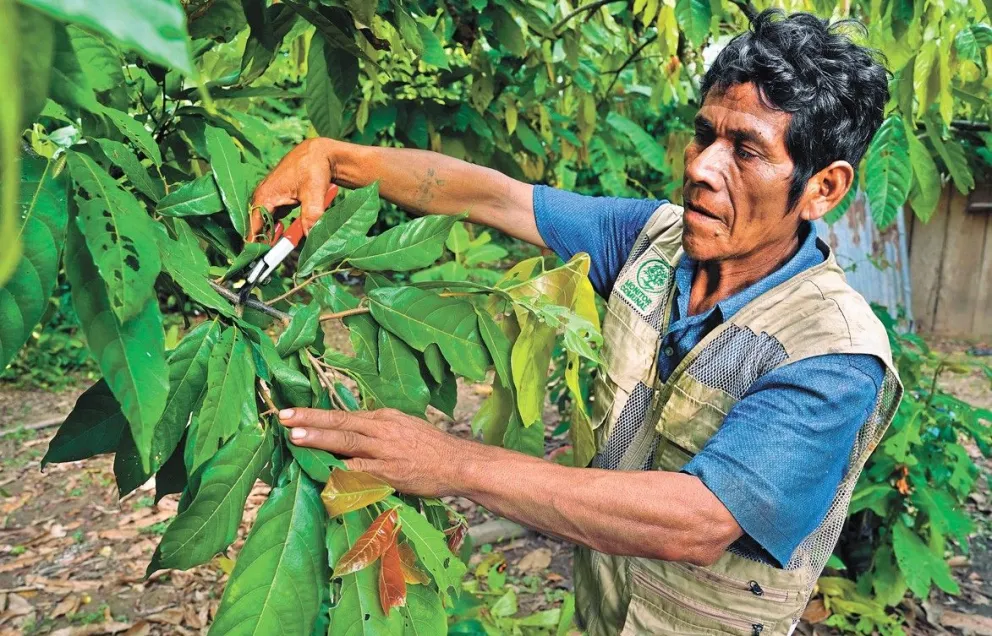
A community member cuts the leaves of a cacao tree. Photo: CIPTA – Practical Action
Despite adversity and lack of attention from the authorities, a group of Tacana families from the Capaina Baja community, located in the municipality of San Buenaventura, in the department of La Paz, refuses to give up and is betting on chocolate production to improve their living conditions.
Germán Yuamona is the president of the Mura Vita Vita enterprise, which was officially founded in June 2023, driven by the non-governmental organization Soluciones Prácticas (Practical Action), which arrived in the community to provide knowledge, guidance, and machinery to the group members.
Initially, there were 15 participants, both men and women; however, many abandoned the project as they did not consider that a venture does not bear fruit overnight. In the end, seven partners remained, relying on the plots of two members who already had advanced production.
“When we started with the two partners who had their production, in terms of the market—which is precisely people’s main concern—we didn’t have any problems,” Yuamona explained to Visión 360.
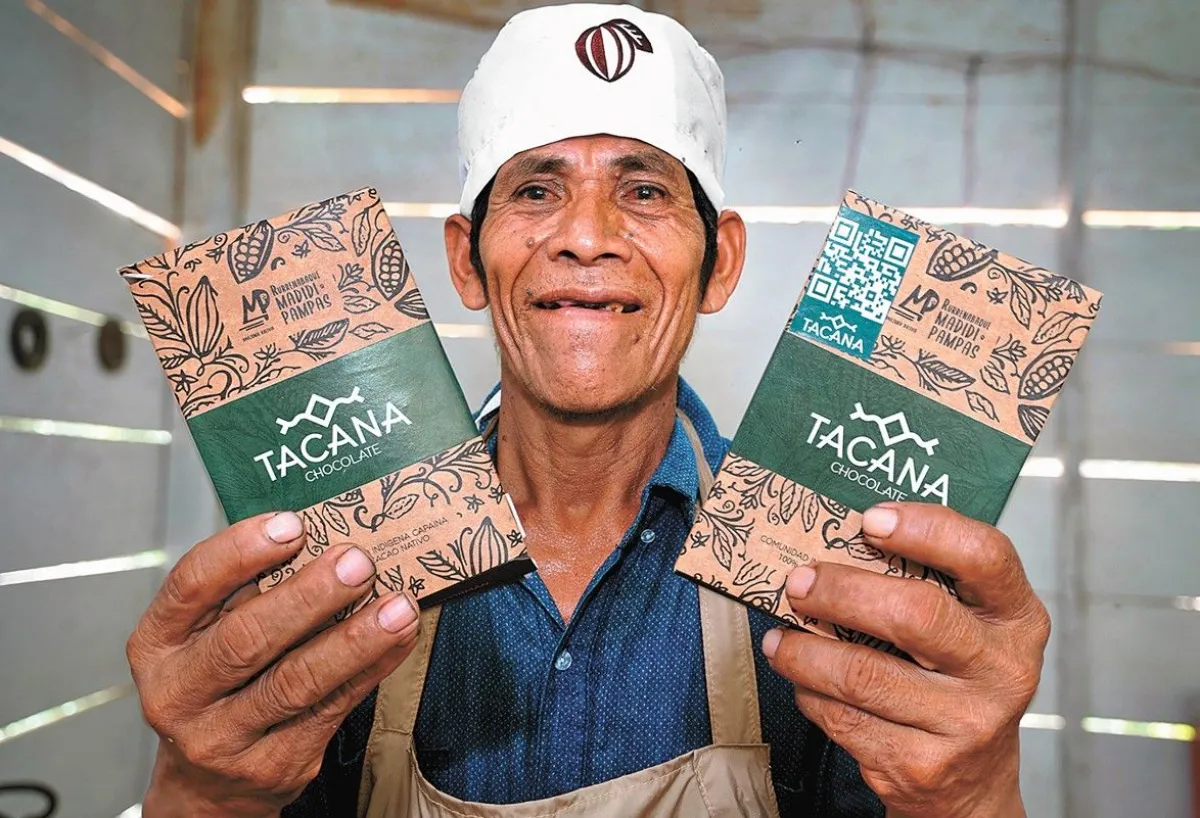
Weekly, the enterprise produced between 30 and 40 chocolate pastes, which they offered in two presentations: one of 250 grams and another of 150 grams. The main points of sale were hotels and restaurants, although they also received orders from urban areas. However, the commercialization of cacao seeds did not succeed.
However, the forest fires that affected the country in 2023 devastated the two plots they worked with, halting production and, along with it, the project, as well as the dreams and expectations of the community members.
“The project could not move forward because the fire consumed the entire plantation; we were left at a standstill,” says the president of the enterprise.
Faced with this situation, Practical Action offered them a loan to start over. However, the group declined, as if anticipating another blow from nature. After the forest fires, a severe drought followed, heavily impacting all types of production.
Little by little and with great effort, the community members managed to recover, and currently, the plantations are in progress, with hopes that they will bear fruit by 2026.
Yuamona explains that they decided to place the nurseries within the community, which is located seven kilometers from the riverbank. This way, they can monitor and create the right conditions to cultivate Criollo cacao. The initial proposal was to bring it from another location, but this posed the risk of obtaining hybrids, which lack the essential oil also in demand in the market.
“From the time the nurseries are established until the cacao trees bear fruit, it takes three years, depending on how the growth process is managed,” emphasizes the entrepreneur.
As if facing natural phenomena and human intervention, such as devastating fires, wasn’t enough, the Tacana community also endures neglect from the authorities, in this case, the municipal government, which claims to lack financial resources whenever a demand is made.
The entrepreneur explains that there is a road, more of an access route than a completed road, leading from the main highway to the community. This road is essential for transporting products to the markets, along with the need for a bridge over a stream that turns into a lake during the rainy season, preventing people from passing. These requests have been pending for over 10 years, and no response has yet been given.
“Our municipality isn’t what you would call poor, but every time we go to ask, they say, ‘There’s no money, there’s no funding.’ So, under the previous mayors, all they did was steal the money and now they’re in debt,” reflects Yuamona.
A major need is potable water, which is non-existent in the community.
While they await next year, the members of this initiative produce corn, yucca, and plantains individually, but their focus is on chocolate, which has higher demand both locally and abroad.
According to Yuamona, the main goal of the venture is to produce chocolate pastes, a task managed by the women, while the men are responsible for establishing the cacao plots.
They are also considering producing derivatives such as oil, because there are interested parties willing to support the activity. “The goal is to increase capacity and form a small business that could potentially export the product,” he says, noting that countries like Peru and Ecuador are already seeking the product.
Although they face a “huge” problem, which is the lack of tools, they are determined to continue implementing the cacao plots and producing chocolate, keeping their spirits high.
They live from the production of food and crafts
The inhabitants of the Capaina Baja tacana community are primarily dedicated to the production of corn, cassava, and plantains. Some families work with crafts, and very few produce chocolate, although they see this product as having good returns, making income generation favorable. There are those who leave the community because they take on other types of jobs, such as “day labor.”
“Since we don’t have, let’s say, a stable job, people move from one place to another,” says Germán Yuamona, president of the Mura Vita Vita venture. In total, there are 42 families in the community, which together represent about 200 people.
The community has a health post, a school, and a social hall. The region has a warm climate, with high temperatures nearly year-round, although the rainy season generates much concern due to heavy rainfall.
Capaina Baja belongs to the TCO San Buenaventura, is part of the Madidi National Park and Integrated Natural Area, and is within the Madidi-Pilón Lajas-Cotapata Conservation Corridor.
After the 2023 fires, some families decided to migrate because they lost their plantations and crops; others, however, began to replant short-term crops as part of an early recovery process.
The inhabitants of this tacana community and the others that make up the indigenous people, especially the women, have a strong connection to the environment and biodiversity; thus, they also work to protect it, for example, by avoiding chemicals in food production and instead opting for organic farming.
Therefore, indigenous women play a key role in their communities when it comes to the intergenerational transmission of their traditions, myths, legends, and philosophy of life regarding natural resource management.
Data
START. The chocolate production venture began in June 2023.
SUPPORT. The non-governmental organization Practical Action encouraged the community members and provided them with advice, training, and machinery.
SEARCH. Today, the entrepreneurs are moving forward on their own and seeking funding to acquire tools.
GOAL. In the short term, they aim to produce chocolate paste, but in the long term, they aspire to become a microenterprise that exports their product.
Por Marisol Alvarado, Vision 360:
Fueron afectados por incendios
Mura Vita Vita se denomina el emprendimiento que impulsan siete socios de la comunidad indígena tacana, que está en el municipio de San Buenaventura, en el departamento de La Paz.
Un comunario corta las hojas de un árbol de cacao. Foto: Foto: CIPTA- Practical Action
A pesar de la adversidad y la falta de atención por parte de las autoridades, un grupo de familias tacanas de la comunidad Capaina Baja, ubicada en el municipio de San Buenaventura, en el departamento de La Paz, no se rinde y apuesta por la producción de chocolate para mejorar sus condiciones de vida.
Germán Yuamona es el presidente del emprendimiento Mura Vita Vita, que nació formalmente en junio de 2023, impulsado por la organización no gubernamental Soluciones Prácticas (Practical Action), que llegó a la comunidad para proporcionar conocimientos, asesoramiento y maquinarias a los integrantes del grupo.
En un inicio, los participantes eran 15, entre mujeres y varones; sin embargo, muchos fueron abandonando el emprendimiento porque no tomaron en cuenta que un proyecto no da frutos de la noche a la mañana. Entonces quedaron siete socios, que contaban con las parcelas de dos de los miembros, que ya tenían avanzada su producción.
“Cuando empezamos con los dos compañeros que tenían su producción, en el tema del mercado que justamente es el temor de la gente, nosotros no hemos tenido problemas”, explica Yuamona a Visión 360.
Semanalmente, el emprendimiento producía entre 30 y 40 pastas de chocolate que las ofrecían al mercado en dos presentaciones, una de 250 gramos y otra de 150. Los principales puntos de venta eran los hoteles y los restaurantes, aunque también tenían pedidos de las urbes. Lo que no prosperó fue la comercialización de semilla de cacao.
Sin embargo, los incendios forestales que afectaron al país en 2023 arrasaron los dos predios con los que ellos trabajaban y la producción quedó paralizada como también, por ese tiempo, el proyecto, y junto a él los sueños y expectativas de los comunarios.
“Ahí ya no ha podido avanzar el proyecto porque el incendio ha consumido toda la plantación, hemos quedado parados”, cuenta el presidente del emprendimiento.
Ante esta situación, Soluciones Prácticas se ofreció a brindarles un préstamo para comenzar de nuevo; sin embargo, el grupo no aceptó, como si adivinara una nueva arremetida de la naturaleza. Y es que, después de los incendios forestales, llegó la la sequía que golpeó duramente a la producción de todo tipo.
De a poco y con mucho esfuerzo, los comunarios lograron levantarse y, en la actualidad, las plantaciones están en proceso y esperan que “fruteen” para 2026.
Yuamona explica que se decidió ubicar los viveros dentro de la comunidad, que se encuentra a siete kilómetros de la ribera del río, porque de esa manera se pueden controlar y generar las condiciones para tener un cacao criollo, porque la propuesta era traerlo de otro lugar, lo que lleva el riesgo de que sean híbridos y de ser así carecen de aceite que también es requerido en el mercado.
“Desde que se hacen los viveros hasta que frutea, tarda tres años, dependiendo de cómo se ayude al crecimiento, al proceso”, recalca el emprendedor.
Por si fuera poco, tener que enfrentar los fenómenos naturales y la intervención humana, que causa tragedias como los incendios, la comunidad tacana debe soportar la falta de atención de las autoridades, en este caso, municipales, que alegan carecer de recursos económicos cuando reciben alguna demanda.
El emprendedor explica que de la carretera principal hasta la comunidad existe una vía, más que todo un acceso, que no está concluido y es fundamental para sacar los productos hacia los mercados, a lo que se suma la necesidad de un puente sobre un arroyo que en la época de lluvia se transforma en un lago que impide el tránsito de las personas. Esas gestiones tienen más de 10 años y hasta la fecha la respuesta se deja esperar.
“Nuestro municipio no es un municipio que se puede decir pobre, pero cada vez que vamos a reclamar, nos dicen: ‘No hay dinero, no hay plata’. Entonces, en la gestión de los anteriores alcaldes lo único que han hecho es robarse la plata y están en deuda”, reflexiona Yuamona.
Un requerimiento mayúsculo es agua potable, que es inexistente en la comunidad.
Mientras aguardan al próximo año, los comunarios de este emprendimiento producen maíz, yuca y plátano, de manera individual, pero los ojos están puestos en el chocolate, que es más demandado en el mercado interno y externo.
El principal objetivo del emprendimiento, según Yuamona, es elaborar las pastas de chocolate, tarea que está a cargo de las mujeres; los varones se hacen responsables de implementar las parcelas.
Indica que se pensaría en producir derivados como el aceite, además, porque hay interesados que quieren apoyar esa actividad. “La meta es aumentar la capacidad y llegar a formar una microempresa que quizá exporte el producto”, menciona, porque, por ejemplo, en Perú y Ecuador están requiriendo el producto.
Aunque tropiezan con un “enorme” problema, que es la falta de herramientas, al margen de eso aseguran que los ánimos están muy “elevados” para seguir implementando las parcelas y producir el chocolate.
Viven de la producción de alimentos y artesanías
Los habitantes de la comunidad tacana Capaina Baja se dedican a la producción de maíz, yuca y plátano, principalmente. Algunas familias trabajan con artesanías y muy pocas producen chocolate, aunque ven que este último producto tiene muy buen rendimiento y, por lo tanto, la generación de ingresos es favorable. No faltan quienes salen de la comunidad porque hacen otro tipo de trabajos, se dedican a “jornalear”.
“Como nosotros no tenemos, digamos, un empleo seguro, entonces la gente busca de un lugar a otro”, indica Germán Yuamona, presidente del emprendimiento Mura Vita Vita.En total son 42 familias las que habitan en la comunidad, las que reúnen aproximadamente a 200 personas.
La comunidad cuenta con una posta de salud, una escuela y una sede social. En la región reina un clima cálido, con elevadas temperaturas casi todo el año, aunque la época de lluvias genera bastante preocupación debido a que las precipitaciones son copiosas.
Capaina Baja pertenece a la TCO San Buenaventura, forma parte del Parque Nacional y Área Natural de Manejo Integrado Madidi y del Corredor de Conservación Madidi-Pilón Lajas-Cotapata.
Luego de los incendios de 2023, algunas familias decidieron migrar debido a que perdieron sus plantaciones y cultivos; en cambio, otras volvieron a sembrar los productos a corto plazo dentro de un proceso de recuperación temprana.
Los habitantes de esta comunidad tacana y de las otras que componen el pueblo indígena, y sobre todo las mujeres, tienen un gran arraigo con el medio ambiente y la biodiversidad; por ende trabajan también en su defensa, por ejemplo, evitando los químicos en la producción de los alimentos y más bien apuestan por una producción orgánica.
Por tanto, las mujeres indígenas tienen un papel clave dentro de sus pueblos en lo que se refiere a la transmisión intergeneracional de sus tradiciones, mitos, leyendas y filosofía de vida en el manejo de los recursos naturales.
Datos
INICIOS. El emprendimiento de producción de chocolate nació en junio de 2023.
IMPULSO. La organización no gubernamental Soluciones Prácticas incentivó a los comunarios y les brindó asesoramiento, capacitación y maquinarias.
BÚSQUEDA. Hoy, los emprendedores marchan solos y buscan financiamiento para dotarse de herramientas.
OBJETIVO. A corto plazo es producir pasta de chocolate, pero a largo plazo es convertirse en una microempresa que exporte su producto.

 Bolivian Thoughts | Pensamientos Bolivianos (Bilingual/Bilingüe)