
By Vision 360:
Conflict
The People’s General Staff, aligned with Evo Morales, refused to pause. The Government states they will not negotiate as long as the blockade continues, aiming to generate impunity.
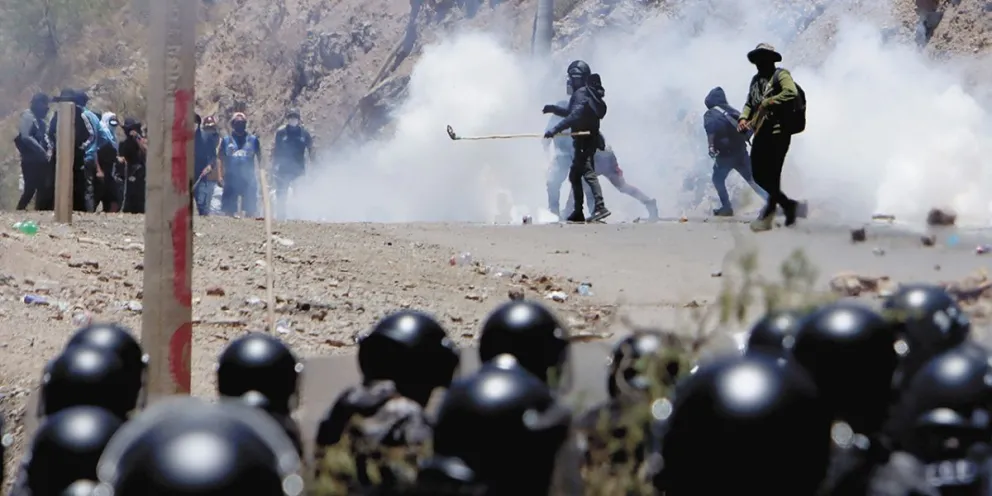
Police intervened Friday morning at the Parotani blockade. Photo: APG
With no consolidated dialogue and losses totaling $2.109 billion, Bolivia enters a fourth week of national blockades. Protest groups refuse to pause, while the Government states it will not negotiate as long as the pressure tactics continue.
“If there’s a desire to negotiate for the benefit of our country, not for one person, and for the popular classes oppressed by Evo Morales, we are open to dialogue; but first, all blockades must be lifted,” affirmed Government Minister Eduardo del Castillo.
Since October 14, Evo Morales supporters have blocked roads, demanding the national government drop cases against Morales for trafficking and statutory rape and allow his candidacy in the 2025 elections. Protesters also seek solutions for rising food costs, currency shortages, and fuel supply issues.
The government’s stance was clarified Saturday night in a statement by Minister of the Presidency Marianela Prada, who reiterated the willingness to discuss Executive Branch issues but not Morales’ potential candidacy or legal cases.
In response, Morales, on his radio program, insisted on unconditional talks, with two focused discussions—one on economic issues and another on political matters.
Without agreement, the country enters a fourth week of costly blockades.
To date, according to Vice Minister of Commerce and Internal Logistics Grover Lacoa, losses in various sectors have reached $2.109 billion, with irreversible damage reported in crop planting and meat production.
“It will be costly to recover. Just to give some figures: the agricultural sector lost $88 million per day; sugar $6 million; poultry $4.7 million; pork $2 million; cattle $7.1 million; textiles $12.5 million; hotels and restaurants $7 million; alcohol industry $4 million; and the oilseed industry $14 million,” he detailed in an interview with Bolivia TV.
Lacoa explained that the blockade could impact upcoming planting as agricultural producers have been unable to receive necessary supplies.
“We were preparing for planting, now affected because blockades prevented the arrival of diesel, gasoline, supplies, seeds, and more. This could have a significant impact next year, also affecting meat production,” Lacoa said.
Additionally, he noted that due to the blockade, baby chicks are not reaching production centers, and corn, sorghum, and soybean meal are not being transported.
Speaking to the Erbol Network, Rolando Morales, Vice President of Cochabamba’s Chamber of Agricultural Producers, stated that with only 50 days until the year’s end, many members face imminent bankruptcy and warned of potential unemployment.
“This situation is irreversible. With less than 50 days left in the year and under 40 days to pay bonuses and October and November salaries, how will we manage? The Chamber represents 18 sectors and over 154,000 members, many of whom are facing imminent bankruptcy. Government solutions are necessary to ensure transit,” he said.
Por Vision 360:
Conflictos
En el Estado Mayor del Pueblo, afín a Evo Morales, se negaron a ingresar en un cuarto intermedio. Desde el Gobierno señalan que no dialogarán mientras la medida de presión persista y se busque generar impunidad.
La Policía intervino la mañana del viernes el bloqueo en Parotani. Foto: APG
Sin un diálogo consolidado y con pérdidas que ya suman los 2.109 millones de dólares, Bolivia ingresa en una cuarta semana de bloqueos a nivel nacional. Los grupos movilizados se niegan a ingresar a un cuarto intermedio mientras que el Gobierno afirma que no dialogará mientras persistan las medidas de presión.
“Si quiere negociar abiertamente en beneficio de nuestro país y no de una persona, en beneficio de las clases populares que están siendo oprimidas -lamentablemente- por el señor Evo Morales, estamos dispuestos a dialogar; pero primero levanten todos los puntos de bloqueo”, aseguró el ministro de Gobierno, Eduardo del Castillo.
Desde el 14 de octubre, los seguidores de Evo Morales mantienen un bloqueo indefinido de caminos exigentes al Gobierno nacional se retiran los procesos judiciales en contra el exmandatario por trata de personas y estupro, además de su habilitación como candidato en als elecciones generales 2025. movilizados aseguran que también buscan soluciones al encarecimiento de alimentos, la falta de dólares, el suministro irregular de combustibles.
La posición del gobierno fue dada a conocer la noche del sábado, mediante un comunicado de la ministra de la Presidencia, Marianela Prada. En sus declaraciones reiteró la voluntad de diálogo con los movilizados, en temas que atañen al Órgano Ejecutivo, y no así para abordar la eventual candidatura de Evo Morales ni la “liberación de los procesos judiciales”.
En respuesta, Morales, en su programa de radio, insistió en que el diálogo debe ser sin condiciones. Insistió en que un encuentro debe centrarse en dos mesas, una económica y otra política.
Sin acuerdo, el país ingresa en una cuarta semana de bloqueos que van sumando pérdidas, daños y perjuicios.
Hasta la fecha, según el viceministro de Comercio y Logística Interna, Grover Lacoa, ya se han registrado pérdidas por 2.109 millones de dólares en diferentes rubros. Asimismo se denunció un daño irreparable a la siembra y producción de carne.
“Nos va a costar mucho reponer estas pérdidas. (…) Sólo por dar algunos datos: el sector agrícola perdió 88 millones de dólares por día; el sector del azúcar 6 millones; el avícola 4,7 millones; el que se dedica a la porcinocultura, 2 millones; el vacuno 7,1 millones; el área de los textiles 12,5 millones; la hotelería y restaurantes 7 millones; el rubro de alcohol 4 millones y la industria oleaginosa 14 millones de dólares”, detalló en entrevista con Bolivia TV.
La autoridad explicó que se prevé que el bloqueo afectará a la próxima siembra debido a que los productores agrícolas no pudieron recibir los insumos necesarios para su trabajo.
“Nos estábamos preparando para la siembra y ahora se está viendo afectado porque los bloqueos han impedido que llegue el diésel, la gasolina, los insumos, las semillas y otros. Esto podría tener un correlato importante la siguiente gestión y también afecta a la producción de carne”, señaló Lacoa.
Asimismo, explicó que los pollos bebé no son llevados a los centros de producción y de engorde por el bloqueo, tampoco llega el maíz, el sorgo ni la torta de soja.
En contacto con la Red Erbol, el vicepresidente de la Cámara de Agropecuarios de Cochabamba, Rolando Morales, señaló que –a 50 días de terminar el año- varios de sus afiliados están frente a una quiebra inminente. Advirtió que podría venir una ola de desempleo.
“Esto ya no tiene retorno. A menos de 50 días para fin de año ya menos de 40 días para el pago del aguinaldo y los salarios de octubre y noviembre, ¿con qué vamos a cumplir?. La Cámara Agropecuaria aglutina a 18 sectores y más de 154.000 asociados, muchos de los cuales enfrentan una quiebra inminente. Es necesario buscar soluciones gubernamentales para garantizar la transitabilidad”, afirmó.

 Bolivian Thoughts | Pensamientos Bolivianos (Bilingual/Bilingüe)