
Editorial, El Deber:
When it was believed that the country’s deinstitutionalization had hit rock bottom, new elements emerge that show that democracy can be even more tainted and that laws are used at will to generate scenarios of abuse of power.
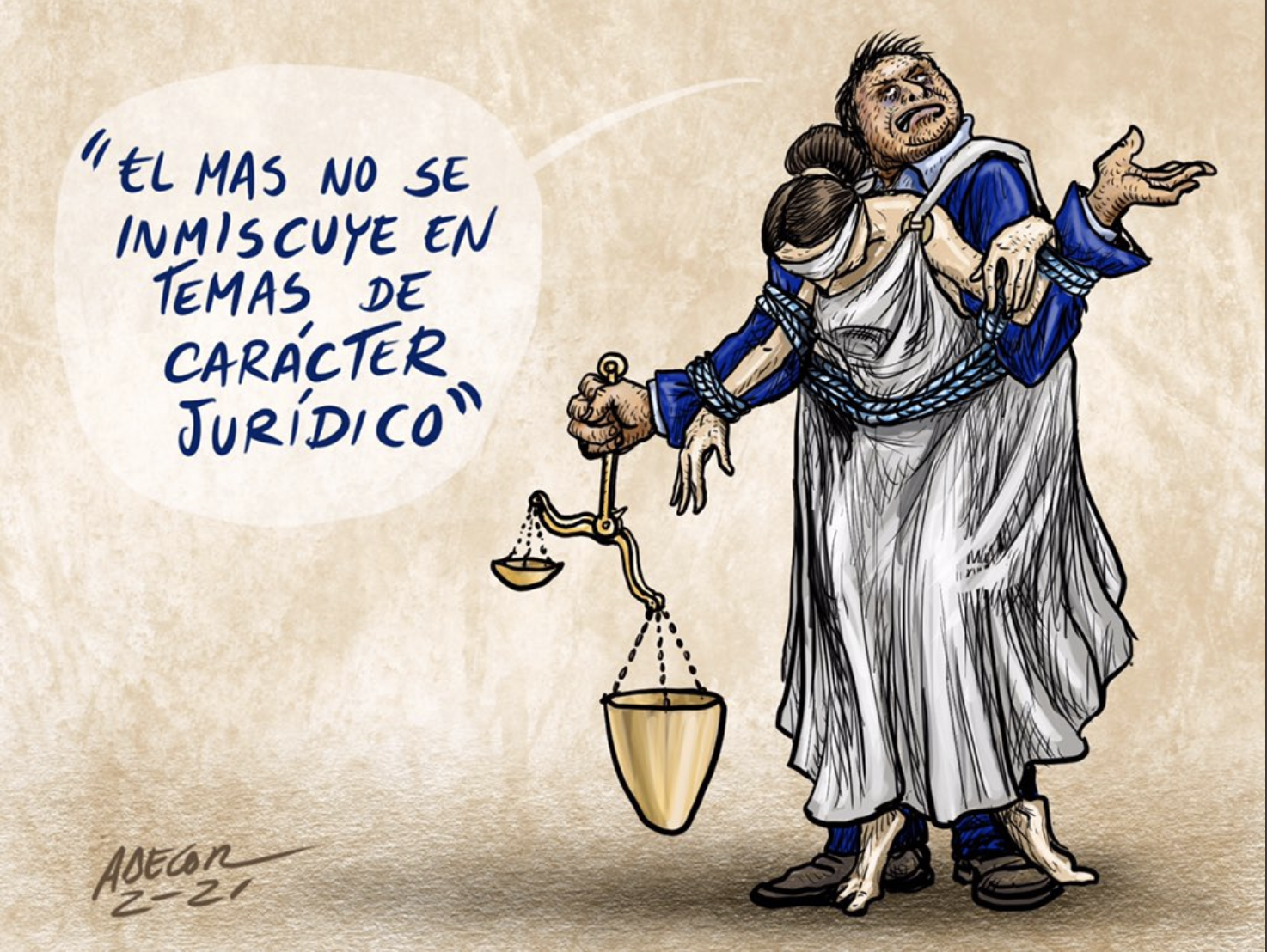
This is the case of the Judiciary that does not mind failing to comply with ethics, being a judge and a party, as long as the magistrates keep up the slack, leaving judicial elections uncertain. Beyond remaining in office longer than the Constitution mandates, the members open the blinds to authoritarian temptations that are dangerous and that have already been noted by the Inter-American Commission on Human Rights (IACHR).
On Thursday, the Plenary Chamber of the Supreme Court of Justice (TSJ) presented a Prior Consultation on the constitutionality of the Transitory Law project for the 2023-2024 Judicial Elections and asked to suspend the treatment of any rule on this issue until the Plurinational Constitutional Court (TCP). The latter admitted the request and froze any action by the Legislature to give the green light to the rule that guarantees the elections. Checkmate.
The Political Constitution of the State sets December 31 as the deadline for the highest judicial authorities, who are elected by vote of all Bolivians. With this resource, the members of the Judiciary establish a political position: they want to stay and are not willing to respect the law. In return, they are willing to do anything, giving new signs of how broken the Judiciary is.
The Legislative Branch had the key to the judicial election in its hands, but its members did not reach timely agreements. When one was reached, in which Creemos, Comunidad Ciudadana and the evista faction of the MAS participated, it was the arcista faction that put the obstacles with a series of maneuvers, among which is the absurd medical discharge of the president of the Constitution commission lasting six hours, only for the session not to take place.
In reality, up to this point the chicana has been incurred, which the Dictionary of the Royal Academy of the Spanish Language defines as: “Practice that seeks to obstruct the judicial process through permanent malicious and reckless proposals” and the chicanero as someone who “uses up to satiety mechanisms to lengthen trials and thereby obtain economic advantages for themselves and sometimes for their client, promoting endless appeals, dilatory exceptions, inadmissible complaints within the trial and requests for suspensions.
Magistrates and fathers of the country, who should give their lives for the validity of justice, resorting to tricks to obtain personal and partisan benefits, before the passive gaze of the Executive Branch, through the Minister of Justice.
The extremes do not go unnoticed. The IACHR issued a statement urging a return to the path of institutions and democracy. “The IACHR expresses concern about the challenges that arise in the process of electing authorities for the Supreme Court of Justice, Plurinational Constitutional Court, Agro-Environmental Court and Council of the Judiciary that may weaken the functioning of the Bolivian justice system,” the document says and also “urges the Plurinational State of Bolivia, especially the Plurinational Legislative Assembly, to generate consensus, approve the respective call and regulations, to advance and conclude the process of selecting the authorities in a timely manner. of the aforementioned justice institutions, in observance of international standards and with guarantees of transparency and independence.”
The danger is not only that the judicial system continues its free fall, but that – in order to remain in power – the current magistrates manipulate justice in favor of the political power of the Executive and that the rulings continue to punish only the opponents, converting democracy into a kind of tyranny.
Cuando se creía que la desinstitucionalización del país había tocado fondo, surgen nuevos elementos que hacen ver que la democracia puede ser aún más mancillada y que las leyes se utilizan a conveniencia para generar escenarios de abuso de poder.
Es el caso del Poder Judicial al que no le importa faltar a la ética, ser juez y parte, con tal de que los magistrados mantengan la pega, dejando inciertas las elecciones judiciales. Más allá de permanecer en el cargo más tiempo que el que manda la Constitución, los vocales abren las persianas a tentaciones autoritarias que son peligrosas y que ya han sido notadas desde la Comisión Interamericana de Derechos Humanos (CIDH).
El jueves, la Sala Plena del Tribunal Supremo de Justicia (TSJ) presentó una Consulta Previa de constitucionalidad del proyecto de Ley Transitorio para las Elecciones Judiciales 2023- 2024 y pidió dejar en suspenso el tratamiento de cualquier norma sobre este tema mientras no se pronuncie el Tribunal Constitucional Plurinacional (TCP). Este último admitió el pedido y congeló cualquier acción del Legislativo para dar luz verde a la norma que garantice los comicios. Jaque mate.
La Constitución Política del Estado fija el 31 de diciembre como fecha límite para las máximas autoridades de la justicia, que son elegidas por voto de todos los bolivianos. Con este recurso, los miembros del Poder Judicial fijan una postura política: quieren quedarse y no están dispuestos a respetar la ley. A cambio, están dispuestos a todo, dando nuevas muestras de cuán descompuesto está el Poder Judicial.
El Poder Legislativo tuvo en sus manos la llave de la elección judicial, pero sus miembros no lograron acuerdos oportunos. Cuando se alcanzó uno, en el que participaron Creemos, Comunidad Ciudadana y la facción evista del MAS, fue la facción arcista la que puso las trabas con una serie de maniobras, entre las que está la absurda baja médica del presidente de la comisión de Constitución con duración de seis horas, solo para que no se realice la sesión.
En realidad, hasta aquí se ha incurrido en la chicana, que el Diccionario de la Real Academia de la Lengua Española define como: “Práctica que persigue obturar el proceso judicial mediante permanentes planteos maliciosos y temerarios” y al chicanero como quien “utiliza hasta la saciedad mecanismos para alargar los juicios y obtener con ello ventajas económicas para sí y a veces para su cliente, promoviendo apelaciones sin fin, excepciones dilatorias, denuncias improcedentes dentro del juicio y solicitud de suspensiones”.
Magistrados y padres de la patria, que deberían dar su vida por la vigencia de la justicia, recurriendo a artimañas para sacar beneficios personales y partidarios, ante la mirada pasiva del Poder Ejecutivo, a través del ministro de Justicia.
Los extremos no pasan desapercibidos. La CIDH emitió un comunicado instando a volver al cauce de la institucionalidad y democracia. “La CIDH expresa preocupación ante los desafíos que se presentan en el proceso de elección de las autoridades para el Tribunal Supremo de Justicia, Tribunal Constitucional Plurinacional, Tribunal Agroambiental y Consejo de la Magistratura que pueden debilitar el funcionamiento del sistema de justicia de Bolivia”, dice el documento y además “urge al Estado Plurinacional de Bolivia, en especial, a la Asamblea Legislativa Plurinacional, a generar consensos, aprobar la convocatoria y el reglamento, respectivos, para avanzar y concluir en tiempo y forma el proceso de selección de las autoridades de las mencionadas instituciones de justicia, en observancia de los estándares internacionales y con garantías de transparencia e independencia”.
El peligro no solo es que el sistema judicial siga su caída libre, sino que -con tal de seguir en el poder- los actuales magistrados manipulen la justicia a favor del poder político del Ejecutivo y que los fallos sigan castigando solamente a los opositores, convirtiendo la democracia en una suerte de tiranía.
https://eldeber.com.bo/edicion-impresa/tentaciones-peligrosas-del-poder-judicial_341401

 Bolivian Thoughts | Pensamientos Bolivianos (Bilingual/Bilingüe)