
I do not know if Bolivia already entered into an electoral campaign, meaning re-electing current president… but I wonder why current governmental policies show very little analysis…
This is from Los Tiempos:
Bolivia, which is a member of CAN, was invited to be a full member of Mercosur. The Government is seeking mechanisms to belong to both blocks
Bolivia sells 82% more to the CAN than to the Mercosur
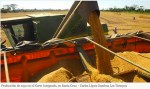 As of September 2012, Bolivia exported 82 percent more to the market of the Andean Community of Nations (CAN) than to the block of the South common market (Mercosur) in the manufacturing category, according to data from the Bolivian Institute of Foreign Commerce (IBCE).
Thus, from January to September, Bolivia exported to Mercosur the equivalent of 157 million dollars in manufactured products; While towards the market of CAN, Bolivia exported the equivalent of 887 million dollars.
The protectionist policies of Brazil and Argentina have prevented that Bolivia can sell them manufactured goods, which are the main generators of Bolivian employment, noted economic analyst Julio Alvarado.
Among the main manufactured products exported to the Andean market (Peru, Bolivia, Colombia and Ecuador) are the oil of soybean, sunflower, soybean, ethyl alcohol and prepared meals.
According to the document of the Andean entrepreneurial meeting, carried out by the CAN last March, trade among the Andean countries reached the figure record of 9,187 billion dollars, in 2011,
In the case of Bolivia, the paper quotes data from the National Institute of Statistics (INE) that indicate that, in 2011, of the total of Bolivian exports to the Andean market, 62.2 percent corresponds to manufactured goods. The main were soy oil and its derivatives ($262 million), sunflower ($37 million) oil, bean and soy flour (26 million), food preparations of fats or oils (6 million dollars) and ethyl alcohol (five million).
On the other hand, exports to Mercosur (Brazil, Argentina, Paraguay and Uruguay), in the first nine months of the year, were about $ 4 million of which 84 per cent correspond to natural gas and 16 per cent to manufacturing.
They are difficult negotiations
Negotiations so that Bolivia can be a full member of Mercosur without having to leave the CAN will be very complex, according to former diplomat Alberto Zelada Castedo.
Zelada explains that the legal system of both blocks is based on a customs union, making it inconsistent that a state associated with a block may be part of another. “Bolivia can be member of multiple zones of free trade (such as MERCOSUR);” but you can only be a member of a customs union.
Mercosur could not make exceptions with Bolivia, he said, since another partner country could claim founded in which a rule among the States member is non-discrimination. Regarding the CAN, its legal system is even more strict and if Bolivia wants to initiate negotiations with Mercosur, must officially inform and manage permission to do so under the conditions that the Andean bloc may impose.
Pagina Siete also reports on this important matter, an excerpt follows:
This year the country exported 900 million dollars to the CAN
CAO said that the soy market is in jeopardy due to admission to Mercosur
BARRIERS according to producers, in the CAN not governed no restriction for “gold grain” and their derivatives; in Mercosur, there are quotas and phytosanitary measures.

The Agricultural Chamber of the East (CAO) yesterday warned that the accession of Bolivia to Mercosur will put at risk or danger 900 million dollars of exports of soy without hindrance to the Andean Community of Nations (CAN).
The President of the business organization, Julio Roda, reported that the agricultural sector is concerned due to the announcement of the Government to promote the full integration of the country into the block comprised of Brazil, Argentina, Paraguay, Uruguay and Venezuela.
He said that today the Bolivian soy does not have any restrictions, quota or duty payment in the Andean Community of Nations (CAN), but in the Mercosur, there is the risk that the country is subject to limits of export, taxes or customs charges and plant-protection barriers or quasi-tariff measures,
Furthermore, the CAO believes that Bolivian producers are at a disadvantage in aspects of technology, productivity and costs against Brazil or Argentina, which we will have to compete to.
“These countries are monsters in the production of soy, have technology, machinery and the country still can not boost transgenic;” “that is why we should look seriously at the entry to Mercosur, we could lose the CAN”, said Roda.
The employer stated that recently there was a requirement for Brazil to import soybeans and procedures were made, but domestic production did not comply with the plant-protection measures. Subsequently there was a temporary exception and only a minimum volume could thus be sent.
…
http://www.paginasiete.bo/2012-11-29/Economia/Destacados/10Eco00129-01.aspx

 Bolivian Thoughts | Pensamientos Bolivianos (Bilingual/Bilingüe)