By Windsor Hernani, Vision 360:
Exporting Water to Chile: Bottled Silala Water? It Wouldn’t Be the First Time
The diplomatic corps represents the State, not the government of the day; it pursues state objectives, not personal ones; and it is guided by the national interest, not by private or group interests.
In recent days, Bolivia’s consul general in Santiago, Chile, has appeared in several media outlets to explain the scope of the meeting between the presidents of Bolivia and Chile, as well as the prospects for a new stage in bilateral relations.
During an interview with journalist Mery Vaca, when asked about the management of transboundary water resources, the newly appointed consul replied: “I feel that Bolivia has a lot of water, while the mining industry and Chile have very little water.” Consequently, he proposed that “Bolivia should EXPORT water to Chile.”
The interviewer’s reaction was spontaneous and telling. She responded: “Export water to Chile. That’s the first time I’ve heard it put that way (…)”
Personally, the answer left me bewildered. I thought unusual ideas were a thing of the past. I believed that so-called people’s diplomacy was merely a bad memory, and that the aspiration to project a new image of Bolivia to the world, and of the world to Bolivia, would put an end to wishful thinking, improvisation, and outlandish ideas that would never materialize.
I was wrong. It is always possible to revive an idea from the past, give it a new twist, make it just as unusual—or even more so—and present it as something new.
Let us remember that in June 2014, President Evo Morales Ayma came up with the idea of industrializing Silala water on a small scale as a way of demonstrating ownership of the resource.
The first and only production run yielded 42,000 bottles of Silala water, which were distributed during the G77 plus China Summit. The initiative was presented as an expression of national sovereignty and dignity.
Later, there was talk of continuing the venture and marketing Silala water in bottles.
Why did that initiative never become a regular distribution business? I do not know, although I believe production costs were excessive. What I do know is that a revamped version has now emerged.
I assume the proposal is no longer about bottling Silala water, but rather exporting larger quantities of water through pipelines. Apparently, this would involve some or all of the waters of the Bolivian Altiplano, since the consul claims the region has abundant supplies.
This raises further questions. Is the Bolivian Altiplano really a water-rich region? Does lithium extraction not threaten to leave Indigenous communities in Bolivia without water?
Bolivia’s 1980–2020 Water Balance, published in 2024 by the Ministry of Environment and Water, highlights the vulnerability of this region. It receives an average annual precipitation of 330 millimeters and has runoff of just 25 millimeters, compared with 550 millimeters of runoff in the Amazon basin.
Against this backdrop, the proposal raises several questions: What specific water source would be used? Would it be limited to the border area or involve the entire Altiplano? How would the water be transported—through pipelines, pumping systems, tanker trucks, or artificial canals? How much would the infrastructure cost? What net benefit would Bolivia receive? Or, ultimately, is this simply water that naturally flows into Chile and would now be measured and sold?
Furthermore, it is necessary to understand how Chile applies customs duties to this product. At first glance, there is good news: Bolivian-origin water, in its various forms, enters Chile with a 100% tariff preference under Economic Complementation Agreement No. 22 (ACE No. 22).
The truth is that the consul did not go into detail. The proposal was explained only briefly. It would therefore be appropriate to provide more information so that the public can understand precisely what this business of “exporting water to Chile” actually entails.
Ultimately, I believe the interviewer’s question touched on another issue—one that is far from minor and is, in fact, of the utmost importance. More broadly, she was seeking to establish what the Bolivian State has done in its dealings with the Chilean State regarding the integrated management of existing transboundary water basins.
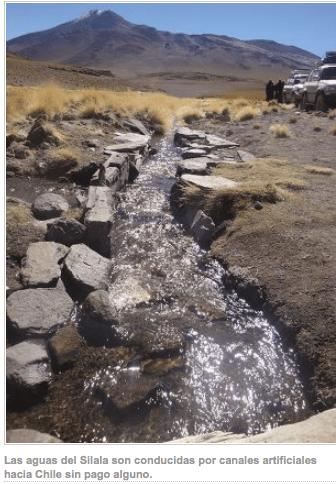
More specifically, it is also important to know what happened to Silala water after Bolivia’s representatives acknowledged before the International Court of Justice (ICJ) that it constitutes an international watercourse. This issue remains unresolved in the eyes of the Bolivian public, which deserves to know how it will be addressed. Following the Court’s ruling, both Bolivia and Chile are entitled to an equitable and reasonable use of the resource. Yet, to date, only the neighboring country has benefited from its use.
The diplomatic corps represents the State, not the government of the day; it pursues state objectives, not personal ones; and it is guided by the national interest, not by private or group interests. That is why it does not improvise. Every action it takes puts the State’s credibility and standing before the international community at stake.
Por Windsor Hernani Limarino, Vision 360:
Exportar agua a Chile: ¿el silala embotellado? No sería la primera vez
El cuerpo diplomático representa al Estado, no al gobierno de turno; persigue objetivos estatales, no personales; y se guía por el interés nacional, no por intereses particulares o de grupo.
En los últimos días, el cónsul general de Bolivia en Santiago de Chile, ha recorrido varios medios de comunicación para explicar los alcances del encuentro realizado entre los mandatarios de Bolivia y Chile; y las perspectivas de la nueva etapa de la relación bilateral.
En una entrevista con la periodista Mery Vaca, ante la consulta sobre el manejo de los recursos hídricos transfronterizos, la flamante autoridad consular respondió: “Siento que Bolivia tiene mucha agua; y la minería y Chile tiene muy poca agua”; consecuentemente propuso que: “Bolivia debería EXPORTAR agua a Chile”.
La reacción de la entrevistadora fue espontánea y elocuente. Replicó: “Exportar agua a Chile. Es la primera vez que lo escucho en esos términos (…)”.
En lo personal, la respuesta me dejó desconcertado. Pensé que las ideas inusuales habían quedado atrás. Que la llamada diplomacia de los pueblos era solo un mal recuerdo; y que aquella aspiración de proyectar una nueva imagen de Bolivia al mundo y del mundo en Bolivia vendría a desterrar el voluntarismo, la improvisación y las insólitas ideas que nunca se concretarán.
Me equivoqué. Siempre es posible recuperar una idea del pasado, para hacer una nueva versión. Tan insólita o más que la anterior y ofrecerla como novedad.
Recordemos que, en junio de 2014, el presidente Evo Morales Ayma, tuvo la ocurrencia de industrializar, a mínima escala, las aguas del Silala y así mostrar la propiedad sobre el recurso.
La primera y única producción generó 42.000 botellas de agua del Silala, las cuales fueron distribuidas durante la Cumbre del G77 más China. Lo hecho fue presentado como una expresión de soberanía y dignidad nacional.
Posteriormente, se habló de seguir con el emprendimiento y comercializar las aguas del Silala en botella.
¿Por qué aquella iniciativa no se convirtió en un negocio de distribución regular? No lo sé, creo que el costo de producción era excesivo. Lo que sí sé es que ahora aparece una versión renovada.
Supongo, que ya no se trata de embotellar el agua del Silala, sino de una exportación de agua, en mayor cantidad por ducto. Aparentemente, involucraría parte o todas las aguas del altiplano, ya que según la autoridad, es abundante.
Ahí, surgen nuevas dudas. ¿Acaso el Altiplano boliviano es una región de abundancia hídrica? ¿Acaso la extracción de litio no amenaza con dejar sin agua a comunidades indígenas de Bolivia?
El balance hídrico de Bolivia 1980-2020, publicado en 2024 por el Ministerio de Medio Ambiente y Agua, muestra la vulnerabilidad de esta región. Tiene una precipitación media anual de 330 milímetros y un escurrimiento de 25 milímetros, frente a los 550 milímetros de escurrimiento de la cuenca amazónica.
En ese marco, la iniciativa trae consigo varias preguntas como: ¿qué fuente concreta de agua se pretende utilizar?, ¿será solo en la zona fronteriza o todo el Altiplano?, ¿habrá transporte de agua: mediante tuberías, bombeo, cisternas o canales artificiales?, ¿cuánto costaría la infraestructura?, ¿qué beneficio neto recibiría Bolivia?; o al final, ¿se trata solo del agua que de manera natural discurre a Chile y que ahora será cuantificada y vendida?
Es más, es necesario saber qué tratamiento aduanero da Chile al producto. En principio, hay buenas noticias, el agua de origen boliviana, en sus diversas formas, ingresa a Chile con una preferencia arancelaria del 100%, en el marco del ACE N.º 22.
La verdad, es que la autoridad no entró en detalles. La iniciativa fue explicada de manera breve, consecuentemente sería apropiado brindar mayor información y conocer con propiedad en qué consiste el negocio de: ¡exportar agua a Chile!
Al final, creo que la pregunta formulada por la entrevistadora abordaba un otro tema, no menor, al contrario de la mayor y absoluta relevancia. En lo global, pretendía indagar qué ha hecho el Estado boliviano frente al Estado chileno, en la gestión integrada de las cuencas hídricas transfronterizas existentes.
En lo específico, saber también que sucedió con las aguas del Silala, luego de que la representación boliviana reconociera ante la CIJ su carácter de curso de agua internacional. Tema pendiente que los bolivianos merecen conocer como se resolverá; ya que, tras el fallo, tanto Bolivia y Chile tiene derecho a un uso equitativo y razonable del recurso; sin embargo, hasta la fecha, solo el país vecino se beneficia de su aprovechamiento.
El cuerpo diplomático representa al Estado, no al gobierno de turno; persigue objetivos estatales, no personales; y se guía por el interés nacional, no por intereses particulares o de grupo. Por eso, no improvisa, en cada una de sus actuaciones está en juego la fe del Estado y la credibilidad del país ante la comunidad internacional.


Leave a Reply