By El Diario:
In its 88 years of existence
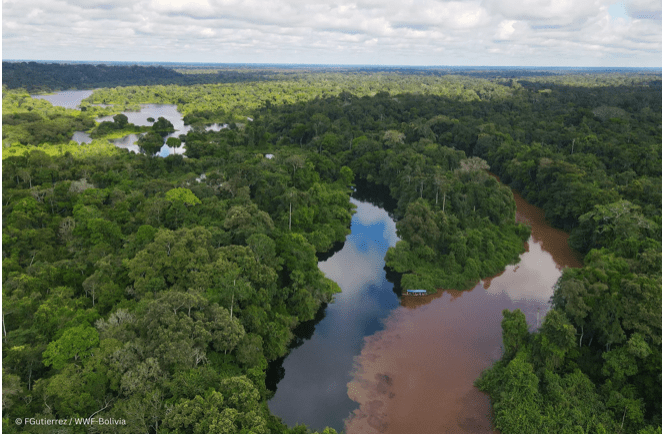
Pando has just over 134,000 inhabitants, but its strategic location in the Bolivian Amazon makes the department an important hub for cross-border economic activity.
Its population, exports, and commercial exchange with Brazil reflect the characteristics of an economy shaped by Amazonian resources and its connection to the Brazilian market.
According to the results of the 2024 Population and Housing Census, Pando has 134,194 inhabitants. Men account for 52.8% of the population and women 47.2%, while nearly two-thirds of residents (64.3%) are between 15 and 64 years old.
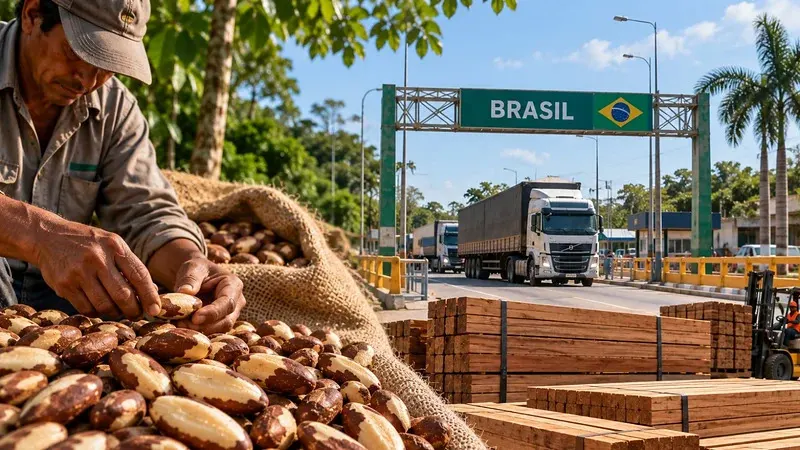
The Brazil nut industry is one of the main drivers of Pando’s economy. In 2025, the department exported products worth US$49.3 million, according to data from Bolivia’s National Statistics Institute (INE) processed by the Bolivian Institute of Foreign Trade (IBCE).
Of that total, approximately US$38.9 million came from exports of shelled Brazil nuts, a product that accounted for nearly 79% of the value of Pando’s foreign sales during the year. Profiled wood and sawn timber also ranked among the department’s main exports, although with a smaller share.
Export destinations show that Pando’s production is not dependent solely on neighboring countries.
The United States was the leading buyer of products from Pando in 2025, importing approximately US$17.1 million worth of goods. Brazil, by contrast, imported about US$1.04 million, equivalent to 2.11% of the department’s total exports.
Brazil’s importance to Pando becomes much clearer when looking at trade flows in the opposite direction.
Between 2010 and 2023, Brazil accounted for approximately 70% of the department’s cumulative imports, according to IBCE data. This reflects the significant role the neighboring country plays as a supplier within the border economy.
The commercial relationship is also linked to the proximity between Cobija and the Brazilian cities of Brasiléia and Epitaciolândia.
In this border region, there is a constant flow of people, goods, and services, forming part of the department’s everyday economic dynamics.
The figures therefore portray Pando through three dimensions: a population of 134,194 inhabitants, an export economy strongly tied to Brazil nuts, and cross-border commercial activity in which Brazil plays an important role, especially as a supplier to the local market.
HISTORY
On September 24, 1938, Bolivia officially incorporated Pando as its ninth department. The law enacted by President Germán Busch created the new political entity from the former National Territory of Colonies, located in an Amazonian region bordering Brazil and Peru.
The decision had a clear geopolitical purpose. Decades earlier, northern Bolivia had been the scene of the Acre dispute, driven by the rubber boom and the weak presence of the state in a vast and difficult-to-access region. Following the Treaty of Petrópolis in 1903, which redefined the border with Brazil, the need to strengthen Bolivian administration in the Amazon remained a permanent concern.
The territory that would later become Pando had been organized in 1900, during the administration of José Manuel Pando, as the National Territory of Colonies. Thirty-eight years later, Busch’s government decided to elevate it to departmental status in order to grant it greater political importance and encourage demographic and economic growth.
The new department was named Pando in honor of former President José Manuel Pando, an explorer of Bolivia’s northwest and a key figure in the country’s defense during the Acre conflict.
The law established four provinces—Tahuamanu, Abuná, Manuripi, and Madre de Dios—and initially designated Puerto Rico as the capital. Cobija did not receive that status until September 29, 1945.
Thus, in 1938, a region that had previously been administered as a national territory gained departmental status. Pando was born from the need to strengthen administration, integration, and Bolivia’s presence along its Amazonian frontier. (With information from Red Uno and El Diario.)
Por El Diario:
En sus 88 años de existencia
Pando tiene poco más de 134.000 habitantes, pero su ubicación estratégica en la Amazonía boliviana convierte al departamento en un punto importante para la actividad económica de frontera.
La población, las exportaciones y el intercambio comercial con Brasil muestran las características de una economía marcada por los recursos amazónicos y su conexión con el mercado brasileño.
Según los resultados del Censo de Población y Vivienda 2024, Pando cuenta con 134.194 habitantes. El 52,8% corresponde a hombres y el 47,2% a mujeres, mientras que casi dos tercios de la población, el 64,3%, se encuentra entre los 15 y 64 años.
La economía pandina tiene en la castaña uno de sus principales motores. Durante 2025, el departamento exportó productos por un valor de $us 49,3 millones, de acuerdo con datos del Instituto Nacional de Estadística (INE) procesados por el Instituto Boliviano de Comercio Exterior (IBCE).
De ese total, aproximadamente $us 38,9 millones correspondieron a la exportación de castaña sin cáscara, producto que concentró cerca del 79% del valor de las ventas externas de Pando durante esa gestión. La madera perfilada y la madera aserrada también aparecen entre los principales productos enviados al exterior, aunque con una participación menor.
Los mercados de destino muestran que la producción pandina no depende exclusivamente de los países vecinos.
Estados Unidos fue el principal comprador de productos de Pando en 2025, con exportaciones por aproximadamente $us 17,1 millones. Brasil, en cambio, recibió productos pandinos por alrededor de $us 1,04 millones, equivalentes al 2,11% del total exportado.
La importancia de Brasil para Pando aparece con mayor claridad cuando se observa el flujo en sentido contrario.
Entre 2010 y 2023, Brasil concentró aproximadamente el 70% de las importaciones acumuladas del departamento, según información del IBCE. Esto refleja el peso que tiene el país vecino como proveedor dentro de la economía fronteriza.
La relación comercial está vinculada también con la cercanía entre Cobija y las ciudades brasileñas de Brasiléia y Epitaciolândia.
En esta zona fronteriza existe un movimiento constante de personas, bienes y servicios, que forma parte de la dinámica económica cotidiana del departamento.
Así, las cifras permiten retratar a Pando desde tres dimensiones: una población de 134.194 habitantes, una economía exportadora fuertemente vinculada a la castaña y una actividad comercial fronteriza en la que Brasil ocupa un lugar importante, especialmente como proveedor de productos para el mercado pandino.
HISTORIA
El 24 de septiembre de 1938, Bolivia incorporó oficialmente a Pando como su noveno departamento. La ley promulgada por el presidente, Germán Busch, creó la nueva unidad política sobre el antiguo Territorio Nacional de Colonias, en una región amazónica fronteriza con Brasil y Perú.
La decisión tenía un marcado propósito geopolítico. El norte boliviano había sido escenario, décadas antes, de la disputa por el Acre, impulsada por el auge de la goma y por la débil presencia estatal en una zona extensa y de difícil comunicación. Tras el Tratado de Petrópolis de 1903, que redefinió la frontera con Brasil, la necesidad de consolidar la administración boliviana en la Amazonía quedó como una preocupación permanente.
El territorio que daría origen a Pando había sido organizado en 1900, durante el gobierno de José Manuel Pando, como Territorio Nacional de Colonias. Treinta y ocho años después, el gobierno de Busch decidió elevarlo a departamento para darle mayor jerarquía política y favorecer su crecimiento demográfico y económico.
El nuevo departamento recibió el nombre de Pando en homenaje al expresidente José Manuel Pando, explorador del noroeste y protagonista de la defensa boliviana durante el conflicto del Acre.
La ley estableció cuatro provincias: Tahuamanu, Abuná, Manuripi y Madre de Dios, y fijó inicialmente a Puerto Rico como capital. Cobija obtuvo esa condición recién el 29 de septiembre de 1945.
Así, en 1938, una región administrada hasta entonces como territorio nacional adquirió rango departamental. Pando nació de la necesidad de fortalecer la administración, la integración y la presencia boliviana en su frontera amazónica. (Con datos de la RedUno y EL DIARIO)


Leave a Reply