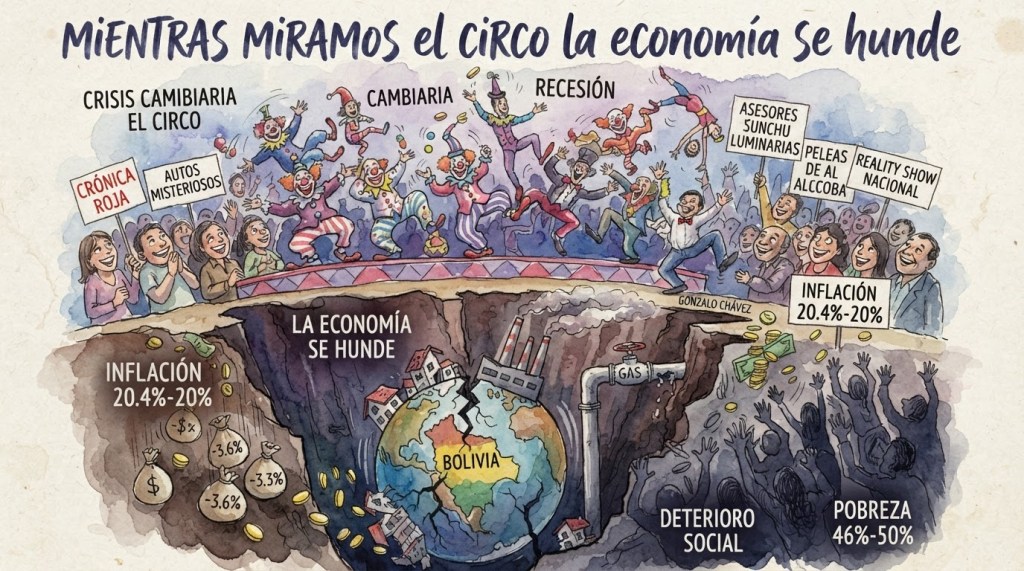
By Renzo Abruzzese, Brujula Digital:
Over the past few months, and especially throughout the 53 days of blockades, we have witnessed a staggering level of governmental ineffectiveness that made it clear—to everyone involved—that the government is not in a position to restore order, much less confront an uprising like the one seen during those 53 days.
The question now is whether the wave of tensions and conflicts that will be unleashed by the removal of the diesel subsidy can be properly managed by the government; undoubtedly, uncertainty looms on all sides.
For many, the government is not capable of withstanding another assault from MAS-aligned forces and the entire array of anti-democratic groups and factions that have regrouped. There is little doubt that the government’s discourse of “dialogue,” used to mask its weaknesses, has only succeeded in weakening democracy and pushing it to the limits of its survival. Added to this is the fact that political mistakes have ultimately eroded public confidence in institutions and in the government itself, which appears to drift through an ocean of superfluous rhetoric.
As a result of this way of managing the state, Bolivian democracy is undergoing an accelerated process of progressive disintegration. The real risk is not a classic twentieth-century-style coup d’état, but rather the establishment of a government in which the rules of the democratic game are hollowed out from within—a better planned and more efficient version of what was experienced during the era of evismo.
This not only diminishes the government’s political and operational capacity; it also acts like a boomerang whereby, in direct proportion, the greater the incompetence, the stronger the tensions become, leading to an increase in internal mistakes. It is there that the fate of a government is ultimately decided—a government that seems to move blindly, with little intention of finding a historical course that would allow it to consolidate democratic reconstruction.
When state authority fails, conflicts leave the official negotiating tables and take over public spaces; politics is carried out in the streets, with highways and public squares becoming the only mechanisms of negotiation. In reality, these obsolete ways of doing politics hijack democratic values and revive the power dynamics of past dictatorships.
Managing affairs as the government has been doing means operating at the very edge of the democratic pact, since one never knows which side it is ultimately on: whether it stands in favor of democracy or seeks accommodation with its detractors. Added to this is the fact that everything seems to boil down to eloquent speeches lacking practical meaning. Repeating a word three times does not create a message—it only sounds like empty rhetoric.
We are therefore approaching a decisive moment in the process of democratic reconstruction, hemmed in by government mistakes and the coordinated actions of anti-democratic forces strongly allied from the Chapare region. One can only hope that those in power fully understand the historical significance of this moment.
Renzo Abruzzese is a sociologist.
Por Renzo Abruzzese, Brujula Digital:
Hemos experimentado en los últimos meses, y sobre todo a lo largo de los 53 días de bloqueo, una pasmosa inoperancia gubernamental que dejó claro –para todos los involucrados– que el gobierno no está en condiciones de poner las cosas en su lugar y menos de afrontar una asonada como la de los 53 días.
La duda estriba ahora en saber si la ola de tensiones y conflictos que desatará el levantamiento de la subvención al diésel podrá ser adecuadamente manejada por el gobierno; sin duda, las incógnitas acechan por todos lados.
Para muchos, el gobierno no está en condiciones de soportar otro embate de las fuerzas masistas y todo el bagaje de grupos y fracciones antidemocráticas que se han rearticulado. No cabe duda alguna de que el discurso del “diálogo” que utiliza el gobierno para cubrir sus debilidades, lo único que ha logrado es debilitar la democracia y ponerla al límite de sus posibilidades de sobrevivencia, a lo que se suma el que los errores políticos terminaron erosionando la confianza ciudadana en sus instituciones y en el propio gobierno, que parece divagar en un océano de discursos superfluos.
Producto de esta manera de manejar el Estado, la democracia boliviana atraviesa un proceso acelerado de desestructuración progresiva. El riesgo real no es un golpe de Estado clásico al estilo del siglo XX, sino la puesta en marcha de un gobierno donde las reglas del juego democrático se vacían por dentro, en una versión mejor planificada y más eficiente de la que vivimos con el evismo.
Esto no solo merma capacidad política y operativa al gobierno; actúa como un bumerán donde, de forma proporcional, a mayor ineptitud, mayor fuerza adquieren las tensiones, lo que deriva en un incremento de los errores internos. Es ahí donde finalmente se dirimen los avatares de un gobierno que parece moverse a tientas y sin la más mínima intención de encontrar un derrotero histórico que le permita consolidar la reconstrucción democrática.
Cuando el poder del Estado fracasa, los conflictos abandonan las mesas de diálogo oficiales y se posesionan del espacio público; la política se ejerce en las calles, con las carreteras y las plazas como único mecanismo de negociación. En realidad, estas formas noegésimas de hacer política secuestran los valores democráticos y reactualizan el poder de las dictaduras del pasado.
Manejar las cosas como lo ha estado haciendo el gobierno supone operar al límite del pacto democrático en tanto y en cuanto nunca sabes de qué lado finalmente está: si a favor de la democracia o conciliando con sus detractores, a lo que se suma que todo parece resumirse a discursos elocuentes pero faltos de sentido práctico. Repetir tres veces una palabra no hace mensaje y suena a discurso vacío.
Nos aproximamos, pues, a un punto culminante del proceso de reconstrucción democrática, cercado por los errores del gobierno y el accionar concertado de las fuerzas antidemocráticas fuertemente coaligadas desde el Chapare. Ojalá los gobernantes tengan claras las dimensiones históricas de este momento.
Renzo Abruzzese es sociólogo.


Leave a comment