By Los Tiempos:
Unresolved Scandals Damage Paz and the Government’s Image
 Image of the suitcases at Viru Viru Airport, whose contents and destination remain unknown ten months later. | Social Media
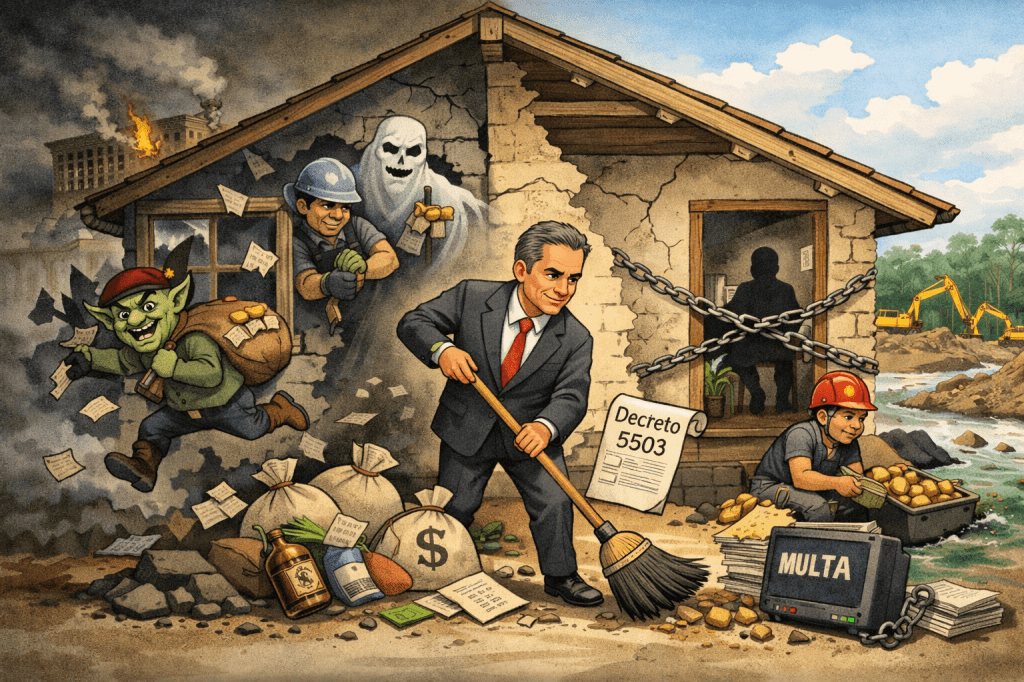
No government since Bolivia’s return to democracy in 1982 has begun its administration as poorly—or accumulated so many problems in its first nine months in office—as that of President Rodrigo Paz.
The number of corruption allegations, investigations, scandals, and irregular incidents continues to grow by the day.
Substandard gasoline, former minister José Espinoza’s Audi vehicle, gold trafficking, the suitcase and timber cases, arms trafficking, accusations against officials of the National Health Fund (CNS), the scandal involving Argentine adviser Fernando Cerimedo’s presence within the government structure, and others.
Yet instead of responding swiftly to neutralize allegations or demonstrate to the public a genuine intention to investigate and establish accountability, the government has generated uncertainty and public rejection.
Four of these cases—the suitcases, gold trafficking, arms smuggling, and Cerimedo—share one thing in common: they are severely damaging the image of both the government and President Rodrigo Paz. A recent Ciesmori survey revealed a drop in the president’s popularity, from 65% during his first months in office to 21% in August of this year.
An interesting detail is that all four cases are, in one way or another, connected to Viru Viru Airport in Santa Cruz.
The 32 suitcases whose contents and whereabouts remain unknown arrived at Viru Viru.
The shipment of weapons for which police have still not provided information regarding origin, destination, or ownership also arrived at Viru Viru.
The 189 kilograms of gold that a young man attempted to take from Bolivia to Dubai were seized at Viru Viru.
Finally, Fernando Cerimedo, adviser to President Rodrigo Paz, was arrested at Viru Viru. Whether he was arriving from La Paz to Santa Cruz or attempting to leave for Argentina at the time of his detention has yet to be clarified.
According to Miroslava Fernández, journalist and political analyst, the apparent paralysis of the justice system and the lack of prosecutorial results have turned cases as serious as the 32 suitcases, gold smuggling, and the Cerimedo affair into major scandals.
“All these events follow a pattern of opacity, inaction, and impunity that appears to protect those who circulate close to power,” Fernández said.
The Suitcase Case
On November 29, 2025, a private aircraft arriving from the United States brought 32 suitcases to the city of Santa Cruz. The owner of the luggage was former lawmaker Laura Rojas. Also on board were Uruguayan citizen Gabriel Giuliano Leoni and two minors.
What is striking is that when the luggage was unloaded, no official at Viru Viru Airport attempted to verify its contents—a mystery that remains unresolved nearly a year later.
Rojas allegedly used a diplomatic passport, which had already expired at the time, to avoid inspections.
The suitcases remained at customs for several days before being moved out of the airport to facilities belonging to a security company linked to former judge Hebert Zeballos. There, they disappeared.
Adding to the controversy, during a search of Zeballos’s property, police discovered a shipment of marijuana.
Only a few weeks ago, both Rojas and Zeballos, who had been held in preventive detention, were granted house arrest without a clear explanation from authorities.
To this day, the contents and destination of the suitcases remain unknown.
What Was Inside the Suitcases?
Numerous theories circulated regarding the contents of the luggage, including cash, drugs, weapons, and other goods. None of these hypotheses has been confirmed by the authorities investigating the case.
From the outset, the Paz administration maintained that the case should be investigated and that no one should be above the law. Interior Minister Marco Antonio Oviedo stated that the executive branch demanded transparency and that responsibility should be determined through investigation.
Political analyst Gonzalo Mendieta questioned the lack of explanations in an interview with a media outlet in La Paz. He argued that, in the absence of substantive information, society is left with no choice but to speculate, imagining everything from the most serious scenarios to the most innocent.
He also criticized both the government and the prosecutor’s office for failing to provide an adequate explanation regarding the case and subsequent judicial decisions.
The latest development was a report produced by a legislative commission, which the Chamber of Deputies unanimously rejected on the grounds that it was insufficient and lacked objectivity. One member of the commission acknowledged that no independent investigation had been conducted and that testimony from the main suspects had not been obtained.
Missteps
According to Fernández, these early mistakes reflect “a profound disconnect between rhetoric and the actual exercise of power,” where President Rodrigo Paz allegedly allowed Cerimedo to operate as “an unchecked abuser with delegated authority” within the cabinet.
“Additionally, the government made the strategic mistake of delegating its digital governance and public opinion management to post-truth tools (such as bot farms and fake profiles discovered in La Paz) in order to simulate fictitious social support through astroturfing, instead of building real legitimacy on the streets and through institutions, despite having all the advantages of being in government,” the analyst said.
When the criminal attack against Nadia Beller occurred, the executive branch mistakenly applied a “strategy of silence” in an attempt to distance itself and frame the incident as strictly a domestic matter.
“However, silence in situations of extreme gravity produces a boomerang effect that suggests weakness, instability, or a lack of honor, accelerating the president’s political erosion,” Fernández concluded.
Distrust
For Fernández, the accumulation of unresolved scandals is dragging the rest of the state institutions into an abyss of distrust and degradation.
“We are witnessing the total discrediting of the National Police and the Ministry of Government with revelations that the head of intelligence at FELCN, Erick Correa Gonzales (‘ECG’), monitored the scene of the attack against Nadia Beller and reported developments minute by minute to a foreign consultant, exposing how state intelligence apparatuses were diverted from their constitutional mandate and turned into instruments of private security and concealment,” she said.
According to Fernández, this loss of credibility also extends to the Legislative Assembly, citing allegations of payments to 28 lawmakers and questionable dealings involving Paz’s family circle.
Consequences
The gold, suitcase, and weapons cases are affecting other branches of government. What could the consequences be?
Fernández answers:
“I could envision two negative scenarios: an implosion within the executive branch due to this ‘invisible government,’ and a constitutional impeachment trial. There are de facto powers without formal representation that allegedly directed the fundamental decisions of the state.”
Regarding audio recordings presented by Edmand Lara, Fernández argues that they could increase pressure to expand the State of Emergency because of the possibility of a new phase of conflict.
“They may be seeking the resignation of the president, with Vice President Lara assuming the presidency constitutionally, which would mark the definitive end of the current administration,” the analyst concluded.
As time passes, the outlook continues to worsen for the government, with several sectors announcing plans to take to the streets—or already doing so—to challenge the state of emergency.
Por Los Tiempos:
Escándalos irresueltos dañan la imagen de Paz y el Gobierno
Imagen de las maletas en Viru Viru cuyo contenido y destino se deconocen, diez meses después. | RRSS
Ningún Gobierno, desde la conquista de la democracia en Bolivia en 1982, empezó tan mal su gestión hasta arrastrar tal cantidad de problemas en sus primeros nueve meses de gestión como el del presidente Rodrigo Paz.
La cantidad de denuncias de corrupción, investigaciones, escándalos y hechos irregulares suman día que pasa.
Gasolina basura, el auto Audi del exministro José Espinoza, tráfico de oro, casos maletas y maderas, tráfico de armas, denuncias en contra funcionarios de la Caja Nacional de Seguridad (CNS), escándalo por la presencia del asesor argentino Fernando Cerimedo en el esquema de Gobierno y otros.
Pero en lugar de una rápida reacción del Gobierno para neutralizar la denuncia o para mostrar a la población que tiene la intención de investigar el caso y establecer responsabilidades, el Gobierno desata incertidumbres y genera rechazo ciudadano.
Cuatro de estos casos (maletas, tráfico de oro, contrabando de armas y Cerimedo) tienen en común que están deteriorando gravemente la imagen del Gobierno y del presidente Rodrigo Paz. Una reciente encuesta de Ciesmori reveló una caída de la popularidad del Presidente, desde el 65% en los primeros meses de gestión hasta el 21% en agosto de este año.
Un detalle interesante es que, de alguna manera, los cuatro casos mencionados pasan por el aeropuerto cruceños de Viru Viru.
Al aeropuerto de Viru Viru llegaron las 32 maletas de las que aún no se conoce su contenido ni su paradero.
Al Viru Viru llegó el cargamento de armas del que tampoco la Policía ha dado un informe sobre su procedencia, destino o propietario.
En Viru Viru incautaron los 189 kilos de oro que un joven pretendía sacar de Bolivia rumbo a Dubái.
Finalmente, en Viru Viru fue arrestado Fernando Cerimedo, asesor del presidente Rodrigo Paz. La circunstancia sobre sí estaba llegando de la ciudad de La Paz a Santa Cruz o si pretendía salir rumbo a Argentina en el momento que fue aprehendido, aún no fue esclarecida.
Para Miroslava Fernández, periodista y analista política, la aparente parálisis de la justicia y la falta de resultados procesales terminan en escándalos tan graves como el de las 32 maletas o el contrabando de oro o el propio caso Cerimedo.
“Todos estos hechos responden a un patrón de opacidad, inacción e impunidad que parece proteger a quienes pululan cerca del poder”, dijo Fernández.
Caso maletas
El 29 de noviembre de 2025 un avión privado, procedente de Estados Unidos, trajo hasta la ciudad de Santa Cruz 32 maletas. La propietaria de las valijas es la exdiputada Laura Rojas. En el vuelo también estaba presente el ciudadano uruguayo Gabriel Giuliano Leoni y dos menores.
Lo llamativo es que al momento del descargo de las maletas, ningún funcionario del aeropuerto de Viru Viru intentó establecer el contenido de la maletas, misterio que hasta hoy, casi un año después, aún no se ha esclarecido.
Laura Rojas habría utilizado un pasaporte diplomático (ya fenecido en ese momento), para evitar los controles.
Las maletas permanecieron varios días en la Aduana y luego fueron trasladadas fuera del aeropuerto hasta dependencias de una empresa de seguridad vinculada al exjuez Hebert Zeballos. Allí desaparecieron.
A esto se suma que durante una requisa a la propiedad del exjuez Zeballos la Policía halló un cargamento de marihuana.
Hace pocas semanas tanto Rojas como Zeballos, detenidos preventivamente, se beneficiaron con detención domiciliaria sin una explicación clara de parte de las autoridades.
Hasta el día de hoy, se desconoce el contenido y destino de las maletas.
Contenido de las maletas
Varias versiones circularon sobre el contenido de las maletas, desde dólares, droga, armas y otros bienes. Ninguna de esas hipótesis fue avalada por las autoridades que investigan el caso.
Desde el inicio, el Gobierno de Paz sostuvo que el caso debía investigarse y que nadie debía estar por encima de la ley. El ministro de Gobierno, Marco Antonio Oviedo, afirmó que el Ejecutivo exigía transparencia y que las responsabilidades debían establecerse mediante la investigación.
El analista político Gonzalo Mendieta cuestionó, en un medio de La Paz, el vacío de explicaciones. Dijo que, ante la falta de información de fondo, la sociedad queda obligada a “conjeturar” y termina imaginando desde las hipótesis más graves hasta las más inocentes.
También cuestionó que ni el Gobierno ni la Fiscalía hayan dado una explicación suficiente sobre el caso y las decisiones judiciales.
Lo último que supo del caso es el informe de una comisión de asambleístas que la Cámara de Diputados rechazó por unanimidad al considerar que el documento era insuficiente y carecía de objetividad. Un integrante de la propia comisión reconoció que no se realizó una investigación propia ni se logró obtener la declaración de los principales sindicados.
Desaciertos
Estos desaciertos tempranos responden a “una profunda desconexión entre la retórica y la práctica de poder, donde el presidente Rodrigo Paz, por ejemplo, habría permitido que Cerimedo actuara como un “abusivo sin control, con poder delegado” dentro de su gabinete. Recordemos artículos de prensa de meses pasados al respecto”, anotó Fernández.
“Adicionalmente, el gobierno cometió el error estratégico de delegar su gobernabilidad digital y el modelado de la opinión pública a herramientas de posverdad (como las granjas de bots” y perfiles falsos hallados en La Paz) para simular un apoyo social ficticio (técnica del astroturfing), en lugar de construir legitimidad real en las calles y con las instituciones, aprovechando que tienen “el sartén por el mango” como gobierno”, refirió la analista.
Al estallar la crisis del atentado criminal (contra Nadia Beller) el Ejecutivo aplicó de forma errada la “técnica del silencio” para intentar distanciarse y encasillar el hecho como un asunto estrictamente de pareja. “Sin embargo, el silencio en situaciones de alta gravedad produce un efecto bumerán que “sugiere debilidad, inestabilidad o falta de honor”, acelerando el desgaste del presidente, concluyó Fernández.
Desconfianza
Para Fernández, la acumulación de estos escándalos sin resolver está arrastrando al resto de las instituciones del Estado a un abismo de desconfianza y degradación.
“Vemos el desprestigio total de la Policía Nacional y el Ministerio de Gobierno con la revelación de que el jefe de Inteligencia de la Felcn, Erick Correa Gonzales (“ECG”), monitoreaba la escena del atentado de Nadia Beller y le reportaba minuto a minuto a un consultor extranjero, develando que los aparatos de inteligencia del Estado fueron desviados de su mandato constitucional para operar como una escolta de seguridad privada y encubrimiento”, señaló la analista.
Según Fernández, este despretigio pasa también por la crisis de legitimidad en la Asamblea Legislativa “con la denuncia de pago a 28 asambleístas, o los negociados con el entorno familiar de Paz.”.
Consecuencias
Los casos oro, maletas y armas están afectando a otras instancias de Gobierno. ¿Cuáles serían las consecuencias?
Fernández responde “podría hablar de dos escenarios negativos, como la implosión en el Ejecutivo por este “Gobierno invisible” y Juicio de Responsabilidades. Existen fuerzas fácticas sin representatividad formal que aseguran dirigían las decisiones fundamentales del Estado.”.
Sobre los audios presentados por Edmand Lara, Fernández anota que pueden empujar a la necesidad de ampliar el Estado de Excepción, por la posibilidad de otra etapa de conflictos.
“Estarían buscando una renuncia del primer mandatario, asumiendo la presidencia el vicepresidente Lara de forma constitucional, lo que sellaría un fin definitivo de la administración actual”, concluye la analista.
Pasa el tiempo y la perspectiva empeora para el Gobierno con anuncios de varios sectores que se alistan para salir a las calles, o ya salieron a desafiar el estado de excepción.
https://www.lostiempos.com/actualidad/pais/20260906/escandalos-irresueltos-danan-imagen-paz-gobierno


Leave a Reply