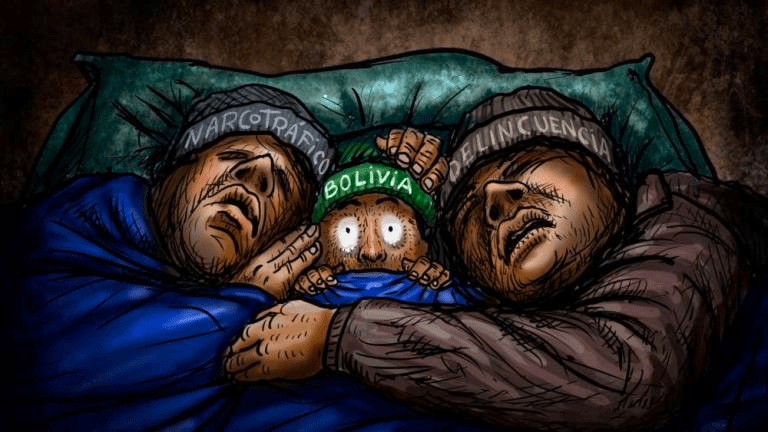
By Ernesto Estremadoiro, El Deber:
End of MAS Era Leaves 1.9 Million People in Extreme Poverty in Bolivia

The scene reflects a reality that affected 16.7% of Bolivians: 1.9 million people fell into extreme poverty, according to the INE | Fuad Landívar
The end of 2025, the final year of MAS government, shows a sharp deterioration in social conditions: extreme poverty rose by 3.9 percentage points, while poverty reached 44.7% of the population. On the streets, some people search through garbage or survive on the charity of passersby
Early in the morning, as Santa Cruz de la Sierra begins to wake up amid the noise of cars and the voices of vendors and shoppers, Lidia Villavicencio is already looking for something to take home.
She is 60 years old and comes from Plan 4.000 to the area around the former Abasto Market. She is not there to shop. She searches through garbage containers for something that might still be useful to feed the seven grandchildren under her care.
“There isn’t enough money,” she repeats.
The phrase is harsh, and it reflects an economy in which food and transportation prices are rising every day, while incomes are no longer enough to cover them—or, in some cases, no longer exist at all.
Lidia stopped working because she has to take care of her grandchildren. The children’s father died and their mother is ill, she explains. She has no permanent family support. Last year, she began searching for food among the waste at the former Abasto Market.
Lidia’s situation is backed by official figures.
The 2025 Household Survey conducted by the National Statistics Institute (INE), recently published, reveals that 1.9 million people, equivalent to 16.7% of the population, were living in extreme poverty. Extreme poverty stood at 12.8% in 2024. The increase was 3.9 percentage points.
On the street, the number is not seen as a statistical table. It is seen in a woman searching through garbage for food.

At the old Abasto Market, people search through garbage for something to eat and take home. The scene has become commonplace in this area | Fuad Landívar
The 2025 picture takes on a political dimension because it corresponds to the end of the MAS governments’ cycle.
The 2025 result was stark: 44.7% of the population was living in poverty, while 16.7% was living in extreme poverty.
Extreme poverty also measures more than simply the number of people below the poverty line. The INE also calculates the poverty gap, which shows how far people’s incomes are from that threshold. In 2025, the average gap was approximately 5.8%.
Poverty Has a Face
Lidia says that she used to receive help more frequently. Now she has to travel farther to find something she can take home to her grandchildren. Even getting to the market costs money.
The fare from Plan 4.000 rose from Bs 2 to Bs 3.50. And every coin counts when the family budget is not enough to cover basic needs.
The survey defines extreme poverty based on income. In other words, a person is considered to be in that condition when their household’s per-capita income falls below the cost of a basic food basket calculated by the INE. In 2025, the threshold was approximately Bs 660 per person per month.
This figure helps explain the daily reality of this woman, who must divide her scarce resources among food, transportation, and the needs of seven children.
On Cumavi Avenue, a few kilometers from Abasto, Luis Fernando Sánchez also values every coin. He has spent 32 years singing on the streets. An accident caused him to lose his sight and brought an end to his career as a folk-music performer. Since then, he has turned his voice into a means of survival.
He now mainly performs Christian music. His stage is the street. His audience is made up of passersby, and his income depends on their generosity.
Luis Fernando has five children, all grown up, but he still feels responsible for helping them whenever he can. For decades, he managed to put food on the table by singing in the streets.
But now everything has changed. “Things are difficult,” he says when asked about his economic situation.
He does not need to see to know that prices have risen. He senses it in the coins he receives and in what he can buy with them.
He also sees the impact of the dollar. If imported products become more expensive, he says, the effect eventually reaches the prices people pay. His explanation does not come from an economics textbook, but from three decades of working on the streets.
Roxana Telles also learned about economics without attending university. From a very young age, she has sold candy to support herself. But for the past 15 years, she has used a wheelchair because of lupus, an autoimmune disease that attacked her body and left her confined to that kind of prison made of wheels and metal.
She has no family who can support her financially. She relies on a person whom she considers a “sister in Christ,” who helps her whenever she can.
Her sales stand is also her means of survival. Roxana sees the crisis from another perspective: that of someone who must generate money every day to cover her medical expenses.
“I have no other choice,” she says when explaining why she continues working despite her condition.

Adversity does not stop Roxana, who sells candy from her wheelchair | Fuad Landívar
The phrase sums up one of the defining characteristics of poverty: for those living on the edge, stopping work and losing an income is not always an option.
End of an Era
The result is one of the main signs of the social deterioration with which Bolivia closed 2025, a year that also marked the end of the cycle of MAS governments that began with Evo Morales in 2006 and continued under Luis Arce Catacora.
The period cannot be assessed solely on the basis of the 2025 figures.
During the first years of the MAS cycle, Bolivia recorded a reduction in poverty. According to INE data, extreme poverty fell from 38.2% in 2005 to 15.2% in 2018—a reduction of more than 23 percentage points.
Moderate poverty also declined during that period, from 60.6% in 2005 to 34.6% in 2018.
That was one of the period’s main bright spots: millions of Bolivians moved out of conditions of extreme poverty during the years of strong economic growth and rising incomes.
The international context was also favorable. The commodities boom allowed the State to collect greater revenues from gas and mineral exports, while public spending, investment, and social transfers played an important role in the economy.
The main shadow appears when looking at what happened afterward.
The reduction in poverty was neither linear nor permanent. The country began facing a different scenario after the boom period: lower hydrocarbon revenues, weaker economic momentum, a fiscal deficit, declining gas production, and growing pressure on international reserves.
The pandemic aggravated the problem and, afterward, Bolivia entered a period marked by a shortage of foreign currency, difficulties importing goods, and strong inflation.
The 2025 Household Survey shows the social outcome of this process of decline.
Overall poverty reached 44.7% of the population, compared with 37.6% in 2024. That represents an increase of 7.1 percentage points in a single year.
Therefore, it was not only the number of people living in extreme poverty that increased. The overall population whose income is insufficient to cover the cost of the total basic basket also grew significantly.
Another significant figure is that accumulated inflation during 2025 reached 20.4%, far above the growth in nominal labor income.
Economist Carlos Aranda said the figure reflects deterioration that goes beyond statistics and directly affects families’ ability to buy food, pay for services, and cover their daily expenses. “We are talking about a very brutal impact on families’ purchasing power,” he said.
According to his assessment, the situation is forcing households to cut back on their spending, while the Government faces the challenge of containing inflation and, at the same time, restoring production and employment.
Fiscal Deterioration
Minister of Economy and Finance Christian Morales argues that the situation is the result of a process of deterioration in public finances accumulated over the past two decades.
“We come from 20 years of a policy that, in the end, has drained the State’s coffers,” Morales says, explaining the economic situation facing the current administration.
The minister said that, following the elimination of fuel subsidies, the Government created the PEPE program to support sectors considered vulnerable. He insists that the fundamental solution is to rebuild public finances, restore international reserves, and create conditions for the private sector to resume investing with confidence.
Morales maintains that the administration of Rodrigo Paz has not stopped supporting these sectors and will continue evaluating mechanisms of assistance “when the time is right.”
But for Lidia, Luis Fernando, and Roxana, the crisis is not another figure from the INE: it is the food missing from their homes, the coins that are not enough, and the work that cannot stop.
And while the country seeks to recover, they continue surviving among garbage containers, with a song, or by selling candy. For them, recovery will only have meaning when it allows them to return home with something more than uncertainty and a few coins.
Por Ernesto Estremadoiro Flores, El Deber:
Fin del ciclo del MAS deja a 1,9 millones de personas en pobreza extrema en el país
La escena refleja una realidad que alcanzó al 16,7% de los bolivianos: 1,9 millones de personas cayeron en pobreza extrema, según el INE |Fuad Landívar
El cierre de 2025, último año del gobierno masista, muestra un fuerte deterioro social: la pobreza extrema subió 3,9 puntos y la pobreza alcanzó al 44,7% de la población. En las calles algunas personas buscan entre la basura o viven de la caridad de la gente de a pie
A primera hora de la mañana, mientras Santa Cruz de la Sierra comienza a despertar entre el ruido de los autos y el eco de vendedores y compradores, Lidia Villavicencio ya está buscando qué llevar a casa.
Tiene 60 años y llega desde el Plan 4.000 hasta los alrededores del antiguo Mercado Abasto. No viene a comprar. Busca entre los contenedores de basura algo que todavía pueda servir para alimentar a los siete nietos que tiene bajo su responsabilidad.
“No alcanza la plata”, repite.
La frase es dura, y demuestra que detrás de ella hay una economía con precios de alimentos y transporte que se encarecen a diario y que los ingresos para cubrirlos ya no alcanzan, o incluso ya no existen.
Lidia dejó de trabajar porque debe hacerse cargo de sus nietos. El padre de los niños murió y la madre está enferma, cuenta. No tiene apoyo familiar permanente. Desde el año pasado comenzó a buscar comida entre los desechos del antiguo Abasto.
La escena de Lidia tiene un respaldo en las cifras oficiales.
La Encuesta de Hogares 2025 del Instituto Nacional de Estadística (INE), publicada recientemente, revela que 1,9 millones de personas, equivalentes al 16,7% de la población, se encontraban en situación de pobreza extrema. La pobreza extrema había sido de 12,8% en 2024. El salto fue de 3,9 puntos porcentuales.
En la calle el número no se visualiza como una tabla estadística. Sino en una mujer que revisa basura para encontrar comida.
En el mercado Abasto Antiguo personas busca entre la basura algo que comer y llevar a casa. La escena se ha vuelto cotidiana en este lugar | Fuad Landívar
La fotografía de 2025 adquiere una dimensión política porque corresponde al cierre del ciclo de gobiernos del MAS.
El resultado de 2025 fue contundente: 44,7% de la población estaba en situación de pobreza, mientras que el 16,7% estaba en pobreza extrema.
La pobreza extrema, además, no solamente cuenta cuántas personas están debajo de la línea. El INE calcula también la brecha, que permite conocer qué tan lejos están sus ingresos de ese umbral. En 2025, esa brecha promedio fue de aproximadamente 5,8%.
La pobreza tiene rostro
Lidia cuenta que antes recibía ayuda con mayor frecuencia. Ahora debe recorrer una distancia mayor para encontrar lo que pueda llevar a sus nietos. Incluso llegar hasta el mercado tiene un costo.
El pasaje desde el Plan 4.000 subió de 2 hasta Bs 3,50. Y cada moneda cuenta cuando el presupuesto familiar no alcanza para cubrir las necesidades básicas.
La encuesta define la pobreza extrema por ingresos. Es decir, una persona está en esa condición cuando el ingreso per cápita de su hogar está por debajo del costo de una canasta básica alimentaria, calculada por el INE. Para 2025, la línea fue de aproximadamente Bs 660 por persona al mes.
Esta cifra ayuda a entender el día a día de esta mujer, que debe repartir sus escasos recursos entre alimentación, transporte y las necesidades de siete niños.
En la avenida Cumavi, a unos kilómetros del Abasto, Luis Fernando Sánchez también valora cada moneda. Lleva 32 años cantando en las calles. Un accidente le hizo perder la vista y puso fin a su carrera como intérprete de música folclórica. Desde entonces convirtió su voz en una forma de subsistencia.
Ahora interpreta principalmente música cristiana. Su escenario es la calle. Su público, los transeúntes, de cuya ‘voluntad’ dependen los ingresos.
Luis Fernando tiene cinco hijos, ya mayores, pero todavía siente la responsabilidad de ayudar cuando puede. Durante décadas consiguió llevar el pan a su casa cantando en la vía pública.
Pero ahora todo cambió. “Está complicada”, responde cuando se le pregunta por su situación económica.
No necesita ver para saber que los precios subieron. Lo percibe en las monedas que recibe y en lo que puede comprar con ellas.
También observa el impacto del dólar. Si suben los productos importados, dice, el efecto termina llegando a los precios que paga la gente. Su explicación no viene de un libro de economía. Sino de tres décadas trabajando en la calle.
Roxana Telles también aprendió esa economía sin pasar por una universidad. Desde muy joven vende dulces para sostenerse. Pero desde hace 15 años utiliza una silla de ruedas debido al lupus, una enfermedad autoinmune que atacó su cuerpo hasta dejarlo en esa especie de prisión con ruedas y metal.
No tiene una familia que pueda sostenerla económicamente. Cuenta con una persona a quien considera una “hermana en Cristo”, que la ayuda cuando puede.
Su puesto de venta es también su mecanismo de supervivencia. Roxana observa la crisis desde otro ángulo: el de quien debe generar a diario el dinero para cubrir sus gastos de salud.
“No me queda otra”, dice cuando explica por qué continúa trabajando, pese a su condición.
La adversidad no frena a Roxana, que vende dulces en su silla de ruedas |Fuad Landívar
La frase resume una de las características de la pobreza: para quienes viven al límite, dejar de generar ingresos no siempre es una opción.
Fin de ciclo
El resultado constituye una de las principales señales del deterioro social con el que Bolivia cerró 2025, año que marcó también el final del ciclo de gobiernos del MAS iniciado con Evo Morales en 2006 y continuado por Luis Arce Catacora.
El balance del periodo no puede hacerse únicamente a partir del dato de 2025.
Durante los primeros años del ciclo del MAS, Bolivia registró una reducción de la pobreza. Según datos del INE, la pobreza extrema pasó de 38,2% en 2005 a 15,2% en 2018, es decir, una reducción de más de 23 puntos porcentuales.
La pobreza moderada descendió durante ese periodo, de 60,6% en 2005 a 34,6% en 2018.
Esa fue una de las principales luces del periodo: millones de bolivianos dejaron las condiciones de pobreza extrema durante los años de fuerte crecimiento económico y expansión de los ingresos.
El contexto internacional también fue favorable. El auge de las materias primas permitió al Estado captar mayores ingresos provenientes de las exportaciones de gas y minerales, mientras el gasto público, la inversión y las transferencias sociales adquirieron un rol importante en la economía.
La principal sombra aparece cuando se observa lo ocurrido posteriormente.
La reducción de la pobreza no fue lineal ni permanente. El país comenzó a enfrentar un escenario diferente después del periodo de bonanza: menores ingresos por hidrocarburos, menor dinamismo económico, déficit fiscal, caída de la producción de gas y una creciente presión sobre las reservas internacionales.
La pandemia agravó el problema y, posteriormente, Bolivia entró en una etapa marcada por escasez de divisas, dificultades para importar y una fuerte inflación.
La Encuesta Hogares de 2025 muestra el resultado social de este proceso de declive.
La pobreza general alcanzó al 44,7% de la población, frente al 37,6% registrado en 2024. Es un incremento de 7,1 puntos porcentuales en un solo año.
Por tanto, no solamente aumentó la cantidad de personas en pobreza extrema. También creció de manera importante el conjunto de la población cuyos ingresos no alcanzan para cubrir el costo de la canasta básica total.
Otro dato no menor es el de la inflación acumulada durante 2025 alcanzó 20,4%, muy por encima del crecimiento nominal del ingreso laboral.
El economista Carlos Aranda sostuvo que el dato refleja un deterioro que va más allá de las estadísticas y que se manifiesta directamente en la capacidad de las familias para comprar alimentos, pagar servicios y sostener sus gastos cotidianos. “Estamos hablando de un impacto muy brutal en el poder adquisitivo de las familias”, afirma.
El escenario, según su evaluación, obliga a los hogares a ajustar sus gastos mientras el Gobierno enfrenta el desafío de contener la inflación y, al mismo tiempo, recuperar la producción y el empleo.
Deterioro fiscal
El ministro de Economía y Finanzas, Christian Morales, sostiene que la situación es consecuencia de un proceso de deterioro de las finanzas públicas acumulado durante las últimas dos décadas.
“Venimos de 20 años de una política que al final lo que ha hecho es desangrar las arcas del Estado”, afirma Morales, al explicar la situación económica que enfrenta la actual administración.
El ministro dijo que, tras la eliminación de la subvención a los combustibles el Gobierno creó el programa PEPE, para acompañar a los sectores considerados más vulnerables. Insiste en que la solución de fondo pasa por reconstruir las finanzas públicas, recuperar las reservas y generar condiciones para que el sector privado vuelva a invertir con seguridad.
Morales asegura que la administración de Rodrigo Paz no ha dejado de atender a estos sectores y que continuará evaluando mecanismos de apoyo “cuando el momento sea el correcto”.
Pero para Lidia, Luis Fernando y Roxana, la crisis no es una cifra más del INE: es la comida que falta en sus casas, las monedas que no alcanzan y el trabajo que no puede detenerse.
Y mientras el país busca recuperarse, ellos siguen sobreviviendo entre contenedores, con una canción o vendiendo dulces. Para ellos, la recuperación tendrá sentido cuando les permita llegar a casa con algo más que incertidumbre y unas pocas monedas.
https://eldeber.com.bo/economia/fin-ciclo-deja-1-9-millones-personas-pobreza-extrema-pais_1788651270


Leave a Reply