By Milenka Parisaca, ABI:
Two Hyacinth Macaw Chicks Hatch for the First Time in a Nest Box in the Bolivian Pantanal

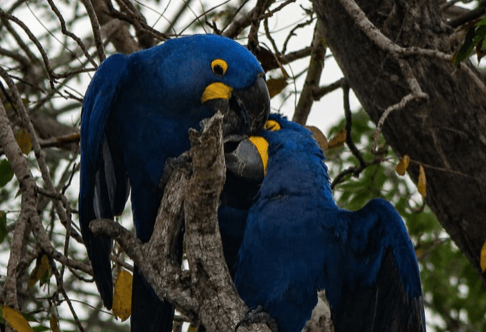
A hyacinth macaw peers out from its nest in the San Matías Integrated Management Natural Area (ANMI), part of the Bolivian Pantanal. | Photos: René Ibañez / CLB.
Santa Cruz, September 3, 2026 (ABI).— Saturnina and Avelino are only beginning to discover the world, but their birth has already marked a milestone for hyacinth macaw conservation in Bolivia. The two chicks are the first of their species to hatch inside a nest box specially built for these birds and installed in the community of Candelaria, within the San Matías Integrated Management Natural Area (ANMI) in eastern Santa Cruz Department.
The San Matías ANMI covers 2,918,500 hectares and includes parts of the Ángel Sandoval, Germán Busch, Chiquitos, and Velasco provinces along the border with Brazil. The protected area forms part of the Bolivian Pantanal and is home to a remarkable diversity of wildlife and plant species.
The birth of Saturnina and Avelino represents the first successful recorded breeding of the hyacinth macaw (Anodorhynchus hyacinthinus) in a nest box within the region. The achievement is especially significant because the species is listed as endangered in the 2026 edition of Bolivia’s Red Book of Vertebrates.
The success comes six months after researchers, park rangers, and conservation organizations began installing these structures as an alternative solution to the loss of natural nesting sites.
The story began when a pair of hyacinth macaws occupied one of the nest boxes for several months. Located behind a home at El Cussy retreat in Candelaria, one of the northern communities within the protected area, the birds gradually adapted the structure and remained close to it, leading park rangers to suspect they had selected it for nesting.

The chicks’ names also reflect the history of the region. Saturnina and Avelino were named in honor of the area’s first settlers.
“This result is the product of joint work between the National Service of Protected Areas (Sernap), the San Matías ANMI park rangers, the Conservation of Parrots in Bolivia Foundation (CLB), and the World Parrot Trust, with support from the Phoenix Zoo,” Rafael Mounzón, director of the CLB Foundation, told the Environmental Information Network (RAI).
The initiative draws on previous experience using nest boxes to conserve the blue-throated macaw (Ara glaucogularis), a smaller species. For the hyacinth macaw, recognized as the largest macaw species, the structures had to be redesigned to suit its size and behavior.
The boxes are five centimeters larger than those used for blue-throated macaws. They also feature a thicker wooden entrance, a modification recommended by park rangers because hyacinth macaws often chew and shape wood while preparing their nests.
To date, the project has installed 30 nest boxes across various locations within the San Matías ANMI, including Candelaria, Santo Rosario, Santo Corazón, San Fernando, and Pozones. The distribution varies according to local conditions and the challenges of transporting materials along the region’s roads.

“We have covered the entire area with varying numbers of boxes in each location. In San Matías, difficult road conditions complicate logistics, which is why some places have fewer boxes,” Mounzón explained.
An Alternative to the Loss of Large Trees
The initiative addresses a problem that directly affects hyacinth macaw reproduction: the disappearance of large trees with natural nesting cavities.
Ricardo Barbery, a park ranger at the San Matías ANMI for 29 years, has witnessed these changes firsthand. During past wildlife surveys, he frequently found large sujo trees with cavities suitable for nesting macaws. Many of these trees were lost in the wildfires that have impacted the region since 2019.
RAI documented that the fires that year damaged many of the large trees used by macaws for nesting. The 2024 wildfire affected approximately 75% of the San Matías ANMI territory.
The fires also damaged motacú and totaí palm trees, whose fruits provide food for numerous wildlife species.
“Six years of fires since 2019 have devastated their habitat,” Barbery said.
As large trees became scarcer, macaws began nesting in smaller tree species such as tarumá and totaí. According to Barbery, nesting attempts in these trees often fail.
The shift has also altered the species’ distribution within the region.
“Now they can be seen in Santo Corazón, where hyacinth macaws were not previously found,” he noted.

Barbery believes that wildfires and the loss of suitable nesting sites now pose a greater threat to the species than bird trafficking. Additional pressure comes from the expansion of Mennonite communities in some areas and the resulting demand for natural resources.
The loss of natural cavities has also intensified competition among species. Red macaws, toucans, and other birds now compete for the limited nesting spaces available.
“Four years ago, the talking parrot, the yellow parakeet, and the parabachi did not damage crops. Today they are beginning to feed on bananas, coconut plants, and other foods they never used to eat,” Barbery explained.
For Antonio Tacuchaba, another San Matías ANMI park ranger, these cumulative changes reveal a profound disruption of the ecosystem.
“The natural balance in San Matías has been broken,” he said, referring to the impacts of wildfires, climate change, and growing competition among species.
From a Nest Box to an Opportunity for Local Communities
The birth of Saturnina and Avelino has also generated enthusiasm among residents and park rangers in Candelaria. For the CLB Foundation, the next step is to increase community participation in the project.

The initiative responds directly to a problem affecting hyacinth macaw reproduction: the loss of large trees with natural cavities. | Photos: Nativa
The proposal includes involving local school students in building nest boxes, training environmental monitors, and creating new conservation-related employment opportunities.
“Following the birth of these chicks, we have seen tremendous excitement among both park rangers and community members. We want to use this stage to involve local residents and schoolchildren even more—encouraging them to participate in building nest boxes, training as environmental monitors, and creating new employment opportunities linked to conservation,” Mounzón said.
The project also seeks to strengthen birdwatching as a sustainable activity for communities within the protected area.
“The idea is to encourage birdwatching among local residents and eventually help Santo Rosario, Candelaria, San Fernando, and Santo Corazón become important birding destinations, because they have enormous potential,” he added.
For now, Saturnina and Avelino represent two small signs of hope for a species facing the loss of trees and natural nesting sites in the Bolivian Pantanal. Their birth demonstrates that a specially designed nest box can provide a new refuge for the hyacinth macaw and opens a promising new chapter in the species’ conservation.
//MPC/EO
Por Milenka Parisaca Carrasco, ABI:
Dos pichones de paraba azul nacen por primera vez en una caja nido en el Pantanal boliviano
Una paraba azul asoma desde su nido en el ANMI San Matías, parte del Pantanal boliviano. | Fotos: René Ibañez / CLB.
Santa Cruz, 3 de septiembre de 2026 (ABI).- Saturnina y Avelino apenas comienzan a descubrir el mundo, pero su nacimiento ya marca un hito para la conservación de la paraba azul en Bolivia. Los dos pichones son los primeros de esta especie en romper el cascarón dentro de una caja nido construida especialmente para estas aves e instalada en la comunidad de Candelaria, en el Área Natural de Manejo Integrado (ANMI) San Matías, en el este del departamento de Santa Cruz.
El ANMI San Matías tiene una superficie de 2.918.500 hectáreas y comprende parte de las provincias Ángel Sandoval, Germán Busch, Chiquitos y Velasco, en la frontera con Brasil. El área protegida forma parte del Pantanal boliviano y alberga una importante diversidad de fauna y flora.
El nacimiento de Saturnina y Avelino constituye el primer registro exitoso de reproducción de la paraba azul (anodorhynchus hyacinthinus) en una caja nido dentro de la zona y cobra mayor relevancia porque la especie figura en la categoría en peligro en el Libro Rojo de los Vertebrados de Bolivia, edición 2026.
El resultado llega seis meses después de que investigadores, guardaparques y organizaciones dedicadas a la conservación comenzaron a instalar estas estructuras como una alternativa ante la reducción de los sitios naturales de nidificación.
La historia comenzó con una pareja de parabas azules que ocupó durante meses una de estas cajas, ubicada en el patio trasero de una vivienda del retiro El Cussy, en Candelaria, una de las comunidades de la zona norte del área protegida. Las dos aves acondicionaron el espacio y permanecieron cerca del lugar, una señal que llevó a los guardaparques a sospechar que habían elegido la estructura para anidar.
Los nombres de los pichones también guardan parte de la historia de este territorio. Saturnina y Avelino fueron bautizados en homenaje a los primeros pobladores de esas tierras.
“Este resultado es fruto del trabajo conjunto entre el Servicio Nacional de Áreas Protegidas (Sernap), los guardaparques del ANMI San Matías, la Fundación Conservación de Loros en Bolivia (CLB) y el Fondo Mundial para los Loros, con apoyo del zoológico de Phoenix”, destacó Rafael Mounzón, director de la Fundación CLB, a la Red Ambiental de Información (RAI).
La experiencia toma como referencia el uso de cajas nido para la conservación de la paraba barba azul (ara glaucogularis), una especie de menor tamaño. En el caso de la paraba azul, considerada la más grande de las parabas, las estructuras tuvieron que adaptarse a sus características.
Las cajas son cinco centímetros más grandes que las utilizadas para la paraba barba azul. También cuentan con una entrada fabricada con madera de mayor grosor, una modificación recomendada por los guardaparques debido a que estas aves suelen morder y trabajar la madera para acondicionar sus nidos.
Hasta ahora, el proyecto permitió instalar 30 cajas nido en distintos puntos del ANMI San Matías: Candelaria, Santo Rosario, Santo Corazón, San Fernando y Pozones. La distribución varía según las condiciones de cada sitio y las dificultades para trasladar los materiales por los caminos de la zona.
“Tenemos cubierta toda la zona por distintas cantidades de cajas en cada lugar. En San Matías, por la dificultad de los caminos, se complica la logística y por esta razón en algunos lugares hay menos”, explicó Mounzón.
Una alternativa frente a la pérdida de árboles
La iniciativa responde a un problema que afecta directamente a la reproducción de la paraba azul: la pérdida de árboles grandes con cavidades naturales.
Ricardo Barbery, guardaparque del ANMI San Matías desde hace 29 años, conoce de cerca estos cambios. Durante antiguos censos encontró árboles de sujo de gran tamaño, con cavidades apropiadas para la reproducción de las parabas. Muchos de ellos desaparecieron después de los incendios que golpearon la zona desde 2019.
La RAI documentó que los incendios registrados ese año afectaron los árboles de gran porte que las parabas utilizaban para nidificar. El incendio de 2024 alcanzó alrededor del 75% del territorio del ANMI San Matías.
El fuego también afectó a palmeras de motacú y totaí, cuyos frutos forman parte de la alimentación de distintas especies.
“Seis años de incendios desde 2019 acabaron con su hábitat”, afirmó Barbery.
Ante la reducción de los árboles de gran porte, las parabas comenzaron a utilizar especies de menor diámetro, como el tarumá y el totaí. De acuerdo con el guardaparque, los intentos de nidificación en estos árboles suelen fracasar.
El cambio también modificó la presencia de la especie en el territorio. “Ahora se la ve en Santo Corazón, donde las parabas antes no llegaban”, relató.
Barbery considera que el fuego y la pérdida de sitios adecuados para reproducirse representan actualmente una amenaza mayor que el tráfico de aves. A esto se suma la presión sobre los recursos naturales en algunas zonas por la expansión de comunidades menonitas.
La pérdida de cavidades naturales también incrementó la competencia entre especies. Parabas rojas y tucanes, entre otras aves, disputan los espacios disponibles para establecer sus nidos.
“Hace cuatro años, el loro hablador, la cotorrita amarilla y la parabachi no dañaban los cultivos. Hoy ya están empezando a comer plátano, plantas de coco, todo lo que antes no comían”, relató Barbery.
Para Antonio Tacuchaba, otro de los guardaparques del ANMI San Matías, los cambios acumulados muestran una alteración profunda del ecosistema.
“Se ha roto el equilibrio natural en San Matías”, afirmó, al referirse a los efectos de los incendios, el cambio climático y la competencia entre especies.
De una caja nido a una oportunidad para las comunidades
El nacimiento de Saturnina y Avelino también despertó entusiasmo entre los pobladores y guardaparques de Candelaria. Para la Fundación para la CLB, el siguiente paso es ampliar la participación de las comunidades en el proyecto.
La iniciativa responde a un problema que afecta directamente a la reproducción de la paraba azul: la pérdida de árboles grandes con cavidades naturales. | Fotos: Nativa
La propuesta contempla involucrar a estudiantes de las escuelas locales en la elaboración de cajas nido, formar monitores ambientales y abrir nuevas oportunidades laborales vinculadas con la conservación.
“A raíz del nacimiento de estos pichones hemos visto mucha emoción, tanto por parte de los guardaparques como de la comunidad. Queremos aprovechar esta etapa para involucrar cada vez más a los pobladores locales, a los estudiantes de la escuela: hacerlos partícipes de la elaboración de las cajas nido, formar monitores ambientales, buscando también generar más oportunidades de empleo a partir de la conservación”, expresó Mounzón.
El proyecto también apunta a fortalecer la observación de aves como una actividad para las comunidades del área protegida.
“La idea es fomentar la observación de aves entre la población local y lograr que, en algún momento, Santo Rosario, Candelaria, San Fernando y Santo Corazón puedan convertirse en lugares importantes para el aviturismo, porque tienen mucho potencial”, señaló.
Por ahora, Saturnina y Avelino representan dos pequeñas señales de esperanza para una especie que enfrenta la pérdida de árboles y sitios naturales de reproducción en el Pantanal boliviano. Su nacimiento demuestra que una estructura construida especialmente para estas aves puede convertirse en un nuevo refugio para la paraba azul y abre una nueva etapa para su conservación.
//MPC/EO


Leave a Reply