By Oscar Antezana, El Dia:
My dear readers: over the last month I was absent from this column due to vacation. I barely followed national or international news. My mind needed more rest than my body. A few days ago I landed—both physically and mentally—and all it took was opening the newspapers to confirm that, in Bolivia, reality had not gone on vacation.
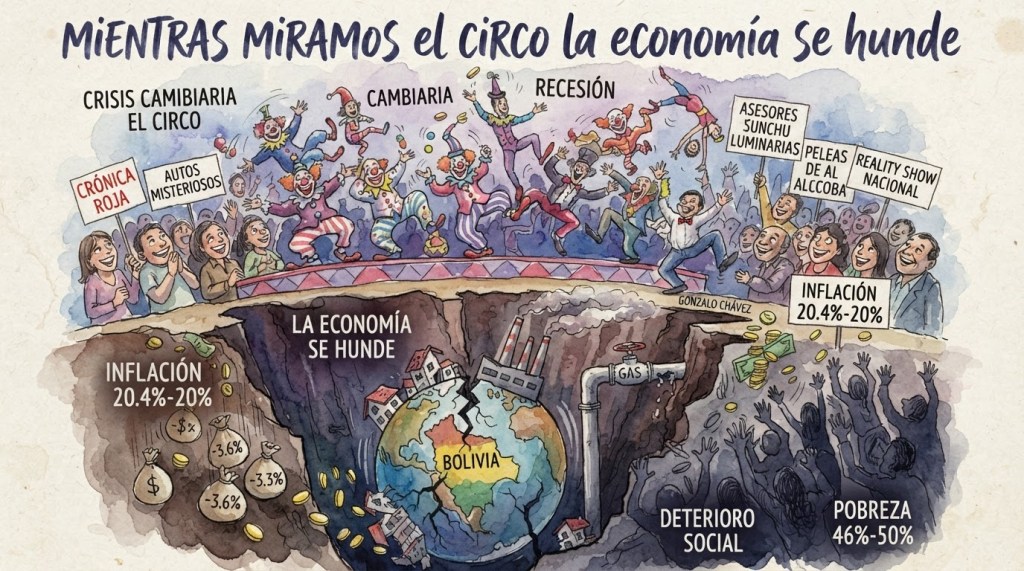
The Beller-Cerimedo case provokes a painfully familiar mix of sadness, anger, and helplessness. But we know the script: investigation, headlines, statements, the passage of time, oblivion, and probably nothing. The President tried to let the storm pass, but only recently spoke out, apparently due to political pressure from other parties: a disgrace. However, his statements seem to contradict the evidence—photographs—and the chats, which still need to be verified. But if they are verified, we are facing a President who, at the very least, tolerates and covers up wrongdoing, just as happened with Evo and Tilín. It would no longer be merely disgraceful—it would be unacceptable. Some expected—though I did not—that this government would break with certain practices inherited from the MAS. There is also the suitcase case, with the main suspect released, among other recent episodes.
The case of former minister Espinoza is no help either: “I leave with the peace of mind that I gave it my all.” That effort was not enough; he did not measure up. Ministers should be judged by results, but since there is not even a government plan in which he should have played a leading role, everything is adrift and there are no clear objectives. It is now reported that the new minister has been tasked by the President with obtaining and securing more foreign loans to slow the crisis. During the campaign, the President emphatically and demagogically declared that he would not take on debt, that there was plenty of money in the country; it was all a lie, and he knew it. Evo and Tilín squandered the reserves; Paz will bury us in debt.
And what is the government doing to “clean up” the economy, increase productivity, boost exports, reduce public spending, and curb corruption? This government was elected to solve the country’s problems—or at least begin to solve them—not to postpone them and, in doing so, plunge us into a deeper crisis and greater poverty. The apparent slogan is: “Let the next government deal with it,” once again, just as Evo and Tilín did. But the serious issue is that the consequences grow worse every time because resources are running out and debt is increasing.
Now they are considering repealing—although opinions within the executive branch are divided—Supreme Decree 5676, which raises the price of diesel, because it has generated and would continue generating conflict. Yes, it is true: it will affect costs and prices, but it is unavoidable. For decades, thanks to Evo and Tilín, through pure demagoguery and abundant resources, we lived in an Alice in Wonderland fantasy with cheap, heavily subsidized fuels—one of the very causes that led us to where we are today.
Now that they have wrecked the economy, there is no choice but to face reality. It is the task and responsibility of this government, and of the entire population—including governors, mayors, and business leaders—to confront these challenges in the best way possible, no matter how painful they may be. But this government has lost credibility and lacks leadership, or lacks the courage to exercise it; everything is done the easy way, without clarity.
Finally, the President announced—for a change—that efforts are underway to manage the economy, stabilize the dollar, and restore the independence of the Central Bank of Bolivia (BCB). Are they reinventing the wheel? Nearly nine months have passed. Everyone knows what must be done, and the country has done it before. Reduce the fiscal deficit. To cut the umbilical cord between the government and the Central Bank, they could simply photocopy the decree issued more than twenty years ago and little else. What is lacking is the courage to cut public spending and stop depending on Central Bank financing.
It is also incomprehensible that we do not publicly know the work plan of the recently appointed Bolivian ambassador to Paraguay—or of any other ambassador, for that matter. Bolivia desperately needs foreign investment, new markets, and more exports. Saying that an ambassador will “attract investment” and “expand markets” is not a plan; it is simply a description of the job.
A real plan must include objectives, activities, timelines, and measurable targets. How much investment will he seek to attract? Which products will he promote? Within what timeframe? Are we sending an ambassador to Paraguay with a mission, or are we paying off a political campaign debt? Is the same being done—or will it be done—with other ambassadors? What are the MAS-appointed ambassadors doing, those who have a different agenda and do not know the “ABC” of economics and exports? What a waste of time, opportunities, and resources! Meanwhile, our neighbors and the rest of the world move forward.
I returned from vacation hoping for some good news. Instead, I found a President who is far too absent when he should be facing the public and sending unmistakable signals of transparency; a President who seems lost and confused, weak, with significantly diminished credibility and lacking the courage to “take the bull by the horns.”
Until when?
Oscar Antezana Malpartida | Columnist
Por Oscar Antezana Malpartida, El Dia:
Mis queridos lectores: durante el último mes me ausenté de esta columna por vacaciones. Apenas seguí las noticias nacionales y mundiales. Mi mente necesitaba más descanso que mi cuerpo. Hace pocos días aterricé —física y mentalmente— y bastó abrir los periódicos para comprobar que, en Bolivia, la realidad no se había tomado vacaciones.
El caso Beller-Cerimedo provoca una mezcla demasiado conocida: pena, rabia e impotencia. Pero conocemos el libreto: investigación, titulares, declaraciones, paso del tiempo, olvido y, probablemente, nada. El Presidente trató de dejar que pasara la tormenta, pero recién se pronunció, aparentemente por presiones políticas de los otros partidos: una vergüenza. Sin embargo, sus declaraciones parecen contradecir las evidencias —fotos— y los chats, que habría que validar. Pero, si resultan validados, estamos ante un Presidente que, por decir lo menos, tolera y encubre, como pasó con Evo y Tilín. Ya no sería una vergüenza: sería inaceptable. Se esperaba —yo no— que este Gobierno rompiera ciertas prácticas heredadas del MAS. Ahí está también el caso de las maletas, con la principal investigada liberada, entre otros episodios recientes.
El caso del exministro Espinoza tampoco ayuda: «Me voy con la tranquilidad de haber dado todo mi esfuerzo». Ese esfuerzo no fue suficiente; no dio la talla. A los ministros se los debe evaluar por sus resultados, pero, como no hay ni siquiera un plan de gobierno en el que él debería haber sido protagonista, todo queda a la deriva y no existen objetivos claros. Ahora se reporta que el nuevo ministro tiene el encargo del Presidente de conseguir y asegurar más créditos externos para frenar la crisis. Enfática y demagógicamente, el Presidente, durante la campaña, dijo que no iba a contratar deuda, que había «plata» en el país; todo era mentira y él lo sabía. Evo y Tilín se farrearon las reservas; Paz nos llenará de deuda.
¿Y qué está haciendo el Gobierno para «sanear» la economía, aumentar la productividad, exportar más, reducir el gasto público y poner coto a la corrupción? A este Gobierno se lo ha elegido para solucionar los problemas del país o, por lo menos, para encaminarlos; no para postergarlos y, con ello, sumirnos en una mayor crisis y más pobreza. Parece que la consigna es: «Que se las arregle el próximo Gobierno», nuevamente, tal como hicieron Evo y Tilín. Pero lo grave es que cada vez las consecuencias son peores, porque se acaban los recursos y aumenta la deuda.
Ahora piensan abrogar —aunque hay posiciones divididas en el Ejecutivo— el D.S. 5676, que sube el precio del diésel, porque generó y generaría más conflictos. Sí, es verdad: tendrá efectos sobre los costos y los precios, pero es inevitable. Durante décadas, gracias a Evo y Tilín, a pura demagogia y recursos abundantes, vivimos en Alicia en el país de las maravillas, con combustibles baratos y altamente subvencionados, lo que constituye una de las causas que nos llevó a donde estamos.
Ahora que destrozaron la economía, no queda otra que pisar tierra. Es tarea y responsabilidad de este Gobierno, y de toda la población —incluidos gobernadores, alcaldes y dirigentes de gremios empresariales—, afrontar estos desafíos de la mejor manera posible, por más dolorosos que sean. Pero este Gobierno perdió credibilidad y no hay liderazgo, o no tiene la valentía de ejercerlo; todo se hace por la vía fácil y no hay claridad.
Finalmente, el mandatario anunció —para variar— que se está trabajando para manejar la economía, estabilizar el dólar y devolver la independencia al Banco Central de Bolivia (BCB). ¿Están reinventando la pólvora? Han pasado casi nueve meses. Todos saben lo que se tiene que hacer y el país ya lo hizo anteriormente. Reduzcan el déficit fiscal. Para cortar el cordón umbilical entre el Gobierno y el Banco Central, pueden fotocopiar el decreto de hace más de veinte años y poco más. Lo que no hay es la valentía de cortar el gasto público para dejar de depender del financiamiento del Banco Central.
También resulta incomprensible que no conozcamos públicamente el plan de trabajo del recientemente designado embajador boliviano en Paraguay, ¡ni el de ningún otro embajador! Bolivia necesita desesperadamente inversión extranjera, nuevos mercados y más exportaciones. Decir que un embajador buscará «atraer inversiones» y «ampliar mercados» no es un plan: es simplemente describir su trabajo.
Un verdadero plan debe contener objetivos, actividades, plazos y metas verificables. ¿Cuánta inversión buscará atraer? ¿Qué productos promoverá? ¿En qué plazo? ¿Enviamos a Paraguay a un embajador con una misión o estamos pagando una factura política de campaña? ¿Se está haciendo o se hará lo mismo con otros embajadores? ¿Qué hacen los embajadores masistas que tienen otra agenda y que no saben el «ABC» de la economía y las exportaciones? ¡Qué manera de perder tiempo, oportunidades y recursos! Mientras tanto, nuestros vecinos y el mundo avanzan.
Volví de vacaciones esperando alguna buena nueva. Encontré, en cambio, a un Presidente demasiado ausente cuando debería dar la cara y enviar señales inequívocas de transparencia; a un Presidente perdido y confundido, débil, con una merma significativa en su credibilidad y sin el coraje necesario para «agarrar al toro por las astas».
¿Hasta cuándo?
Oscar Antezana Malpartida | Columnista
https://eldia.com.bo/2026-08-28/opinion/tribuna/volviendo-al-futuro-con-el-presidente-paz.html


Leave a comment