Bolivian Thoughts, Editorial:
Every August 17, Bolivians celebrate Flag Day. Schoolchildren march, military units raise the Tricolor, and public institutions display one of the country’s most recognizable symbols. Yet few Bolivians realize that the flag flying today is actually the third national flag adopted since independence, and that each redesign reflected a different vision of what the young republic was becoming.
Bolivia was born on August 6, 1825, and only eleven days later the Deliberative Assembly approved the first national flag. The new republic needed more than independence; it needed symbols capable of uniting territories that had previously belonged to the Spanish Empire. The first flag consisted of green-red-green stripes and included five golden stars surrounded by olive and laurel branches, representing the five founding departments: La Paz, Potosí, Cochabamba, Chuquisaca and Santa Cruz.
The colors themselves were important, but the deeper message was political. Bolivia was a new country with uncertain borders, weak institutions and strong regional identities. The first flag was designed to proclaim unity among territories that had little experience acting as a single nation. The stars mattered as much as the colors because they visually announced the creation of a common state.
Only a year later, however, the government concluded that the first design was too complex and insufficiently representative of the emerging republic. In July 1826, under President Antonio José de Sucre, the flag was modified. The upper green stripe became yellow and the five stars were replaced by the national coat of arms. The change reflected a transition from a federation of founding departments toward a more centralized republic represented by a single national emblem.
The second flag remained in use for twenty-five years. During that period Bolivia experienced political instability, territorial disputes and frequent changes of government. The republic survived, but its symbols still lacked the simplicity and visual strength found in many other national flags.
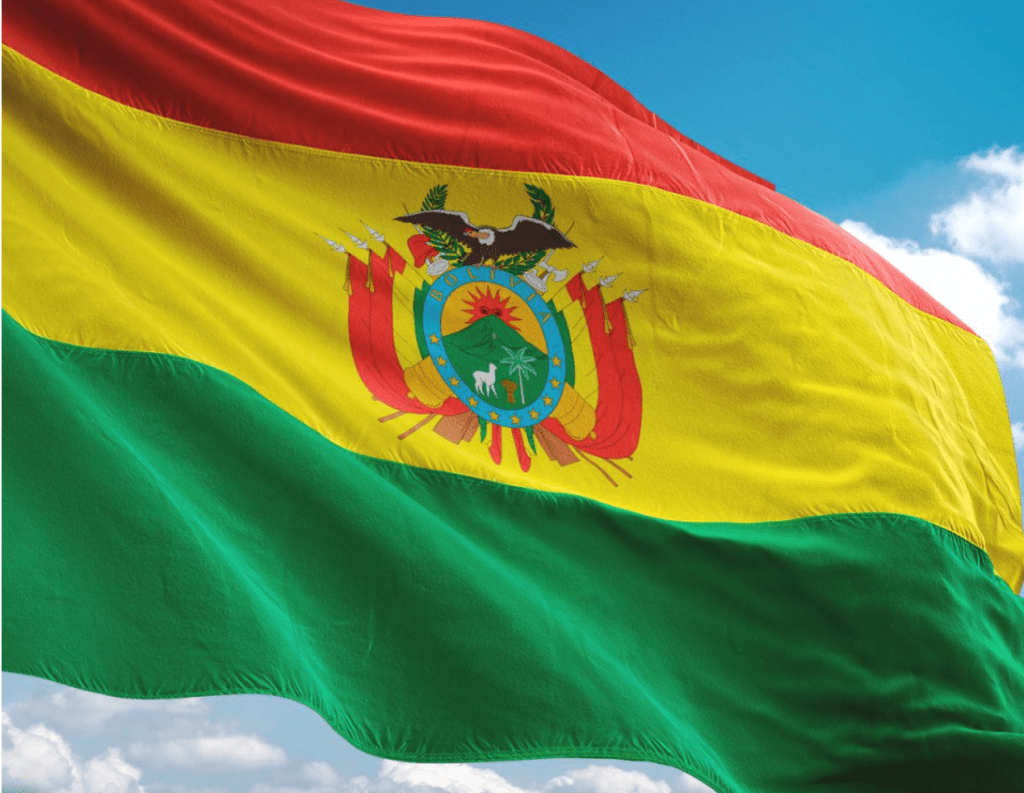
The definitive transformation came in 1851 during the presidency of Manuel Isidoro Belzu. According to historical accounts, while traveling to Oruro he observed a rainbow in which red, yellow and green stood out prominently. Inspired by the image, Belzu promoted a redesign of the national banner. On October 31, 1851, the National Convention approved the flag that Bolivia continues to use today: three horizontal bands of red, yellow and green.
The new arrangement was not merely aesthetic. It sought to create a clearer national identity. Red came to symbolize the blood shed by those who fought for independence and defended the nation. Yellow represented Bolivia’s immense mineral wealth, while green reflected the country’s natural richness and hope for the future. The message was simple, memorable and uniquely Bolivian.
More than 170 years later, the Tricolor remains one of the few national symbols capable of generating broad consensus in a country often marked by political and regional divisions. Governments have changed, constitutions have been rewritten, and public debates have intensified over identity and representation. Yet the red, yellow and green flag continues to be recognized across the Andes, the valleys and the lowlands as a shared symbol of statehood.
Today, Bolivians tend to see the flag through multiple lenses. For some it represents sacrifice and patriotism. For others it symbolizes national unity in a diverse and multicultural society. Younger generations often associate it less with military history and more with citizenship and belonging. Whatever the interpretation, the Tricolor remains one of the rare symbols that links modern Bolivia to the hopes of those who founded the republic in 1825.
As Bolivia marks another Flag Day, the story of its three flags serves as a reminder that national symbols are never static. They evolve alongside the nation itself. The history of Bolivia’s flags is ultimately the history of Bolivia: a continuing effort to define who its people are, where they come from, and what unites them.
Pensamientos Bolivianos, Editorial:
Cada 17 de agosto los bolivianos celebran el Día de la Bandera. Los escolares desfilan, las Fuerzas Armadas izan la Tricolor y las instituciones públicas exhiben uno de los símbolos más reconocidos del país. Sin embargo, pocos recuerdan que la bandera actual es en realidad la tercera bandera nacional adoptada desde la independencia, y que cada cambio respondió a una nueva visión de lo que Bolivia debía ser.
Bolivia nació el 6 de agosto de 1825 y apenas once días después la Asamblea Deliberante aprobó su primera bandera. La nueva república necesitaba algo más que independencia: requería símbolos capaces de unir territorios que durante siglos habían formado parte del Imperio español. Aquella primera enseña estaba compuesta por franjas verde-rojo-verde y llevaba cinco estrellas doradas rodeadas por ramas de laurel y olivo, representación de los cinco departamentos fundadores: La Paz, Potosí, Cochabamba, Chuquisaca y Santa Cruz.
Los colores tenían importancia, pero el mensaje principal era político. Bolivia era un país nuevo, con fronteras todavía inciertas, instituciones frágiles y fuertes identidades regionales. La primera bandera buscaba transmitir unidad entre territorios que apenas comenzaban a reconocerse como parte de una misma nación. Las estrellas eran tan importantes como los colores porque anunciaban visualmente el nacimiento de un Estado común.
Sin embargo, al poco tiempo las autoridades concluyeron que aquel diseño resultaba complejo y no representaba adecuadamente a la república emergente. En julio de 1826, durante la presidencia del mariscal Antonio José de Sucre, la bandera fue modificada. La franja superior verde fue reemplazada por una amarilla y las cinco estrellas cedieron su lugar al escudo nacional. Más que un simple cambio gráfico, la reforma reflejaba el paso de una unión de departamentos fundadores a una república que deseaba proyectar una identidad nacional más sólida y centralizada.
La segunda bandera permaneció vigente durante veinticinco años. Fueron décadas marcadas por conflictos políticos, disputas territoriales y frecuentes cambios de gobierno. Bolivia sobrevivió, pero sus símbolos seguían buscando una imagen más clara y poderosa.
La transformación definitiva llegó en 1851 bajo la presidencia de Manuel Isidoro Belzu. Según la tradición histórica, mientras viajaba hacia Oruro observó un arcoíris en el que destacaban los colores rojo, amarillo y verde. Inspirado por esa imagen, promovió la creación de una nueva bandera. El 31 de octubre de 1851 la Convención Nacional aprobó la Tricolor que continúa vigente hasta hoy: rojo en la parte superior, amarillo en el centro y verde en la inferior.
La nueva disposición no respondía únicamente a razones estéticas. Buscaba construir una identidad nacional más clara. El rojo pasó a representar la sangre derramada por quienes lucharon por la independencia y la defensa de la patria. El amarillo simbolizó la inmensa riqueza mineral del país y el verde su extraordinaria riqueza natural y la esperanza en el futuro. Era un mensaje sencillo, fácil de recordar y profundamente boliviano.
Más de 170 años después, la Tricolor sigue siendo uno de los pocos símbolos capaces de generar consenso en una nación frecuentemente marcada por diferencias políticas y regionales. Han cambiado gobiernos, constituciones y debates sobre identidad, pero la bandera roja, amarilla y verde continúa siendo reconocida desde el altiplano hasta los llanos orientales como un emblema compartido de pertenencia nacional.
Hoy los bolivianos la observan desde distintas perspectivas. Para algunos representa sacrificio y patriotismo. Para otros simboliza la unidad dentro de una sociedad diversa y multicultural. Las generaciones más jóvenes suelen verla menos como un símbolo militar y más como una expresión de ciudadanía y pertenencia. Sea cual sea la interpretación, la Tricolor sigue conectando a la Bolivia contemporánea con las aspiraciones de quienes fundaron la República en 1825.
En este nuevo Día de la Bandera, la historia de las tres enseñas nacionales recuerda que los símbolos patrios no son estáticos. Evolucionan junto con el país. La historia de las banderas de Bolivia es, en el fondo, la historia de Bolivia misma: la búsqueda permanente de una identidad común capaz de unir a una nación tan diversa como orgullosa de su pasado.


Leave a Reply