By ABI; Eju.tv:


In San Ignacio de Moxos, in Bolivia’s Beni Department, memory is not kept in silence. Every year, figures covered in feathers, masks, and colorful costumes fill the streets to reenact an ancient story in which solar warriors confront the guardians of the forests and waters. Born from the encounter between Moxeño traditions and Christianity, the conflict ends with a victory that does not destroy the defeated, but instead incorporates them into a new faith.
This is the setting of the Ichapekene Piesta, a celebration that keeps alive the memory of the Moxeño people through dance, symbolism, and ritual. As part of a series dedicated to Bolivia’s cultural heritage, ABI highlights the uniqueness of this remarkable tradition using official information.
The festivities begin in May with fireworks, songs, and praises, and continue through June, July, and August with masses, vigils, offerings, and communal feasts. During this time, the streets become the stage where oral history comes to life.
The story behind the celebration resembles the great epic narratives of classical literature, where journeys, battles, and supernatural beings intertwine on the path to victory. In San Ignacio de Moxos, the tale dates back to the Jesuit mission era and the arrival of Saint Ignatius of Loyola in the Bolivian Amazon.

In the center, the Tintiririnti, a character that symbolizes the apostle Santiago during the Ichapekene Piesta.
The Moxeño tradition reinterpreted Christian history from its own worldview and turned the spirits of nature into protagonists of a narrative that is still performed.
In the center appears the Holy Flag, a symbol that, according to tradition, was taken by the Jichis, spirits linked to the forests and waters and considered their former owners. To recover it, San Ignacio has twelve solar warriors, the Chiripieruana, currently represented by Los Macheteros.
With their large feather headdresses, these characters evoke the strength of the sun and star in the confrontation against the guardians of the jungle. Around it, animals and other figures appear that complete the vision of an Amazon understood as a living space, inhabited by forces, beings and spirits.

The historic church of San Ignacio de Moxos concentrates the main religious events of the Fiesta Grande.
The Elders of the Festival
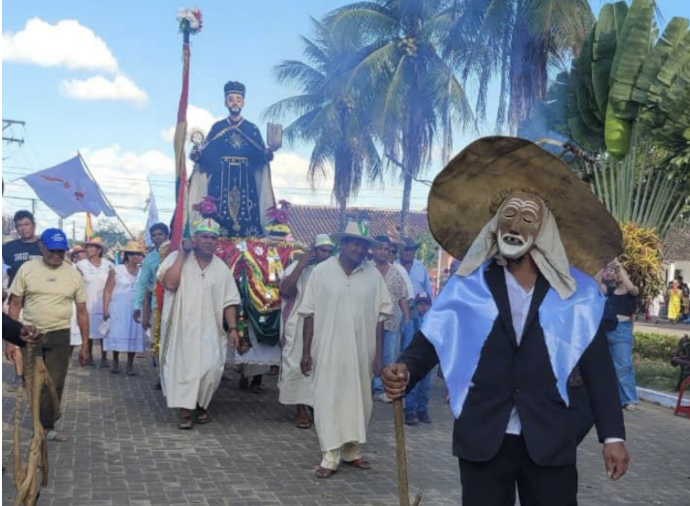
Among the most striking characters are the Achus, considered the “grandfathers” of the celebration and protective spirits of the forest. Their wooden masks, oversized noses, wigs, and extravagant costumes make them instantly recognizable and admired by spectators.
They play, joke, and interact with the public throughout the festivities, yet their role carries a deeper meaning. According to tradition, the forest guardians are not destroyed after the battle. Instead, they receive light and enlightenment—understood as knowledge of God—and become part of the new Christian order.
For this reason, during the central nights of the Ichapekene Piesta, on July 30 and 31, the Achus take on an even more spectacular appearance. Their hats are fitted with structures loaded with sparklers and fireworks that create dazzling bursts of light above their heads. These lights symbolize the transformation of the ancient guardians and the possibility of living in harmony with nature.

The Achus, macheteros and animals, like the tiger, are characters that are not missing from the festival.
A Tradition That Unites Two Worlds
The Ichapekene Piesta is more than a religious celebration. Its strength lies in the coexistence of Christian elements and Indigenous Moxeño cosmology, a blend that has allowed the story to survive and evolve across generations.
According to UNESCO, the festival reinterprets the Moxeño founding myth of the victory of Saint Ignatius of Loyola while incorporating Indigenous beliefs and traditions. Because of its cultural significance, it was inscribed on December 5, 2012, on UNESCO’s Representative List of the Intangible Cultural Heritage of Humanity.
In San Ignacio de Moxos, a story born from the meeting of two worlds continues to unfold in the streets. Feathers, masks, music, and fire are not merely elements of a celebration—they are expressions of a living Moxeño memory passed on to new generations.
Por ABI; Eju.tv:
En San Ignacio de Moxos, Beni, la memoria no se guarda en silencio. Cada año, personajes cubiertos de plumas, máscaras y trajes coloridos salen a las calles para representar una antigua historia en la que guerreros solares se enfrentan a los guardianes de los bosques y las aguas. La batalla, nacida del encuentro entre la tradición moxeña y el cristianismo, termina con una victoria que no destruye al vencido, sino que lo incorpora a una nueva fe.
Ese es el escenario de la Ichapekene Piesta, una festividad que conserva en sus danzas, personajes y rituales parte de la memoria del pueblo moxeño. Y en ABI presentamos la singularidad de esta expresión cultural a partir de información oficial, como parte de la serie dedicada a los patrimonios de Bolivia por el aniversario patrio.
Los festejos comienzan en mayo con fuegos artificiales, cantos y alabanzas, y continúan en junio, julio y agosto con misas, velatorios, donaciones y banquetes, y las calles se convierten en el espacio donde aquella memoria oral cobra vida.
Pero la historia que sostiene la celebración tiene el aire de aquellas grandes narraciones de La Odisea, donde viajes, enfrentamientos y personajes sobrenaturales se entrelazan en el camino hacia una victoria. En San Ignacio de Moxos, ese relato se remonta a la época de las misiones jesuíticas y a la llegada de San Ignacio de Loyola a la Amazonía boliviana.
Al centro, el Tintiririnti, personaje que simboliza al apóstol Santiago durante la Ichapekene Piesta.
La tradición moxeña reinterpretó la historia cristiana desde su propia cosmovisión y convirtió a los espíritus de la naturaleza en protagonistas de una narración que todavía se representa.
En el centro aparece la Bandera Santa, símbolo que, según la tradición, fue arrebatado por los Jichis, espíritus vinculados a los bosques y las aguas y considerados sus antiguos dueños. Para recuperarla, San Ignacio cuenta con doce guerreros solares, los chiripieruana, representados actualmente por Los Macheteros.
Con sus grandes tocados de plumas, estos personajes evocan la fuerza del sol y protagonizan el enfrentamiento contra los guardianes de la selva. A su alrededor aparecen animales y otras figuras que completan la visión de una Amazonía entendida como un espacio vivo, habitado por fuerzas, seres y espíritus.
La histórica iglesia de San Ignacio de Moxos concentra los principales actos religiosos de la Fiesta Grande.
Los abuelos de la fiesta
Entre las figuras más llamativas están Los Achus, considerados los “abuelos” de la celebración y espíritus protectores del bosque. Sus máscaras de madera, grandes narices, pelucas y trajes extravagantes los hacen inconfundibles y despiertan la admiración de quienes presencian el festejo.
En las calles juegan, hacen bromas y provocan al público, pero su presencia tiene un significado que va más allá de la picardía. Al final del enfrentamiento, los guardianes del bosque no son destruidos. La tradición cuenta que reciben la luz y la clarividencia, entendidas como el conocimiento de Dios, y se incorporan al nuevo orden cristiano.
Por eso, durante las noches de las jornadas centrales de la Ichapekene Piesta, el 30 y 31 de julio, Los Achus adquieren una apariencia aún más llamativa. Sus sombreros se encienden con estructuras cargadas de bengalas y petardos que hacen brotar destellos sobre sus cabezas. La luz representa la transformación de los antiguos guardianes y la posibilidad de vivir en armonía con la naturaleza.
Los Achus, macheteros y animales, como el tigre, son personajes que no faltan en la fiesta.
Una tradición que une dos mundos
La Ichapekene Piesta no es únicamente una expresión religiosa. Su fuerza está en la convivencia de elementos cristianos y de la cosmovisión indígena, una combinación que permitió que el relato sobreviviera y se renovara de generación en generación.
Según información de la Unesco, la celebración reinterpreta el mito fundacional moxeño de la victoria de San Ignacio de Loyola y lo vincula con creencias y tradiciones indígenas. Por ese valor, fue inscrita el 5 de diciembre de 2012 en la Lista Representativa del Patrimonio Cultural Inmaterial de la Humanidad.
Así, en San Ignacio de Moxos, una historia nacida del encuentro de dos mundos continúa encontrando su escenario en las calles. Plumas, máscaras, música y fuego no son solo elementos de una celebración: son parte de una memoria moxeña que vuelve a cobrar vida para las nuevas generaciones.
https://eju.tv/2026/08/beni-hace-danzar-a-espiritus-del-bosque-guerreros-y-abuelos/


Leave a comment