By Andrés Gómez, Facebook:
The changes made by President Rodrigo Paz do not appear to be merely a ministerial reshuffle. Taken together, they convey three political messages that are likely to shape the second phase of his administration.
1. The Coalition Government Is Over
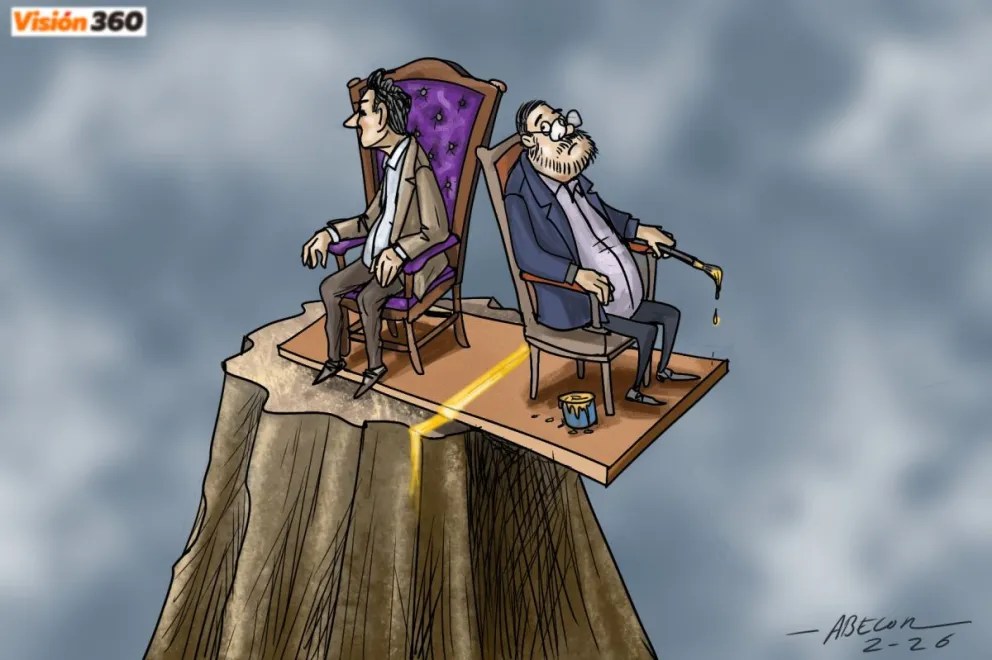
The departure of José Luis Lupo from the Ministry of the Presidency and his appointment as ambassador to the OAS effectively bring to a close the alliance with Samuel Doria Medina. That political bloc had already announced the breakup. The new cabinet now confirms that Rodrigo Paz will govern with his own team.
This poses a significant challenge: the government will have to build parliamentary majorities on a project-by-project basis, in a political environment where negotiations are likely to become more complex.
2. The Government Wants to Project Austerity and Efficiency
The elimination of the Ministry of Planning and the downgrading of the Ministry of Tourism into a National Agency for Tourism, Folklore, and Gastronomy send a clear signal: the executive branch wants to present a leaner state, with less bureaucracy and a more streamlined institutional structure.
This message resonates with public demands for austerity and greater efficiency. However, its credibility will depend on results. Will public spending, government positions, and bureaucracy actually be reduced, or will only the names of institutions change?
3. A Foreign Minister with Human Rights Experience, Not a Career Diplomat
The appointment of Héctor Francisco Huanca Gutiérrez as foreign minister—a figure with experience in human rights, mediation, and conflict resolution rather than a career diplomat—suggests that the government is betting on a Foreign Ministry focused on dialogue and negotiation. Nothing more can be inferred at this stage.
Nevertheless, the new foreign minister will inherit a weakened institution, with several diplomatic missions operating with insufficient staff. His main challenge will not simply be representing the country abroad, but rebuilding the capacity of Bolivia’s foreign service.
Three Questions Still Unanswered
Every cabinet reshuffle is intended to send a message. This one appears to signal that Rodrigo Paz is beginning a new phase: governing with his own team, reducing the size of the state, and reorganizing the foreign service under someone without a diplomatic career background.
In politics, messages create expectations. From this point forward, citizens will judge not the composition of the 12 ministries, but the results. Will the government become more efficient? Will it save public resources? Can it govern without a stable coalition in the Legislative Assembly?
The answers to those three questions will determine whether Monday’s reshuffle marked the beginning of a new chapter or merely a change of names.
Por Andrés Gómez Vela, Facebook:
Los cambios realizado por el presidente Rodrigo Paz no parecen responder únicamente a una renovación de ministros. En conjunto, transmiten tres mensajes políticos que marcarán el rumbo de la segunda etapa de su gobierno.
1. Se acabó el gobierno de coalición
La salida de José Luis Lupo del Ministerio de la Presidencia y su nominación como embajador ante la OEA cierran, en los hechos, la etapa de la alianza con Samuel Doria Medina. La ruptura ya había sido anunciada por ese bloque político. Ahora, el gabinete confirma que Rodrigo Paz gobernará con un equipo propio.
Eso supone un desafío importante: el Gobierno deberá construir mayorías parlamentarias proyecto por proyecto, en un escenario donde la negociación será más compleja.
2. El Gobierno quiere proyectar austeridad y eficiencia
La eliminación del Ministerio de Planificación y la reducción del Ministerio de Turismo a una Agencia Nacional de Turismo, Folklor y Gastronomía envían una señal: el Ejecutivo quiere mostrar un Estado más pequeño, con menos burocracia y una estructura más concentrada.
Es un mensaje que conecta con una demanda ciudadana de austeridad y mayor eficiencia. Sin embargo, su credibilidad dependerá de los resultados. ¿Se reducirán realmente el gasto público, los cargos y la burocracia, o solo cambiarán los nombres de las instituciones?
3. Canciller con experiencia en DDHH, no diplomático de carrera
La designación de un canciller (Héctor Francisco Huanca Gutiérrez) con experiencia en derechos humanos, mediación y resolución de conflictos, en lugar de un diplomático de carrera, indica que el Gobierno parece apostar por una Cancillería orientada al diálogo y la negociación. Sólo eso.
No obstante, el nuevo canciller asumirá una institución debilitada, con varias representaciones diplomáticas que operan con personal insuficiente. Su principal desafío no será solo representar al país, sino reconstruir la capacidad del servicio exterior.
Tres preguntas por responder
Todo cambio de gabinete busca enviar un mensaje. Este parece decir que Rodrigo Paz inicia una nueva etapa: gobernar con su propio equipo, reducir el tamaño del Estado y reorganizar el servicio exterior con alguien que carece de carrera diplomática.
En política, los mensajes generan expectativas. A partir de ahora, la ciudadanía no evaluará a los 12 ministerios, sino los resultados. ¿Logrará el gobierno ser más eficiente? ¿Ahorrará recursos públicos? ¿Podrá gobernar sin una coalición estable en la Asamblea Legislativa?
Las respuestas a esas tres preguntas mostrarán si el reajuste de este lunes fue el inicio de una nueva etapa o simplemente un cambio de nombres.


Leave a Reply