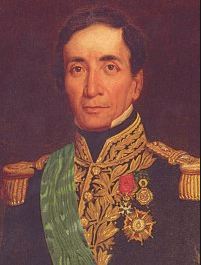
By Juan José Toro, Brújula Digital:
Santa Cruz, the Royalist
Andrés de Santa Cruz was a royalist during most of the War of Independence, but he switched to the patriot side in January 1820.

Andrés de Santa Cruz was a royalist during most of the War of Independence, but he switched to the patriot side in January 1820. In the context of the crisis of the colonial order, was that change due to ideological conviction, political pragmatism, or in response to his mestizo identity?
To find answers, one must begin with the origins of Josef Andrés de Santa Cruz y Calahumana who, as Alfonso Crespo himself details, came from an illustrious family on his father’s side.
This figure was educated as was appropriate for the wealthy of the time: the son of a field marshal with recognized ancestry, he entered the royalist army when he was 17 years old and built his career under that banner.
His promotions were fundamentally due to actions against the independence forces, and some of them were very distinguished, such as, for example, the Battle of Guaqui in which José Manuel de Goyeneche obtained a resounding victory against the River Plate troops of Antonio Gonzáles Balcarce and Juan José Castelli. Another historic episode in which Santa Cruz participated was the campaign against Mateo Pumacahua, in which he helped exterminate scattered guerrilla groups.
In the Cinti campaign, which ended with the execution of Vizente Camargo, he commanded a cavalry squadron (Norberto Torres), and his contribution to the destruction of the Potosí guerrilla leader was so notable that Colonel Buenaventura Centeno even entrusted him with the task of delivering Camargo’s horse to Commander Joaquín de la Pezuela (Torres), who shortly afterward was appointed viceroy of Peru.
Although Crespo does not mention Guaqui or Pumacahua, he does acknowledge Santa Cruz’s role in the fall of Camargo: “Thus concludes the ‘Republiqueta de Cinti,’ destroyed by Centeno, Santa Cruz, and Olarría. So incredible is the victory that the Spanish commander attributes it to ‘a miracle of Our Lady of Carmen.’”
In the Battle of Tarija, which many still call “of La Tablada,” he was on the royalist side and was taken prisoner. “Santa Cruz is sent to Tucumán and later to the concentration camp that the Government of Buenos Aires maintains in Las Bruscas. There he languishes for a long time, until—with the help of British corsairs—he manages to escape, entering Brazil, to arrive afterward, after multiple hardships, in Rio de Janeiro” (Crespo).
He requests to be reinstated in the Royal Army, so “the Viceroy appoints him second commander of the southern coast, with jurisdiction up to Nazca (Peru), and later, Military Chief of the Port of Chorrillos.”
We are already in October 1820, and Juan Antonio Álvarez de Arenales’ expedition has managed to reach Ica and coordinates its actions with José de San Martín. In order to stop him, Viceroy De la Pezuela orders the O’Reilly division, in whose ranks Santa Cruz is found, to operate in harmony with the column of General (Manuel) Quimper, which is located in Pisco (Crespo).
This episode is so important that Spanish historians also highlight it: “when no one was unaware anymore of the fortunate advance of the daring Arenales, Brigadier O’Relly left Lima for Cerro de Pasco with an under-strength battalion and a militia squadron of the Carabaillo dragoons, the first commanded by the distinguished D. Manuel Sánchez, and the second by the brevet colonel D. Andrés Santa Cruz” (García Camba).
“Then, upon receiving news that Álvarez de Arenales was in Jauja, (the viceroy) ordered O’Reilly to attack Cerro de Pasco. His purpose was to catch Álvarez de Arenales between two fires” (Crespo).
But things go wrong. According to García Camba, the royalist divisions were composed “both of inexperienced troops and carelessly dressed so that they could not withstand the harsh temperature of the mountain range. The result, therefore, was, as was to be feared, disastrous for the Spanish arms…” (342). On December 6, 1820, Álvarez de Arenales defeated the royalists at Cerro de Pasco, causing them 58 deaths, 15 wounded, and 343 prisoners, among whom were Santa Cruz and O’Reilly. The latter could not bear the dishonor and committed suicide with a shot to the heart (Ibid.).
“With greater philosophy, Andrés Santa Cruz handed his sword to Major Juan Lavalle, and was then taken into the presence of General San Martín.” And it is at this point in his life that Josef Andrés de Santa Cruz y Calahumana made one of the most transcendental decisions of his life: he changed sides.
It is Crespo who describes it best, so we turn to him to reflect it: “Santa Cruz has fought with courage, no one doubts it; but this time his spirit falters and his pride is humbled. Perhaps that hidden voice that seems to arise from the deepest part of his spirit has spoken to him again and has reproached him, very quietly, for fighting against his compatriots.
“His conviction as a royalist soldier wavers. After all, for whom does he fight? For a monarch whom he does not know and from whom thousands of kilometers separate him; for a political system rejected by the Americans. Against whom? Against his brothers in race, against his countrymen. His commanders are Spaniards. His adversaries, Argentines and Peruvians. At some point he has felt and been troubled by the arrogance of the royalists and the strangeness of the Creoles, given his position as an American defending Spain’s interests.
“Besides, he is a skilled calculator. The experience gathered in these last campaigns warns him that the independence of the Colonies is a fatal historical fact, which may be postponed, but cannot be stopped. The insurrection grows stronger every day, and the libertarian spirit has spread throughout America like a fire.
“The royalists may obtain some more military victories, but it is undeniable that in the end they will be irreversibly defeated. What, then, will be the fate of the Americans who helped them?
“A tormenting dilemma arises before him. Should he continue fighting for the king? Would it not be more noble—and also more convenient—to place his sword at the service of those who fight and die to achieve their freedom? “However, he is bound by moral commitments. He owes much to the royalists and with them he became a soldier. His father, Don Joseph, gave his life in service of this cause. It is not possible to suddenly deny the past, because it will always rise up, like an impalpable but accusing shadow.
“What should he do? “The call of the land becomes more pressing. That mysterious voice repeats to him that the independence of America is near. Battles may be lost, but the war will be won, because such is the kairos of the century. America will be free. The dynamics of events inevitably lead to that result. “He no longer hesitates. On January 8, 1821, he offers his services to General José de San Martín, and the latter accepts them immediately. “Andrés Santa Cruz, the royalist, no longer exists.”
The historian seems to have understood the change that took place in Santa Cruz on that date, and the key lies in one single line of his: “he is a skilled calculator.”
And the person who also seemed to notice it, but in the 19th century, was Andrés García Camba y de las Heras, a Spaniard from Lugo who fought in the War of Independence and, therefore, had information from the very moment in which he lived. For him, as for the majority of Spaniards of his time, Josef Andrés de Santa Cruz y Calahumana made his decision before the Battle of Cerro de Pasco: “Among the prisoners of such an unfortunate encounter were Colonel Sánchez, commander of the infantry, Brigadier O’Relly and his very brave aide-de-camp D. Eustaquio Barron, and with strong suspicions of not having been loyally supported by the cavalry commander D. Andrés Santa Cruz” (García Camba, 342 and 343).
The accusation is serious: for the Spaniards, Santa Cruz committed treason because he had already previously reached an agreement with the independence forces (“he is a skilled calculator”) and during the Battle of Cerro de Pasco he showed negligence that may have influenced the final outcome. That fact would have determined his destiny because, following García Camba’s account, after O’Reilly’s suicide he was “taken to the camp of the independents, joined their banners, and was later Grand Marshal and president of the newly born republics of Bolivia and Peru.”
Juan José Toro is founder of the Historical Research Society of Potosí (SIHP).
Por Juan José Toro Montoya, Brújula Digital:
Santa Cruz, el realista
Andrés de Santa Cruz fue realista durante la mayor parte de la Guerra de la Independencia, pero se pasó al bando patriota en enero de 1820.
Andrés de Santa Cruz fue realista durante la mayor parte de la Guerra de la Independencia, pero se pasó al bando patriota en enero de 1820. En el contexto de la crisis del orden colonial, ¿ese cambio fue por convicción ideológica, pragmatismo político o en atención a su identidad mestiza?
Para encontrar respuestas, hay que partir del origen de Josef Andrés de Santa Cruz y Calahumana que, como detalla el propio Alfonso Crespo, proviene de una ilustre familia por el lado paterno.
Este personaje fue formado conforme correspondía a los pudientes de la época: hijo de un maestre de campo con reconocida ascendencia, ingresó al ejército realista cuando tenía 17 años e hizo carrera bajo ese estandarte.
Sus ascensos se debieron fundamentalmente a acciones en contra de las tropas independentistas, y algunas de ellas muy ilustres como, por ejemplo, la Batalla de Guaqui en la que José Manuel de Goyeneche obtuvo una resonante victoria contra las tropas rioplatenses de Antonio Gonzáles Balcarce y Juan José Castelli. Otro episodio histórico en el que Santa Cruz tuvo participación fue en la campaña contra Mateo Pumacahua, en la que ayudó a exterminar a guerrillas dispersas.
En la campaña de Cinti, que culminó con la ejecución de Vizente Camargo, estuvo al mando de un escuadrón de caballería (Norberto Torres) y su aporte en la destrucción del guerrillero potosino fue tan notable que, incluso, el coronel Buenaventura Centeno le encomendó la tarea de entregar el caballo de Camargo al comandante Joaquín de la Pezuela (Torres) que, poco después, fue nombrado virrey del Perú.
Aunque Crespo no habla de Guaqui ni Pumacahua, sí admite el papel de Santa Cruz en la caída de Camargo: “Así concluye la “Republiqueta de Cinti”, destruida por Centeno, Santa Cruz y Olarría. Tan increíble es la victoria que el jefe español la atribuye a ‘un milagro de Nuestra Señora del Carmen’”.
En la Batalla de Tarija, que muchos siguen llamando “de la Tablada”, estuvo en el bando realista y fue tomado prisionero. “Santa Cruz es remitido a Tucumán y posteriormente al campo de concentración que el Gobierno de Buenos Aires posee en Las Bruscas. Allí languidece por mucho tiempo, hasta que –ayudado por unos corsarios británicos– logra fugarse, internándose en el Brasil, para llegar después de múltiples peripecias, a Río de Janeiro” (Crespo).
Solicita reincorporarse al Ejército realista así que “el Virrey le designa segundo comandante de la costa sur, con jurisdicción hasta Nazca (Perú), y luego, Jefe Militar del Puerto de Chorrillos”).
Ya estamos en octubre de 1820 y la expedición de Juan Antonio Álvarez de Arenales ha logrado llegar hasta Ica y coordina sus acciones con José de San Martín. Con el fin de frenarlo, el virrey De la Pezuela ordena a la división O’Reilly, en cuyas filas se encuentra Santa Cruz, operar en armonía con la columna del general (Manuel) Quimper que se halla en Pisco (Crespo).
Este episodio es tan importante que también lo destacan los historiadores españoles: “cuando ya nadie ignoraba la afortunada marcha del atrevido Arenales, salió de Lima para el cerro de Pasco el brigadier O’Relly con un batallón bajo de fuerza y un escuadrón de milicias de los dragones de Carabaillo, mandado el primero por el acreditado D. Manuel Sánchez, y el segundo por el coronel graduado D. Andrés Santa Cruz” (García Camba).
“Luego, al tener noticia que Álvarez de Arenales se halla en Jauja, (el virrey) dispone que O’Reilly ataque el Cerro de Pasco. Su propósito es coger entre dos fuegos a Álvarez de Arenales (Crespo).
Pero las cosas salen mal. Según García Camba, las divisiones realistas estaban compuestas “ambos de tropa poco experimentada y descuidadamente vestida para poder resistir la rigorosa temperatura de la cordillera. El resultado pues, fue, como era de temer, funesto a las armas españolas…” (342). El 6 de diciembre de 1820, Álvarez de Arenales derrotó a los realistas en Cerro de Pasco causándoles 58 muertos, 15 heridos y 343 prisioneros entre los que se encontraban Santa Cruz y O’Really. Este último no soporta la deshonra y se suicida con un balazo en el corazón (Ídem).
“Con más filosofía, Andrés Santa Cruz entrega su espada al mayor Juan Lavalle, siendo conducido luego a presencia del general San Martín”. Y es en este punto de su vida que Josef Andrés de Santa Cruz y Calahumana toma una de las decisiones más trascendentales de su vida: cambia de bando.
Es Crespo quien lo describe de mejor manera, así que recurrimos a él para reflejarlo: “Santa Cruz ha combatido con denuedo, nadie lo duda; pero esta vez su ánimo flaquea y su orgullo se abate. Quizá ha vuelto a hablarle esa voz recóndita que parece surgir de lo más hondo de su espíritu y le ha reprochado, muy a la sordina, el que combate contra sus compatriotas.
“Vacila su convicción de soldado realista. Al fin ¿por quién lucha? Por un monarca al que no conoce y de quien le separan miles de kilómetros; por un sistema político repudiado por los americanos. ¿Contra quiénes? Contra sus hermanos de raza, contra sus paisanos. Sus jefes son españoles. Sus adversarios, argentinos y peruanos. Alguna vez le ha alcanzado y mortificado la altivez de los realistas y la extrañeza de los criollos, ante su posición de americano defendiendo los intereses de España.
“Además, hábil calculador es. La experiencia recogida en estas últimas campañas, le advierte que la independencia de las Colonias es un hecho histórico fatal, que podrá postergarse, pero no detenerse. La insurrección es cada día más vigorosa y el espíritu libertario ha cundido por toda América, como un incendio.
“Podrán los realistas obtener algunos triunfos militares más, pero es indudable que al final serán irremisiblemente vencidos. ¿Cuál, entonces, la suerte de los americanos que les ayudaron?
“Un dilema torturante se plantea ante él. ¿Deberá seguir combatiendo por el rey? ¿No sería más noble –y también más conveniente– poner su espada en servicio de aquellos que pelean y mueren por conseguir su libertad? “Empero, está reatado a compromisos morales. Mucho debe a los realistas y con ellos se ha hecho soldado. Su padre, don Joseph, ha rendido la vida en servicio de esta causa. No es posible renegar súbitamente del pasado, pues él se alzará siempre, como sombra impalpable pero acusadora.
“¿Qué hacer? “El llamado de la tierra se toma más apremiante. Esa su voz misteriosa, le repite que la independencia de América está próxima. Podrán perderse combates, pero la guerra será ganada, porque tal es el kairos del siglo. América será libre. La dinámica de los acontecimientos conduce fatalmente a ese resultado. “No vacila ya. El 8 de enero de 1821 ofrece sus servicios al general José de San Martín y éste los acepta al punto. “Andrés Santa Cruz, el realista, no existe más”.
El historiador parece haber entendido el cambio que se operó en Santa Cruz en aquella fecha y la clave está en una sola de sus líneas: “hábil calculador es”.
Y quien también pareció advertirlo, pero en el siglo XIX, fue Andrés García Camba y de las Heras, español de Lugo que combatió en la Guerra de la Independencia y, por tanto, tuvo información del momento en el que le tocó vivir. Para él, como para la mayoría de los españoles de su tiempo, Josef Andrés de Santa Cruz y Calahumana tomó su decisión antes de la Batalla de Cerro de Pasco: “Entre los prisioneros de tan desgraciado encuentro se contaban el coronel Sánchez, jefe de la infantería, el brigadier O’Relly y su bizarrísimo ayudante de campo D. Eustaquio Barron, y con vehementes sospechas de no haber sido lealmente secundados por el jefe de la caballería D. Andrés Santa Cruz” (García Camba, 342 y 343).
La acusación es grave: para los españoles, Santa Cruz cometió traición porque ya estuvo avenido anteriormente con los independentistas (“hábil calculador es”) y durante la batalla de Cerro de Pasco mostró una negligencia que pudo haber influido en el resultado final. Ese hecho habría determinado su destino porque, siguiendo la relación de García Camba, luego del suicidio de O’Really fue “conducido al campo de los independientes, tomó partido bajo sus banderas, y fue mas tarde gran mariscal y presidente de las repúblicas nacientes de Bolivia y del Perú”.
Juan José Toro es fundador de la Sociedad de Investigación Histórica de Potosí (SIHP).
https://brujuladigital.net/sociedad/2026/07/12/cronicasanta-cruz-el-realistajuan-jose-toro-63499


Leave a Reply