By Infobae, Eju.tv:
José Luis Lupo, Bolivia’s Minister of the Presidency: “We Are at a Turning Point Between the Past and the Future”
After more than two weeks of social unrest, the chief of staff explained the government’s interpretation of the country’s situation
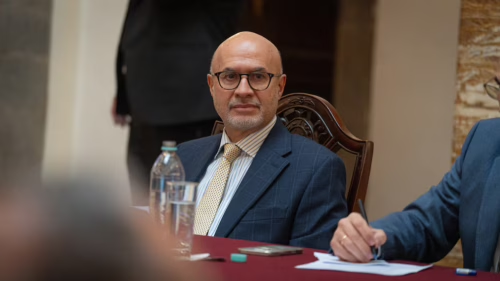
Minister José Luis Lupo, chief of staff to Rodrigo Paz, spoke with Infobae about the conflicts in Bolivia, which for more than two weeks has been paralyzed by road blockades demanding the president’s resignation.
Lupo, a technocrat trained in multilateral organizations with experience in three previous governments, is cautious when pointing out what actions the Paz administration will take in response to the protests, but he assures that negotiations are continuing nonstop with the sectors whose demands they consider legitimate.
In this interview, the “superminister,” who accumulated powers and responsibilities as the government settled in, admitted that certain contradictions between campaign promises and public management caused social discontent. With occasional self-criticism between the lines, Lupo emphasized the government’s willingness to include all social sectors in decision-making and stated that the Economic and Social Council being created is a response to that demand.
—Minister, what is the government’s interpretation of the social protests affecting the country?
This is not a conflict like those that happen every year when there is a wage-related protest movement. Something different is happening here; we are at a turning point between the past and the future. I would separate three groups here: a wage-related protest movement; another made up of peasant sectors from western Bolivia, whom we recognize it is absolutely fair to address through a policy of social inclusion because they are historically neglected sectors; and a political movement of destabilization and attack against Bolivian democracy that comes with a single slogan, a seditious and unacceptable one, which is the resignation of the president.
—This indigenous group from the west that you mention has stated through its spokespeople that it feels excluded from decision-making. What is your opinion on that?
That is the underlying issue. What is being demanded here is not a traditional or wage-related claim, nor are they conspiratorial movements, but rather the clear recognition of a neglected sector that must be the object of an inclusive policy in order to respond to a situation of poverty and inequality. They have a list of demands covering many things, basically development opportunities and demands for inclusion.
—What does the government understand by inclusion in this context?
The western groups that gave a mandate to the government, because they clearly voted for this government, feel disappointed because they had a series of needs that are not simply solved through agreements. This is a demand for inclusion in terms of shared responsibility.
We need to work and jointly manage this vision of Bolivia with them so that it does not appear — because it has never been the president’s intention — that the country is governed for one sector or one region. We want all regions and all sectors to feel represented and also responsible for delivering concrete results.
—You mention that these sectors voted for President Paz, and they are the same sectors now pointing out contradictions between what was promised during the campaign and what has been done during the six months in office. Do you believe these observations are legitimate?
Yes, I believe so. They are legitimate, and it is in the interest of the government’s political project to achieve full inclusion and shared responsibility. There should be no confusion about this vision, which integrates the popular and rural sectors with a modern Bolivia, an exporting Bolivia. We must be capable of fully integrating these demands.
—Some ministers have accused the protesters of receiving money from drug trafficking to finance the mobilizations, but they have not gone into detail. What concrete indications does the government have that this is the case?
That is handled by the Ministry of Government and is part of state security matters; it must be managed with the necessary confidentiality and prudence. But there is clearly a political intention driven by interests that border on illegality in Bolivia.
—Where does Evo Morales fit within the map of the conflict you are describing?
At the moment when Evo Morales is calling for elections to be held within 90 days, he is entering this seditious field because what he is asking for is the president’s resignation.
—Do you believe there are interests seeking Vice President Edmand Lara to take office, given that he has openly declared himself opposed to the government?
He is an institutional and democratic vice president; he was elected as part of a ticket. This is his government; therefore, he could not be against it.
—What is the government’s plan to defuse the tension of recent days? You have mentioned cabinet reforms and the creation of the Economic and Social Council. Is there anything else?
The Economic and Social Council is simply the first step: opening the door, discussing our reality, examining our participation, and how we organize ourselves to achieve greater inclusion of these sectors and address the development demands of the communities. This is the most important issue and it must emerge from dialogue. That is our proposal, and we are waiting for it to materialize.
—The government’s agenda includes drafting a package of ten laws. What is your plan to prevent this process from triggering new conflicts, and how is coordination with the Legislature progressing for their approval?
There are three stages. The first is the drafting of the law, which is almost finished. The second is approval in the Assembly, for which a working basis has been created with the different parties. And the most important stage is the implementation of the laws, which depends on proper public outreach and the level of understanding among the different sectors. The Economic and Social Council will be an extremely important body for explaining and socializing the laws.
—On another matter, I wanted to ask you about the distrust that the rapprochement with the United States and international financial organizations has generated in some sectors. To what extent are the government’s decisions conditioned by these new relationships?
To no extent whatsoever, and I say this with complete clarity: zero. Bolivia has zero international conditioning. We are doing our work convinced that this is the only sustainable model. Bolivia needed stability; that is what we are building. It is the foundation for everything else. No organization or country conditions this; it is our own model, which we believe is the only viable one.
—Given the terrible social cost of the blockades in La Paz, what deadline does the government have to put an end to these conflicts?
As soon as possible. We are acting with a total sense of urgency. We know it has already been many days in which the population has been suffering, and we truly empathize with that situation. We ask for a little patience because we are acting with great responsibility and prudence.
By Carlos Corz
Por Infobae, Eju.tv:
José Luis Lupo, ministro de la Presidencia de Bolivia: “Estamos en un punto de inflexión entre el pasado y el futuro”
Tras más de dos semanas de conflictos sociales, el jefe de Gabinete explicó la lectura del gobierno sobre la situación del país
El ministro José Luis Lupo, jefe de gabinete de Rodrigo Paz, conversó con Infobae sobre los conflictos en Bolivia, que desde hace más de dos semanas está paralizada por bloqueos de carreteras que exigen la renuncia del primer mandatario.
Lupo, un tecnócrata formado en organismos multilaterales con experiencia en tres gobiernos anteriores, es cauto al señalar cuáles son las acciones que asumirá la administración de Paz frente a las protestas, pero asegura que se está negociando sin pausa con los sectores que tienen demandas que consideran legítimas.
En esta entrevista, el “superministro” que sumó atribuciones y responsabilidades a medida que el gobierno se acomodaba, admitió que ciertas contradicciones entre las promesas electorales y la gestión pública causaron malestar social. Con una que otra autocrítica entre líneas, Lupo subrayó la voluntad del gobierno de incluir a todos los sectores sociales en la toma de decisiones y afirmó que el Consejo Económico y Social que se está creando es una respuesta a ese reclamo.
—Ministro, ¿cuál es la lectura que hace el gobierno de las protestas sociales que atraviesa el país?
Este no es un conflicto como los que suceden cada año cuando hay un movimiento reivindicativo salarial. Acá está ocurriendo algo diferente; estamos en un punto de inflexión entre el pasado y el futuro. Yo separaría acá tres grupos: un movimiento reivindicativo salarial, otro de sectores campesinos del occidente, a quienes nosotros reconocemos que es absolutamente justo atender en una política de inclusión social porque son sectores históricamente postergados; y un movimiento político de desestabilización y ataque a la democracia boliviana que viene con una sola consigna, sediciosa e inaceptable, que es la renuncia del presidente.
-Este grupo indígena de occidente que usted menciona ha manifestado, a través de sus voceros, que se siente excluido de la toma de decisiones. ¿Qué opina al respecto?
Ese es el tema de fondo. Acá no se está pidiendo una reivindicación tradicional ni salarial y tampoco son movimientos conspirativos, sino el claro reconocimiento de un sector postergado que debe ser objeto de una política inclusiva para dar respuesta a una situación de pobreza y desigualdad. Ellos tienen un pliego que va de muchas cosas, básicamente, oportunidades de desarrollo y demanda de inclusión.
—¿Qué entiende el gobierno por inclusión en este contexto?
Los grupos del Occidente que le dieron un mandato al gobierno, porque claramente votaron por este gobierno, se sienten defraudados porque tenían una serie de necesidades que no son objeto simplemente de acuerdos. Es una demanda de inclusión en términos de corresponsabilidad.
Necesitamos trabajar y cogestionar con ellos esta visión de Bolivia para que no parezca, porque nunca ha sido la intención del presidente, que se gobierna para un sector o una región. Queremos que todas las regiones y todos los sectores se sientan representados y responsables también para dar resultados concretos.
-Usted menciona que estos sectores votaron por el presidente Paz, y son estos mismos sectores los que ahora apuntan contradicciones entre lo que se prometió en campaña y lo que se hizo durante los seis meses de gestión. ¿Cree que son legítimas estas observaciones?
Sí, yo creo que sí. Son legítimas y es interés del proyecto político del gobierno la incorporación plena y la corresponsabilidad. No debe haber ninguna confusión sobre esta visión que integra lo popular y lo rural, con una Bolivia moderna, una Bolivia exportadora. Debemos ser capaces de integrar completamente estas demandas.
-Algunos ministros han acusado a los manifestantes de recibir dinero del narcotráfico para las movilizaciones, pero no han entrado en detalles. ¿Qué indicios concretos tiene el gobierno de que esto es así?
Eso lo maneja el Ministerio de Gobierno y es parte de la seguridad del Estado, debe manejarse con la reserva y con la prudencia necesaria. Pero claramente hay una intencionalidad política que viene con intereses que rozan lo ilegal en Bolivia.
-¿Dónde se ubica Evo Morales en el mapa del conflicto que usted plantea?
En el momento en que Evo Morales está pidiendo que se llamen a elecciones en 90 días, está entrando en este campo sedicioso porque lo que está pidiendo es la renuncia del presidente.
-¿Cree que hay intereses en que asuma el vicepresidente Edmand Lara, quien se ha declarado abiertamente opositor al Gobierno?
Es un vicepresidente institucional y democrático; ha sido electo en una fórmula. Este es su gobierno; por tanto, no podría estar en contra de él.
– ¿Cuál es el plan del gobierno para desactivar la tensión de estos días? Han mencionado reformas en el gabinete y la creación del Consejo Económico y Social. ¿Hay algo más?
El Consejo Económico y Social es simplemente el primer paso: es abrir la puerta, discutir nuestra realidad, ver nuestra participación y cómo nos ordenamos para tener una mayor inclusión con estos sectores y gestionar las demandas de desarrollo que tienen las comunidades. Es el tema más importante y tiene que ser producto del diálogo. Esa es nuestra propuesta y estamos esperando que se pueda materializar.
–En la agenda del gobierno está la elaboración de un paquete de diez leyes. ¿Cuál es su plan para evitar que este proceso detone nuevos conflictos y cómo va la coordinación con el Legislativo para su aprobación?
Hay tres etapas. La primera es la elaboración de la ley que está casi concluida. La segunda es la aprobación en la Asamblea, para lo cual se ha creado una base de trabajo con los diferentes partidos, y lo más importante es la implementación de las leyes, y eso depende de la adecuada socialización y el grado de comprensión de los diferentes sectores. El Consejo Económico y Social va a ser una instancia importantísima para la socialización de las leyes.
-Por otro lado, quería consultarle sobre la desconfianza que ha suscitado en algunos sectores el acercamiento con Estados Unidos y organismos de financiamiento internacional. ¿Hasta qué punto las decisiones del gobierno están condicionadas por estas nuevas relaciones?
Hasta ningún punto, y se lo digo con total claridad, cero. Bolivia tiene cero condicionamiento internacional. Estamos haciendo nuestro trabajo convencidos de que este es el único modelo sostenible. Bolivia necesitaba estabilidad; eso es lo que estamos construyendo; es el cimiento de cualquier cosa. Ningún organismo ni país condiciona esto; es un modelo nuestro que creemos que es el único viable.
-Dado el terrible costo social de los bloqueos en La Paz, ¿qué plazo tiene el gobierno para poner fin a estos conflictos?
El menor plazo posible. Estamos actuando con un sentido de urgencia total. Sabemos que son ya muchos días en los que la población está sufriendo y realmente empatizamos con esa situación. Le pedimos un poco de paciencia porque estamos actuando con mucha responsabilidad y prudencia.
por Carlos Corz


Leave a Reply