
By Rocío Lloret – La Región, Erbol:
MILESTONE FOR SCIENCE IN BOLIVIA
Clouded tiger cat: Why scientists are amazed by the presence of this species in Cochabamba?
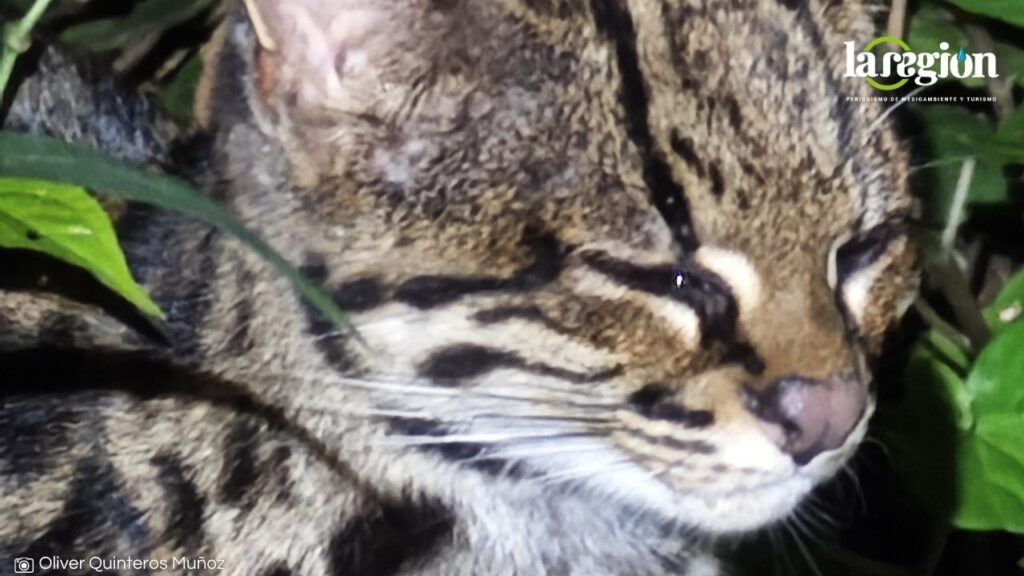
Courtesy of Oliver Quinteros Muñoz.
The night of February 8, 2025 marked a new milestone for science in Bolivia. Around 8:30 p.m., biologist Oliver Quinteros Muñoz, together with other herpetologist researchers, was conducting amphibian and reptile monitoring in the Sehuencas area, inside Carrasco National Park, about 160 kilometers from the city of Cochabamba. While surveying a section of secondary Yungas forest or montane forest, at 2,251 meters above sea level, their flashlight unexpectedly illuminated a feline resting on the branch of a mountain alder tree (Alnus acuminata), only 1.30 meters above the ground.
“The most surprising thing was that the animal appeared docile and remained calm for about eight minutes,” Quinteros-Muñoz told La Región. This passiveness allowed the biologists to approach within two meters and capture high-quality photos and videos using a mobile phone. They were also able to clearly observe the pattern of dark, irregular rosettes and other physical traits. There was no doubt: it was a clouded tiger cat, or Andean oncilla [watch video]; recently elevated to full species status, since until before 2024 it had been considered a subspecies of the tiger cat (L. tigrinus pardinoides).
From chance encounter to scientific paper
The sighting went from being a field anecdote to becoming a scientific milestone once the researchers realized it represented the first formal record for the department of Cochabamba and for Carrasco National Park. After consulting with other experts such as mammalogist Damián Rumiz, Quinteros-Muñoz and the other researchers decided to write a scientific paper presenting the results of their investigation.
Finding the clouded tiger cat in this part of Bolivia helps close an information gap that existed between La Paz and Tarija: 760 kilometers in a straight line between one point and the other. “The first record of Leopardus pardinoides (=L. tigrinus) in Bolivia dates back to 2001, in Apolobamba. In 2017 and 2022 it was recorded in Cotapata (both in northern La Paz). Later, Ximena Vélez-Liendo (an expert in large mammals) provided us with information about a record in Tarija,” says Quinteros-Muñoz.
With the discovery at an intermediate point (Cochabamba), it is now possible to continue studies on the species’ distribution range and to highlight the importance of ecological corridors, or forest connectivity, in this case montane forests or Yungas ecosystems.
“Green corridors or biological corridors allow wildlife to move and distribute continuously from northern La Paz to the south of the country,” says Quinteros-Muñoz.
A discovery at a crucial moment
The study, published in the journal Notas sobre Mamíferos Sudamericanos, identifies the specimen observed in Carrasco National Park by its physical characteristics that distinguish it from other species: a size similar to a domestic cat, short rounded ears, and a pattern of irregular solid-black rosettes over a yellowish-brown background.
From the standpoint of wildlife classification, this record comes at an important time because the Andean oncilla was only recently recognized as an independent species; a classification that is still in the process of being updated in international threat lists such as those of the International Union for Conservation of Nature.
Above all, however, it is a conservation milestone, because it is now known that this small wild cat inhabits a national protected area, which enhances the value of that designation. “In terms of research, it matters because it shows that there is still much left to discover in Carrasco National Park,” concludes Quinteros-Muñoz.
Por Rocío Lloret – La Región, Erbol:
HITO PARA LA CIENCIA EN BOLIVIA
Gato tigre nublado: ¿por qué la ciencia se impacta ante la presencia de esta especie en Cochabamba?
Gentileza Oliver Quinteros Muñoz.
La noche del 8 de febrero de 2025 marcó un nuevo hito para la ciencia en Bolivia. A eso de las 20.30, el biólogo Oliver Quinteros Muñoz junto con otros investigadores herpetólogos, se encontraban en un monitoreo de anfibios y reptiles en la zona de Sehuencas, dentro del Parque Nacional Carrasco, a unos 160 kilómetros de Cochabamba capital. Mientras recorrían un sector de bosque secundario de Yungas o bosque montano, a 2251 metros de altitud, la linterna iluminó inesperadamente a un félido que descansaba sobre una rama de aliso de cerro (Alnus acuminata), a solo 1.30 metros del suelo.
“Lo más sorprendente fue que el animal se mostró dócil y permaneció en calma durante unos ocho minutos”, cuenta Quinteros-Muñoz a La Región. Esta pasividad permitió que los biólogos se acercaran a dos metros de distancia para registrar fotos y videos de calidad utilizando un teléfono móvil. Además, observaron con claridad el patrón de rosetas oscuras e irregulares, y otros rasgos físicos. No había duda, era un gato tigre nublado u oncilla andina [ver video]; recientemente elevado a rango de especie plena, ya que, hasta antes de 2024, se consideraba una subespecie del tigrillo (L. tigrinus pardinoides).
De la casualidad a un documento científico
El avistamiento pasó de ser una anécdota de campo a ser un hito en la ciencia, en el momento en que los investigadores se dieron cuenta que se trataba del primer registro formal para el departamento de Cochabamba y para el Parque Nacional Carrasco. Tras consultar con otros expertos como el mastozoólogo Damián Rumiz, Quinteros-Muñoz junto con los demás investigadores decidieron escribir un paper científico o los resultados de su investigación.
Y es que encontrar al gato tigre nublado en este punto de Bolivia, logra acortar un vacío de información que había entre La Paz y Tarija: 760 kilómetros de distancia en línea recta, entre un punto y otro. “El primer registro de Leopardus pardinoides (=L. tigrinus) en Bolivia data de 2001, en Apolobamba. Por 2017 y 2022 lo registraron en Cotapata (ambos en el norte de La Paz). Después, Ximena Vélez-Liendo (experta en mamíferos de gran tamaño) nos proporcionó la información de un registro en Tarija”, asegura Quinteros-Muñoz.
Con el hallazgo en un punto medio (Cochabamba), es posible continuar estudios sobre el rango de distribución de la especie y resaltar la importancia de los corredores ecológicos o la conexión de bosques, en este caso montanos o Yungas.
“Los corredores verdes o corredores biológicos permiten que la fauna se desplace y se distribuya de forma continua desde el norte de La Paz hasta el sur del país”, asegura Quinteros-Muñoz.
Un hallazgo en un momento clave
El estudio, publicado en la revista “Notas sobre Mamíferos Sudamericanos”, identifica al ejemplar visualizado en el Parque Carrasco por sus características físicas distintas de otras especies: tamaño similar a un gato doméstico, orejas cortas y redondeadas, y un patrón de rosetas irregulares de color negro sólido sobre un fondo pardo amarillento.
Desde el punto de vista de la clasificación de la fauna, este registro llega en un momento importante, porque recientemente la oncilla andina fue reconocida como especie independiente; una identidad que aún está en proceso de actualización de las listas de amenaza internacionales como la UICN.
Pero sobre todo es un hito en términos de conservación, porque ahora se sabe que este tigrillo está en un área protegida nacional, lo cual revaloriza tal denominativo. “En términos de investigación, importa porque muestra que falta mucho por descubrir en el Parque Nacional Carrasco”, finaliza Quinteros-Muñoz.

 Bolivian Thoughts | Pensamientos Bolivianos (Bilingual/Bilingüe)