Tarija was one of the last strongholds liberated by the Army of the Argentine North. The battle was led by the then young Gregorio Aráoz de Lamadrid, supported by local caudillos.
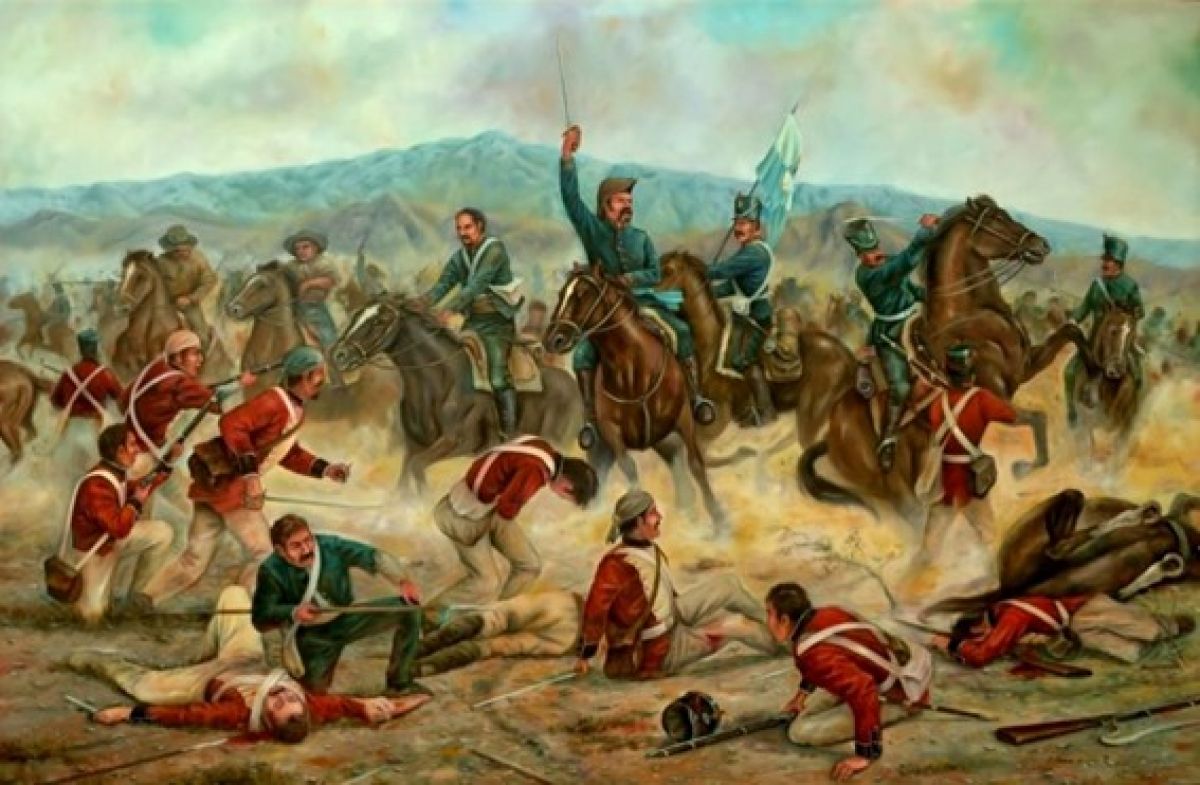
Illustration of the Battle of La Tablada
In Tarija, the days of freedom are counted from April 15, 1817. Although control of the central valley would change hands several times until independence was definitively consolidated, at that moment it became clear that there was no turning back.
The Battle of La Tablada was strategic because it cut off the royalist escape route from the Andean highlands toward the Chaco and the Río de la Plata plains. It is also part of the history linking this department with the Argentine independence process and, in particular, with one of its national heroes: Manuel Belgrano.
Belgrano (1770–1820) was a lawyer, economist, journalist, politician, diplomat, and military leader. Initially a defender of the Viceroyalty of the Río de la Plata against the British invasions, he evolved toward a firm pro-independence stance, albeit with a constitutional monarchist vision that generated political tensions.
In May 1810 he was a central figure in the May Revolution. He participated in the open cabildo of May 22, voted for the removal of the viceroy, and on May 25 was appointed member of the Primera Junta, the seed of Argentina’s first national government.
Although not formally trained as a military officer, he assumed command of the Paraguay expedition and later of the Army of the North. From that position, he sought to consolidate the northern frontier of the United Provinces of the Río de la Plata and project influence toward Upper Peru.
Among his most singular proposals stands out the so-called “Inca Plan,” presented on July 6, 1816 before the Congress of Tucumán: a constitutional monarchy led by an Inca descendant, with a parliamentary system. The initiative, ridiculed by his contemporaries, responded to a political calculation: to attract the support of Andean populations to the independence process.
Along with José de San Martín and Bernardo de Monteagudo, he was one of the promoters of the Declaration of Independence of 1816.
Final Mission in the North
In August 1816, Belgrano resumed command of the Army of the North. Lacking conditions for a new expedition to Upper Peru, he entrusted a key mission: in March 1817 he sent Lieutenant Colonel Gregorio Aráoz de Lamadrid to Tarija, where he took part in the Battle of La Tablada and achieved the liberation of the city.
However, Lamadrid overestimated his possibilities and, with barely 400 men, attempted to seize Chuquisaca by surprise. He was defeated and had to retreat toward Tucumán, crossing mountains and jungle.
Belgrano remained in the north, sustaining the independence cause and containing internal conflicts in Salta and Tucumán. When the government ordered his return—along with San Martín—to control internal tensions, the latter disobeyed, while Belgrano, already ill, reduced his activity.
He arrived in Buenos Aires amid the so-called Anarchy of the Year XX, gravely affected by dropsy, the illness that caused his death on June 20, 1820.
The Roads to Independence
South American independence was consolidated years later thanks to coordinated advances from the south and north of the continent.
The Southern Liberating Expedition, led by José de San Martín from 1819, secured Chile’s independence after the battles of Chacabuco and Maipú, and later that of Peru in 1821.
In parallel, Simón Bolívar led the northern campaign, achieving decisive victories such as Boyacá and Carabobo, which consolidated the independence of Colombia and Venezuela, and later Ecuador.
The process culminated in 1824 with the Battle of Ayacucho, where independence forces under Antonio José de Sucredefinitively defeated royalist power in South America.
What Happened Next in Tarija?
When Bolivia was constituted as a republic on August 6, 1825, Tarija had already exercised de facto independence for at least 16 years, according to Miguel Molina, and likely longer. The “Tarija question” dates back almost to its founding and had a key moment in 1807, when, in an open cabildo, Tarijeños rose against Spanish administration, demanding separation from the Potosí intendancy but also rejecting incorporation into Salta del Tucumán. The seed of independence was already present.
This process resulted from prolonged administrative neglect, except in military matters. Molina argues that Tarija governed itself during the independence struggle and did not depend politically or economically on either Upper Peru or the Río de la Plata. Although there was coordination with military columns from both regions in specific campaigns—such as Suipacha or Cotagaita—he emphasizes that independence cannot be attributed to external forces, but rather to Tarija’s own actions.
In that context, Tarija, Potosí, and northern Argentina became the final stage of royalist resistance, awaiting reinforcements that never arrived due to the European crisis. Meanwhile, the United Provinces of the Río de la Plata had already consolidated independence in 1816. Tarija, however, resisted submission to Salta—though there are historiographical disagreements—both because of troops sent from there and the influence of José María Pérez de Urdininea, who promoted the emancipation cause.
At the beginning of 1825, Urdininea, under orders from Juan Antonio Álvarez de Arenales, participated in a campaign in Upper Peru. After the death of Pedro Antonio Olañeta, he broke from Arenales and advanced northward, receiving the surrender of the last royalist commander in the region, José María Valdez. He later joined the circle of Antonio José de Sucre, who entrusted him with command responsibilities.
At the same time, Simón Bolívar announced his arrival in Upper Peru to restore order, while Sucre called for an Assembly after crossing the Desaguadero, generating tensions with Buenos Aires. Sucre tasked the Irish general Francisco Burdett O’Connor with expanding territorial control; he reached Tarija and promoted its separation from Argentina, consolidating his influence in the region.
Faced with this scenario, the United Provinces decided to grant autonomy to the Upper Peruvian provinces, but not to Tarija, whose conflict remained tied to Salta. Arenales attempted to reassert authority, although Tarija already showed a clear autonomous will. A movement then emerged led by Bernardo Trigo and Eustaquio Méndez, backed by O’Connor, which in practice sought incorporation into Upper Peru.
Despite instructions from Bolívar and Sucre not to intervene, O’Connor removed Governor Felipe Echazú in May 1825 and installed Trigo, who promoted the election of representatives for the Upper Peruvian Assembly. However, Tarija was not convened as an independent entity, and Bolivia was constituted without its participation.
Arenales tried to regain control, and in October 1825 an Argentine delegation presented its claims before Bolívar in Potosí, who accepted them after deliberation, possibly without fully considering Tarija’s will. In February 1826, Tarija was handed over to Argentine delegate Ciriaco Díaz Vélez, but the local cabildo requested autonomy.
The situation led to new conflicts: Arenales appointed Mariano Gordaliza as governor, while the arrest of Eustaquio Méndez, ordered in coordination with O’Connor, sparked a montonero rebellion. They deposed the imposed authority, restored Trigo, and declared their adherence to Bolivia on August 26, 1826.
Finally, in September of that year, Tarija’s deputies were admitted in Chuquisaca, and on October 3 Antonio José de Sucreenacted the law that formalized its incorporation into Bolivia’s Constituent Congress. The war between the United Provinces and Brazil facilitated this outcome.
Nevertheless, tensions persisted. Tarija’s representatives also participated in the Argentine Congress of 1826, which recognized Tarija as a province, although this decision was never implemented in practice, just like the initial aspiration to become an independent entity within the new South American order.
Key Figures of the Battle of La Tablada
Eustaquio Méndez
Known as “Moto,” he was Tarija’s main independence leader. He actively participated in the Battle of La Tablada alongside the forces sent by Belgrano and in multiple guerrilla actions. His organizational role was decisive in consolidating resistance and securing victory over royalists.
Gregorio Aráoz de Lamadrid
Born in Tucumán in 1795, he was a bold young officer who joined Belgrano’s army. Sent to Tarija, he led the attack at La Tablada that defeated royalist forces. He later attempted to advance on Chuquisaca, where he was defeated. His career was marked by risky actions and mixed results.
Francisco Pérez de Uriondo
A Chilean-born military and politician, he was a key figure in the gaucho war and in coordinating Tarija’s caudillos. He became governor by popular vote and played a significant role in the political organization of the territory, keeping it within the United Provinces of the Río de la Plata.
The Royalist Capitulation; The Beginning of Freedom
After the skirmish at La Tablada, Commander Gregorio Aráoz de Lamadrid recalls in his memoirs that he returned victorious to the San Roque camp amid thunderous cheers from his soldiers and the people who followed him. He then ordered the release of wounded prisoners, instructing them to inform their commander that with only 35 hussars he had defeated more than 140 of their men, and that they had no choice but to surrender or perish within their trenches, which would soon be assaulted.
Lamadrid then moved with all artillery and infantry to the San Juan hill, ordering a ceasefire to observe the effect of the prisoners’ report. Noticing officers running in the plaza and convening a council of commanders, he sent aide Manuel Cainzo with a summons to Lieutenant Colonel and Commander of the Tarija garrison, Mateo Ramírez, stating:
“It has never been improper for honorable officers to surrender unconditionally when they have no means of support nor hope of assistance, as you do. Neither Lubin nor O’Reilly, to whom you have written for this purpose, can do so because they lack the strength to withstand mine. Therefore, you may confirm your surrender, with the understanding that you, your officers, and troops will be treated with all the esteem and distinction befitting my character. If you do not, I will verify what I stated in my dispatch yesterday within five minutes. I assume you are already aware of the fate of Commander Malacabeza, given the prisoners I have sent you, but I inform you nonetheless: there are 65 dead, 40 prisoners, and 70 rifles captured. All of this proves your own ruin and leads me to believe that no more blood will be shed. May God grant you many years. -San Juan Heights, April 15, 1817.”
After a few moments, Lieutenant Cainzo returned, bearing the following reply:
“Having seen your official communication, which I have just received, in which you issue a second ultimatum, anticipating that you have denied the appeals requested from Lubin and O’Relly, due to the seizure, as is implied, of the dispatches I sent to them, I reply that this reason is not sufficient to cause me or my officers to falter in defending His Majesty’s arms in this stronghold to the last, as I still have sufficient forces, well-equipped with what is necessary, as you will see. However, the defeat suffered by the cavalry squadron compels me to enter into capitulation, consulting with the conscience of both divisions, if you will accept it under the following terms: 1. That all members of this garrison be received as prisoners with the honors of war, and that officers be allowed to carry their swords, permitting us to take our baggage to the prisoner depot. 2. That the civilians…” Those of us who have committed to taking up arms shall be treated well, allowing them to live alongside their families. 3rd. –That only regular troops enter the Plaza, preventing any disorder in the town. Under these terms, and persuaded that you, as an honorable officer, know how to observe what has been proposed, we have unanimously agreed, and I await notification of your acceptance. –Tarija, April 15, 1817. –“.
Reply to the previous proposal:
“In your letter, which I have just received, I have seen fit to accept the surrender of that plaza, under the three articles proposed, out of a generosity characteristic of the American spirit, with the understanding that you must immediately leave with the entire garrison to surrender your arms at the field of Las Carreras, located east of the town, with your respective commanders and officers. –May God grant you many years. –Alto de San Juan, April 15, 1817. Gregorio Aráoz de La Madrid.”
Consequently, a short time later, 300 men, led by their commanders and officers, surrendered their weapons to the Argentine flag in the field known as “Las Carreras” in the town of Tarija. Among them were a colonel, three lieutenant colonels, sixteen officers, and three hundred soldiers of the Cuzco Grenadier Regiment. The spoils of this splendid victory included 400 rifles, 140 weapons of all kinds, 8 ammunition boxes, a flag, and numerous other military supplies.
Tarija fue una de las últimas plazas liberadas por el ejército del norte argentino. La batalla fue protagonizada por el entonces joven Gregorio Aráoz de Lamadrid, apoyado por caudillos locales
Ilustración de la Batalla de la Tablada
En Tarija se cuentan los días de libertad desde el 15 de abril de 1817. Aunque el control del valle central cambiaría de manos en varias ocasiones hasta la consolidación definitiva de la independencia, en ese momento quedó claro que no había vuelta atrás.
La Batalla de La Tablada fue estratégica porque cortó la salida realista desde las cumbres andinas hacia el Chaco y la llanura del Río de la Plata. Además, forma parte de la historia que vincula a este departamento con el proceso independentista argentino y, en particular, con uno de sus próceres: Manuel Belgrano.
Belgrano (1770–1820) fue abogado, economista, periodista, político, diplomático y militar. Inicialmente defensor del Virreinato del Río de la Plata frente a las invasiones inglesas, evolucionó hacia una firme postura independentista, aunque con una visión monárquica constitucional que le generó tensiones políticas.
En mayo de 1810 fue protagonista central de la Revolución de Mayo. Participó en el cabildo abierto del 22 de mayo, votó por la destitución del virrey y el 25 de mayo fue designado vocal de la Primera Junta, germen del primer gobierno patrio argentino.
Aunque no era militar de formación, asumió el mando de la expedición al Paraguay y luego del Ejército del Norte. Desde esa posición buscó consolidar la frontera norte de las Provincias Unidas del Río de la Plata y proyectar influencia hacia el Alto Perú.
Entre sus propuestas más singulares destaca el llamado “Plan del Inca”, presentado el 6 de julio de 1816 ante el Congreso de Tucumán: una monarquía constitucional encabezada por un descendiente inca, con un sistema parlamentario. La iniciativa, ridiculizada por sus contemporáneos, respondía a un cálculo político: atraer el apoyo de las poblaciones andinas al proceso emancipador.
Junto a José de San Martín y Bernardo de Monteagudo, fue uno de los impulsores de la Declaración de Independencia de 1816.
Última misión en el norte
En agosto de 1816, Belgrano retomó el mando del Ejército del Norte. Sin condiciones para una nueva expedición al Alto Perú, encomendó una misión clave: en marzo de 1817 envió al teniente coronel Gregorio Aráoz de Lamadrid hacia Tarija, donde participó en la Batalla de La Tablada y logró la liberación de la plaza.
Sin embargo, Lamadrid sobreestimó sus posibilidades y, con apenas 400 hombres, intentó tomar Chuquisaca por sorpresa. Fue derrotado y debió replegarse hacia Tucumán atravesando la sierra y la selva.
Belgrano permaneció en el norte sosteniendo la causa independentista y conteniendo conflictos internos en Salta y Tucumán. Cuando el gobierno ordenó su retorno —junto a San Martín— para controlar las tensiones internas, este último desobedeció, mientras que Belgrano, ya enfermo, redujo su actividad.
Llegó a Buenos Aires en medio de la llamada Anarquía del Año XX, gravemente afectado por hidropesía, enfermedad que le causó la muerte el 20 de junio de 1820.
Los caminos de la Independencia
La independencia sudamericana se consolidó años después gracias al avance coordinado desde el sur y el norte del continente.
La Expedición Libertadora del Sur, liderada por José de San Martín desde 1819, permitió asegurar la independencia de Chile tras las batallas de Chacabuco y Maipú, y posteriormente la del Perú en 1821.
En paralelo, Simón Bolívar encabezó la campaña del norte, logrando victorias decisivas como Boyacá y Carabobo, que consolidaron la independencia de Colombia y Venezuela, y posteriormente de Ecuador.
El proceso culminó en 1824 con la Batalla de Ayacucho, donde las fuerzas independentistas al mando de Antonio José de Sucre derrotaron definitivamente al poder realista en Sudamérica.
¿Y qué pasó después en Tarija?
Cuando Bolivia se constituyó como República el 6 de agosto de 1825, Tarija llevaba al menos 16 años ejerciendo una independencia de facto, según Miguel Molina, e incluso probablemente más. La cuestión tarijeña se remonta casi a su fundación y tuvo un punto clave en 1807, cuando en un cabildo abierto los tarijeños se alzaron contra la administración española, exigiendo separarse de la intendencia de Potosí, pero sin aceptar tampoco su incorporación a la de Salta del Tucumán. El germen independentista ya estaba presente.
Este proceso fue consecuencia de un prolongado abandono administrativo, salvo en lo militar. Molina sostiene que Tarija se gobernó a sí misma durante la lucha independentista y que no dependió ni del Alto Perú ni del Río de la Plata en términos políticos y económicos. Si bien hubo coordinación con columnas militares de ambas regiones en campañas específicas —como en Suipacha o Cotagaita—, remarca que la independencia no puede atribuirse a fuerzas externas, sino a la propia acción tarijeña.
En ese contexto, Tarija, Potosí y el norte argentino se convirtieron en el último escenario de resistencia realista, a la espera de refuerzos que nunca llegaron debido a la crisis europea. Mientras tanto, las Provincias Unidas del Río de la Plata ya habían consolidado su independencia en 1816. Tarija, sin embargo, se resistía a someterse a Salta —aunque hay discrepancias historiográficas—, tanto por el accionar de tropas enviadas desde allí como por la influencia de José María Pérez de Urdininea, quien impulsó la causa emancipadora.
A inicios de 1825, Urdininea, bajo órdenes de Juan Antonio Álvarez de Arenales, participó en una campaña al Alto Perú. Tras la muerte de Pedro Antonio Olañeta, se desligó de Arenales y avanzó hacia el norte, recibiendo la rendición del último jefe realista en la región, José María Valdez. Posteriormente se incorporó al entorno de Antonio José de Sucre, quien incluso le confió responsabilidades de mando.
En paralelo, Simón Bolívar anunció su llegada al Alto Perú para ordenar la situación, mientras Sucre convocaba a una Asamblea tras cruzar el Desaguadero, lo que generó tensiones con Buenos Aires. Sucre encargó al general irlandés Francisco Burdett O’Connor expandir el control territorial, quien llegó a Tarija y promovió su desvinculación de Argentina, consolidando su influencia en la región.
Ante este escenario, las Provincias Unidas decidieron otorgar autonomía a las provincias altoperuanas, pero no a Tarija, cuyo conflicto seguía ligado a Salta. Arenales intentó reafirmar su autoridad, aunque Tarija ya mostraba una clara voluntad autónoma. Surgió entonces un movimiento liderado por Bernardo Trigo y Eustaquio Méndez, respaldado por O’Connor, que en los hechos buscaba la incorporación al Alto Perú.
Pese a las instrucciones de Bolívar y Sucre de no intervenir, O’Connor desplazó en mayo de 1825 al gobernador Felipe Echazú y colocó a Trigo, quien impulsó la elección de representantes para la Asamblea altoperuana. Sin embargo, Tarija no fue convocada como entidad independiente y Bolivia se constituyó sin su participación.
Arenales intentó recuperar el control y, en octubre de 1825, una delegación argentina presentó sus reclamos ante Bolívar en Potosí, quien accedió a ellos tras deliberaciones, posiblemente sin considerar plenamente la voluntad tarijeña. En febrero de 1826, Tarija fue entregada al delegado argentino Ciriaco Díaz Vélez, pero el cabildo local solicitó su autonomía.
La situación derivó en nuevos conflictos: Arenales nombró gobernador a Mariano Gordaliza, mientras que la detención de Eustaquio Méndez, ordenada en coordinación con O’Connor, provocó una rebelión de montoneros. Estos depusieron a la autoridad impuesta, restituyeron a Trigo y declararon su adhesión a Bolivia el 26 de agosto de 1826.
Finalmente, en septiembre de ese año, los diputados tarijeños fueron admitidos en Chuquisaca, y el 3 de octubre Antonio José de Sucre promulgó la ley que oficializó su incorporación al Congreso Constituyente de Bolivia. La guerra entre las Provincias Unidas y Brasil facilitó este desenlace.
No obstante, persistieron tensiones. Representantes tarijeños participaron también en el Congreso argentino de 1826, que reconoció a Tarija como provincia, aunque esta decisión nunca se concretó en la práctica, al igual que la aspiración inicial de constituirse como entidad independiente en el nuevo orden sudamericano.
Los nombres clave de la Batalla de La Tablada
Eustaquio Méndez Conocido como el “Moto”, fue el principal líder independentista de Tarija. Participó activamente en la Batalla de La Tablada junto a las fuerzas enviadas por Belgrano y en múltiples acciones guerrilleras. Su rol organizador fue determinante para consolidar la resistencia y asegurar la victoria sobre los realistas.
Gregorio Aráoz de Lamadrid Nacido en Tucumán en 1795, era un joven militar audaz que se integró al ejército de Belgrano. Enviado a Tarija, lideró el ataque en La Tablada que doblegó a las fuerzas realistas. Posteriormente intentó avanzar sobre Chuquisaca, donde fue derrotado. Su trayectoria estuvo marcada por acciones arriesgadas y resultados dispares.
Francisco Pérez de Uriondo Militar y político de origen chileno, fue una figura clave en la guerra gaucha y en la articulación de los caudillos de Tarija. Llegó a ser gobernador por voto popular y jugó un papel relevante en la organización política del territorio, manteniéndolo dentro de las Provincias Unidas del Río de la Plata.
La capitulación realista; el inicio de la libertad
Después de la escaramuza en La Tablada, el comandante Gregorio Aráoz de La Madrid recuerda en sus memorias que regresó vencedor al campamento de San Roque, entre las atronadoras vivas de sus soldados y del pueblo que lo seguía; luego mandó poner en libertad a los prisioneros que estaban heridos, con especial encargo de ir a ver a su jefe y decirle que sólo con 35 húsares había derrotado a más de 140 de los suyos, que no les quedaba ya más remedio que rendirse o perecer dentro de sus trincheras, que iban en seguida a ser asaltadas.
Luego el comandante La Madrid se trasladó con la artillería toda y los infantes al morro de San Juan, ordenando suspender el fuego para ver qué efecto producía en la plaza el informe de los prisioneros. Al notar correteos de oficiales en la plaza y que llamaban a junta de jefes, destacó al ayudante Manuel Cainzo, con una intimación para el Señor Teniente Coronel y Comandante de la Guarnición de Tarija D. Mateo Ramírez que decía:
“Nunca ha sido impropio de oficiales de honor el rendirse a discreción, cuando no tienen como sostenerse ni esperanza de auxilio como usted, pues ni Lubin, ni O’Relly, a quienes usted ha escrito para el efecto, pueden hacerlo porque no tienen una fuerza capaz de resistir a la mía. En esta virtud puede usted verificar su rendición, en la inteligencia que serán tratados, tanto usted como sus oficiales y tropa, con todo el aprecio y distinción propio de mi carácter y en caso contrario verificaré, dentro de cinco minutos, lo dicho en mi oficio de ayer. Ya lo supongo a usted impuesto de la suerte que ha corrido el comandante Malacabeza por los prisioneros que le he remitido, pero sin embargo le anoticio: que los muertos son 65, prisioneros 40, fusiles tomados 70. Todo lo que prueba su propia ruina y me hace creer que no se derrame más sangre. Dios guarde a usted muchos años. -Alto de San Juan, abril 15 de 1817”.
Después de pocos momentos regresó el teniente Cainzo, portador de la respuesta siguiente:
“Visto el oficio de usted, que acabo de recibir, en que se me hace la segunda intimación, anticipándome haberme negado los recursos pedidos a Lubin y O’Relly, por la toma, según se deja entrever, de los pliegos que remití a estos. Contesto a Ud. que este motivo no es bastante para desmayar yo ni mis oficiales para sostener hasta el último extremo las armas de S.M. en esta plaza, pues aún tengo fuerzas suficientes y bien dotadas de lo necesario, según lo verá Ud. Más la derrota que ha sufrido el escuadrón de caballería me hace entrar en capitulación consultando con la humanidad por parte de ambas divisiones, si la admite usted bajo los términos siguientes. 1°. –Que se nos reciba prisioneros a todos los de esta guarnición con los honores de la guerra, y uso de espadas para los oficiales, permitiéndonos bagajes hasta el depósito de prisioneros. 2°. –Que los paisanos a quienes hemos comprometido a tomar las armas sean bien tratados, permitiéndoseles la existencia al lado de sus familias. 3°. –Que entren en la Plaza solo las tropas de línea, que eviten todo desorden en el pueblo. Bajo estas bases y persuadidos que Ud. como oficial de honor, que sabe observar lo propuesto, hemos venido en ello unánimes y conformes, de cuya aceptación espero el aviso. –Tarija, abril 15 de 1817. –“.
Contestación a la propuesta anterior:
“En el oficio de usted que acabo de recibir he tenido a bien admitir la rendición de esa plaza, bajo los tres artículos propuestos, por una generosidad propia del carácter americano, en la inteligencia de que ahora mismo deberá salir con toda la guarnición a rendir las armas al campo de las Carreras, situado al este del pueblo, con sus respectivos jefes y oficiales. –Dios guarde a usted muchos años. –Alto de San Juan, a 15 de abril de 1817. Gregorio Aráoz de La Madrid”.
En consecuencia, pocos momentos después se presentaron 300 hombres con sus jefes y oficiales a la cabeza y rindieron las armas ante la bandera argentina, en el campo llamado de «Las Carreras» de la Villa de Tarija, un coronel, tres tenientes coroneles, dieciséis oficiales y trescientos soldados del regimiento de los Granaderos del Cuzco. Siendo los trofeos de este espléndido triunfo, 400 fusiles, 140 armas de todas clases, 8 cajas de guerra, una bandera y muchísimos otros pertrechos militares.
https://eju.tv/2026/04/la-tablada-la-batalla-que-sello-el-rumbo-de-tarija/


Leave a comment