By Abel Reynaga, Correo del Sur; Eju.tv:
Historical data supports the authenticity of the relic that is in Santa Teresa
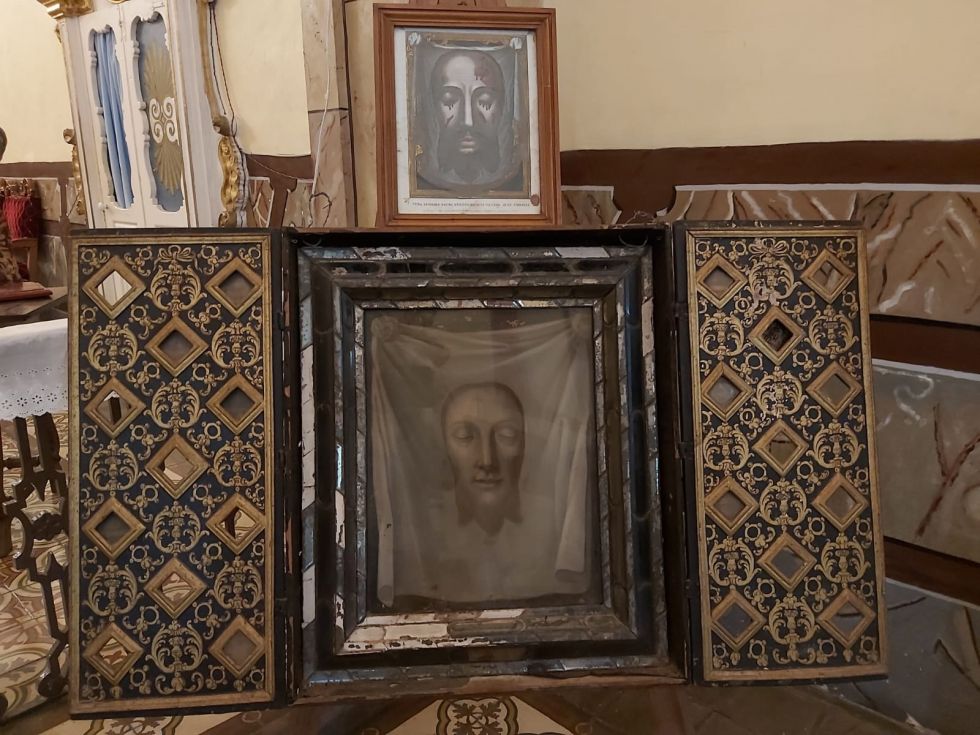
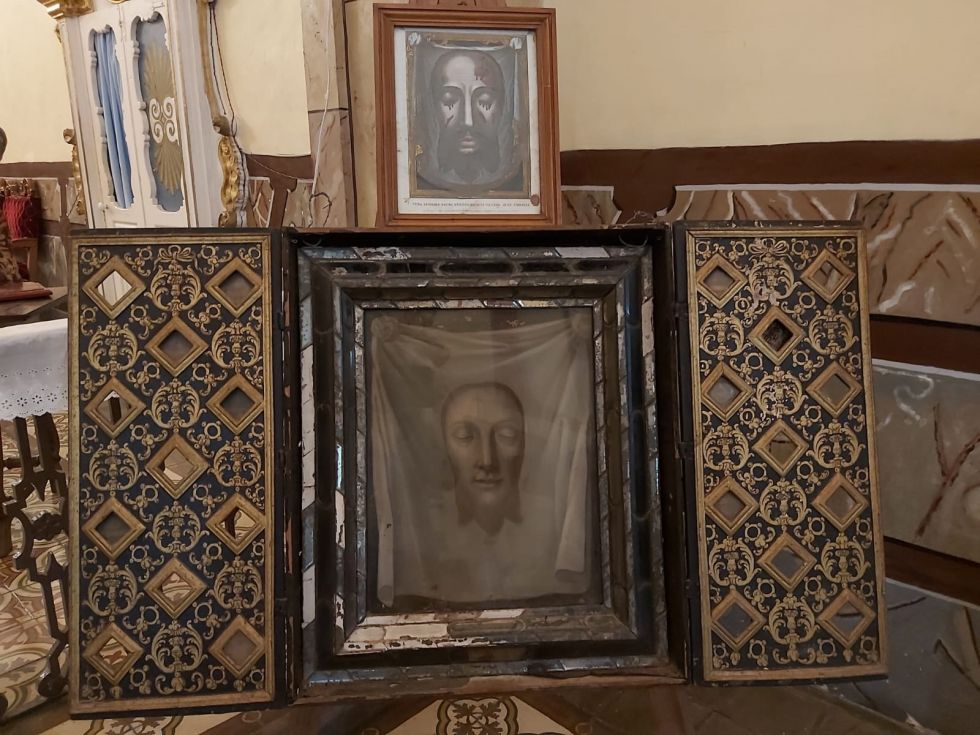
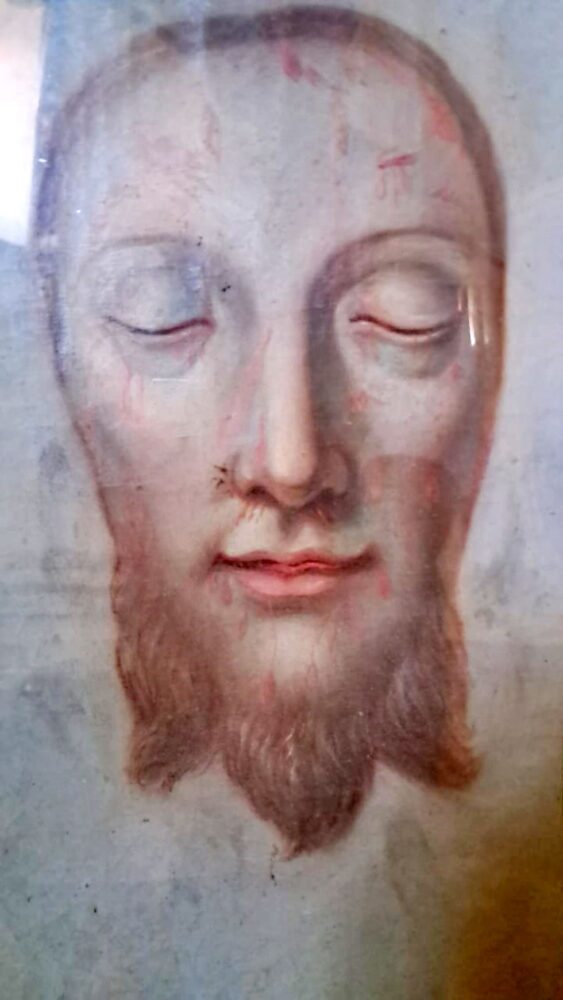
One of the first three replicas of the original painting of the Holy Face or Holy Countenance of Jesus Christ—currently kept in the Basilica of Saint Peter in the Vatican, in Rome, Italy—has been discovered in Sucre; but how did it arrive in the capital?
According to the explanation of Father Bernardo Gantier, delegate of the Commission of Sacred Art and Heritage of the Archdiocese of Sucre, in the world there are first- and second-degree relics: first-degree relics are physical parts of the saint (such as bones, blood, hair), considered the most valuable. Second-degree relics are objects the saint used or possessed in life, such as clothing, books, or personal instruments.
In the Metropolitan Cathedral of the capital, first-degree remains are preserved such as the skull of Pope Saint Clement, or Clement I, known as the fourth Pope. There are also bone remains of the martyr Saint Aquila and Saint Sebastian.
But there are also second-degree relics such as a sleeve of Saint Francis Solano and an original imprint of the Shroud of Turin, that is, a cloth placed directly over the Shroud that copied it exactly.
In that sense, Gantier pointed out that the copy of the Holy Face found in the capital is considered a second-order object.
HISTORY
Gantier told CORREO DEL SUR that currently, on one of the columns of Saint Peter’s Basilica in Rome (Vatican), the Holy Face of Veronica is preserved, “which is believed to be the true face of Jesus.”
He said that, according to archaeological studies, this is the face of Christ copied from the true image of the Shroud, which is currently kept in Turin. “That is to say, they have an image copied with the same features of Jesus, or the ‘vera icon,’ which means the true image of Jesus. This copy is very ancient, dating from the 7th or 8th centuries,” he specified.
The priest explained that in the past in Rome it was forbidden to make copies of that image, but with the authorization of Pope Paul V (1605–1621), three identical copies were made and sent to the three greatest “Majesties of Europe”: “Queen Doña Margaret of Austria, another to the Emperor, who at that time was of Germany, and the third to the Most Christian King of France,” according to the historical fragment cited by Gantier.
“The history we have been able to gather says that the Pope (Paul) at a certain time ordered his painter to make three copies: one was sent to Emperor Maximilian of Austria, Emperor of the Holy Roman Empire, and the other copy was sent to Queen Margaret of Austria, wife of King Philip III of Spain,” he indicated.
He detailed that of these paintings, the whereabouts of two are known, which ended up in the hands of Queen Margaret, since besides the one she received from the Pope, her brother Maximilian also sent her his.
“They say that one of these two copies (the queen) sent to the Convent of the Poor Clares in Lima, which should be there—or we do not know—but the copy from her brother was inherited by one of her maids, who later became a nun in a convent of the Capuchin sisters in Madrid, where she left it,” Gantier mentioned.
HOW DID IT ARRIVE IN SUCRE?
The story recounts that in that convent there was a chaplain of Chilean origin, Antonio Herrera y Toledo, who was later appointed canon of the Cathedral of La Plata, today Sucre, and therefore had to travel from Madrid to what is now the capital of Bolivia.
Before embarking, the cleric ordered the nuns of the Capuchin convent in Madrid to have a copy made of that painting of the Holy Face to take to America; however, at the moment of packing there was a mistake and they packed the original painting.
“It turns out they packed the original, the one that initially belonged to the Emperor (Maximilian), and the copy they had made in the convent was kept by the nuns. The chaplain informed them, but they told him ‘it is God’s will that it go to America with you,’” Gantier recounted. He said that when Antonio Herrera y Toledo was arriving from Lima (Peru) to La Plata (today Sucre), he met Father Ignacio de Arbieto, who at that time was rector of the Jesuit colleges of La Plata, to whom he handed over the relic of the Holy Face for the brotherhood of indigenous people of the Jesuit college.
“Up to that point, the history; up to that point, the documents we have found. But in my mind I kept wondering: where did such an important relic end up? And seeing the things held by the Discalced Carmelite sisters of Santa Teresa, there they had it. The frame is the same as that of the relic in Rome, the Veronica of Saint Peter’s in Rome, which used to be in the church of San Silvestre,” Gantier revealed.
WHEN WAS IT DISCOVERED?
The priest specified that the historical documents about this painting of the Holy Face that arrived in La Plata, today Sucre, were found about 15 years ago, but its location was unknown, since in 1767 the Jesuits were expelled by King Charles III of Spain and their belongings were confiscated.
He pointed out that in his different visits to the Convent of Santa Teresa he had seen the painting in an upper area, but believed it to be other important replicas made in later centuries.
“Last Friday (March 27) we had the painting taken down because it was very high up, and we were able to see that it matches all the data, characteristics, and historical features,” he assured.
He stated that the convent also holds another original copy of the Holy Face, but a more modern one.
Andrea Collazos, head of the Network of Museums of the Catholic Church of Sucre, affirmed that these repositories hold objects still under investigation, emphasizing the importance of their preservation.
“We have a great heritage and we are still investigating what relics exist, as in this case the history of the Holy Face preserved in the Museum of the Convent of Santa Teresa,” she confirmed.
POPE’S SKULL
In the museum of the Metropolitan Cathedral of Sucre, several first-order relics are kept, among them part of the skull of the fourth Pope, Saint Clement I.
Gantier
Father Bernardo Gantier is a prominent Bolivian Jesuit priest, recognized as “Favorite Son of the City” of Sucre in 2018 for his extensive educational, social, and cultural work. He is also an expert in Church history and sacred art, known for his contributions on the Virgin of Guadalupe and the Revolution of 1809.
Por Abel Reynaga, Correo del Sur; Eju.tv:
Datos históricos respaldan la autenticidad de la reliquia que está en Santa Teresa
Foto: Correo del Sur
Descubren en Sucre una de las tres primeras réplicas del cuadro original de la Santa Faz o Rostro Santo de Jesucristo que actualmente se encuentra custodiado en la Basílica de San Pedro del Vaticano, en Roma, Italia; pero, ¿cómo llegó a la capital?
De acuerdo con la explicación del padre Bernardo Gantier, delegado de la Comisión de Arte Sacro y Patrimonio del Arzobispado de Sucre, en el mundo existen reliquias de primer y segundo grado: las de primer grado son partes físicas del santo (como huesos, sangre, cabello), consideradas las más valiosas. Las de segundo grado son objetos que el santo utilizó o poseyó en vida, como ropa, libros o instrumentos personales.
En la Catedral Metropolitana de la capital se guardan vestigios de primer grado como el cráneo del papa San Clemente o Clemente I, conocido como el cuarto Papa. También se tiene restos óseos de la mártir Santa Áquila y de San Sebastián.
Pero también se cuenta con reliquias de segundo grado como una manga de San Francisco Solano y un calco original de la Sábana Santa de Turín, es decir, una tela que se puso directamente sobre la Sábana Santa y la copió tal cual.
En ese sentido, Gantier señaló que la copia de la Santa Faz encontrada en la capital viene a ser un objeto de segundo orden.
HISTORIA
Gantier contó a CORREO DEL SUR que actualmente en una de las columnas de la Basílica de San Pedro de Roma (Vaticano) se conserva la Santa Faz de la Verónica, “que se supone que es el verdadero rostro de Jesús”.
Dijo que según estudios arqueológicos, esta es la faz o rostro de Cristo copiada de la verdadera faz de la Sábana Santa que actualmente se conserva en Turín. “Es decir, tienen una imagen copiada con los mismos rasgos de Jesús, o la ‘vera icon’ que significa la verdadera imagen de Jesús. Esta copia es muy antigua, que proviene de los siglos VII u VIII”, precisó.
El Sacerdote explicó que antiguamente en Roma se tenía prohibido hacer copias de aquella imagen, pero con la autorización del papa Paulo V (1605 y 1621) se elaboraron tres copias idénticas, las cuales fueron enviadas a las tres mayores “Majestades de Europa”: “la Reina Dª Margarita de Austria, otro al Emperador que entonces era de Alemania, y el tercero al Rey Cristianísimo de Francia”, de acuerdo al fragmento histórico citado por Gantier.
“La historia que hemos podido recabar, dice que el Papa (Paulo) en cierta época mandó a su pintor a hacer tres copias: una la mandó al emperador Maximiliano de Austria, emperador del Sacro Imperio Romano Germánico, y la otra copia la mandó a la reina Margarita de Austria, esposa del rey de España, Felipe III”, indicó.
Detalló que de estos cuadros, se sabe el paradero de dos, los cuales fueron a parar a las manos de la reina Margarita, ya que aparte del que recibió del Papa, también su hermano Maximiliano le envió el suyo.
“Dicen que una de estas dos copias, (la reina) la mandó al Convento de las Clarisas de Lima, que ahí debe estar o no sabemos, pero la copia de su hermano la heredó una criada suya que luego entró de monja a un convento de las hermanas Capuchinas de Madrid donde la dejó”, mencionó Gantier.
¿CÓMO LLEGO A SUCRE?
La historia narra que en ese convento se encontraba de capellán un sacerdote de origen chileno, Antonio Herrera y Toledo, que luego fue nombrado racionero de la Catedral de La Plata, hoy Sucre, por ello tuvo que viajar desde Madrid hasta la hoy capital de Bolivia.
Antes de embarcar, el eclesiástico ordenó a las monjas del Convento de las hermanas Capuchinas de Madrid mandar a hacer una copia de ese cuadro de la Santa Faz para traerla a América; sin embargo, al momento de empaquetar hubo un error y empaquetaron el cuadro original.
“Resulta que empaquetaron la original, la que en principio pertenecía al Emperador (Maximiliano) y la copia que hicieron hacer ahí en el convento, la tenían las monjas. El capellán avisó a ellas, pero le dijeron ‘es cosa de Dios, que se vaya a América con usted’”, relató Gantier. Dijo que cuando Antonio Herrera y Toledo estaba llegando de Lima (Perú) a La Plata (hoy Sucre), se encontró con el padre Ignacio de Arbieto, que en ese entonces era el rector de los colegios jesuitas de La Plata, a quien le entregó la reliquia de la Santa Faz para la cofradía de los indios del colegio de jesuitas.
“Hasta ahí la historia, hasta ahí los documentos que hemos encontrado. Pero yo dentro de mi cabeza decía: dónde ha ido a parar una reliquia tan importante, y viendo las cosas que tienen las hermanas Carmelitas Descalzas de Santa Teresa, ahí lo habían tenido. El marco es igual al de la reliquia que hay en Roma, la de La Verónica de San Pedro de Roma, que antes estaba en la iglesia de San Silvestre”, reveló Gantier.
¿CUÁNDO FUE DESCUBIERTA?
El Sacerdote precisó que los documentos históricos de este cuadro de la Santa Faz que llegó a La Plata, hoy Sucre, los encontró hace aproximadamente 15 años, pero no se sabía dónde estaba, ya que en 1767 los jesuitas fueron expulsados por el rey de España, Carlos III, y sus pertenencias quedaron confiscadas.
Apuntó que en sus diferentes visitas al Convento de Santa Teresa lo había visto el cuadro en una parte superior, pero creía que se trataba de otras réplicas importantes que fueron hechas en posteriores siglos.
“El viernes pasado (27 de marzo) hemos hecho bajar el cuadro porque estaba muy alto, y hemos podido ver que coincide con todos los datos, las características y los rasgos históricos”, aseguró.
Expresó que en el convento también se tiene otra copia original de la Santa Faz, pero ya más moderna.
Andrea Collazos, responsable de la Red de Museos de la Iglesia Católica de Sucre, aseveró que en estos repositorios se guardan objetos que todavía están en investigación, por lo que resaltó la importancia de su conservación.
“Tenemos un gran patrimonio y estamos aun investigando qué reliquias hay como en este caso la historia de la Santa Faz que se conserva en el Museo del Convento de Santa Teresa”, certificó.
CRÁNEO DE PAPA
En el museo de la Catedral Metropolitana de Sucre se guardan varias reliquias de primer orden, entre elles se encuentra una parte del cráneo del cuarto Papa, San Clemente I.
Gantier
El padre Bernardo Gantier es un destacado sacerdote jesuita boliviano, reconocido como “Hijo Predilecto de la Ciudad” de Sucre en 2018 por su vasta trayectoria educativa, social y cultural. Además es experto en historia de la Iglesia y arte sacro, es conocido por sus aportes sobre la Virgen de Guadalupe y la Revolución de 1809.

 Bolivian Thoughts | Pensamientos Bolivianos (Bilingual/Bilingüe)