
By Erika Segales, El Deber:
Trade, Technology and Agriculture Gain Ground in the Country’s External Economic Agenda

This Monday, President Rodrigo Paz continues his international agenda with bilateral meetings in Brazil, and a delegation of 80 business leaders will participate in a dialogue in São Paulo. The approval of an investment law remains pending.
Trade, technology, and agribusiness are beginning to consolidate as the most visible pillars of Bolivia’s external economic agenda. In recent months, international efforts by the government and the private sector have focused on opening markets, promoting productive business opportunities, and seeking investment, in an attempt to diversify the country’s commercial opportunities beyond traditional sectors.
“We are going to open markets, step by step, so that Bolivia can produce and sell to the world,” said President Rodrigo Paz before departing for the United States to participate in the “Shield of the Americas” summit. This Monday the head of state continues his international agenda seeking to open markets in Brazil.
Unlike previous periods, when international relations were concentrated on political cooperation or multilateral affairs, the new approach repeatedly highlights sectors such as foreign trade, technological innovation, agroindustrial production, and tourism services in bilateral meetings, economic forums, and business gatherings.
The emphasis on these sectors also responds to the challenges facing the Bolivian economy, which seeks to expand its export base and generate new sources of income in a regional and international context marked by transformations in energy, food, and technology markets.
Advances in agriculture and trade
One of the most visible fronts of the external economic agenda is the agricultural sector, particularly the opening of new markets for food production. In recent months the government has promoted negotiations aimed at expanding export destinations for Bolivian products, with emphasis on beef, which appears as one of the sectors with the greatest potential for expansion.
Within this framework, Paraguay authorized three Bolivian meat-processing plants to export beef to its market. Alongside this development, Bolivia is also working to enable new markets in the region.
The Minister of Productive Development, Óscar Mario Justiniano, indicated that Chile appears as the next destination for the export of Bolivian beef and milk, in a negotiation process that is in its final stage.
Efforts in the agricultural field also include outreach with other countries in the region. In a meeting with the ambassador of El Salvador, Ana Guadalupe Rivas, Bolivian authorities analyzed trade opportunities related to beef, genetic material, and agricultural products.
According to the Ministry of Productive Development, the objective of these meetings is to strengthen bilateral cooperation and generate new opportunities for the national productive sector.
In parallel with the push for the agricultural sector, the government has developed an agenda aimed at expanding Bolivia’s commercial integration into international markets.
This process of commercial opening is also occurring in a regional context marked by the association agreement between Mercosur and the European Union, which after more than two decades of negotiations gave way to one of the largest free trade zones in the world.
Meetings in the United States
The Bolivian delegation held meetings with different governments during the recent international agenda carried out in the United States, where bilateral meetings were also held with several countries on the continent.
The conversations included delegations from El Salvador, the Dominican Republic, Costa Rica, Honduras, Argentina, and Chile, among other countries, with whom various issues of bilateral cooperation were addressed.
Among the matters discussed were economic areas related to tourism, trade, and the development of regional infrastructure, in addition to projects related to bioceanic corridors and other mechanisms of economic integration, climate pressures, and technological pressures, among other topics.
Within the framework of the visit to the North American country, Foreign Minister Fernando Aramayo said a few days ago that conversations for trade agreements had already begun and announced a visit by a group of U.S. business representatives in the coming weeks.
“We will soon have another North American business group that will visit the country in the coming weeks, and within this framework one of the components that is already part of the agenda developed over the past three weeks is also being carried out with the support of an extensive mission from the Millennium Corporation,” he said.
Mission to Brazil
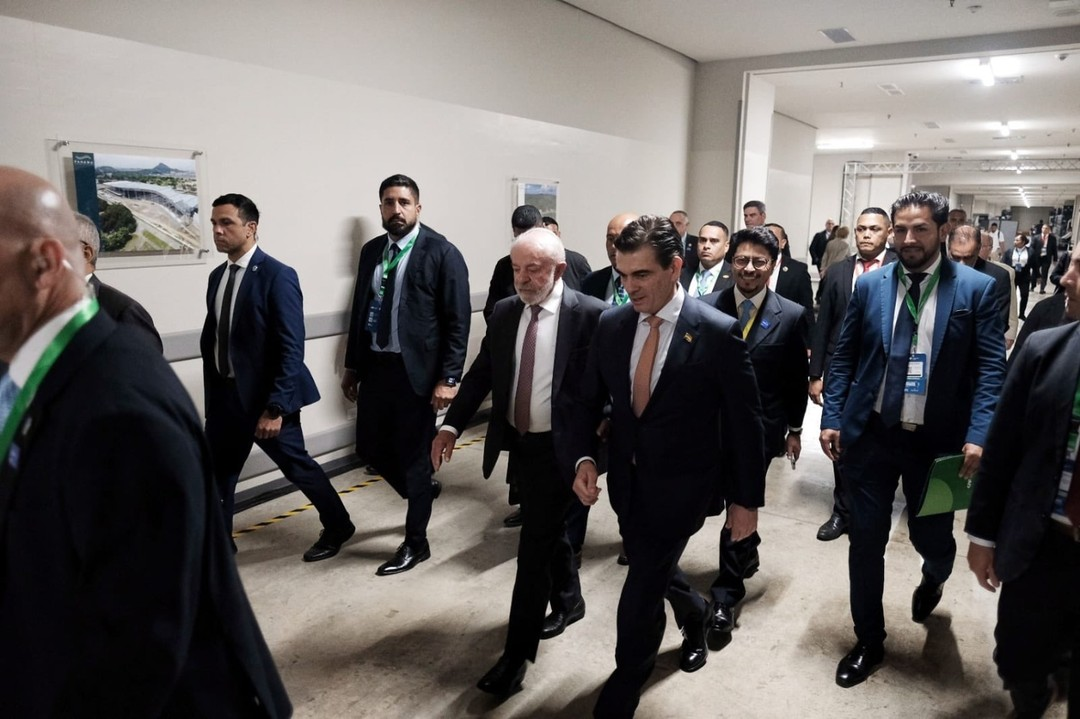
President Paz met with Lula da Silva in Panama
Within this international economic agenda, one of the next activities will be the official visit to Brazil that President Rodrigo Paz will lead at the invitation of his counterpart, Luiz Inácio Lula da Silva.
The agenda includes bilateral meetings between both presidents in Brasília, as well as working meetings between ministers from both countries to address different aspects of the bilateral relationship.
According to the foreign minister, the discussions will include matters related to the environment, agriculture, security, migration, and cooperation in water resources, in addition to border infrastructure projects such as the bridge between Guayaramerín and Guajará-Mirim.
During the visit, the signing of five bilateral agreements is also expected, which will be announced by both presidents.
Afterward, the Bolivian delegation will travel to the city of São Paulo, where a business dialogue will take place with the participation of companies from both countries. A delegation of approximately 80 Bolivian business leaders will participate in that meeting and will hold discussions with representatives of the Brazilian private sector.
“We will have a business dialogue in different sectors to present what the economic conditions and strategic sectors are in matters of energy, fuels, agribusiness, and environmental financing,” said Aramayo.
The meetings are also expected to include sectoral encounters between Bolivian and Brazilian business leaders aimed at identifying opportunities for business and productive cooperation.
Business expectations
The export sector is observing with interest the expansion of the country’s international economic agenda and the possibility of generating new spaces for commercial cooperation. The president of the National Chamber of Exporters of Bolivia (Caneb), Osvaldo Barriga, stated that strengthening diplomatic relations can translate into better conditions for foreign trade.
“For the first time we will be able to go in a large delegation to generate major business deals, important deals, with the presence of the government accompanying us, not in spite of the government,” Barriga said.
Barriga also pointed out that although Bolivia maintains a trade surplus with Brazil due to gas exports, the balance in other products is negative, which reinforces the importance of expanding trade in productive sectors.
In 2025, Bolivia reached $1.237 billion in exports to the South American giant, according to data from the Bolivian Institute of Foreign Trade (IBCE). Among the main products sent to that market are natural gas, urea, natural and calcined ulexite, antimony oxides, aluminum scrap and waste, as well as denatured tallow, among others.
However, imports from Brazil exceeded Bolivian exports, reaching $1.420 billion, reflecting a trade balance unfavorable to our country. Among the main imported products are beverage preparations, malt beer, iron or steel bars, chemical wood pulp, polypropylene, particle boards, live domestic roosters and hens weighing up to 185 grams, and copper electrical conductors, among others.
Pending law
The National Chamber of Industries (CNI) presented its investment bill on February 18.
Concern about the institutional framework has been raised by the international business community. A few days ago, the president of the Official Spanish Chamber of Commerce in Bolivia, Ildefonso Núñez, noted that legal certainty is one of the key factors in attracting new foreign investment to the country. The executive emphasized that the country has broad productive potential, but that in order to materialize larger projects it is necessary to strengthen legal conditions.
Ten days ago, the National Chamber of Industries (CNI) issued a public statement expressing concern over delays in legislative decisions linked to the economic agenda. In the document, the sector recalled that it had presented to the Legislative Assembly a package of proposals aimed at strengthening the investment climate and generating conditions for the country’s productive reactivation.
“Every month without decisions generates uncertainty, postponed investments, legal insecurity, and lost opportunities, affecting workers, families, small businesses, and national industry,” the statement released by the business organization says.
The industrial sector’s draft proposal was presented on February 18 to the president of the Chamber of Deputies, Roberto Castro. The document proposes incorporating principles such as fair and equitable treatment for investors, freedom to transfer capital, and free currency convertibility. It also proposes the creation of a National Superintendency of Investments and a National Registry of Investment Contracts, as well as tax incentives, special economic zones, and the recognition of international arbitration as the preferred mechanism for resolving disputes.
Por Erika Segales, El Deber:
Comercio, tecnología y agro ganan espacio en la agenda económica externa del país
Este lunes, el presidente Rodrigo Paz continúa su agenda internacional con reuniones bilaterales en Brasil y una comitiva de 80 empresarios participará en un diálogo en São Paulo. Queda pendiente la aprobación de una ley de inversiones.
Comercio, tecnología y agroindustria comienzan a consolidarse como los ejes más visibles de la agenda económica externa de Bolivia. En los últimos meses, las gestiones internacionales del Gobierno y del sector privado han puesto el foco en la apertura de mercados, el impulso a negocios productivos y la búsqueda de inversiones, en un intento por diversificar las oportunidades comerciales del país más allá de los sectores tradicionales.
“Vamos a abrir mercados, paso a paso para que Bolivia pueda producir y vender al mundo”, expresó el presidente Rodrigo Paz antes de partir hacia Estados Unidos para participar en la cumbre “Escudo de América”. Este lunes el jefe de Estado continúa su agenda internacional en busca de abrir mercados en Brasil.
A diferencia de etapas anteriores, en las que las relaciones internacionales se concentraban en cooperación política o asuntos multilaterales, en el nuevo enfoque, sectores como el comercio exterior, la innovación tecnológica, la producción agroindustrial y los servicios turísticos aparecen de forma recurrente en reuniones bilaterales, foros económicos y encuentros empresariales.
El énfasis en estos sectores responde también a los desafíos que enfrenta la economía boliviana, que busca ampliar su base exportadora y generar nuevas fuentes de ingresos en un contexto regional e internacional marcado por transformaciones en los mercados energéticos, alimentarios y tecnológicos.
Avances en agro y comercio
Uno de los frentes más visibles de la agenda económica externa es el sector agropecuario, particularmente la apertura de nuevos mercados para la producción de alimentos. En los últimos meses el Gobierno impulsa negociaciones orientadas a ampliar los destinos de exportación para productos bolivianos, con énfasis en la carne bovina, que aparece como uno de los rubros con mayor potencial de expansión.
En ese marco, Paraguay habilitó a tres frigoríficos bolivianos para exportar carne bovina a su mercado. A la par de este avance, Bolivia también trabaja para habilitar nuevos mercados en la región.
El ministro de Desarrollo Productivo, Óscar Mario Justiniano, indicó que Chile aparece como el próximo destino para la exportación de carne bovina y leche boliviana, en un proceso de negociación que se encuentra en su fase final.
Las gestiones en el ámbito agropecuario también incluyen acercamientos con otros países de la región. En una reunión con la embajadora de El Salvador, Ana Guadalupe Rivas, autoridades bolivianas analizaron oportunidades de comercio vinculadas a carne bovina, material genético y productos agrícolas.
Según el Ministerio de Desarrollo Productivo, el objetivo de estos encuentros es fortalecer la cooperación bilateral y generar nuevas oportunidades para el sector productivo nacional.
En paralelo al impulso del sector agropecuario, el Gobierno ha desarrollado una agenda orientada a ampliar la inserción comercial de Bolivia en los mercados internacionales.
Este proceso de apertura comercial ocurre además en un contexto regional marcado por el acuerdo de asociación entre el Mercosur y la Unión Europea, que tras más de dos décadas de negociaciones dio paso a una de las mayores zonas de libre comercio del mundo.
Reuniones en EE.UU.
La delegación boliviana sostuvo encuentros con distintos gobiernos durante la reciente agenda internacional desarrollada en Estados Unidos, donde también se realizaron reuniones bilaterales con varios países del continente.
Las conversaciones incluyeron a delegaciones de El Salvador, República Dominicana, Costa Rica, Honduras, Argentina y Chile, entre otros países, con los que se abordaron distintos temas de cooperación bilateral.
Entre los asuntos tratados destacaron áreas económicas vinculadas al turismo, el comercio y el desarrollo de infraestructura regional, además de proyectos relacionados con corredores bioceánicos y otros mecanismos de integración económica, presiones climáticas y presiones tecnológicas, entre otras temáticas.
En el marco de la visita al país norteamericano, el canciller Fernando Aramayo señaló hace unos días que ya se iniciaron las conversaciones para los acuerdos comerciales y anunció una visita de un grupo empresarial estadounidense en las siguientes semanas.
“Vamos a tener pronto otro grupo empresarial norteamericano que va a visitar el país en las próximas semanas y en este marco también se viene desarrollando uno de los componentes que ya es parte de la agenda que se ha desarrollado en las últimos tres semanas de la mano de una extensa y amplia misión del Millennium Corporation”, señaló.
Misión a Brasil
El presidente Paz se reunió con Lula da Silva en Panamá
Dentro de esta agenda económica internacional, uno de los próximas actividades será la visita oficial a Brasil que encabezará el presidente Rodrigo Paz por invitación de su homólogo, Luiz Inácio Lula da Silva.
La agenda contempla reuniones bilaterales entre ambos mandatarios en Brasilia, además de encuentros de trabajo entre ministros de ambos países para abordar distintos temas de la relación bilateral.
Según explicó el canciller, las conversaciones incluirán asuntos vinculados a medio ambiente, agricultura, seguridad, migración y cooperación en recursos hídricos, además de proyectos de infraestructura fronteriza como el puente entre Guayaramerín y Guajará-Mirim.
Durante la visita también se prevé la suscripción de cinco acuerdos bilaterales que serán anunciados por ambos presidentes.
Posteriormente, la delegación boliviana se trasladará a la ciudad de São Paulo, donde se realizará un diálogo empresarial con participación de compañías de ambos países. En ese encuentro participará una delegación de aproximadamente 80 empresarios bolivianos que sostendrán reuniones con representantes del sector privado brasileño.
“Vamos a tener un diálogo empresarial en diferentes sectores para dar cuenta de cuáles son las condiciones económicas y los sectores estratégicos en materia energética, de combustibles, de agroindustria y financiamiento ambiental”, señaló Aramayo.
Se prevé que las reuniones también incluyan encuentros sectoriales entre empresarios bolivianos y brasileños con el objetivo de identificar oportunidades de negocios y cooperación productiva.
Expectativa empresarial
El sector exportador observa con interés la ampliación de la agenda económica internacional del país y la posibilidad de generar nuevos espacios de cooperación comercial. El presidente de la Cámara Nacional de Exportadores de Bolivia (Caneb), Osvaldo Barriga, afirmó que el fortalecimiento de las relaciones diplomáticas puede traducirse en mejores condiciones para el comercio exterior.
“Por primera vez vamos a poder ir en una delegación grande a generar grandes negocios, importantes negocios, con la presencia del gobierno, acompañándolo, no a pesar del Gobierno”, afirmó Barriga.
Barriga también señaló que, si bien Bolivia mantiene superávit comercial con Brasil debido a las exportaciones de gas, la balanza en otros productos es deficitaria, lo que refuerza la importancia de ampliar el intercambio comercial en sectores productivos.
En 2025, Bolivia alcanzó $us 1.237 millones en exportaciones hacia el gigante sudamericano, según datos del Instituto Boliviano de Comercio Exterior (IBCE). Entre los principales productos enviados a ese mercado destacan gas natural, urea, ulexita natural y calcinada, óxidos de antimonio, desperdicios y desechos de aluminio, además de sebo desnaturalizado, entre otros.
Sin embargo, las importaciones provenientes de Brasil superaron a las exportaciones bolivianas, alcanzando $us 1.420 millones, lo que refleja una balanza comercial desfavorable para nuestro país. Entre los principales productos importados figuran preparaciones para bebidas, cerveza de malta, barras de hierro o acero, pasta química de madera, polipropileno, tableros de partículas, gallos y gallinas domésticas vivas de hasta 185 gramos y conductores eléctricos de cobre, entre otros.
Ley pendiente
La CNI presentó su proyecto de Ley de inversiones el 18 de febrero
La preocupación por el marco institucional se planteó desde el ámbito empresarial internacional. Hace unos días, el presidente de la Cámara Oficial Española de Comercio en Bolivia, Ildefonso Núñez, señaló que la seguridad jurídica es uno de los factores clave para atraer nuevas inversiones extranjeras al país. El ejecutivo remarcó que el país cuenta con un amplio potencial productivo, pero que para concretar mayores proyectos es necesario fortalecer las condiciones legales.
Hace 10 días, la Cámara Nacional de Industrias (CNI) emitió un pronunciamiento público en el que expresó su preocupación por la demora en la toma de decisiones legislativas vinculadas a la agenda económica. En el documento, el sector recordó que presentó ante la Asamblea Legislativa un paquete de propuestas orientadas a fortalecer el clima de inversiones y generar condiciones para la reactivación productiva del país.
“Cada mes sin definiciones genera incertidumbre, inversiones postergadas, inseguridad jurídica y oportunidades perdidas, afectando al trabajador, a la familia, a la pequeña empresa y a la industria nacional”, señala el comunicado difundido por la organización empresarial.
El anteproyecto de los industriales fue presentado el 18 de febrero ante el presidente de Diputados, Roberto Castro. El documento propone incorporar principios como el trato justo y equitativo a los inversionistas, la libertad de transferencia de capitales y la libre conversión de divisas. Asimismo, plantea la creación de una Superintendencia Nacional de Inversiones y de un Registro Nacional de Contratos de Inversión, además de incentivos tributarios, zonas económicas especiales y el reconocimiento del arbitraje internacional como mecanismo preferente para la resolución de controversias.

 Bolivian Thoughts | Pensamientos Bolivianos (Bilingual/Bilingüe)