
By Gina Baldivieso, EFE; Vision 360:
Bolivian women are making their way in construction amid persistent inequalities and prejudices
One of the main problems faced by women builders is wage inequality and, in addition, prejudices persist, along with fear or doubt about whether they will be able to do the job well.
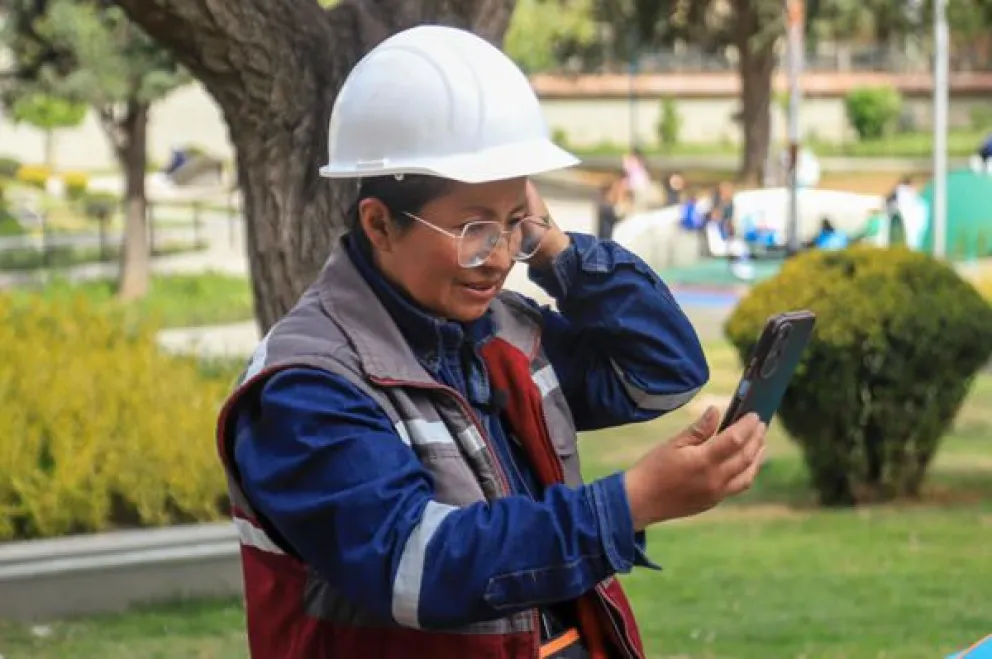
Photograph showing Martha Quispe, a woman construction worker, preparing for her workday in La Paz (Bolivia). EFE / Gabriel Márquez
Bricklayers, painters, plumbers or electricians, women in Bolivia have opened spaces for themselves in construction in recent years, despite voices that still tell them it is “a man’s thing” and persistent prejudices and inequalities in salary or in the treatment they receive.
Some learned these trades out of necessity and others out of curiosity to know how to make a repair or an installation at home by themselves, electrician Martha Quispe told EFE. She is the secretary of finance of the Association of Women Builders of La Paz (Asomuc).
“We are fighting and most of my colleagues are single mothers who support their households. So we ask everyone to lend us a hand and hire them and support them (…) because nowadays, with the crisis, sometimes there is work and sometimes there is no work,” she said.
Starting on the path of construction is not easy, Quispe admitted from her own experience, since for example it can be frightening to climb to elevated places, but with care and the necessary safety equipment “we can easily do the jobs.”
“I am an electrician and I say that electricity must be respected, and it can be done,” assured the leader, who has two children and a granddaughter.
In her case, Quispe saw the need to look for a trade after a “painful” family episode and thus found an electricity course through which she got to know Asomuc, an organization that “has been a fundamental pillar” in allowing her to “change” her story.
“There I saw women who actually did that work and I was astonished. I said (…) it can be done, they were able to do it and I will be able to do it,” she maintained.
When she began training, she often heard phrases such as “you won’t be able to do it, you are getting into men’s things, you are wasting your time,” but in 2024 she graduated as a higher technician in industrial electricity.
According to Quispe, Asomuc has around two hundred registered members, although about 50 are “active,” due to factors such as the COVID-19 pandemic or the economic crisis caused by the shortage of dollars that made construction materials more expensive, which forced several of them to change occupations.
Problems and figures
One of the main problems faced by women builders is wage inequality and, in addition, prejudices persist, along with fear or doubt about whether they will be able to do the job well, Quispe noted.
There is also the need to have separate changing rooms and bathrooms, or for work clothing to have two pieces, since the overalls worn by men are uncomfortable for them.
The executive director of Red Hábitat, Anelise Melendez, told EFE that a study by the International Labour Organization (ILO) from 2018 indicates that women’s participation in construction reaches 4.5% of the economically active population in that sector in Bolivia.
The report, which is the only one offering specialized data on women in construction in Bolivia, also indicates that “the wage gap was around 38%,” compared with the average in other sectors which, according to UN Women, is 24%, she said.
Melendez promoted various projects in favor of women builders between 2010 and 2021 through Red Hábitat, under the premise that “women have the right to participate in a dynamic sector of the economy” and to “break into male-dominated markets” such as construction.
Thanks to those programs, the organization offered technical training, education on rights, and leadership development, which led to the creation of Asomuc and similar entities in other Bolivian regions.
In addition, in response to the wage gap, Red Hábitat and the women’s associations worked on a bill that seeks “equal pay for equal work, but also greater job opportunities, given the low percentage of participation that women have,” Melendez said.
The bill was presented to the previous legislature and its discussion is expected to be reactivated with the current Parliament, which began its work last November.
Por Gina Baldivieso, EFE; Vision 360:
Las bolivianas se abren campo en la construcción entre persistentes desigualdades y prejuicios
Uno de los principales problemas que afrontan las mujeres constructoras es la desigualdad de salario y, además, prevalecen los prejuicios, el temor o la duda de si ellas podrán hacer bien el trabajo.
Fotografíaque muestra a Martha Quispe, una mujer constructora, preparándose para si jornada de trabajo en La Paz (Bolivia). EFE/ Gabriel Márquez
Albañiles, pintoras, fontaneras o electricistas, las mujeres en Bolivia se han abierto espacios en la construcción en los últimos años, pese a las voces que aún les dicen que es “cosa de hombres” y a persistentes prejuicios y desigualdades en salario o en el trato que reciben.
Algunas aprendieron estos oficios por necesidad y otras por la inquietud de saber cómo hacer una reparación o una instalación en casa por sí mismas, comentó a EFE la electricista Martha Quispe, que es secretaria de Hacienda de la Asociación de Mujeres Constructoras de La Paz (Asomuc).
“Estamos luchando y la mayoría de mis compañeras son mamás solas que sostienen a sus hogares. Entonces pedir a todos que puedan echarnos una manito y contratarlas y apoyarlas (…) porque hoy en día, con la crisis, a veces hay trabajo y a veces no hay trabajo”, contó.
Iniciarse en el camino de la construcción no es sencillo, confesó Quispe desde su propia vivencia, ya que por ejemplo, da temor el subirse a lugares elevados, pero con cuidado y el equipo de seguridad necesario “tranquilamente podemos hacer los trabajos”.
“Soy electricista y digo hay que tenerle respeto a la electricidad, y se puede”, aseguró la dirigente, que tiene dos hijos y una nieta.
En su caso, Quispe vio la necesidad de buscar un oficio por un episodio familiar “doloroso” y así encontró un curso de electricidad por el que conoció a Asomuc, organización que “ha sido un pilar fundamental” para poder “cambiar” su historia.
“Ahí he visto a mujeres que sí hacían ese trabajo y me quedaba anonadada, decía (…) se puede, ellas han podido y yo voy a poder”, sostuvo.
Cuando comenzó a capacitarse, a menudo escuchaba frases como “no vas a poder, te estás metiendo a cosas de hombres, estás perdiendo tu tiempo”, pero en 2024 se tituló como técnica superior en electricidad industrial.
Según Quispe, la Asomuc tiene alrededor de dos centenares de integrantes registradas, aunque están “activas” unas 50, por factores como la pandemia de la covid-19 o la crisis económica por la falta de dólares que hizo que encarezcan los materiales de construcción, lo que obligó a varias a cambiar de rubro.
Problemática y cifras
Uno de los principales problemas que afrontan las mujeres constructoras es la desigualdad de salario y, además, prevalecen los prejuicios, el temor o la duda de si ellas podrán hacer bien el trabajo, señaló Quispe.
También está la necesidad de contar con cambiadores y baños diferenciados, o de que la ropa de trabajo tenga dos piezas, ya que el overol que llevan los hombres les resulta incómodo.
La directora ejecutiva de Red Hábitat, Anelise Melendez, dijo a EFE que un estudio de la Organización Internacional del Trabajo (OIT) de 2018 señala que la participación de las mujeres en la construcción alcanza al 4,5 % de la población económicamente activa en ese sector en Bolivia.
El informe, que es el único que ofrece datos especializados sobre las mujeres en la construcción en Bolivia, también indica que “la brecha salarial estaba en el orden del 38 %”, frente a la media en otros sectores que, según ONU Mujeres, es de 24 %, indicó.
Melendez impulsó entre 2010 y 2021 desde Red Hábitat diversos proyectos en favor de las constructoras, bajo la premisa de que “las mujeres tienen derecho a participar en un sector dinámico de la economía” e “irrumpir mercados masculinizados” como la construcción.
Gracias a esos programas, la organización ofreció capacitaciones técnicas, en derechos y formación de liderazgos, lo que dio lugar a la creación de la Asomuc y de entidades similares en otras regiones bolivianas.
Además, ante la brecha salarial, Red Hábitat y las asociaciones de mujeres trabajaron un proyecto de ley que busca “la igualdad de remuneración por igual trabajo, pero además mayores oportunidades laborales, dado el porcentaje bajo de participación que tienen las mujeres”, indicó Melendez.
El proyecto se presentó a la anterior legislatura y se espera reactivar su tratamiento con el actual Parlamento, que inició labores en noviembre pasado.

 Bolivian Thoughts | Pensamientos Bolivianos (Bilingual/Bilingüe)