
By Correo del Sur:
Learn the requirements that comparsas must present for identification
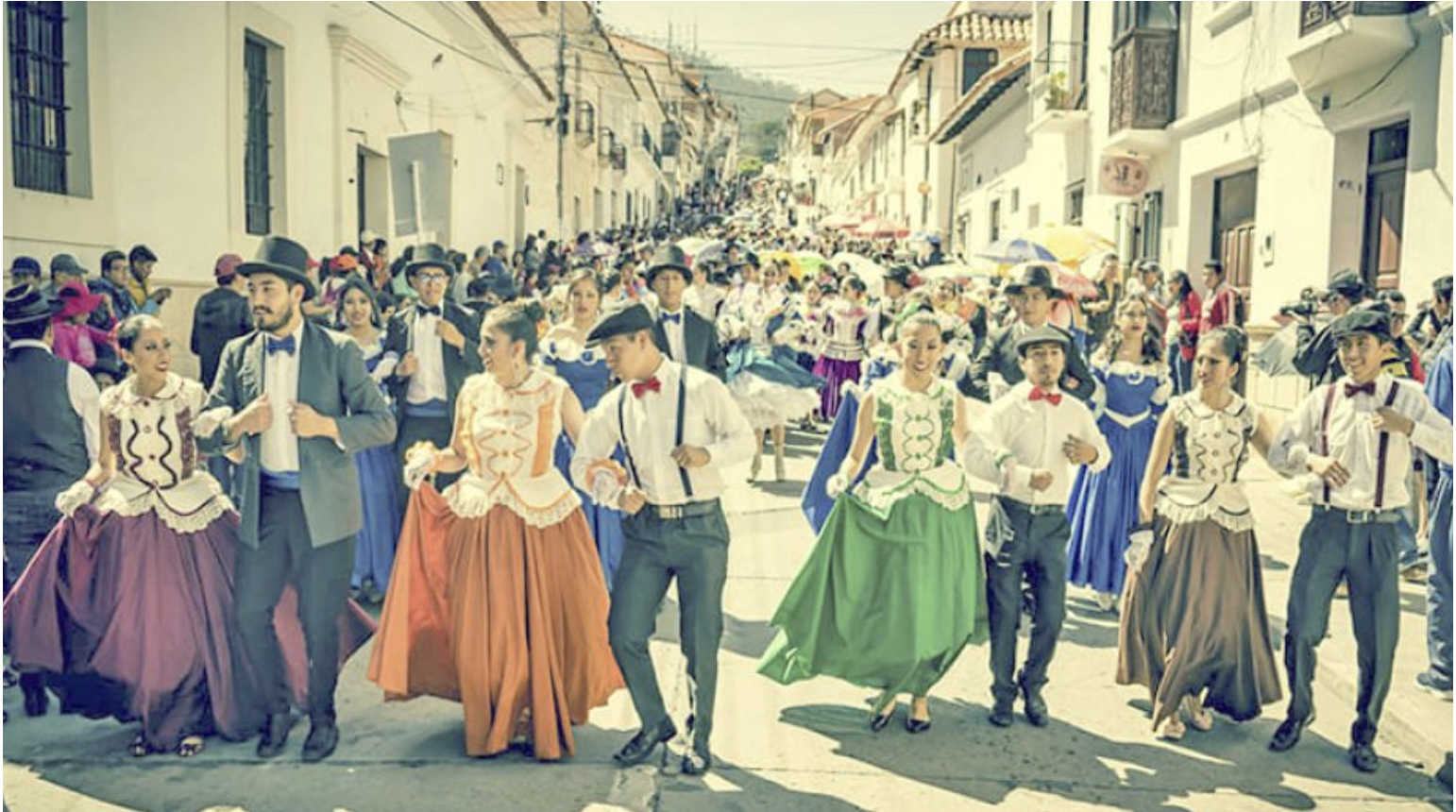
CELEBRATION. A past parade of the Carnival of Yesteryear through the streets of downtown Sucre. Photo: Archive
Sucre, unlike most cities in the country, has three types of Carnival, each with clearly defined characteristics that make the festivity an important attraction for visitors and tourists. For that reason, work is underway to correct several negative aspects from past years, among them the “clandestine” comparsas and their excesses.
After the latest coordination meetings between City Hall and the Association of Comparsas and Pandillas of the Sucre Carnival, it was decided to address this issue rigorously, since brawls, street fights, and excesses caused by “outside” groups harm the image of the celebration.
In that regard, the Association’s president, Javier Achá, told Correo del Sur that a digital platform and the Municipal House of Culture will be enabled for the registration of comparsas, along with several control measures to facilitate their identification.
He announced that registration will begin on January 20 and that each comparsa must submit a series of requirements, such as personal data and identity cards of the person in charge and two members, the address of its headquarters, and the list of participants.
“In the case of comparsas affiliated with the Association, credentials will be issued to them,” Achá stated.
He added that several control mechanisms were also agreed upon, such as a QR code that must be placed in a visible spot and in a considerable size when the comparsa goes out into the streets.
If they do not have that information, they will be stopped by the Police and exposed to the confiscation of the band’s instruments and to fines of up to 2,000 bolivianos.
“What is wanted is to prevent clandestine comparsas from being out on the streets and making Sucre’s Carnival look bad,” Achá said, noting that some pending aspects still remain and will be resolved at a new meeting next Monday the 19th.
A UNIQUE CARNIVAL
Sucre stands out for its uniqueness in having three types of Carnival: the Carnival of Yesteryear, the Carnival of comparsas, and the autochthonous or rural Carnival.
Regarding the Carnival of Yesteryear, it shows the customs practiced between the 18th century and the beginning of the 19th century. According to the explanation of Chuquisaca historian Felipe Medina, this celebration in the capital has been strongly revived in recent decades by prominent figures and authorities.
He said that its essence is represented in the participation of floats, which used to be a spectacle. Added to this is the elegant touch of the clothing of ladies and gentlemen, accompanied by student music groups (estudiantinas).
Then comes the Carnival of comparsas, whose main characteristic lies in the presence of groups of friends, families, and institutions that tour the streets dancing to the rhythm of brass bands or sikuris.
According to Medina, the comparsas emerged during the last period of the Carnival of Yesteryear, through groups that gathered in the streets to play with water.
Finally, the autochthonous Carnival is experienced mainly in the peri-urban and rural areas of the capital, where the “pukara” takes center stage — a monument covered with products and fruits placed as thanks for the fertility of Pachamama (Mother Earth), around which there is dancing and celebration.
There, different towns and communities display their customs, dances, traditions, gastronomy, and products.
PROMOTION
Medina emphasized that Sucre’s Carnival is unique, but unfortunately it has not been properly promoted by the city’s authorities for tourism purposes.
“They should give full attention to promoting Carnival, because Sucre’s Carnival is essentially participatory; I call it a ‘democratic carnival,’ where it does not discriminate between poor, rich, or peasants, where everyone gathers in the streets and hugs one another,” he said.
He also stressed that it lasts several days with sector-based celebrations. For example, on Compadres Thursday mainly men celebrate; on Comadres, women; on Institutions Friday, students, schools, companies, and others take part; “and on Saturday, I call it the workers’ carnival, when mechanical workshops and others take to the streets.”
“So everything is Carnival. I say that the authorities, in coordination with the hotel and gastronomy sectors, should offer tourism packages, but unfortunately people do not see it that way and see Sucre’s Carnival as crazy and violent,” he emphasized.
ACTIVITIES
The president of the Association of Comparsas and Pandillas of the Great Carnival of Sucre reported that they will choose their queens on January 30 and the Children’s Queen on February 1. This Friday they will present the full schedule of activities.
Por Correo del Sur:
Conozca los requisitos que deben presentar las comparsas para su identificación
CELEBRACIÓN. Una pasada entrada del Carnaval de Antaño, por las calles del centro de Sucre. Foto: Archivo
Sucre, como pocas ciudades del país, cuenta con tres tipos de Carnaval, cada uno con marcadas características que hacen de la festividad un importante atractivo para visitantes y turistas. Por ello, se trabaja para subsanar varios aspectos negativos de años pasados, entre ellos, las comparsas “clandestinas” y sus excesos.
Tras las últimas reuniones de coordinación entre la Alcaldía y la Asociación de Comparsas y Pandillas del Carnaval de Sucre, se determinó abordar este tema con rigurosidad, dado que las riñas, peleas callejeras y excesos provocados por grupos “ajenos” afectan la imagen de la festividad.
En ese sentido, el presidente de la Asociación, Javier Achá, indicó a CORREO DEL SUR que se habilitará una plataforma digital y la Casa Municipal de la Cultura para el registro de las comparsas. Además de varias medidas de control para facilitar su identificación.
Anticipó que dicho registro comenzará el 20 de enero y cada comparsa debe presentar una serie de requisitos como los datos personales y cédula de identidad del responsable y de dos integrantes, la dirección de su sede y la lista de integrantes.
“En el caso de las comparsas afiliadas a la Asociación, nos van a hacer la entrega de credenciales”, afirmó Achá.
Dijo que también se acordó la implementación de varios mecanismos de control como un QR que deberá estar en un lugar visible y en un tamaño considerable cuando la comparsa salga a las calles.
En caso de que no cuenten con dicha información, serán intervenidos por la Policía y se expondrán al decomiso de instrumentos de la banda de música y a sanciones de hasta 2.000 bolivianos.
“Lo que se quiere es evitar que comparsas clandestinas puedan estar en las calles y hacer quedar mal al Carnaval sucrense”, aseguró Achá al anticipar que todavía existen algunos aspectos pendientes que serán resueltos en una nueva reunión el próximo lunes 19.
UN CARNAVAL ÚNICO
Sucre se distingue por su particularidad de contar con tres tipos de Carnavales: el de antaño, el de las comparsas y el autóctono o rural.
Respecto al Carnaval de Antaño, este muestra las costumbres que se practicaban entre los siglos XVIII y principios del XIX. De acuerdo a la explicación del historiador chuquisaqueño Felipe Medina, esta celebración en la capital fue recuperada con mayor fuerza en las últimas décadas por personalidades y autoridades.
Dijo que su esencia está representada en la participación de las carrozas, que antes era un espectáculo. A ello se suma el toque elegante de las vestimentas de las damas y los varones, acompañado de las estudiantinas.
Luego está el Carnaval de las comparsas, cuya característica principal recae en la presencia de grupos de amigos, familiares e instituciones que recorren las calles bailando al ritmo de bandas de música o sikuris.
Según Medina, las comparsas surgieron durante la última época del carnaval de Antaño, a través de grupos que se juntaban en las calles para jugar con agua.
Finalmente, el Carnaval autóctono se vive principalmente en las zonas periurbanas y rurales de la capital, donde cobra protagonismo la “pukara”, un monumento cubierto de productos y frutas colocados como agradecimiento a la fertilidad de la Pachamama (madre tierra), alrededor del cual hay baile y fiesta.
Allí, los diferentes pueblos y comunidades muestran sus costumbres, danzas, tradiciones, gastronomía y productos.
PROMOCIÓN
Medina resaltó que la característica del carnaval de Sucre es única, pero que lamentablemente no ha sido adecuadamente promocionado por las autoridades de la capital, con fines turísticos.
“Deberían darle toda la atención en la promoción al Carnaval, porque el Carnaval de Sucre es un Carnaval esencialmente participativo, yo lo llamo ‘carnaval democrático’, donde no discrimina a pobres, ricos, campesinos, donde todos se reúnen en las calles y se dan de abrazos”, afirmó.
Además, remarcó que es de varios días en los cuales se tiene celebraciones sectorizadas. Por ejemplo, en el jueves de compadres celebran mayormente los hombres, en comadres, las mujeres, en viernes de instituciones, lo hacen los estudiantes, colegios, empresas y otros, “y el sábado, yo lo llamo el carnaval de los obreros, donde salen a las calles los talleres mecánicos y otros”.
“Entonces todo es Carnaval. Digo yo, las autoridades en coordinación con la hotelería y gastronomía, deberían ofrecer paquetes turísticos, pero lamentablemente la gente no lo ve de esta manera y lo ven al Carnaval de Sucre como de locos y violentos”, enfatizó.
ACTIVIDADES
El Presidente de la Asociación de Comparsas y Pandillas del Carnaval Grande de Sucre informó que elegirán a sus soberanas el 30 de enero y a la Reina Infantil, el 1 de febrero. Este viernes presentarán la agenda completa de actividades.
https://correodelsur.com/local/20260116/la-capital-busca-preservar-sus-tres-tipos-de-carnaval.html

 Bolivian Thoughts | Pensamientos Bolivianos (Bilingual/Bilingüe)