
By Eju,tv:
Justiniano: Evo’s nervousness confirms that Chapare coca goes to drug trafficking
The Vice Minister of Social Defense says the former president broke international cooperation and argues that reopening those ties explains the criticism following the Arica case.
The Vice Minister of Social Defense and Controlled Substances, Ernesto Justiniano, responded to criticism from former president Evo Morales regarding the seizure of Bolivian timber impregnated with cocaine in Chile, and assured that the current strengthening of international cooperation is reducing spaces of impunity in the fight against drug trafficking—spaces that were a constant during nearly two decades of rule by the Movement for Socialism (MAS).
Justiniano questioned Morales’s claim that the government had remained silent on the case. “Evo Morales also speaks about it and makes a kind of interpellation, saying they are silent about the seizure—he speaks of hundreds of kilos of cocaine and marijuana in Chile coming from Bolivia,” he said. However, he recalled that the verified facts come from Chilean authorities. “I have spoken with Chilean authorities, and FELCN has been in permanent contact with the security area and the prosecutors’ offices of both countries,” he stated.

Photo: screenshot
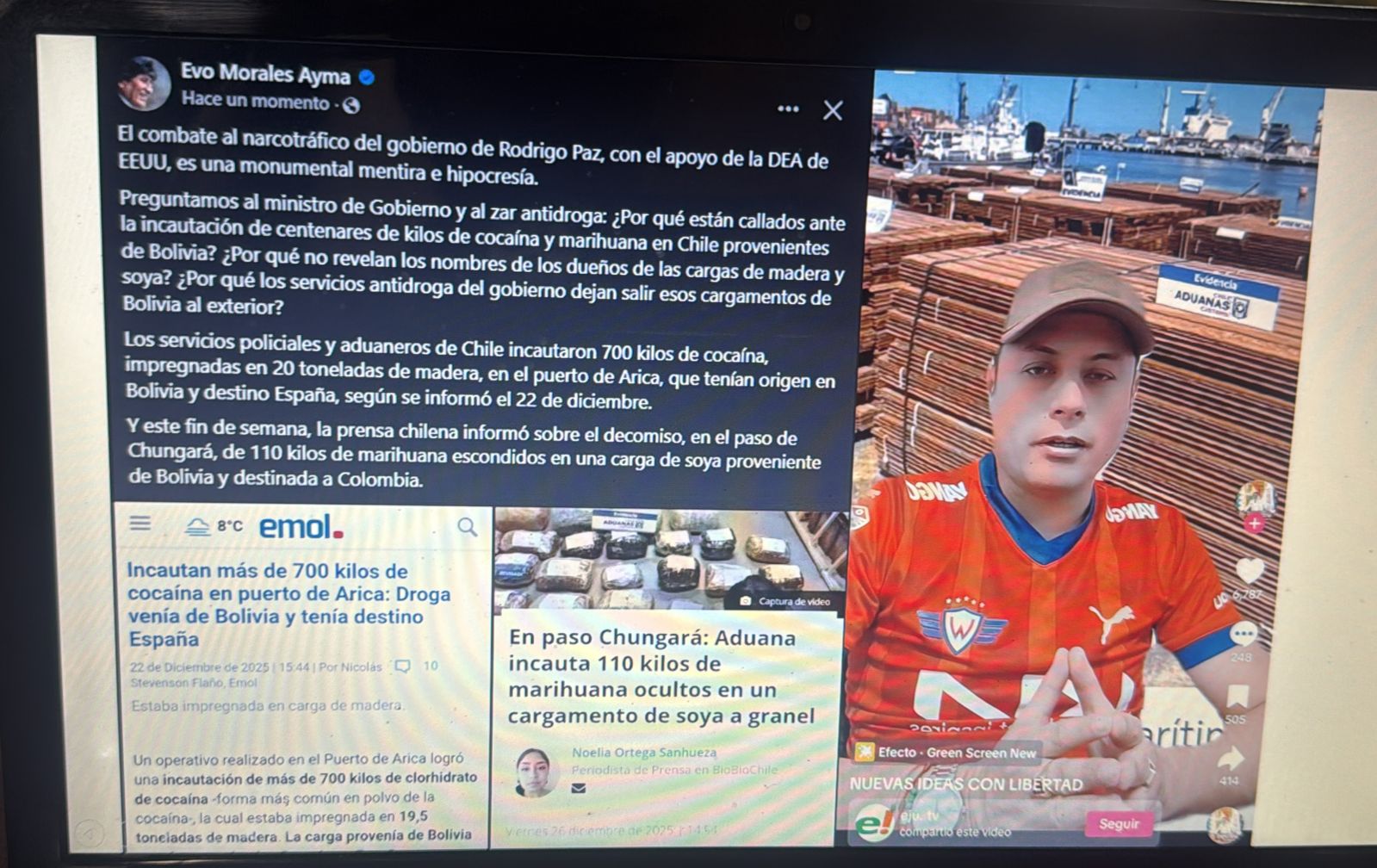
Morales harshly criticized the government of Rodrigo Paz and its anti-drug policy, calling it a “monumental lie and hypocrisy,” and criticized the silence of the Minister of Government and the anti-drug czar regarding the seizure carried out in Chile of 700 kilos of cocaine hidden in timber and 110 kilos of marijuana concealed in soybeans—both shipments originating in Bolivia. According to the former president, these cases show serious failures in the country’s anti-drug fight.
In response, Justiniano detailed that on December 22, at the port of Arica, a container of tajibo wood from Bolivia, with final destination Spain, was indeed seized, with a preliminary estimate of 700 kilos of impregnated cocaine. He also underscored a key detail of the case: the container left Bolivia in October 2025, that is, during the government of Luis Arce Catacora and not under the current administration. “I want to say that emphatically,” he stressed.
Morales and Lara referred to the drug seizure. Photo: FELCN
On the political front, Justiniano was categorical in holding Morales responsible for weakening the anti-drug fight during his government. “Evo Morales disconnected Bolivia from the world in the fight against drug trafficking, broke cooperation, and weakened the State’s capacity,” he remarked. “Today the story has changed; we are reopening cooperation and foreign agencies are returning to collaborate,” recalled the Bolivian anti-drug czar.
He assured that that stage is over and that international channels for information exchange and collaboration in the anti-drug fight are currently being reactivated—a topic also criticized by the former president, who appealed to an alleged Bolivian sovereignty on the matter. “We understand the nervousness Evo Morales may feel, because the world is once again looking at us and cooperating, and spaces of impunity are shrinking,” he said.

Photo: screenshot
Justiniano also addressed the issue of excess coca production and stated that official data provided by the United Nations Office on Drugs and Crime (UNODC) clearly show that most of the leaf produced in the Cochabamba tropics does not enter legal markets. “A week ago, specifically on Monday, we announced that only 8.5% of Chapare coca goes through the Sacaba channels, to the Sacaba market. The remaining 91.5% goes to informal markets—in this case, to drug trafficking,” he emphasized.
Finally, he confirmed that the investigation into the Arica case is advancing with searches in Bolivia and binational coordination, and warned that information is communicated responsibly so as not to alert criminal structures. “To date, the investigation has already begun under judicial oversight, in coordination with the Public Ministry and prosecutors’ offices of both Bolivia and Chile. Searches have already been carried out in Bolivia, and they will continue as part of the investigation,” he reported.
 The Vice Minister Justiniano at a press conference. Photo: FELCN
However, he recalled that details of the investigation cannot be amplified by the media or social networks because they are a matter of State security. “This is not disclosed because it would alert the people, the mafias that are working on this, and obviously that would harm the investigation,” he reflected, then emphasized that “this is not about hiding; it is about investigating seriously.”
Por Eju,tv:
Justiniano: el nerviosismo de Evo confirma que la coca del Chapare va al narcotráfico
El Viceministro de Defensa Social afirma que el exmandatario rompió la cooperación internacional y sostiene que la reapertura de esos vínculos explica las críticas tras el caso Arica.
El viceministro de Defensa Social y Sustancias Controladas, Ernesto Justiniano, respondió a las críticas del expresidente Evo Morales sobre la incautación de madera boliviana impregnada con cocaína en Chile y aseguró que el actual fortalecimiento de la cooperación internacional reduce los espacios de impunidad en el tema del narcotráfico, que fueron la constante durante casi dos décadas de ejercicio del poder del Movimiento al Socialismo (MAS).
Justiniano cuestionó que Morales haya interpelado al Gobierno por un supuesto silencio frente al caso. “Evo Morales habla también al respecto y hace una especie de interpelación porque están callados ante la incautación, dice de centenares de kilos de cocaína y marihuana en Chile provenientes de Bolivia”, añadió. Sin embargo, recordó que los hechos verificados provienen de las autoridades chilenas. “He hablado con autoridades de Chile y la FELCN ha estado en contacto permanente con el área de seguridad y las fiscalías de ambos países”, afirmó.
Foto: captura de pantalla
Morales cuestionó duramente al gobierno de Rodrigo Paz y su política de combate al narcotráfico, calificándola de ‘monumental mentira e hipocresía’, criticó el silencio del ministro de Gobierno y del zar antidroga frente a la incautación realizada en Chile de 700 kilos de cocaína ocultos en madera y 110 kilos de marihuana escondidos en soya, ambos cargamentos provenientes de Bolivia. Según el exmandatario, estos casos evidencian fallas graves en la lucha antidroga del país.
En respuesta, Justiniano detalló que el 22 de diciembre, en el puerto de Arica, evidentemente fue incautado un contenedor con madera de tajibo proveniente de Bolivia, con destino final España, con una estimación preliminar de 700 kilos de cocaína impregnada. Subrayó además un dato clave del caso, que el contenedor salió de Bolivia en octubre de 2025, es decir, en el gobierno de Luis Arce Catacora y no así en la gestión actual. “Eso quiero decirlo con contundencia”, enfatizó.
Morales y Lara se refirieron a la incautación de droga. Foto: FELCN
En el plano político, Justiniano fue categórico al responsabilizar a Morales por el debilitamiento de la lucha antidrogas durante su gobierno. “Evo Morales desconectó a Bolivia del mundo en la lucha contra el narcotráfico, rompió la cooperación y debilitó la capacidad del Estado”, remarcó. “Hoy la historia ha cambiado, estamos reabriendo la cooperación y vuelven las agencias extranjeras a colaborar”, recordó el zar antidrogas boliviano.
Aseguró que esa etapa quedó atrás y que actualmente se están reactivando los canales internacionales para el intercambio de información y colaboración en materia de lucha antidroga, tema que también fue criticado por el exmandatario, quien apeló a una supuesta soberanía de Bolivia en ese tema. “Entendemos el nerviosismo que puede tener Evo Morales, porque el mundo nos vuelve a mirar y a cooperar y se achican los espacios de impunidad”, sostuvo.
Foto: captura de pantalla
Justiniano también abordó el tema de la producción excedente de coca y afirmó que datos oficiales provistos por la Agencia de Naciones Unidas contra la Droga y el Delito (UNODC) señalan claramente que la mayor parte de la hoja producida en la región del trópico de Cochabamba no ingresa por los mercados legales. “Hace una semana atrás, el lunes específicamente, hemos dado a conocer que el 8.5% de la coca del Chapare solamente se va a los canales de Sacaba, al mercado de Sacaba. El 91.5% se va a los mercados informales, en este caso al narcotráfico”, remarcó.
Finalmente, ratificó que la investigación del caso Arica avanza con allanamientos en Bolivia y coordinación binacional, y advirtió que la información se comunica de manera responsable para no alertar a estructuras criminales. “A la fecha ya se inició la investigación con control jurisdiccional en coordinación con el Ministerio Público y Fiscalías tanto de Bolivia como de Chile. Ya en Bolivia se han realizado allanamientos, se van a continuar con los allanamientos dentro de la investigación”, comunicó.
El viceministro Justiniano en conferencia de prensa. Foto: FELCN
Sin embargo, recordó que los detalles de la investigación no pueden ser amplificados por los medios de comunicación o las redes sociales, porque es parte de seguridad del Estado. “Esto no se da a conocer porque sería alertar a la gente, a las mafias que están trabajando en esto y obviamente eso perjudica la investigación”, reflexionó, para luego enfatizar que “no se trata de ocultar, se trata de investigar con seriedad”.

 Bolivian Thoughts | Pensamientos Bolivianos (Bilingual/Bilingüe)