
By El Diario:
Population views 2026 with optimism and Government changes economic model
- Bolivia will close 2025 with inflation close to 13% and perhaps the lowest growth in the region; for next year it is also heading in the same direction, and inflation would close above 20%.
The population views 2026 with optimism in economic matters, although it knows that social conflicts will be present. Now, with the change in the economic model through the enactment of Supreme Decree 5503, people are showing differing opinions: while some support the measure, others reject it, but the former is gaining ground. The Minister of Economy and Public Finance, Gabriel Espinoza, stated that the regulation is the beginning that signals a change of direction in public finances.
At a general level, the report Predictions 2026, a survey conducted by Ipsos Global Advisor involving 30 countries, including Bolivia, shows that 2025 is rated as the worst year, but there is optimism about what is coming in 2026.
Balance
2025 is perceived predominantly negatively in Bolivia, far exceeding global and Latin American (Latam) pessimism.
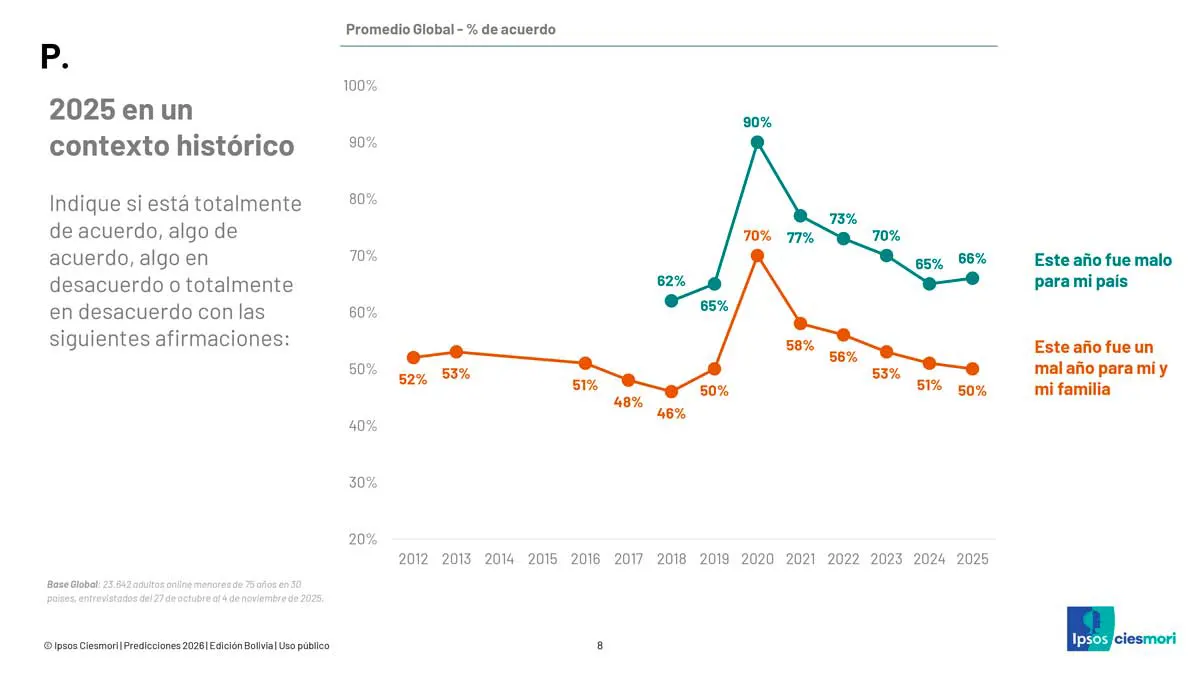
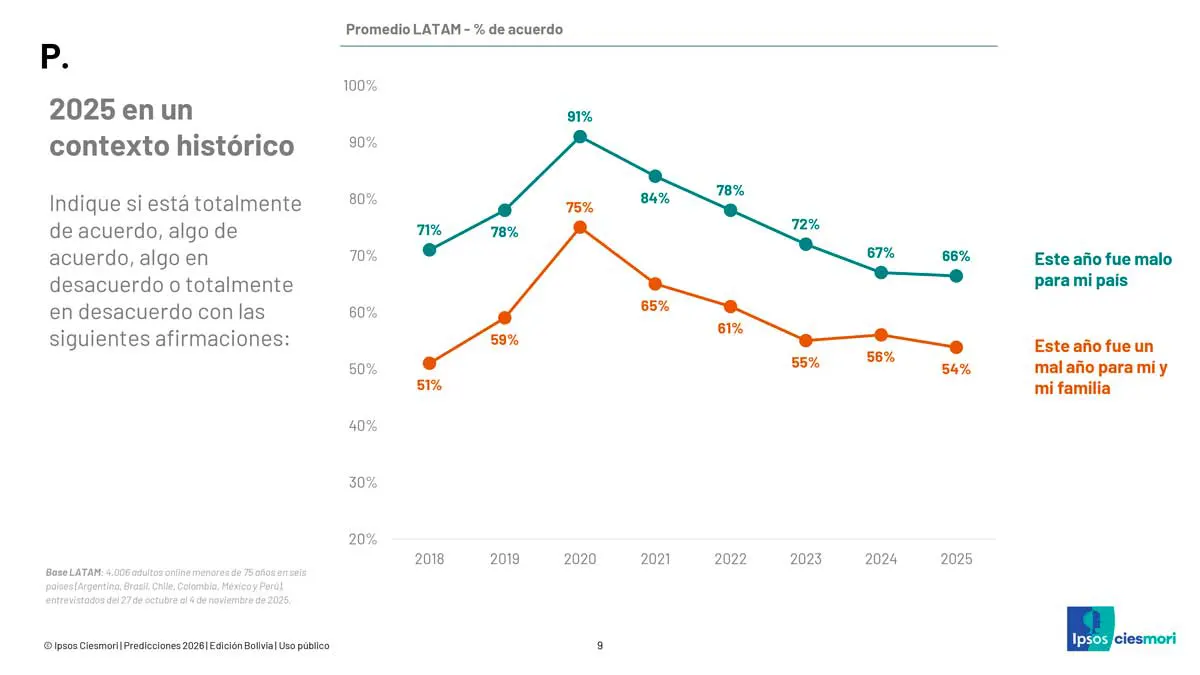
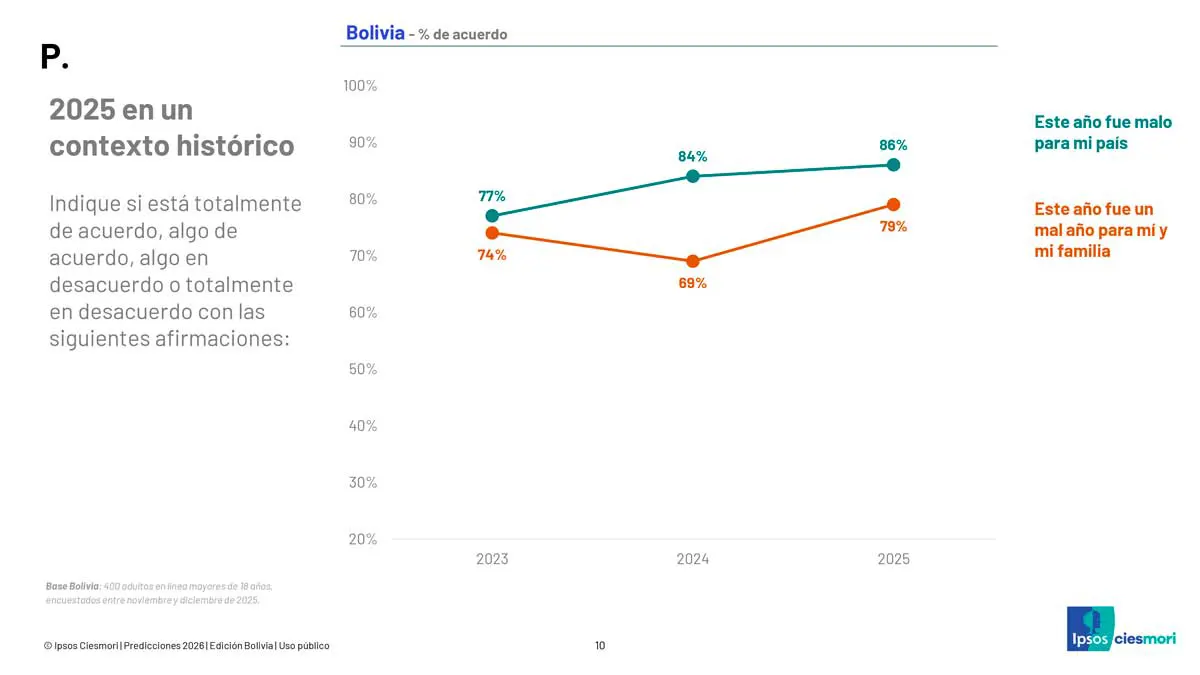
While 66% of the population worldwide considers that 2025 was a bad year for their country, in Bolivia the percentage rises to 86%. This perception of crisis is not only at the macro level, but directly impacts households: 79% of Bolivians say it was a bad year for them and their family, a figure drastically higher than the 50% global average and the 54% Latin American average, the document notes.
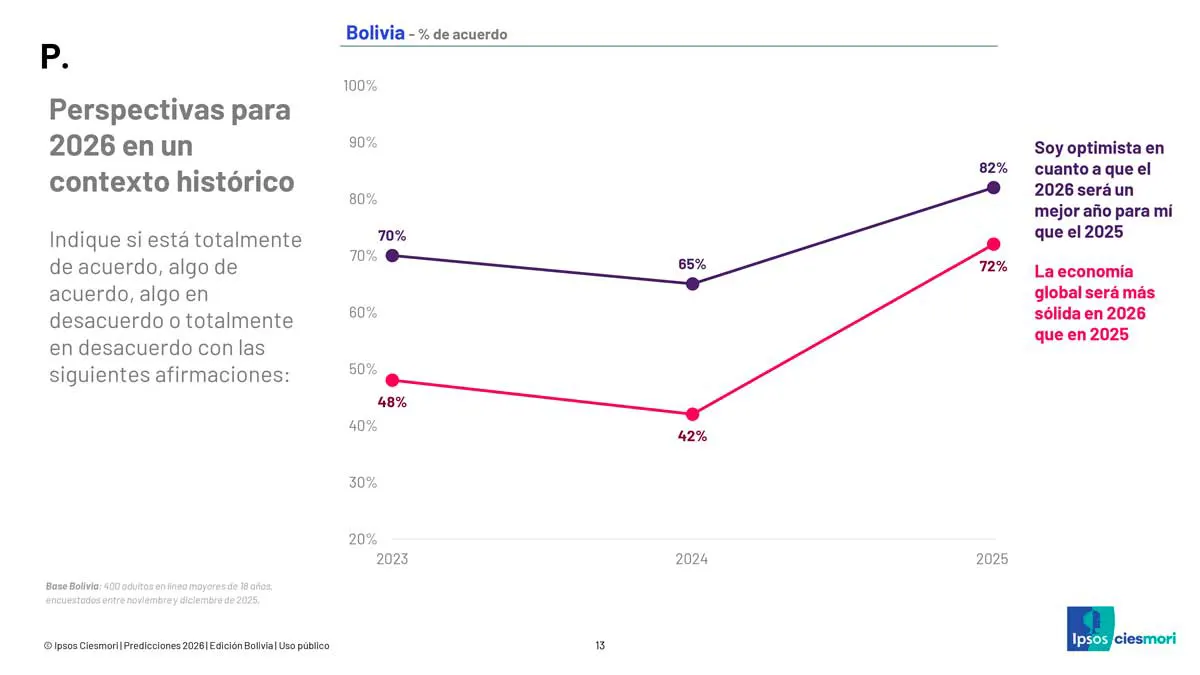
“Compared to 2024, the feeling that it was a bad personal year increased by 10 percentage points in the country. Despite the harsh assessment of the previous year, Bolivia shows notable optimism looking ahead. Eighty-two percent of Bolivians are optimistic that 2026 will be a better year for them, exceeding the global average (71%) and matching the Latam average (84%),” the survey describes.
Economic
Therefore, Bolivia leads global expectations of economic recovery for 2026; a local recession is expected, Ciesmori maintains, and adds that the World Cup generates great expectations in the country, with 68% of the population planning to follow the event, a figure considerably higher than the global average of 59%.
The study details that Bolivia stands out as one of the Latam countries with the highest expectations of global economic improvement. Seventy-two percent of Bolivians believe that the global economy will be stronger in 2026, a figure that nearly doubles the global average (49%). This confidence in recovery has grown exponentially in the country, registering an increase of 30 percentage points compared to expectations for the previous year.
However, this sense of optimism among Bolivians contrasts with the expectation that the country will be in recession during 2026.
The Predictions 2026 report reveals a country that, although it feels deeply hit by the events of 2025, refuses to be defeated. Bolivia enters 2026 with an “active hope”: it does not expect solutions to fall from the sky, as it foresees conflicts and extreme weather, but instead bets on its own capacity for work, its immediate environment, and an economic improvement that it perceives as necessary and almost inevitable after the storm, the report concludes.
New
“Decree 5503 marks the beginning of a new country model. A model that leaves behind a State that blocks, distorts and impoverishes, and gives way to an economy that once again puts people at the center. With macroeconomic stability, social protection and clear rules to produce and invest. Bolivia is beginning to change course,” states the Minister of Economy, Gabriel Espinoza, in his article titled “Changing course: stability, production and dignity as a new country model.”
On the other hand, economic analyst Fernando Romero explains that, despite the change of government, the Bolivian economy is going through a bad moment and the decree points to a long-term restructuring, somewhat traumatic and difficult to carry out.
The center of the city of La Paz has been disrupted by marches by supporters of the Bolivian Workers’ Central (COB), in rejection of DS 5503; however, they have been criticized not only by the Executive but also by the population, who described the protest as having political overtones rather than social demands.
Romero notes that, in order to move forward with the implementation of the decree, complementary measures must be included to avoid the negative aspects of the regulation and minimize its impact on employment and poverty.
He warns that Bolivia has not left behind the risk of entering default, due to the balance-of-payments crisis, a deeper recession, and a greater recession.
He describes the economic crisis as a more complex situation, and also acknowledges that the structural changes aim to reduce public spending, lower the fiscal deficit, and achieve balance in state finances, but it will be quite difficult.
He maintained that, although spending on fuels has been partially reduced, on the other hand issuance, debt, and state spending have increased through bonds, the increase in the national minimum wage, and other obligations that were assumed to stabilize the economy.
For this reason, he sets a period of two years to advance in the application of the decree, which will entail great effort, political conflicts, and even social ones.
Starting point
Likewise, the authority assures that Decree 5503 is the starting point of a new country model. “A model in which, for the first time in a long time, people return to being at the center of economic decisions and public policies. Not as an empty slogan, but as a guiding criterion. Not as discourse, but as a concrete structure of State action,” he said.
He assures that Bolivia was coming from a deep crisis, not only economic, but moral and institutional. “A country trapped in a ‘blockading State,’ where bureaucracy, corruption, and discretion had replaced public service. The result is known to all: fuel shortages, inflation that hit the poorest households harder, rapid loss of international reserves, destruction of confidence, and a State that stopped fulfilling its basic social contract. This decree does not mask that reality: it recognizes it, names it, and acts accordingly,” he maintains.
He affirms that the regulation does not seek to separate macroeconomic stability and social justice, but to complement them. “There is no sustainable social policy without stability, and there is no legitimate stability if it does not protect income, employment, and dignity. That is why financial and monetary stabilization measures go hand in hand with a clear social shield: an increase in the Renta Dignidad, strengthening of the Juancito Pinto Bonus, and the creation of extraordinary transfers focused on the most vulnerable sectors. There is no blind adjustment here: there is prioritization,” he stated.
The new model redefines the relationship between the State and production. “The logic of suffocating control is abandoned and a regulated trust is embraced. Unnecessary authorizations are eliminated, positive administrative silence is introduced, single-window systems are created, and clear deadlines are established,” he notes, adding that “the message is simple but powerful: the State stops being an obstacle and becomes a facilitator. Producing, investing, and working formally once again makes sense.”
The decree lays the foundations of a capitalism for all (…) based on clear rules, competition, legal certainty, and predictability. “The promotion of strategic investments, with stable contracts and dispute-resolution mechanisms, aims to reinsert Bolivia into international financing and production circuits,” he details as another of the objectives embedded in the regulation.
The regulation organizes the fuel price system and eliminates distortions that fueled smuggling, as well as protecting consumers during a transition period, according to the authority.
“The country that emerges from this decree is one that plans again, without imposing; that regulates with reasonableness; that protects, without suffocating. A country that understands that growth is not decreed, but enabled. That trust is not demanded, it is built. And that economic policy, when it puts people first, ceases to be a threat and once again becomes a tool for the future,” he emphasizes.
Finally, he points out that the decree is not the end of the road. It is the beginning. But above all, it is a change of direction. And in a country that had been moving toward the precipice for years, changing course is, in itself, an act of historical responsibility.
Currencies
On the other hand, at Bolivia’s borders there was a lot of activity during the past week due to the loss of value of the boliviano, as in the case with neighboring Argentina; meanwhile, on the Peruvian side the situation is more complex due to fluctuations in value.
Romero emphasized that the Bolivian currency has depreciated against the dollar, although not in recent weeks, despite Decree 5503, which had some impact and then prices returned to previous levels.
The depreciation is the consequence of an economy in recession, with high indebtedness and accelerating inflation, the analyst describes, noting that the currencies of neighboring countries, some of them, have appreciated against the dollar.
Por El Diario:
Población ve con optimismo el 2026 y Gobierno cambia modelo económico
- Bolivia cerrará con una inflación cercana al 13% en 2025 y quizá con el crecimiento más bajo de la región, para el próximo año también va por el mismo camino y la inflación cerraría por más del 20%.
La población ve con optimismo el 2026 en materia económica, aunque sabe que los conflictos sociales estarán presentes, ahora con el cambio del modelo económico con la promulgación del Decreto Supremo 5503 la gente muestra opiniones diferentes, mientras unos apoyan la medida otros la rechazan, pero va ganando el primero. El ministro de Economía y Finanzas Públicas, Gabriel Espinoza, precisó que la norma es el inicio que señala el cambio de dirección en las finanzas públicas.
A nivel general, el informe: Predicciones 2026, encuesta realizada por Ipsos Global Advisor, que involucra a 30 países, incluida Bolivia, muestra que el 2025 es calificado como el peor, pero guardan optimismo frente a lo que se viene en 2026.
Balance
El 2025 es percibido de forma mayoritariamente negativa en Bolivia, superando con creces el pesimismo Global y regional de Latinoamérica (Latam).
Mientras que el 66% de la población a nivel mundial considera que el 2025 fue un mal año para su país, en Bolivia el porcentaje se dispara al 86%. Esta percepción de crisis no solo es a nivel macro, sino que impacta directamente en el hogar: el 79% de los bolivianos afirma que fue un mal año para ellos y su familia, un dato drásticamente superior al 50% del promedio Global y al 54% del promedio en Latinoamérica, señala el documento.
“Comparado con 2024, el sentimiento de que fue un mal año personal aumentó 10 puntos porcentuales en el país. A pesar del duro balance del año anterior, Bolivia muestra un optimismo notable de cara al futuro. El 82% de los bolivianos es optimista respecto a que el 2026 será un mejor año para ellos, superando al promedio Global (71%) y situándose al nivel del promedio de Latam (84%)”, describe la encuesta.
Económica
Por ello, Bolivia lidera las expectativas de recuperación económica global para 2026, se espera una recesión local, sostiene Ciesmori y añade que la Copa Mundial genera una gran expectativa en el país, con un 68% de la población planeando seguir el evento, cifra considerablemente superior al promedio Global del 59%.
El estudio detalla que Bolivia destaca por ser uno de los países de Latam con mayor expectativa de mejora económica global. El 72% de los bolivianos cree que la economía global será más sólida en 2026, una cifra que casi duplica el promedio Global (49%). Esta confianza en la recuperación ha crecido de forma exponencial en el país, registrando un aumento de 30 puntos porcentuales en comparación con las expectativas que se tenían para el año anterior.
Sin embargo, esa sensación de optimismo de los bolivianos contrasta con la expectativa de que el país estará en recesión durante el 2026.
El informe Predicciones 2026 revela un país que, aunque se siente profundamente golpeado por los eventos de 2025, se niega a la derrota. Bolivia entra al 2026 con una “esperanza activa”: no espera que las soluciones caigan del cielo, pues prevé conflictos y clima extremo, sino que apuesta por su propia capacidad de trabajo, su entorno cercano y una mejora económica que percibe como necesaria y casi inevitable tras la tormenta, concluye el informe.
Nuevo
“El decreto 5503 marca el inicio de un nuevo modelo de país. Un modelo que deja atrás el Estado que bloquea, distorsiona y empobrece, da paso a una economía que vuelve a poner a la gente en el centro. Con estabilidad macroeconómica, protección social y reglas claras para producir e invertir. Bolivia empieza a cambiar de rumbo”, indica el ministro de Economía, Gabriel Espinoza, en su artículo titulado “Cambiar el rumbo: estabilidad, producción y dignidad como nuevo modelo de país”.
Por otro lado, el analista económico Fernando Romero explica que, a pesar del cambio de Gobierno, la economía boliviana pasa por un mal momento y el decreto apunta a una reestructuración de largo plazo, traumática de cierta manera y difícil de llevar.
El centro de la ciudad de La Paz se ha visto interrumpida por las marchas de partidarios de la Central Obrera Boliviana (COB), en rechazo al DS 5503; no obstante, han sido criticados, no sólo por el Ejecutivo si no también por la población, que calificaron a la protesta de tintes políticos antes de reivindicaciones sociales.
Romero señala que para avanzar en la implementación del decreto se debe incluir medidas complementarias para evitar lo negativo de la norma y minimizar su impacto en el empleo y pobreza.
Advierte de que Bolivia no ha dejado el riesgo de ingresar en default, debido a la crisis de balanza de pagos, de una recesión más profunda y de una mayor recesión.
Describe la crisis económica como una situación más compleja, también reconoce que los cambios estructurales apuntan a reducir el gasto público, bajar el déficit fiscal y a tener un equilibrio en las finanzas estatales, pero va a ser bastante difícil.
Sostuvo que, si bien han reducido parcialmente el gasto en carburantes, por otro lado, han incrementado la emisión, la deuda y el gasto estatal con bonos, el incremento del salario mínimo nacional y otras obligaciones que fueron asumidas parta estabilizar la economía.
Por lo que fija un período de 2 años para avanzar en la aplicación del decreto, que conllevará mucho esfuerzo, conflictos políticos y hasta sociales.
Punto de partida
Asimismo, la autoridad asegura que el Decreto 5503 es el punto de partida de un nuevo modelo de país. “Un modelo en el que, por primera vez en mucho tiempo, la gente vuelve a estar en el centro de las decisiones económicas y de las políticas públicas. No como consigna vacía, sino como criterio rector. No como discurso, sino como estructura concreta de acción del Estado”, dijo.
Asegura que Bolivia venía de una crisis profunda, no solo económica, sino moral e institucional. “Un país atrapado en un ‘Estado tranca’, donde la burocracia, la corrupción y la discrecionalidad habían reemplazado al servicio público. El resultado es conocido por todos: escasez de combustibles, inflación que golpeó con más fuerza a los hogares más pobres, pérdida acelerada de reservas internacionales, destrucción de la confianza y un Estado que dejó de cumplir su contrato social básico. Este decreto no maquilla esa realidad: la reconoce, la nombra y actúa en consecuencia”, sostiene.
Afirma que con la norma no se busca separar la estabilidad macroeconómica y la justicia social, sino complementarlas. “No hay política social sostenible sin estabilidad, y no hay estabilidad legítima si no protege ingresos, empleo y dignidad. Por eso, las medidas de estabilización financiera y monetaria van de la mano de un escudo social claro: incremento de la Renta Dignidad, fortalecimiento del Bono Juancito Pinto y la creación de transferencias extraordinarias focalizadas en los sectores más vulnerables. Aquí no hay ajuste ciego: hay priorización”, expresó.
El nuevo modelo redefine la relación entre el Estado y la producción. “Se abandona la lógica del control asfixiante y se apuesta por la confianza regulada. Se eliminan autorizaciones innecesarias, se introduce el silencio administrativo positivo, se crean ventanillas únicas y se establecen plazos claros”, apunta y agrega que “el mensaje es simple pero potente: el Estado deja de ser un obstáculo y pasa a ser un facilitador. Producir, invertir y trabajar formalmente vuelve a tener sentido”.
El decreto sienta las bases de un capitalismo para todos (…) basado en reglas claras, competencia, seguridad jurídica y previsibilidad. “La promoción de inversiones estratégicas, con contratos estables y mecanismos de resolución de controversias, apunta a reinsertar a Bolivia en los circuitos internacionales de financiamiento y producción”, detalla otro de los objetivos insertos en la normativa.
La norma ordena el sistema de precios de los combustibles y elimina distorsiones que alimentaban el contrabando, así como se protege al consumidor durante un periodo de transición, según la autoridad.
“El país que emerge de este decreto es uno que vuelve a planificar, sin imponer; que regula con razonabilidad; que protege, sin asfixiar. Un país que entiende que el crecimiento no se decreta, pero sí se habilita. Que la confianza no se exige, se construye. Y que la política económica, cuando pone a la gente primero, deja de ser una amenaza y vuelve a ser una herramienta de futuro”, destaca.
Finalmente, puntualiza que el decreto no es el final del camino. Es el inicio. Pero es, sobre todo, un cambio de dirección. Y en un país que llevaba años avanzando hacia el precipicio, cambiar de rumbo ya es, en sí mismo, un acto de responsabilidad histórica.
Monedas
Por otra parte, en las fronteras de Bolivia se observó mucha actividad en la semana que pasó debido a la pérdida de valor del boliviano, como en el caso con el vecino país de Argentina; mientras tanto, por el lado del Perú la situación es más compleja por la fluctuación del valor.
Romero enfatizó que la moneda boliviana con respecto al dólar se ha devaluado, aunque no en las últimas semanas, a pesar del decreto 5503 que impactó un poco, luego el precio volvió a lo de antes.
La devaluación es consecuencia de una economía en recesión, con alto endeudamiento y con una acelerada inflación, describe el analista al indicar que las monedas de los vecinos países, algunas, se han revaluado respecto al dólar.

 Bolivian Thoughts | Pensamientos Bolivianos (Bilingual/Bilingüe)