
By Erika Ibáñez, La Razón:
The Minister of Productive Development said that starting in January they will disclose details so that the Justice system can take action. He reached agreements with small producers to improve conditions for the sector.
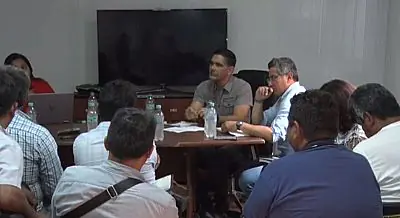
Minister Justiniano with producers from the Integrated North. Photo: BTV
The Minister of Productive, Rural and Water Development, Óscar Mario Justiniano, reported that at least 50 storage and industrial plants were identified as having been used to commit acts of corruption and waste in recent years.
On Saturday he held a meeting with producers from the Integrated North of Santa Cruz, where he explained the measures being taken by the Government and the acts of corruption uncovered through audits of various state-owned industries.
According to Justiniano, these are not only industrial plants, but also grain storage facilities and others. “In the country there are grain storage plants, grain processing plants, of various kinds, that were never completed and generated corruption,” he said.
“Plants that were not finished, even slaughterhouses, feedlots. It is extensive, there are diverse activities—at least 50 plants throughout Bolivia, but of different kinds,” Justiniano added to the media.
Producers
He stated that “there are properties where, theoretically, crops were planted and there was nothing. There were feedlots in El Tinto with a genetics center—total waste and surely all to steal, taking advantage of the population’s needs,” he stressed.
In that context, Justiniano said that the Food Production Support Company (Emapa) also deceived producers by offering to buy their products at high prices and then sell them at even higher prices, “and end up stealing the resources.”
He also announced that starting in January they will publicly release more reports on corruption in the plants and will ask the Justice system to identify and punish those responsible.
In addition, he agreed with producers to work on better conditions so they can form units, produce, and sell to the domestic market as well as export. “To see solid alliances to strengthen the sector of small producers in particular, who have production, potential, and commitment to the country,” he added.
He lamented that in the past that sector was “abused” by Emapa, which paid them late or did not pay them at all. “On the other hand, when they entered the open market with small volumes, they were at a disadvantage in negotiations compared to other producer sizes. Now that must change; groups of small producers can be strengthened to achieve better market conditions,” he emphasized.
With the arrival of the new government, the Government intervened in Emapa and identified economic damage exceeding Bs 95.5 million.
Por Erika Ibáñez, La Razón:
El ministro de Desarrollo Productivo dijo que desde enero harán conocer los detalles para que la Justicia tome acciones. Acordó con los pequeños productores mejores condiciones para el sector.
El ministro Justiniano con productores del Norte Integrado. Foto. BTV
El ministro de Desarrollo Productivo, Rural y Agua, Óscar Mario Justiniano, denunció que se identificó al menos 50 plantas de acopio e industriales que se usaban para cometer actos de corrupción y despilfarro en los últimos años.
Sostuvo este sábado una reunión con productores del Norte Integrado de Santa Cruz, a quienes explicó sobre las medidas que asume el Gobierno y los actos de corrupción que hallaron en auditorías a las diversas industrias estatales.
Según Justiniano, no son solo plantas industriales, sino también de acopio de granos y otros productos. “En el país hay plantas de acopio de granos, transformación de granos, de diversas índoles que no se terminaron y generaron corrupción”, dijo.
“Plantas que no se terminaron, hasta mataderos, confinamiento. Es grande, son diversas las actividades, al menos son 50 plantas en todo Bolivia, pero son de diversas índoles”, acotó Justiniano a los medios de comunicación.
Productores
El ministro dijo que “hay propiedades donde teóricamente se sembraba y no había nada. Se tenían confinamientos en El Tinto con centro de genética, todo un despilfarro y todo seguramente para robar aprovechándose de necesidades de la población”, remarcó.
En ese contexto, Justiniano dijo que en la Empresa de Apoyo a la Producción de Alimentos (Emapa) también engañaba a los productores y les ofrecía comprar sus productos a precios altos para luego venderlos más caro “y terminarán robando los recursos”.
Asimismo, anunció que a partir de enero entregarán públicamente más informes sobre la corrupción en las plantas y pedirán que Justicia identifique y sancione a los responsables.
Además, acordó con los productores que se trabajará en mejores condiciones para que puedan conformar unidades, producir y que ellos puedan vender al mercado interno y también exportar. “Ver alianzas sólidas para fortalecer al sector de los pequeños productores particularmente que tienen la producción, el potencial y el compromiso con el país”, complementó.
Lamentó que, en el pasado, ese sector haya sido “ultrajado” por Emapa que les pagaba tarde o no lo hacía. “Por otra parte, cuando ya entraban al mercado abierto con pocos volúmenes, tenían desventaja con la negociación de otros tamaños de productores. Ahora eso debe cambiar, se puede potenciar a grupos de pequeños productores teniendo para poder tener una mejor condición de mercado”, remarcó.
Con la llegada del nuevo gobierno, el Gobierno intervino Emapa e identificó un daño económico superior a Bs 95,5 millones.

 Bolivian Thoughts | Pensamientos Bolivianos (Bilingual/Bilingüe)