
Editorial, El Dia:
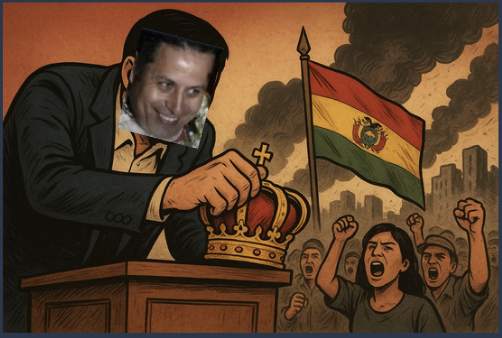
The worst forecast about Edman Lara has come true—and faster than anyone could have imagined. What many feared—an abrupt turn toward systematic attrition, daily confrontation, and concealed ambition—is no longer a hypothesis: it is an unfolding reality. Lara is in coup-mode, a permanent campaign aimed at political arson. His own declarations, forced comparisons, and increasingly strident behavior make this evident.
This does not mean sanctifying Rodrigo Paz’s government. That would be absurd. The disaster inherited from the MAS is so deep that no government could reverse it in such a short time, and there are indeed errors, silences, and weaknesses that must be pointed out. The issue lies elsewhere: it does not matter whether Paz is doing well or poorly. Lara is not interested in governability, reforms, or stability. He is interested in wearing down, eroding, and sowing instability. He follows a script designed to ensure nothing works and to make the country look backward again.
His behavior is a carbon copy of what led to the implosion of the 2019–2020 transition. The comparison he himself drew between the government of Rodrigo Paz and that of Jeanine Áñez is no coincidence; it is a message. He wants to repeat the same strategy that stripped Áñez of legitimacy and operational capacity, thus paving the way for the MAS to return.
Lara has no structure or strength of his own; he has no cadres, no machinery, no project. The only thing he does have is usefulness for those who do possess a well-oiled apparatus and a vocation for returning to power: the MAS and the populist bloc that wants to retake control at any cost. He is, in practice, an instrument—whether consciously or not—of that plan. Not because he says so, but because everything he does benefits exactly those who destroyed the country for two decades.
His discourse tries to portray him as a hardline opponent, but his strategy exposes him. He seeks to sow chaos, weaken the government, plant doubts, fabricate scandals, and keep the country permanently tense. That does not make him a leader, but an operator with a very clear direction: reopening the path for Evo Morales and his circle, rebranded as a “popular bloc,” a “renewed process,” or any name that can repackage a model that has already proven devastating.
The most dangerous aspect is that Lara behaves like a political termite. He does not destroy head-on; he bores through from within. He does not propose solutions; he blows up bridges. He does not work for the country; he works for the scenario that would allow populism to reinstall itself. His obsession with comparing himself to the current government, presenting himself as an ideal manager, and systematically attacking any action that might yield results shows that his goal is not to improve anything, but to prevent everything.
Neutralizing this game does not mean persecuting or censoring him, but exposing him, so citizens recognize that his role is not that of a watchdog, but of a battering ram. So they understand that behind his moralistic rhetoric and media theatrics, he is paving the way for the return of those who sank the economy, institutions, justice, and democratic coexistence.
Bolivia already knows this script. It lived it. It paid the price. And today Lara is trying to reactivate it with a brazenness that no longer surprises, but does alarm. The country must react—not for Rodrigo Paz, but for itself. Because allowing this corrosive operator to reopen the doors to disaster would mean repeating the tragedy in full awareness.
Editorial, El Día:
El peor pronóstico sobre Edman Lara se ha cumplido y más rápido de lo que cualquiera pudo imaginar. Lo que muchos temían —ese giro abrupto hacia el desgaste sistemático, la confrontación diaria y la ambición encubierta— ya no es una hipótesis: es una realidad en marcha. Lara está en modo golpe de Estado, una campaña permanente que busca el incendio político. Él mismo lo ha demostrado con sus declaraciones, sus comparaciones forzadas y su comportamiento cada vez más estridente.
Esto no significa santificar al gobierno de Rodrigo Paz. Sería absurdo. El desastre heredado del MAS es tan profundo que ningún gobierno podría revertirlo en tan poco tiempo, pero aun así hay errores, silencios y debilidades que deben ser señalados. El punto es otro: no importa si Paz lo está haciendo bien o mal. Lara no está interesado en gobernabilidad, en reformas ni en estabilidad. Está interesado en desgastar, erosionar, sembrar inestabilidad. Ejecuta un libreto diseñado para que nada funcione y para que el país vuelva a mirar hacia atrás.
Su comportamiento es un calco del que llevó a la implosión de la transición de 2019-2020. La comparación que él mismo hizo entre el gobierno de Rodrigo Paz y el de Jeanine Áñez no es casual; es un mensaje. Quiere repetir la misma estrategia que vació de legitimidad y operatividad a Áñez, facilitando así el retorno del MAS.
Lara no tiene estructura ni fuerza propia, no tiene cuadros, carece de una maquinaria y proyecto propio. Lo único que sí tiene es utilidad para quienes sí poseen un aparato aceitado y una vocación de retorno: el MAS y el mundo populista que quiere recuperar el poder a cualquier precio. Él es, en la práctica, un instrumento —consciente o no— de ese plan. No porque lo diga, sino porque todo lo que hace beneficia exactamente a quienes destruyeron el país durante dos décadas.
Su discurso pretende mostrarlo como un opositor duro, pero su estrategia lo desmonta. Quiere sembrar caos, desgasta al gobierno, instala dudas, fabrica escándalos, tensiona al país. Eso no lo convierte en líder sino en operador, con una dirección clarísima: abrirle nuevamente el camino a Evo Morales y a su entorno, disfrazados de “bloque popular”, de “proceso renovado” o de cualquier nombre que funcione para reempaquetar un modelo que ya demostró ser devastador.
Lo más peligroso es que Lara actúa como una termita política. No destruye de frente: perfora desde dentro. No propone soluciones: dinamita puentes. No trabaja por el país: trabaja por el escenario que permita reinstalar al populismo. Su insistencia en compararse con el gobierno actual, en presentarse como gestor ideal, en atacar sistemáticamente cualquier acción que pueda dar resultados, revela que su objetivo no es mejorar nada, sino impedirlo todo.
Neutralizar este juego no significa perseguirlo ni censurarlo, sino exponerlo, para que la ciudadanía reconozca que su rol no es el de fiscalizador, sino el de ariete. Que entienda que, detrás de su retórica moralista y de sus shows mediáticos, está preparando el retorno de quienes hundieron la economía, la institucionalidad, la justicia y la convivencia democrática.
Bolivia ya conoce este libreto. Lo sufrió. Lo pagó caro. Y hoy Lara intenta reactivarlo con un descaro que ya no sorprende, pero sí alarma. El país debe reaccionar, no por Rodrigo Paz, sino por sí mismo. Porque permitir que este operador corrosivo vuelva a abrir las puertas al desastre sería repetir la tragedia con plena conciencia.
https://eldia.com.bo/2025-11-25/editorial/lara-en-modo-golpe.html

 Bolivian Thoughts | Pensamientos Bolivianos (Bilingual/Bilingüe)