
By El Diario:
According to Ipsos Ciesmori Poll Report
Government Radiates Hope, but People Demand Jobs and Economic Improvement
- There is confidence in the new government and hope among the population that solutions will come in a way that does not harm vulnerable families.
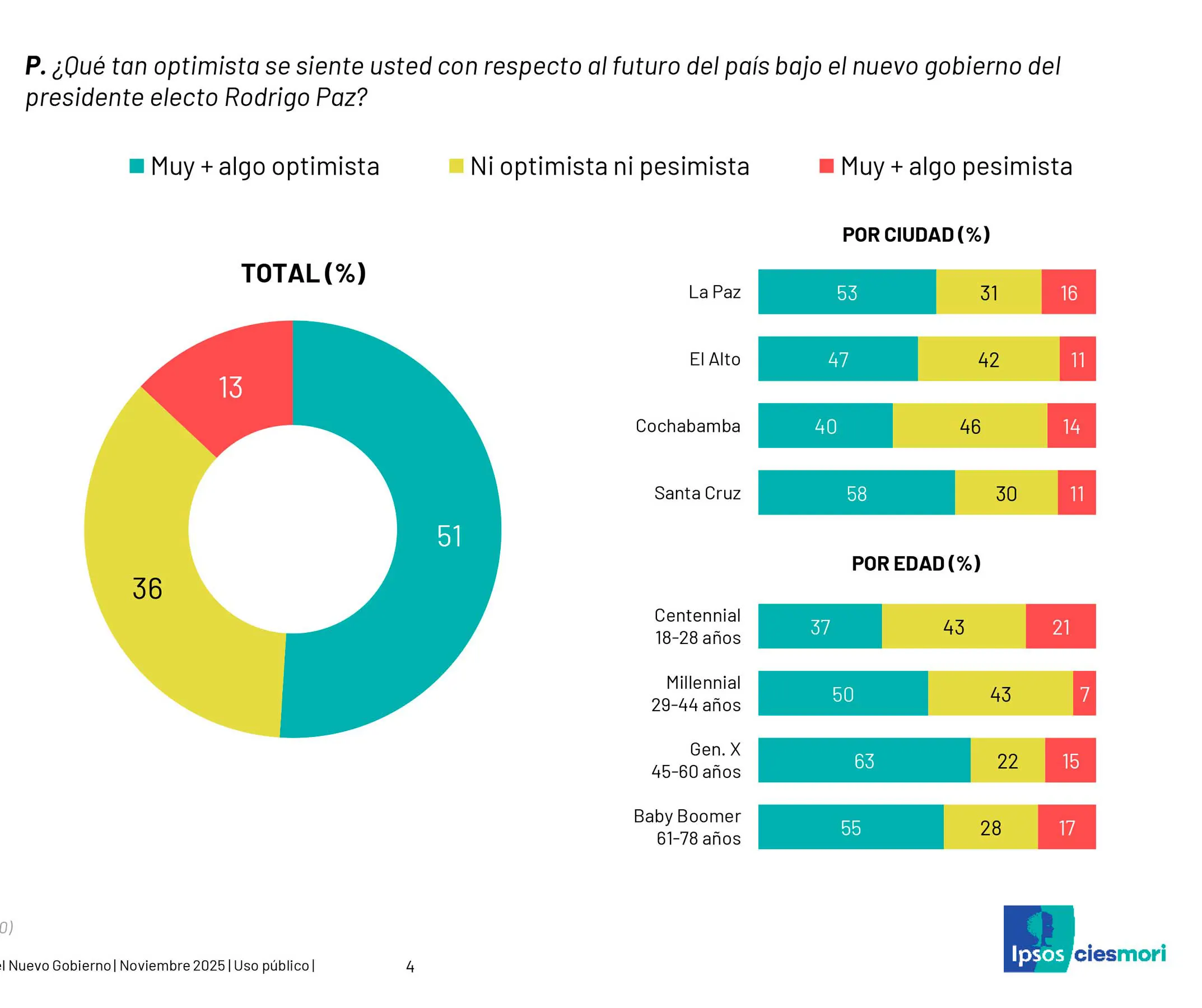
The beginning of President Rodrigo Paz Pereira’s administration is marked by notable—though not yet consolidated—optimism. According to Ipsos Ciesmori’s special report Expectations for the New Government, 51% of respondents described themselves as “very optimistic” about the country’s future under the new administration, compared to only 13% who feel pessimistic. However, a significant portion of citizens—36%—remains neutral (“neither optimistic nor pessimistic”), reflecting a cautious wait-and-see attitude toward the government’s early actions.
Economic analysts noted that Bolivia is facing an energy and economic crisis, along with institutional challenges and high inflation. This situation has led the country into stagflation—rising prices without growth.
Experts and business leaders have repeatedly warned that Bolivia’s labor market is overwhelmingly informal—about 85% informal versus only 15% formal employment. They have urged authorities to adopt measures to reverse this trend, as job opportunities decline and purchasing power erodes each day.
Survey Details
The survey was conducted online by Ipsos Ciesmori between October 24 and November 5, 2025. The results capture public sentiment just before the presidential inauguration.
The main feeling among respondents about the start of the new government is hope, which leads social attitudes with 39%. When combined with expectation (22%), over 60% of respondents express a positive or constructively expectant outlook. On the other hand, the main feeling of caution is uncertainty, cited by 18% of respondents.
Demands and Expectations
The top and most widespread priority for the first three months of the new government is economic reactivation and job creation, a categorical demand expressed by 63% of respondents. This concern dominates across all major cities, peaking in Cochabamba (71%), according to the report.
About 46% of the population expects an improvement in their personal and family economic situation during the first year of the new administration. This optimism is tempered by caution: 26% believe their situation will “remain the same,” while 14% anticipate it will worsen.
Support for Key Proposals
There is broad public backing for three of the main actions proposed by the new government, with approval levels ranging between 65% and 80%.
The reduction of ministries is the most popular measure, supported by 80% of respondents, followed by restoring diplomatic relations with the United States, backed by 71%. Meanwhile, the proposal to target fuel subsidies only to vulnerable sectors by adjusting prices is less consensual but still enjoys a majority approval of 65%.
Regarding President Paz’s ability to unite the country, most of the population (67%) has positive expectations. However, partial unity is the prevailing belief: 48% expect him to unite “some sectors,” while only 19% believe he will achieve unity among “all or most sectors,” according to the report.
By age group, optimism is strongest among Generation X (63%) and Baby Boomers (55%), while Centennials are the least optimistic (37%) and the most pessimistic (21%), indicating greater distrust or lower expectations among younger voters.
51% say they feel optimistic about the country’s future under the new government.
Por El Diario:
Según informe de encuestadora Ipsos Ciesmori
Gobierno irradia esperanza, pero población pide empleo y mejoramiento de la economía
- Hay confianza en el nuevo gobierno y espera la población en que la solución llegue de una manera que no afecte a familias vulnerables.
El inicio de la gestión del presidente del Estado, Rodrigo Paz Pereira, se caracteriza por un optimismo destacable, aunque no consolidado. El 51% de los encuestados se declaró “Muy optimista” respecto al futuro del país bajo el nuevo gobierno, superando ampliamente al 13% que se siente pesimista. Sin embargo, una porción considerable de la ciudadanía, el 36%, se mantuvo en una postura neutral (“Ni optimista ni pesimista”), lo que subraya la cautela y la voluntad de esperar el desarrollo de la gestión, de acuerdo con el informe especial de Ipsos Ciesmori sobre las Expectativas del Nuevo Gobierno.
Los analistas económicos indicaron que Bolivia enfrenta una crisis energética y económica, así como institucional y una alta inflación. Esta situación provocó que el país ingresará en una estanflación, es decir un incremento de precios sin crecimiento.
En reiteradas oportunidades los especialistas, así como empresarios señalaron que Bolivia tiene una alta informalidad, que en porcentaje estaría en el orden del 85% y sólo 15% formal, por lo que sugirieron a las autoridades a tomar medidas para revertir esta situación, ya que el empleo baja y el poder adquisitivo se va perdiendo cada día.
Encuesta
La empresa informa que la información presentada fue realizada mediante encuestas online entre el 24 de octubre y el 5 de noviembre de 2025. Estos resultados reflejan el pulso de la opinión pública antes de la ceremonia de transmisión de mando.
En cuanto al principal sentimiento experimentado ante el inicio del nuevo gobierno, la esperanza lidera el clima social con un 39%, y al sumarle la expectativa (22%), más del 60% de los consultados mantiene una actitud positiva o de espera constructiva.
Por otro lado, el principal sentimiento de reserva es la incertidumbre, manifestada por el 18% de la población.
Demandas y expectativas
La prioridad número uno y transversal para los primeros tres meses de gobierno es la reactivación económica y la generación de empleo, siendo esta una demanda categórica expresada por el 63% de la población total. Esta preocupación es dominante en todas las ciudades del Eje Troncal, alcanzando su punto máximo en Cochabamba (71), señala el documento.
Un 46% de la población espera una mejora en su situación económica personal y familiar durante el primer año del nuevo gobierno. Este optimismo se equilibra con una alta cautela, ya que el 26% cree que su situación “se mantendrá igual” y un 14% anticipa un deterioro.
Respaldo a propuestas
Existe un amplio apoyo popular para tres de las principales acciones propuestas por el nuevo gobierno, con una aprobación que oscila entre el 65% y el 80%.
La reducción de ministerios es la propuesta más popular, con un 80% de acuerdo, seguida por el restablecimiento de relaciones diplomáticas con Estados Unidos que cuenta con el respaldo del 71% de la población. Mientras que enfocar la subvención de combustible solo a sectores más vulnerables ajustando el precio, es la medida menos consensuada, aun así mayoritariamente apoyada con un 65% de acuerdo.
Respecto a la capacidad del presidente Paz para unir al país, la mayoría de la población (67%) tiene una expectativa positiva. No obstante, predomina la creencia en una unidad parcial, ya que el 48% espera la unión de “algunos sectores”. Solo el 19% cree que logrará la unidad de “todos o la mayoría de los sectores”, señala el documento.
En cuanto a la edad, el optimismo es abrumador entre la Generación X con un 63% y la Generación Baby Boomer con 55%. En contraste, la Generación Centennial es la menos optimista (37%) y la más pesimista (21%), lo que revela una mayor desconfianza o expectativas más bajas del sector más joven del electorado.
51% Indica que se siente optimista respecto al futuro del país con el nuevo gobierno.

 Bolivian Thoughts | Pensamientos Bolivianos (Bilingual/Bilingüe)