
By El Diario:
Lucio Tito’s proposal
Land management must be based on potential and productive capacity
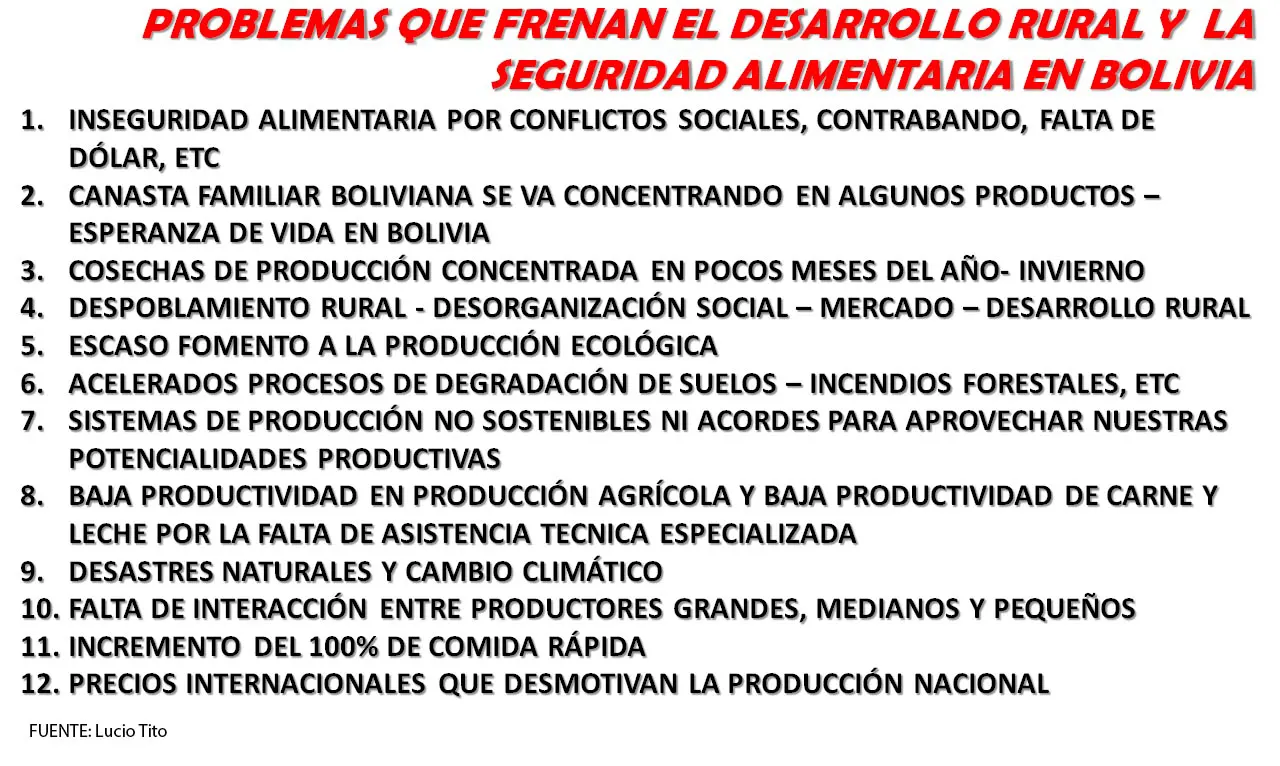
- A task for the new government will be to effectively deliver support to the rural sector — not as it is now, where programs act as they please and do not target resources to improve food production.

Despite investment and programs allocated to the rural area to improve food production, the results have not met expectations; therefore, Lucio Tito — researcher and postgraduate professor at the Universidad Mayor de San Andrés (UMSA) — proposes organizing the entire national territory according to its potential and productive capacity, in order to avoid the destruction of ecosystems.
Meanwhile, the Eastern Agricultural Chamber (CAO) is following its productive agenda, which involves the approval of technology and biotechnology to increase production and prevent losses caused by climate change, which in some areas leads to droughts and in others to flooding.
It is worth recalling that the government of the Movement Toward Socialism (MAS), since the administration of Evo Morales, allocated billions of bolivianos to strengthen the countryside for food sovereignty and food security; at one point, they were even on the verge of mechanizing the rural area with the provision of 3,000 tractors.
The results remain unknown, as does the fate of the agricultural machinery. To date, it is estimated that investment exceeded 1.5 billion dollars, and even the government of Luis Arce alone announced a multimillion investment that reached 1,000 million bolivianos.
Proposal
Tito maintains that it is possible to move forward with the expansion of the agricultural frontier in a planned manner. Furthermore, he points out that forests can indeed be reduced, but first it is necessary to work on a water strategy for the productive system across the country’s 340 municipalities.
“It is necessary to establish resilience in all production systems, to reestablish traditional irrigation systems; it is necessary to sustainably conserve agricultural soils with organic amendments. Innovation must come through specialized technical assistance to the 22,393 communities in the country,” he stated.
Tito affirms that at UMSA, the Rector is promoting entrepreneurship and they are preparing a strategy to make successful enterprises visible in five zones (the Amazon, the Yungas, the enclosed valleys, the northern Altiplano, and the central Altiplano) and replicate them.
In that context, he sees the need to establish a territorial management policy for true rural development, one that emerges from the communities and municipalities. “It is from there that work must be done and land must be organized,” he pointed out.
He lamented that all interventions in the rural productive setting have been imposed by 46 decentralized and deconcentrated government entities, without success. “The new policy must ensure that the territories assume a more prominent role, and therefore their capacities and potentialities must be defined through the governorates, as well as the future programs and projects of the government and of national and international cooperation,” he said.
The UMSA professor is clear in proposing that the country needs a policy that organizes the national territory into 19 territorial strategies (areas with agricultural potential, tourism areas, cultural areas), as well as identifying those with problems that hinder their development — in terms of climate and climate change, and in geomorphological structures.
Lack of coordination
“Today, for example, in the country there are 76 national and international cooperation state institutions, which carry out their work individually, and the lack of coordination among them has already been demonstrated, since each one operates based on its own criteria,” the specialist stressed.
For example, one can observe the lack of coordination among institutions in the municipality of Cuatro Cañadas, in the department of Santa Cruz, where the same producers received wheat seeds from Emapa, also from Iniaf, from the FAO, from IPDSA, and managed to obtain support from Empoderar.
“(…) it is a shame that resources are squandered (…) this shows that there is disorder, the 76 institutions do whatever they want, nobody organizes them; that is why a policy is needed that organizes action from the territory (…), the policy must define 19 action strategies toward the productive future of the country,” he reiterated.
Por El Diario:
Planteamiento de Lucio Tito
Ordenamiento debe ser de acuerdo a potencialidad y capacidad productiva
- Tarea para el nuevo gobierno será efectivizar el apoyo al sector rural, y no como ahora, donde los programas hacen lo que quieren y no focalizan los recursos para mejorar la producción de alimentos.
A pesar de la inversión y los programas destinados al área rural para mejorar la producción de alimentos, los resultados no son los esperados; por lo tanto, el investigador y docente de postgrado de la Universidad Mayor de San Andrés (UMSA), Lucio Tito, plantea ordenar todo el territorio nacional de acuerdo a sus potencialidades y capacidad productiva, así evitar la destrucción de los ecosistemas.
Mientras tanto, desde la Cámara Agropecuaria del Oriente (CAO) va por su agenda productiva, que implica la aprobación de tecnología y biotecnología para aumentar la producción y evitar las pérdidas por el cambio climático que provocan, en algunas zonas, sequías y en otras inundaciones.
Hay que recordar que el gobierno del Movimiento al socialismo (MAS), desde la gestión de Evo Morales, destinó miles de millones de bolivianos para fortalecer el campo, para la soberanía alimentaria y seguridad alimentaria; en un momento, estaban por mecanizar el área rural con la provisión de 3.000 tractores.
Los resultados se desconocen, así como el destino de la maquinaría agrícola. Hasta la fecha estiman que la inversión pasó los 1.500 millones de dólares y como sólo el gobierno de Luis Arce anunció inversión millonaria que ascendió los 1.000 millones de bolivianos.
Planteamiento
Tito sostiene que se puede avanzar en la ampliación de la frontera agrícola de manera planificada. Además, señala que es posible reducir los bosques, pero antes hay que trabajar en una estrategia de agua para el sistema productivo en los 340 municipios del país.
“Es necesario establecer resiliencia a todos los sistemas de producción, reestablecer sistemas de riego tradicional, es necesario conservar, sosteniblemente, los suelos agropecuarios con enmiendas orgánicas. La innovación debe ingresar a través de la asistencia técnica, especializada, a las 22.393 comunidades del país”, sostuvo.
Tito asegura que, en la UMSA, la Rectora promueve el emprendedurismo y están preparando una estrategia para visibilizar emprendimientos exitosos en cinco zonas (Amazonia, Yungas, valles cerrados, altiplano norte y altiplano central) y replicarlos.
En ese contexto, ve la necesidad de establecer una política de gestión territorial para el verdadero desarrollo rural, que venga desde las comunidades y municipios. “Desde ahí se debe trabajar y ordenar por territorio”, apuntó.
Lamentó que todas las intervenciones en el escenario rural productivo fueron impuestos por 46 entidades descentralizados, desconcentrados del gobierno sin éxito. “La nueva política debe establecer que los territorios asuman un rol más protagónico, y por ello sus capacidades, sus potencialidades se deben establecer a través de las gobernaciones, así como los futuros programas y proyectos del gobierno, y de la cooperación nacional e internacional”, dijo.
El docente de la UMSA es claro en plantear que el país necesita una política que ordene el territorio nacional en 19 estrategias territoriales (zonas con potencial agropecuario, áreas turísticas, culturales), así como identificar aquellas con problemas que frenan su desarrollo, en clima y cambio climático, y en estructuras geomorfológicas.
Falta de coordinación
“Hoy en día por ejemplo en el país existen 76 instituciones estatales de cooperación nacional e internacional, que realizan su trabajo individualizado, y ya se demostró la falta de coordinación entre estas, ya que cada una opera con criterio propio”, puntualizó el especialista.
Por ejemplo, se puede observar la descoordinación entre las institucione, en el municipio de 4 Cañadas, en el departamento de Santa Cruz, en la que los mismos productores recibieron semillas de trigo de “Emapa”, también del Iniaf, de la FAO, del IPDSA y lograron captar apoyo de “Empoderar”.
“(…) es una lástima que se despilfarre recursos (…) eso muestra que hay un desorden, las 76 instituciones hacen lo que quieren, nadie los organiza, es por eso que se necesita una política que ordene el accionar desde el territorio (…), la política debe establecer 19 estrategias de acción rumbo al futuro productivo del país”, reiteró.

 Bolivian Thoughts | Pensamientos Bolivianos (Bilingual/Bilingüe)