
The 10 most relevant recent developments we recommend you read:
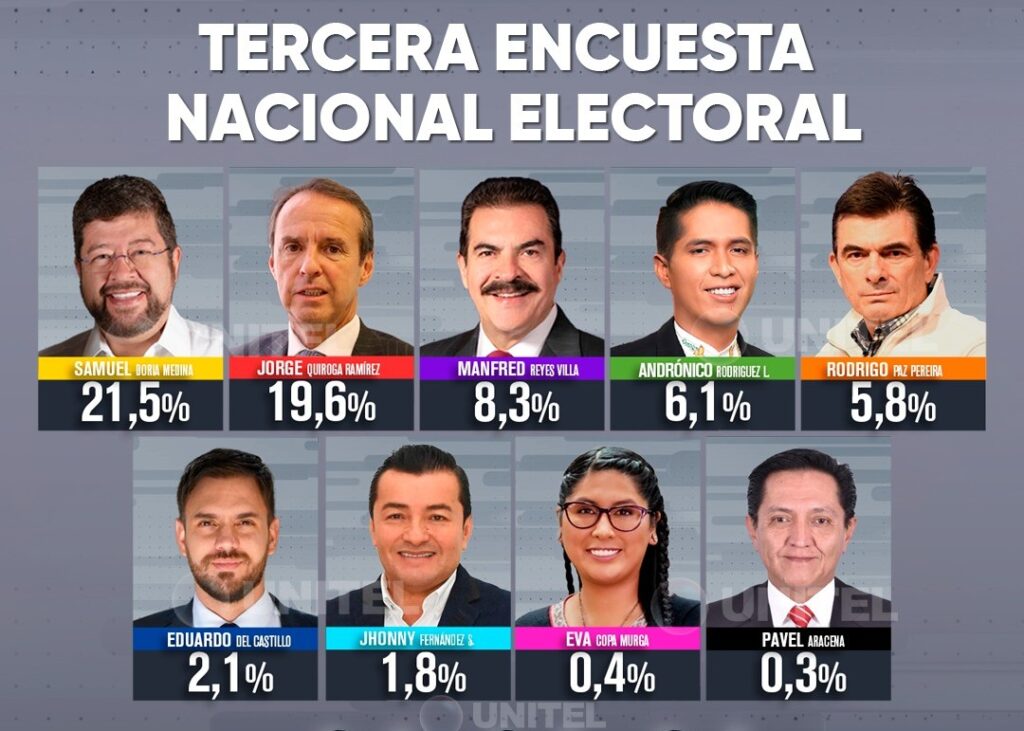
Third UNITEL poll ahead of the presidential elections. Photo: Unitel
Poll: Samuel secures first place but will face Tuto in a runoff; Manfred is third and Andrónico drops to fourth. Poll: Samuel leads voting intention in five departments and Tuto in four. Poll: 40% of voters are not convinced by any candidate; analysts point to a lack of proposals.
eju.tv recommends you read the 10 most relevant developments from the past few hours:
– Poll: Samuel secures first place but will face Tuto in a runoff; Manfred is third and Andrónico drops to fourth
Samuel Doria Medina leads the voting intention poll presented on Wednesday night by the Unitel network. The Unidad candidate garners 21.5% electoral support heading into the August 17 elections. According to the Ipsos Ciesmori poll, he is followed by Jorge Tuto Quiroga of the Libre alliance with 19.6%. Manfred Reyes Villa of APB–Súmate ranks third with 8.3%, while Andrónico Rodríguez of Alianza Popular holds the fourth spot with 6.1%, his worst performance so far. Rodrigo Paz Pereira of the Christian Democratic Party (PDC) has 5.8% support. In the lower half of the table: Eduardo del Castillo of the Movement for Socialism (MAS) with 2.1%, followed by Jhonny Fernández of the alliance La Fuerza del Pueblo with 1.8%. Further down are Eva Copa of the Movement for National Renewal (Morena) with 0.4%, and lastly Pavel Aracena of Libertas y Progreso ADN with 1.3%. The poll also shows that residual voting reaches 34.1%.
– Poll: Samuel leads voting intention in five departments and Tuto in four
The electoral landscape across departments shows changes, with the winds of change blowing in favor of Samuel Doria Medina, presidential candidate of the Unidad alliance, who now leads voting intention in five departments—unlike previous polls—including Santa Cruz (29.8%) and La Paz (18.1%). The third voting intention poll—conducted by Ipsos CIESMORI for UNITEL—also shows Doria Medina in first place in Tarija (37%), Beni (27.3%), and Pando (17.7%). Meanwhile, Jorge Tuto Quiroga, candidate for the Libre alliance, leads in Chuquisaca (27%), Oruro (23.8%), Potosí (16.6%), and Cochabamba (20.1%), pushing Manfred Reyes Villa of APB–Súmate into second place in Cochabamba (17%).
In Santa Cruz:
Samuel Doria Medina (Unidad Alliance): 29.8%
Jorge Tuto Quiroga (Libre Alliance): 24.5%
Manfred Reyes Villa (APB Súmate): 7.1%
Andrónico Rodríguez (Alianza Popular): 3.4%
– Andrónico drops to fourth nationally and in the central axis—his worst showing in voting intention ahead of the elections
Alianza Popular candidate Andrónico Rodríguez has his worst performance in voting intention ahead of the August 17 general elections. In the poll presented Wednesday night by Unitel, the current Senate president scores 6.1%, placing fourth. The opinion poll is led by Samuel Doria Medina (21.5%), followed by Jorge Tuto Quiroga (19.6%) and Manfred Reyes Villa (8.3%). Compared to previous results, Rodríguez has seen a sharp drop: 14.2% in the first poll, 11.8% in the second, and now 6.1%—an eight-point decrease. He lags far behind the top two candidates. In Santa Cruz, Rodríguez (Alianza Popular) polls at 3.4% and ranks fourth. In La Paz, he scores 7.8%, also in fourth place after having led in earlier polls. He also drops in Cochabamba, his home region, with only 5.4%.
– Who will win the presidential election? Check out public perception in the voting intention poll
Less than three weeks before the election of Bolivia’s new president, UNITEL released its third voting intention poll on Wednesday. One of the questions asked about public perception of the likely winner. “Regardless of your preferred candidate, who do you think will win the election?” was posed. 29% of respondents believe Samuel Doria Medina will win—an increase from 22% in the first poll released on July 13. Jorge Tuto Quiroga ranks second in perception and also shows growth. In the first poll, 17% of respondents saw him as the likely winner; in this third poll, 19% do.
– Poll: 40% of voters not convinced by any candidate; analysts point to a lack of proposals
According to the poll presented Wednesday night by Unitel, 40% of voters are not convinced by any candidate. In contrast, 32% of respondents have already decided on their vote. Another 24% are undecided but leaning toward two or three candidates, and 4% did not respond or said they don’t know. Analyst Carlos Valverde noted that candidates lack concrete proposals to win over voters, focusing instead on attacking rivals. Amando Ortuño added that candidates “fail to listen to people’s problems” to craft persuasive proposals. “Communication is a serious problem in these campaigns,” he said. Businessman Fernando Hurtado argued that “we must move from disqualification to proposals,” as “it’s no longer enough to disqualify MAS.” For Amalia Pando, “people want radical solutions” but also need help with basic survival.
– National poll: Undecided and null votes rise again; blank vote drops slightly
The results of the third national voting intention poll, ahead of the August 17 elections, were released Wednesday on UNITEL. Conducted by Ipsos-CIESMORI, the poll shows a rise in residual voting, which includes null, blank, and undecided responses. Blank votes register at 8.1%, down 0.1% from the second poll (8.2%). In the first poll, in early June, the figure was 6.5%. Null votes now stand at 13.6%, up from 12.5% in the second poll and 10.5% in the first. Undecided votes have risen to 12.4%, up from 11.3% in the second and 10% in the first. Altogether, residual votes now total 34.1%, 2.1% higher than in the second poll—and exceeding the totals of any individual candidate.
– 43% of young people in 5 cities don’t feel represented by any politician, and 41% distrust politics
“Young people in the five surveyed cities feel discouraged by various factors, such as disillusionment with democracy in the country and distrust toward current political parties and leaders. These obstacles cause apathy and skepticism among youth, preventing them from taking on active political roles,” said Cristina Stolte, representative of the Konrad-Adenauer Stiftung (KAS) in Bolivia. The study, conducted by KAS and Fundación Aru, highlights that at least 75% of voters in the August 17 general election are aged 18 to 39. When asked what emotions politics inspires, 41% said distrust, 19.7% indifference, 13.7% interest, 9.3% boredom, 7.3% irritation, 6.3% enthusiasm, and 2.7% other. One cited factor is the lack of spaces for young people, they say.
– Some voters want more than economic adjustments—they want to know how they’ll be treated, analyst warns
Following the release of the third voting intention poll, analyst Armando Ortuño observed that some sectors of the electorate demand more than economic reform—they want to understand how they’ll be treated. “There’s an electorate that not only needs a message about adjustments but also about how vulnerable groups will be treated,” he said during UNITEL’s Así Decidimos on Wednesday night. The Ipsos–CIESMORI poll comes at a time when the public reports falling incomes and calls for structural measures to protect vulnerable groups. “Opposition candidates have been more effective at motivating their base, unlike MAS,” he noted, adding this is evident in the latest results. “There’s a failure to listen to people’s problems,” he warned. The expert also highlighted “vote crystallization” in certain sectors.
– “There’s a hidden vote that could be affecting at least 2% of total results,” pollster says about undecided voters
The national voting intention poll for the August 17 elections, released Wednesday by UNITEL and conducted by IPSOS-CIESMORI, reports 8.1% blank votes, 13.6% null, and 12.4% undecided. The pollster went further to analyze the profiles of those who chose these options, which together account for 34.1% of the residual vote. Regarding undecided voters, Luis Garay Langberg, Director of Public Opinion at IPSOS-CIESMORI, explained: “Although they tell us they don’t have a candidate, 10% of them revealed in another part of the questionnaire that they actually do. So, there is clear evidence of a hidden vote that could be affecting at least 2% of the total results.” Undecided voting rose to 12.4% in the third poll—up from 11.3% in the second and 10% in the first.
– How does foreign debt affect low-income groups?
José Gabriel Espinoza, economist and head of the economic team for presidential candidate Samuel Doria Medina, warned that the sustained increase in foreign debt in recent years will directly and negatively impact the population—especially lower-income groups. “As debt grows, future obligations grow. And those can only be paid through higher taxes or monetary issuance, which leads to inflation. One way or another, we all end up paying,” Espinoza explained. He added that if the State chooses to raise taxes, the economy becomes more informal, weakening the labor market and hurting vulnerable groups even more. If the State prints more money, the immediate effect is price increases. “Inflation hits the poor hardest, since they spend almost all their income on consumption and have no way to protect their purchasing power,” he warned on eju.tv’s La Hora Pico.
Las 10 COSAS más relevantes de las últimas horas que le recomendamos leer.
La tercera encuesta de Unitel. Foto: Unitel
Encuesta: Samuel consolida el primer lugar, pero deberá medirse en segunda vuelta con Tuto; Manfred es tercero y Andrónico cae al cuarto sitial. Encuesta: Samuel lidera la intención de voto en cinco departamentos y Tuto en cuatro. Encuesta: Al 40% de los electores «ningún candidato» le convence; analistas apuntan a la falta de propuestas. eju.tv le recomienda leer las 10 COSAS más relevantes de las últimas horas:
Samuel Doria Medina lidera la encuesta de intención de voto presentada la noche de este miércoles por la red Unitel. El postulante de Unidad suma 21,5% de respaldo electoral de cara a los comicios del 17 de agosto. Según la encuesta de Ipsos Ciesmori, le sigue Jorge Tuto Quiroga de la alianza Libre con el 19,6%. En el tercer sitial se ubica Manfred Reyes Villa de APB- Súmate, con el 8,3%. En tanto, el cuarto escaño es de Andrónico Rodríguez de la Alianza Popular con el 6,1%, el peor de sus desempeños. Por su lado, Rodrigo Paz Pereira del Partido Demócrata Cristiano (PDC) suma 5,8% del respaldo electoral. En la segunda parte de la tabla se ubica Eduardo del Castillo del Movimiento Al Socialismo (MAS), con el 2,1%; seguido de Jhonny Fernández de la alianza La Fuerza del Pueblo, que suma 1,8%. Más abajo se ubican Eva Copa del Movimiento de Renovación Nacional (Morena), con 0,4%, y en último lugar está Pavel Aracena de Libertas y Progreso ADN, con el 1,3%. La encuesta además refleja que el voto residual llega al 34,1%.
– Encuesta: Samuel lidera la intención de voto en cinco departamentos y Tuto en cuatro
El tablero electoral en los departamentos registra movimientos y los vientos de cambio soplan a favor de Samuel Doria Medina, candidato presidencial de la Alianza Unidad, que a diferencia de anteriores encuestas, lidera en la intención de voto en cinco departamentos, incluidos Santa Cruz (29,8%) y La Paz (18,1%). La tercera encuesta de intención de voto -realizada por la empresa Ipsos CIESMORI para UNITEL- refleja Doria Medina también aparece en primer lugar en los departamentos de Tarija (37%), Beni (27,3%) y Pando (17,7%). Mientras que Jorge Tuto Quiroga, presidenciable por la Alianza Libre, ostenta el primer lugar en Chuquisaca (27%), Oruro (23,8%), Potosí (16,6%) y Cochabamba (20,1%), relegando en este último departamento al segundo lugar a Manfred Reyes Villa, candidato de APB – Súmate (17%). En Santa Cruz: Samuel Doria Medina (Alianza Unidad): 29,8%. Jorge Tuto Quiroga (Alianza Libre): 24,5%. Manfred Reyes Villa (APB Súmate): 7,1%. Andrónico Rodríguez (Alianza Popular): 3,4%.
El candidato de Alianza Popular, Andrónico Rodríguez, marca su peor desempeño en intención de voto de cara a los comicios generales del 17 de agosto. En la encuesta presentada la noche de este miércoles por Unitel, el actual presidente del Senado suma 6,1% y ocupa el cuarto sitial. Lidera el estudio de opinión Samuel Doria Medina (21,5%), seguido de Jorge Tuto Quiroga (19,6%) y Manfred Reyes Villa (8,3%). Si se comparan los resultados actuales con los anteriores datos se evidencia una caída significativa de Rodríguez. El líder del androquismo sumó en la primera encuesta 14,2%; en la segunda, 11,8% y ahora, 6,1%. Se marca una diferencia de ocho puntos porcentuales y está lejos de los candidatos que se ubican en los primeros dos lugares. En Santa Cruz, Rodríguez (Alianza Popular) suma el 3,4% y es cuarto. En La Paz, Rodríguez suma 7,8% y cae el cuarto sitial cuando en anteriores estudios estaba primero. Rodríguez también cae en Cochabamba, su región natal, al sumar solo 5,4%.
A menos de tres semanas de los comicios para elegir al nuevo presidente de Bolivia, este miércoles UNITEL difundió la tercera encuesta de intención de voto para las elecciones generales donde una de las consultas estuvo enfocada hacia la percepción del posible ganador de la contienda electoral. Más allá del candidato de su preferencia, ¿quién cree que ganará las elecciones?, fue la consulta realizada en la encuesta para UNITEL. El 29% de los encuestados cree que el ganador de las elecciones será Samuel Doria Medina, lo que significa un incremento en comparación con la primera encuesta difundida el 13 de julio en la que el 22% respaldaba una victoria del candidato de la alianza Unidad. En el segundo lugar de la percepción está Jorge Tuto Quiroga y también muestra un crecimiento en comparación con los datos del 13 de julio. En la primera encuesta el 17% de los encuestados apostaba por este candidato como el ganador, ahora en esta tercera encuesta el 19% cree que será una victoria del candidato de la alianza Libre.
Según la encuesta de intención de voto presentada la noche de este miércoles por la red Unitel, al 40% de los electorales «ningún candidato» le convence. En contrapartida, el 32% de los entrevistados ya tiene decidido su voto. En tanto, el 24% de los encuestados tiene dudas, pero inclina su preferencia entre dos o tres candidatos. Mientras que el 4% no respondió o dijo que no sabe. Según el analista Carlos Valverde, a los postulantes les falta propuestas para convencer a los electores. En su criterio, prima el ataque entre los contendores. Por su lado, Amando Ortuño destacó que hay «incapacidad de escuchar a la gente sobre sus problemas» para tratar de persuadirlo con propuestas. «La comunicación es un problema grave de las campañas», dijo. El empresario Fernando Hurtado consideró que «se debe pasar de la descalificación a la propuesta», puesto que «ya no es suficiente descalificar al MAS». Para Amalia Pando, «la gente quiere soluciones radicales», pero al mismo tiempo «quiere resolver sus problemas de subsistencia».
– Encuesta nacional: Sube nuevamente el voto indeciso y nulo; reduce levemente el blanco
Los resultados de la tercera encuesta nacional de intención de voto, rumbo a las elecciones generales del 17 de agosto, se presentaron este miércoles en UNITEL. El estudio fue realizado por la empresa Ipsos-CIESMORI. Según los datos a nivel nacional, hubo un aumento en el porcentaje del voto residual, que suma a aquellos que eligieron las opciones nulo, blanco o indeciso. El voto blanco registra un 8,1%, luego que en la segunda encuesta estuviera en 8,2%. Por lo que el porcentaje redujo 0,1%. En el primer estudio, a inicios de junio, tuvo 6,5%. En cuanto al voto nulo, en la tercera encuesta se muestra 13,6%, lo que es un 1,1% superior al de la segunda encuesta que tuvo 12,5%. En la primera encuesta fue de 10,5%. Respecto al voto indeciso, en la tercera encuesta tiene 12,4%, lo que es un 1,1% superior al 11,3% de la segunda encuesta. En la primera fue de 10%. En la tercera encuesta, el voto residual suma 34,1%, un 2.1% superior a la de la segunda que fue de 32%. El porcentaje está por encima de los obtenidos por los candidatos.
“Los jóvenes de las cinco ciudades encuestadas se sienten desalentados por diversas razones como el desencanto con la democracia en el país y la desconfianza en los partidos y políticos actuales. Estos obstáculos generan apatía y escepticismo entre los jóvenes ocasionando que no quieran asumir roles políticos activos”, afirmó la representante de la Konrad-Adenauer Stiftung (KAS) en Bolivia, Cristina Stolte. El estudio fue elaborado por la Konrad-Adenauer Stiftung (KAS) en Bolivia y la Fundación Aru en las ciudades anteriormente señaladas, donde se destaca que al menos el 75% de los electores que participarán en las elecciones generales del 17 de agosto tienen entre 18 y 39 años. Una de las consultas que se hizo a los jóvenes fue ¿Qué sentimiento te inspira la política? El 41% de ellos dijeron que les inspira desconfianza, 19,7% indiferencia, el 13,7% interés, el 9,3% aburrimiento, el 7,3% irritación, el 6,3% entusiasmo y el 2,7% otros. Uno de los factores es que no hay espacios para que los jóvenes, señalan.
Tras la presentación de la tercera encuesta de intención de voto, el analista Armando Ortuño observó que hay sectores del electorado que no solo exigen propuestas de ajuste económico, sino claridad sobre cómo serán tratados. “Hay un electorado que no solo tiene la necesidad sobre el discurso del ajuste, sino sobre cómo los sectores vulnerables van a ser tratados”, sostuvo durante el programa Así Decidimos, de UNITEL, la noche de este miércoles. Y es que la muestra realizada por IPSOS – Ciesmori para Unitel, aparece en un contexto en el que la población refleja que sus ingresos han caído, pero que también requieren medidas estructurales relacionadas a la protección de los sectores vulnerables. “Los opositores han sido más eficaces en motivar a su electorado, y es algo que no se logra en el campo masista”, sostuvo el analista, al remarcar que esto se refleja en los resultados más recientes. “Hay una incapacidad en escuchar a la gente en sus problemas”, advirtió. El experto señaló que hay una“cristalización del voto” en ciertos sectores.
La encuesta nacional de intención de voto rumbo a las elecciones del 17 de agosto, presentada este miércoles por UNITEL y realizada por la empresa IPSOS-CIESMORI, señala que el voto en blanco a nivel nacional es del 8,1%, el voto nulo del 13,6 y el voto indeciso tiene 12,4. La encuestadora también fue a fondo para identificar los perfiles de las personas que eligieron entre estas tres opciones, que suman 34,1% de voto residual. Respecto a los indecisos, el director de Opinión Pública de IPSOS CIESMORI, Luis Garay Langberg, explicó que “a pesar de que nos dicen que no tienen un candidato por quién votar, un 10 por ciento de estas personas, en otra sección del cuestionario, nos dijeron que ya lo tenían definido. Entonces, hay una evidencia clara de un voto oculto que podría estar incidiendo en al menos en 2% en los resultados totales”. Respecto al voto indeciso, en la tercera encuesta tiene 12,4%, lo que es un 1,1% superior al 11,3% de la segunda encuesta. En la primera encuesta fue de 10%.
– ¿Cómo afecta la deuda externa a las clases populares?
José Gabriel Espinoza, economista y líder del equipo económico del candidato presidencial Samuel Doria Medina, advirtió que el aumento sostenido de la deuda externa en los últimos años tendrá un impacto directo y negativo en la población, especialmente en los sectores de menores ingresos. “En la medida que uno va haciendo crecer la deuda, genera obligaciones futuras. Y esas obligaciones solo se pueden pagar con más impuestos o con emisión monetaria, que se traduce en inflación. De una u otra manera, todos terminamos pagando”, explicó Espinoza. El economista señaló que, si el Estado opta por subir impuestos, la economía tiende a informalizarse, lo que deteriora el mercado laboral y debilita aún más a los sectores vulnerables. Por otro lado, si se recurre a imprimir más dinero, el efecto inmediato es el alza de precios. “La inflación golpea más fuerte a los pobres, porque destinan casi todo su ingreso al consumo y no tienen cómo proteger su poder adquisitivo”, advirtió el economista en el programa La Hora Pico de eju.tv.
por Boris Bueno

 Bolivian Thoughts | Pensamientos Bolivianos (Bilingual/Bilingüe)