
By Álvaro Rosales, Unitel:
The presidential candidates made different proposals focused on improving Bolivia’s economic situation
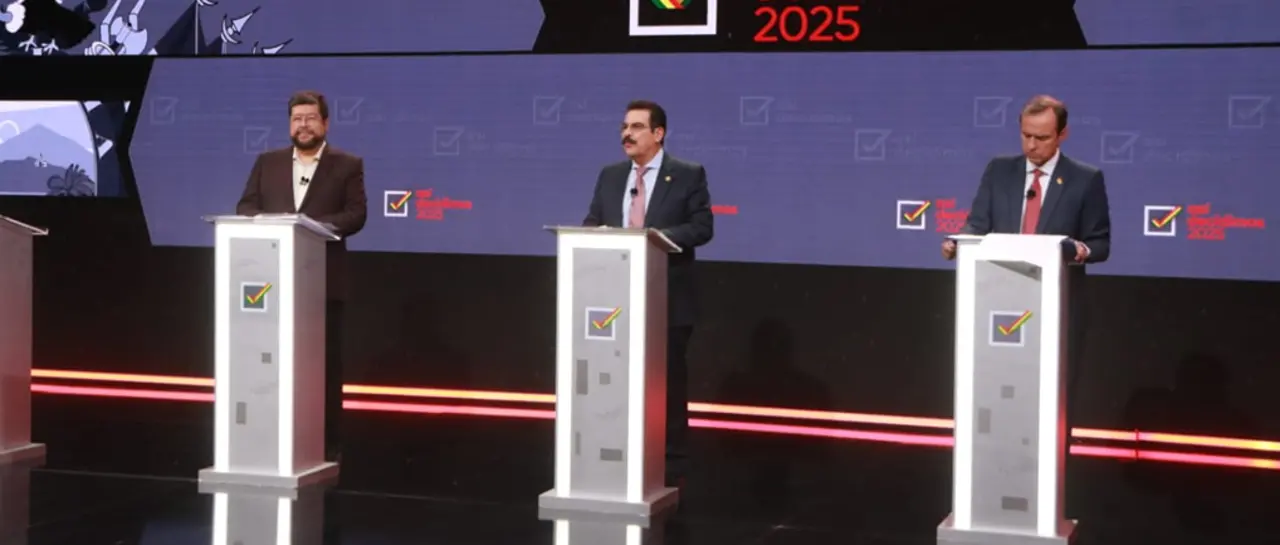
The candidates’ debate was broadcast through UNITEL’s multiplatform network
In UNITEL’s first major presidential candidates’ debate, Samuel Doria Medina, Jorge “Tuto” Quiroga, and Manfred Reyes Villa presented different paths to stabilize the economy, but also revealed four key points of agreement: reduce public spending, recover dollars, stabilize the exchange rate, and limit the Central Bank’s role as a deficit financier.
A key point of agreement was criticism of the unbacked issuance of money and the political use of the Central Bank. For instance, Quiroga spoke of “locking down” the Central Bank (BCB) to stop it from financing the government’s “waste and theft.”
Reyes Villa, in turn, said the Central Bank must be fully institutionalized and independent. Lastly, Doria Medina proposed halting the financing of loss-making public companies and shutting them down instead.
In this regard, all three candidates shared one conclusion: Bolivia cannot continue spending more than it has, emphasizing that public savings and fiscal discipline will be crucial.
Another shared point was the urgent need to recover dollars in order to reactivate imports: Tuto supports an international financing program with backing from the IMF, IDB, and CAF, proposing a $12 billion international rescue plan.
Manfred Reyes Villa ruled out going to the IMF, but proposed leveraging natural resources—specifically lithium—to attract dollars, aiming to secure $10 billion through an advance sale of lithium, which would also help reduce the exchange rate.
Doria Medina avoided big numbers and focused on immediate measures, presenting his 100-day plan to curb inflation, guaranteeing key imports with a $2 billion fund and cutting overspending—i.e., reducing the fiscal deficit.
As a third shared point, all candidates pointed to inflation as a symptom of fiscal disorder. “That’s the result of waste and theft, which devoured the gas, devoured the dollars, and now is causing inflation,” said Tuto. Samuel insisted, “We will not spend more than we have.”
Between January and June 2025, Bolivia’s accumulated inflation reached 15.53%, according to the National Institute of Statistics (INE), a figure that doubles the national government’s projection for the entire year, which had been set at 7.5%.
The fourth point of agreement was the rejection of the discretionary use of the Central Bank to finance the Executive. For example, Reyes Villa emphasized the importance of making the issuing entity institutionalized and independent.
Por Álvaro Rosales Melgar, Unitel:
Los candidatos presidenciables hicieron diferentes propuestas enfocadas a mejorar la situación económica de Bolivia
El debate de candidatos se transmite a través de la multiplataforma de UNITEL
En el primer gran debate de candidatos presidenciales de UNITEL, Samuel Doria Medina, Jorge Tuto Quiroga y Manfred Reyes Villa presentaron rutas distintas para estabilizar la economía, pero también dejaron ver cuatro coincidencias clave: bajar el gasto público, recuperar dólares, estabilizar el tipo de cambio y limitar el rol del Banco Central como financista del déficit.
Una coincidencia clave fue la crítica a la emisión de dinero sin respaldo y al uso político del Banco Central. Por ejemplo, Quiroga habló de poner un candado al BCB para que no financie más la “gastadera” y la “robadera” desde el Gobierno.
Mientras que Reyes Villa manifestó que el Banco Central debe ser totalmente institucionalizado e independiente. Y por último, Doria Medina apuntó a dejar de financiar a empresas públicas deficitarias y cerrarlas en su lugar.
En este sentido, los tres candidatos compartieron una conclusión: Bolivia no puede seguir gastando más de lo que tiene, apuntando que el ahorro público y la disciplina fiscal serán aspectos clave.
Otra coincidencia giró en torno a la urgencia de recuperar dólares para reactivar las importaciones: Tuto apuesta por un programa de financiamiento internacional con apoyo del FMI, BID y CAF, contemplando un plan de salvataje internacional de $us 12.000 millones.
Manfred Reyes Villa descartó acudir al FMI, pero propuso utilizar recursos naturales, específicamente el litio para captar dólar, apuntando a conseguir $us 10.000 millones como una venta adelantada de litio y de esta manera bajar el tipo de cambio.
Doria Medina evitó las grandes cifras y se centró en medidas inmediatas, sacando a relucir su plan de 100 días para frenar la inflación, garantizando importaciones clave con un fondo de $us 2.000 millones y dejando de gastar más de lo que se tiene, es decir, reduciendo el déficit fiscal.
Como tercer punto en común, todos apuntaron a la inflación como un síntoma del desorden fiscal. “Ese es el resultado de la gastadera y robadera, que devoró el gas, que devoraron los dólares y que hoy te genera inflación”, señaló Tuto. Samuel insistió en que “no vamos a gastar más de lo que tenemos”.
Entre enero y junio de 2025, la inflación acumulada en Bolivia alcanzó el 15,53%, según el Instituto Nacional de Estadística (INE), cifra que duplica las proyecciones del Gobierno nacional para todo el año, desde donde se había establecido una tasa del 7,5%.
La cuarta coincidencia fue el rechazo al uso discrecional del Banco Central para financiar al Ejecutivo, por ejemplo Reyes Villar restaltó que es importante que el ente emisor sea institucionalizado e independiente.

 Bolivian Thoughts | Pensamientos Bolivianos (Bilingual/Bilingüe)