
By EFE, Brujula Digital:
University Students in La Paz Create Innovative Device That Measures Water Pollution
Five Unifranz students formed the group ViewGreenTec two years ago and have competed in various national and international technology competitions.
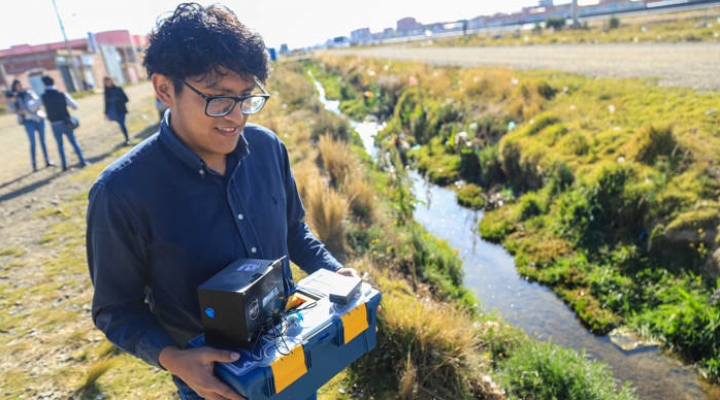
Student José Felix Sarmiento tests the device designed to quickly and accurately measure water pollution levels this Wednesday in Viacha. Photo: EFE
Five Bolivian university students created an innovative device that measures water pollution in a precise and rapid way, allowing the monitoring of water quality in springs, rivers, and lakes. The project was born with the aim of protecting public health and has received awards in national and international technology competitions.
The developers—Ronald Choque, Daniel Escobar, José Félix Sarmiento, Aaron Huanca, and Kevin Apaza—are senior systems engineering students at Franz Tamayo University (Unifranz) in La Paz.
After forming the group ViewGreenTec two years ago, they have competed in various national and international technology contests, where they won first place.
“The project emerged due to the need for information on water quality, because the water from the springs is pure, but as it travels (through some cities) it gets polluted, and it is used for animals, washing clothes, and other purposes, which affects public health,” Choque told EFE.
How the Device Works
He explained that the device collects samples and sends them via radio frequency to a station where all the information is received. This data is stored in a database, processed, and filtered so that accurate data is eventually published on a mobile app.
The analyzed water data—such as pH level, humidity, turbidity, and amount of waste detected—is published on a cellphone. Based on this information, the app confirms that the water is “not suitable” for consumption.
The Beginnings
Daniel Escobar told EFE that they built the prototype several years ago, and the first versions “absolutely” required power from computers and other devices. It also operated using wooden containers, which caused moisture.
“Now it runs directly on rechargeable, non-polluting batteries, and we’ve also managed to cover long distances. The device no longer needs the internet; the radio frequency sends the data,” said Escobar.
ViewGreenTec’s work has already had its first impacts. Data showing that the water from a stream near the municipality of Viacha, in the highlands of La Paz, was “not suitable” for consumption was presented by local residents to the municipal government. As a result, municipal authorities carried out a cleanup of the area.
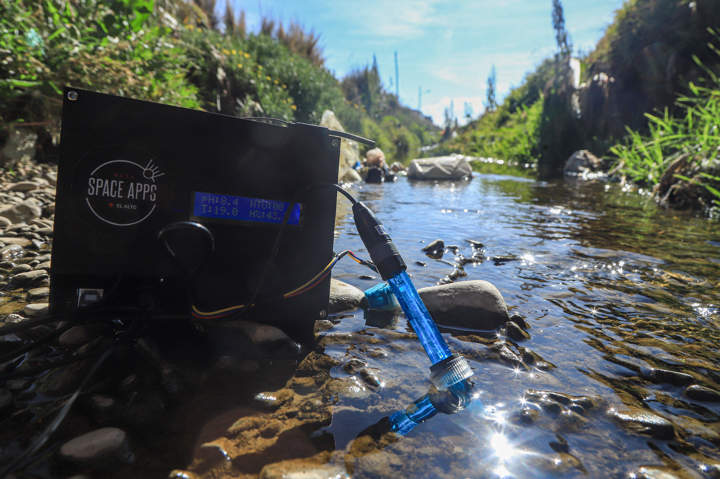
The device designed to quickly and accurately measure water pollution levels this Wednesday in Viacha. Photo: EFE
Looking Ahead
José Félix Sarmiento noted that “while it is a small-scale device,” the future goal is for the project “to become professional, creating more complementary modules that can be adapted to rivers, rain, and more extreme environmental conditions.”
Aaron Huanca shared that the device won first place at a technology fair organized by Unifranz, as well as in a NASA Space Apps Challenge held in the city, which motivated them to refine the device. The group also ranked among the top entries in an international competition.
This device is part of Franz Tamayo University’s integrative projects, in which students must propose initiatives based on socially impactful solutions using new technologies and teamwork.
The five developers hope to eventually establish ViewGreenTec as a company, generate impact at various levels of Bolivian society, and are also working on other devices to measure ultraviolet radiation and air pollution.

Photo of the device designed to quickly and accurately measure water pollution levels. Photo: EFE
BD/
Por EFE, Brujula Digital:
Universitarios de La Paz crean innovador dispositivo que mide la contaminación en el agua
[Si quiere escuchar el resumen, use este link, gracias]
Cinco estudiantes de Unifranz formaron el grupo ViewGreenTec hace dos años y han competido en diferentes concursos de tecnología nacionales e internacionales.
El estudiante José Felix Sarmiento prueba el dispositivo diseñado para medir de forma rápida y precisa los niveles de contaminación en el agua este miércoles, en Viacha. Foto: EFE
Cinco universitarios bolivianos crearon un innovador dispositivo que mide la contaminación del agua de una manera precisa y rápida, lo que permite monitorear la calidad del líquido en vertientes, ríos y lagos, un proyecto que nació con el fin de proteger la salud pública y ha sido premiado en concursos tecnológicos nacionales e internacionales.
Los desarrolladores Ronald Choque, Daniel Escobar, José Félix Sarmiento, Aaron Huanca y Kevin Apaza son estudiantes de ingeniería de sistemas del último año de la Universidad Franz Tamayo (Unifranz), de La Paz.
Tras formar el grupo ViewGreenTec hace dos años, han competido en diferentes concursos de tecnología nacionales e internacionales, donde obtuvieron los primeros lugares.
“El proyecto surgió debido a la necesidad de contar con información sobre la calidad del agua, porque las aguas de las vertientes que hay son puras, pero en su recorrido (por algunas ciudades) se contaminan, y así son empleadas para el consumo de algunos animales, para lavar ropa y otras, y eso influye a la salud pública”, dijo Choque a EFE.
Funcionamiento del dispositivo
Explicó que el dispositivo toma las muestras y las envía, a través de radiofrecuencia, a una estación donde se recibe toda la información. Esta se almacena en una base de datos, donde es procesada y filtrada para que la data precisa se publique finalmente en una aplicación móvil.
En el celular se publican los datos del agua analizada, como el nivel del PH, la humedad, la turbidez y el nivel de residuos que fueron tomados. Al final, la aplicación constata que el agua “no es apta” para el consumo con base en dicha información.
Los inicios
Daniel Escobar contó a EFE que el prototipo del dispositivo lo hicieron hace varios años, y en las primeras versiones “sí o sí” necesitaban la energía de computadoras y otros aparatos. Además, operaba con recipientes de madera, lo que producía humedad.
“Ahora directamente funciona con baterías recargables que no contaminan, y también ya hemos cubierto grandes distancias. Ahora el dispositivo ya no necesita internet; la radiofrecuencia envía los datos”, dijo Escobar.
El trabajo de ViewGreenTec ya tuvo sus primeras repercusiones, pues los datos analizados del agua “no apta” de un riachuelo cerca del municipio de Viacha, en el altiplano de La Paz, fueron presentados a la Alcaldía por los vecinos del lugar. Lo anterior derivó en que las autoridades municipales realicen una limpieza en el lugar.
El dispositivo diseñado para medir de forma rápida y precisa los niveles de contaminación en el agua este miércoles, en Viacha. Foto: EFE
El objetivo a futuro
José Félix Sarmiento señaló que “si bien es un dispositivo a pequeña escala”, el objetivo a futuro es que el proyecto “sea profesional, creando más módulos de complementación que pueda adaptarse a los ríos, a la lluvia y a condiciones ambientales más extremas”.
Aaron Huanca contó que el dispositivo ganó el primer lugar en una feria de tecnología organizada por la Unifranz, así como en una competencia del Nasa Space Apps Challenge realizada en la ciudad, lo que les motivó para perfeccionar el dispositivo. Además, el grupo quedó entre los primeros lugares de un concurso internacional.
Este dispositivo forma parte de los proyectos integradores de la universidad Franz Tamayo, donde los estudiantes deben proponer iniciativas basándose en una solución con impacto social, con la aplicación de nuevas tecnologías y trabajar en equipo.
Los cinco desarrolladores quieren a futuro consolidar ViewGreenTec como una empresa, además de generar impacto en diferentes niveles de la sociedad boliviana, pero también trabajan en otros dispositivos que miden el nivel de radiación ultravioleta y la contaminación del aire.
Fotografía del dispositivo diseñado para medir de forma rápida y precisa los niveles de contaminación en el agua. Foto: EFE
BD/

 Bolivian Thoughts | Pensamientos Bolivianos (Bilingual/Bilingüe)