
By Yenny Escalante y Felicidad Alarcón, Sumando Voces:
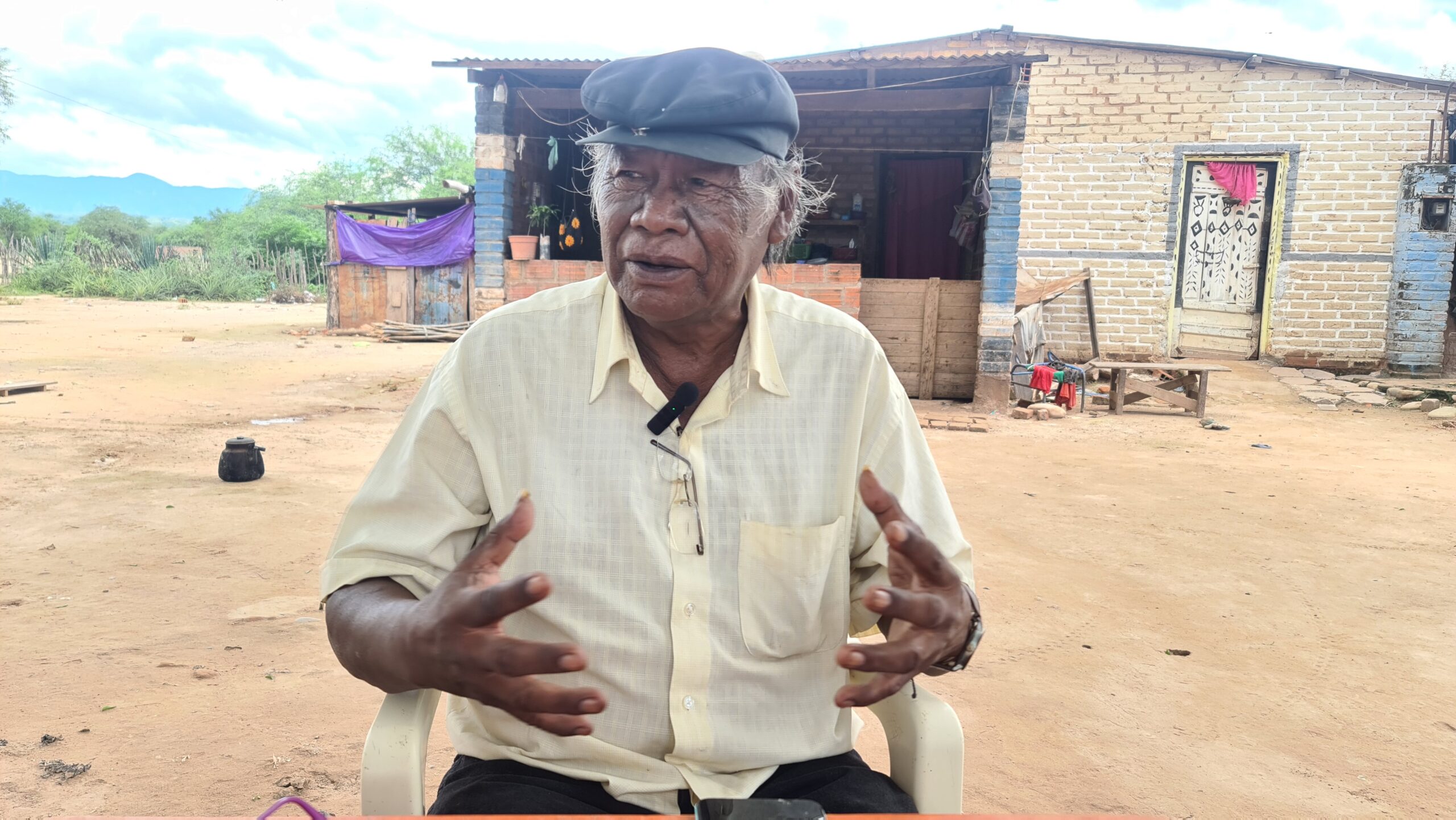
Freddy Cortez, a Weenhayek indigenous man. Photos: Yenny Escalante
Freddy Cortez doesn’t complain about the heat. Even though the thermometer reads 38°C and the sun beats down mercilessly on the Bolivian Chaco, he’s used to enduring even higher temperatures, which are typical of the area. The skin on his face, etched with deep lines like cracks, seems to carry the memory of drought, dust, and time. He’s 58 years old, belongs to the Weenhayek indigenous people from the Capirendita community in the municipality of Villa Montes, Tarija, and for the past four years, he has been surviving with kidney failure.
“They told me it’s because of high blood pressure, but I still keep wondering why I got sick,” he says, trying to understand the root of his condition. Freddy is one of the most visible — and resilient — faces of a disease that spreads slowly and silently.

While some say it’s hypertension, others believe the water — or the lack of it — played a role. In reality, it seems to be a combination of factors: a region that’s increasingly hotter, long droughts, torrential rains, water sources of uncertain quality, and areas plagued with salty water. But the State has yet to show interest in investigating the exact causes. As a result, they are forced to live with that uncertainty.
In the face of this governmental inaction, the Center for Regional Studies for the Development of Tarija (CERDET) conducted a study published in 2020. Its conclusions are clear and specific: the water consumed by some Weenhayek communities contains excess sodium, sulfates, and other elements.
“The Weenhayek communities located along the Pilcomayo River, especially the further downstream toward the southeast, have increasingly saline or hard water. From Crevaux down (toward Argentina), sulfate salts are more common and harder to remove, since they make up what’s known as permanent hardness,” the study concludes.
This finding is confirmed again in 2025 by the institution’s director, Guido Cortez, who states that the situation has not changed. “It has been found that there are problems, especially excess salts and sulfates, which often render the water undrinkable, but people still consume it. Over the years, it causes certain health issues,” he says.
This is not a new problem — salty water has long been characteristic of the region. Martha Mancilla, a city dweller from the municipality of Tarija who lived in Villa Montes in the late ’90s, remembers having to collect rainwater in buckets to cook, since the tap water, which “seemed potable,” was salty. “The food would come out extremely salty; I think that water came from wells,” she recalls.
But in her case, her visits to the Chaco region were brief, just for vacations. The Weenhayek, on the other hand, have no choice — that is their land, and they have nowhere else to go; it’s where they were born and raised, just like their parents, grandparents, and ancestors.


Freddy has plenty of reasons to worry. According to the Pan American Health Organization (PAHO), an estimated 1.89 million deaths per year are linked to sodium consumption, which causes high blood pressure. That condition alone was responsible for 10.8 million deaths in 2019. For this reason, the international body recommends consuming less than 5 grams of salt per day. However, “in the Americas, people consume up to three times that amount, and all age groups — even children — are affected.”
Excess salt causes hypertension; hypertension leads to kidney problems.
The issue of salty water knows no geographic boundaries, warns Guido Cortez, director of Cerdet. “This is a general trend throughout the Chaco — in Argentina, Paraguay, and Bolivia. I’m not just talking about the Tarija region. It’s a regional phenomenon. The water is increasingly salty, animals often refuse to drink it, and if you use it for irrigation, it can dry out plants due to its high salt content,” he explains.
But although the water is not salty in every area where the Weenhayek live, as the Cerdet study also shows, why are some people still developing kidney disease or high blood pressure?
Dr. Fabricio Fernández Loza, an internal medicine specialist in nephrology and kidney transplantation, explains that the environment in which these communities live poses a high risk to their kidney health. “These populations are exposed to very high temperatures and likely have insufficient fluid intake. That can lead to acute kidney disease which, if not treated in time, becomes chronic kidney disease — where the damage is irreversible,” he explains.
Fernández notes that a person should consume 1.5 to 2 liters of water per day, but in hot climates, that amount should be higher due to greater dehydration.
Beyond Bolivia’s borders, this disease has already left its mark. Fernández recalls similar phenomena recorded in Central America, known as Mesoamerican nephropathy: agricultural workers with no history of hypertension or diabetes developed kidney damage after years of exposure to extreme heat and chronic dehydration. “It was found that the common factor was sustained lack of hydration, which over time caused permanent damage to the kidneys.”
Thus, multiple factors contribute to this problem. Scientific studies have not yet reached Freddy’s community, but he wants to know for sure whether the water he drinks contains excess salts, like in other villages — and whether the culprit of his illness is the water he drinks daily or the insufficient amount of it.
***
Villa Montes is nestled in the Gran Chaco province in southern Bolivia, near the border with Argentina and Paraguay. In addition to city dwellers, it is home to three indigenous peoples: Guaraní, Tapiete, and Weenhayek — the latter with a population of approximately 3,500 people who live in areas near the Pilcomayo River.
Here, climate change is not just a perception. The National Service of Meteorology and Hydrology (Senamhi) has recorded a progressive increase in temperatures over the past decade. And as the heat intensifies, access to safe water declines.

On February 17, 2016, Villa Montes hit a record high of 46°C.

Fourteen people live in Freddy’s home: his children, daughters-in-law, and grandchildren. They rely on weekly cistern deliveries from the Autonomous Regional Government of Villa Montes. The water is stored in containers, but with the oppressive heat and the number of people at home, it’s not always enough to last seven days. “Sometimes it runs out in three days,” he says, resigned, as he looks at the black tank at the entrance of his house.
It’s the end of March, rainy season, but the heat presses down with suffocating force, making sweat drip endlessly from foreheads. The air feels still, heavy. Under these conditions, every drop of water counts, and there’s not always enough even to drink — rainwater is absorbed immediately by the soil.
Extreme heat, intensified by climate change and deforestation, is pushing the Chaco ecosystem to a breaking point, warns environmental analyst Stasiek Czaplicki. Consecutive years of drought, increasingly long dry seasons, and the growing risk of devastating fires threaten not only biodiversity but also indigenous communities. These extreme conditions make their survival difficult, forcing them to migrate and lose their livelihoods, languages, and systems of organization. “It’s a silent form of cultural extinction,” the expert concludes.
The Bolivian Chaco has been one of the main hotspots of deforestation in recent decades — Czaplicki continues — especially since 2008. Since then, around half a million hectares of forest have been lost, primarily due to agricultural expansion by Mennonite colonies. This massive loss has had serious consequences: the ecosystem has lost its ability to absorb water. Between 2008 and 2023, the area of surface water — which results directly from rainfall — has nearly halved. Although rains increased in 2024, the damage is already so deep that the ecosystem can no longer retain or regenerate with that water, like a parched plant that doesn’t come back to life with just one sporadic watering.
The lack of potable water in communities like Capirendita pushes residents to drink sodas and processed juices, which are cheaper but loaded with sugar. This change in habits is causing a rise in diabetes cases — a disease that, over time, can lead to kidney failure. This is the warning of Dr. Humberto Delgado, head of epidemiology at the Villa Montes Health Network, and nephrologist Fabricio Fernández from La Paz. Both agree that the excessive consumption of sugary drinks is affecting even children and teenagers. “There are already people with diabetes in this (Weenhayek) population,” Delgado notes.
According to Alia Flores, a doctor at the Capirendita Health Center, there is only one patient with chronic (severe) kidney disease who is undergoing dialysis treatment, and there are 27 diabetics. Although the official number is low, Freddy remembers more cases. He says his brother died from kidney disease, as did a friend from another Weenhayek community. Both began dialysis treatment in the city of Tarija — five to six hours from Villa Montes — but died in the process.
Today, in Villa Montes, the hospital has a dialysis center. But for those living in remote communities, getting there isn’t easy—it requires time, money, and energy. “I get on my motorcycle and go, but others can’t do that. It’s an expensive illness,” says Freddy. That’s why others don’t even start the process: they simply can’t.
Kidney disease is insidious. Nephrologist Fabricio Fernández sums it up this way: “Unfortunately, it’s a silent disease in the sense that it gives no warning, there are no symptoms, or the symptoms are nonspecific. They’re essentially high-cost diseases, mainly caused by diabetes mellitus and hypertension.” Both are increasingly common among the Weenhayek.
Kidney patients by population size in each municipality, according to the 2024 INE census
Villa Montes has, on average, 70 kidney patients per 10,000 inhabitants.
Water: suitable or unsuitable for human consumption?
Around noon, a water truck drives along the dusty road to deliver water to the Weenhayek. “I don’t know where they get it from, but look at the color,” says Freddy, showing a clear glass that reveals yellowish water. Next to it, another glass filled with bottled water shows a clear tone. The difference is obvious and the question is clear: is it fit for human consumption?

“The kids don’t even have time to boil it. Sometimes they drink it straight,” says Freddy while sitting under a leafy carob tree planted in the middle of his yard.
“Sometimes the water comes with little bugs, and there’s nothing we can do, we have to drink it like that, because we have no other option,” says one of Freddy’s daughters.
Hundreds of years ago, the Capirendita community, like many others settled along the Pilcomayo River, depended on the river to survive. Although it was historically their source of life, today the river is unpredictable. In addition to the presence of heavy metals—such as arsenic, cadmium, lead, iron, boron, bromine, manganese, mercury, nickel, silver, zinc, and selenium, according to Acceso Investigativo—it sometimes overflows, as it did this year, wiping out gardens and homes and isolating Indigenous families. Other times, its flow drops dramatically, wiping out the shoals of sábalo, their main daily food source.
Today, their only option is the water delivered by the municipal government, either by tanker truck or pipeline. But health impacts don’t take long to appear. “What they do is consume non-potable water from cisterns or tanks they supply themselves, or that authorities distribute for consumption,” explains Betty Janina Arroyo Calvetti, coordinator of the Villamontes Health Network. She adds that while boiling water before drinking is recommended, in practice “most people don’t do it.”
The water for this district comes from a well located in Capirendita, according to Saidu Valenzuela, Secretary of Public Works of the Villa Montes Regional Government, who adds that it’s drawn with tankers and distributed to each community. “The issue of the storage tank and cleaning is up to them (…) the well can’t possibly have any contaminants because the water comes directly from the wellhead, it’s filtered and has no harmful components,” he assures. However, he admits that no water study has been carried out, and the community would have to request one.
Wilfredo Ligaron, head of the municipal workshop unit, says that the water from wells in Capirendita and Tres Pozos—serving District 5 (Capirendita, Resistencias, Tres Pozos, and Garrobal)—receives no treatment because he believes it doesn’t need any, saying, “it’s guaranteed.” His confidence in the quality of the water appears unshakable. He says that for 15 years, they’ve been extracting water from those wells to supply the Weenhayek, either through pipes or by cisterns into their storage tanks. Meanwhile, the uncertainty of this Indigenous people continues to unfold daily across the arid Chaco landscape.
***
Alia Flores Serrano, doctor at the Capirendita health center, warns that the water distributed by the municipality is not always consumed safely and can cause illnesses. If you add poor eating habits, lack of hygiene—such as limited handwashing—and a deficient diet, conditioned by the economic precarity of many families, the result will be diarrhea; during the first 16 weeks of 2025, 22 cases were treated.

In addition to treatment, they offer guidance on preventive measures at home: boil water before drinking, wash food thoroughly, and maintain proper hygiene. However, in a context of scarcity and extreme heat, these recommendations are not always easy to follow.
On the subject, the head of Epidemiology for the Villa Montes Health Network, Humberto Delgado, explains that acute diarrheal diseases are still present in communities on the right bank of the Pilcomayo River. He reports that between January and March 2025, health facilities in the region reported a total of 81 cases, based on data collected through weekly monitoring.

“On average, we’re talking about one case per day across the region, which is relatively low,” Delgado notes, though he clarifies that there may be more cases that go unreported because they’re mild or self-limiting.
The promised solutions haven’t arrived. “There are always projects, but they never carry them out,” Freddy laments. “They say they’ll bring clean water, install pipes, but they haven’t done anything yet.”
Amid all this precariousness, the Weenhayek keep resisting. Some make a living from fishing, others from wild honey or selling crafts. Freddy raised nine children, some are musicians, others work in radio. He says he’s not afraid of the future because he trusts them. “Our savings aren’t in the bank. They’re in our children. They’ll take care of me when I can’t anymore,” he says with a mix of pride and resignation.
Life in the Chaco is becoming increasingly difficult. The combination of extreme heat, a shortage of potable water, and institutional neglect has created a perfect storm that threatens to wipe out both the health—and the hope—of an ancestral people. Freddy, with his motorcycle and his smile, still goes to his checkups. And though he suspects the water, or lack thereof, made him sick, it hasn’t taken away his will to live.
Rainwater harvesting: an effective alternative
Behind the Buenos Aires school in the Lapachal community, a group of children play with laughter and light steps. One of them runs to find Samuel. Soon, in the distance, a hunched figure appears, leaning on a cane and wearing dark glasses. He walks guided by the teenager who went to get him, gently holding his arm. Samuel Torres Pérez can no longer see, but he still looks after his community. He is the communal leader and has been guiding them for nearly two decades, backed by the experience of his years and struggles.
About 30 families—roughly 200 people—live in Lapachal. Samuel recalls that when they arrived nearly 19 years ago, water scarcity was a constant threat. “We had about 190 goats, and two or three would die every day, even up to five, from lack of water,” he recounts. The situation was critical, with drought destroying both animals and hope. That’s when he mobilized for support and secured a rainwater harvesting project led by the Center for Regional Studies for the Development of Tarija (Cerdet).
Inspired by successful experiences in northeastern Brazil, the project adapted low-cost technologies to capture and store rainwater using the school roof, intended for human consumption. A 52,000-liter cistern was built, which, thanks to a solar-powered filtration system, provides potable water to all the families in the community. But even before that, they had received a 20,000-liter tank.

The collected water is purified. “It’s like mineral water,” says Samuel as he opens the tap. Thus, Cerdet director Guido Cortez showed that with a relatively low investment and technical support, it’s possible to guarantee safe water, lasting at least six months a year—stored fresh in sealed tanks that prevent dirt, insects, or debris from entering.
The experience has transformed daily life for these families. While other communities continue to depend on brackish wells or sporadic rainfall, Lapachal achieved relative water autonomy, which was later replicated in Chimeo and Yacuiba. However, six years after this successful implementation, its expansion to other areas depends on the political will of municipalities—which has yet to arrive.
“I believe it’s a clear solution… you end up with water exclusively for human consumption… you ensure that the water being consumed won’t make people sick,” explains Cortez.
Beyond its technical impact, the project has restored dignity and hope to communities facing daily scarcity, contamination, and neglect. Rainwater harvesting not only improves health but opens up the possibility for productive activities, better nutrition, and reduced forced migration.


Unlike Samuel, who has water for long periods, Freddy waits week after week for water to arrive—but essentially, he waits for a bigger change that will allow him to leap toward a dignified life.
Under the shade of the carob tree, he sings. He does so softly, as if speaking to the Pilcomayo—the river that once brought water, fish, and life. In his song, there is no sadness, only resilience. And in that land, that too is a form of hope.
This report was produced with the collaboration of the communications strategy project of the Fundación para el Periodismo and with the support of South South North, Fundación Avina, WWF, and Voices for Just Climate Action.
Por Yenny Escalante y Felicidad Alarcón, Sumando Voces:
Freddy Cortez, indígena weenhayek. Fotos: Yenny Escalante
Freddy Cortez no se queja del calor, aunque el termómetro marca 38 grados centígrados y el sol cae sin piedad sobre el Chaco boliviano, él está acostumbrado a soportar temperaturas mayores, propias del lugar. La piel de su rostro, surcado de líneas profundas como grietas, parece que cargara la memoria de la sequía, del polvo y del tiempo. Tiene 58 años, es del pueblo indígena Weenhayek, de la comunidad Capirendita del municipio de Villa Montes, Tarija, y desde hace cuatro años sobrevive con insuficiencia renal.
“A mí me dijeron que es por la presión alta, pero yo me sigo preguntando por qué me enfermé”, dice intentado entender cuál es el origen de su padecimiento. Freddy es uno de los rostros más visibles —y resistentes— de una enfermedad que se expande con lentitud y de manera silente.
Mientras unos dicen que es hipertensión, otros piensan que el agua, o la falta de ésta, tuvo algo que ver. En realidad, todo parece haberse combinado: una región cada vez más calurosa, largas sequías, lluvias torrenciales, fuentes hídricas de incierta calidad, pero también, zonas plagadas de agua salada. Pero el Estado aún no se ha interesado en investigar las causas exactas. Por lo tanto, están forzados a vivir con esa incertidumbre.
Ante esa pasividad gubernamental, el Centro de Estudios Regionales para el Desarrollo de Tarija (CERDET), realizó un estudio que fue publicado en 2020. Sus conclusiones son claras y puntuales: el agua que consumen algunas comunidades weenhayek tiene exceso de sodio, sulfatos y otros elementos.
“Las comunidades weenhayek ubicadas a orillas del río Pilcomayo, a medida que se encuentran establecidas más abajo, al sur este, presentan aguas más salinas o duras. Desde Crevaux para abajo (es decir, hacia Argentina) tienden a tener sales de sulfatos y son más difíciles de eliminar, ya que conforman la dureza permanente”, señala la conclusión del estudio.
El dato es corroborado nuevamente este 2025 por el director de la institución, Guido Cortez, quien expresa que la situación no ha cambiado. “Se ha logrado encontrar que hay problemas, especialmente de exceso de sales, problemas de sulfatos, lo que hace que el agua, muchas veces, no sea potable, pero igual la gente la consume, y con los años genera ciertos problemas de salud”, manifiesta.
El problema no es nuevo, pues las aguas salitrosas son características de la región. Martha Mancilla, una citadina del municipio de Tarija que vivió en Villa Montes en los ’98, recuerda que debía recolectar agua de lluvia en valdes para lograr cocinar, pues cuando lo hacía con el agua que salía de la cañería “que parecía potable”, era salada. “La comida me salía extremadamente salada, creo que esa agua la sacaban de pozos”, relata.
Pero en su caso, sus visitas a la región chaqueña eran cortas, ya que solo iba para vacaciones, mientras que los indígenas weenhayek no tienen opción, esa es su tierra y no tienen a dónde irse; allí nacieron y crecieron, así como lo hicieron sus padres, abuelos y toda su estirpe.
Freddy tiene razones de sobra para preocuparse. Según la Organización Panamericana de Salud (OPS), se estima que 1,89 millones de muertes por año están asociadas con el consumo de sodio, lo que causa hipertensión arterial y esa enfermedad específica fue responsable de 10,8 millones de muertes en 2019. En ese sentido, esa instancia internacional recomienda consumir menos de 5 gramos de sal al día, no obstante, “en las Américas, las personas consumen hasta el triple de esa cantidad y todos los grupos de edad, incluso los niños están afectados”.
El exceso de sales provoca hipertensión, la hipertensión desencadena problemas renales.
La situación del agua salada no conoce de límites geográficos, advierte Guido Cortez, director del Cerdet. “Esta es una tendencia general en todo el Chaco —argentino, paraguayo y boliviano—; no hablo solo del Chaco tarijeño, es un fenómeno regional. El agua tiene un sabor cada vez más salado, los animales muchas veces se niegan a beberla, y si se riega con ella, puede secar las plantas por su alto contenido de sales”, explica.
Pero, aunque el agua, evidentemente, no es salada en todas las zonas donde habitan los indígenas wennhayek, como también lo muestra el estudio del Cerdet, ¿por qué hay personas que sí tienen enfermedades renales o están con hipertensión arterial?
El médico Fabricio Fernández Loza, especialista en medicina interna, nefrología y trasplante renal, explica que el entorno en el que viven estas comunidades representa un escenario de alto riesgo para su salud renal. “Estas poblaciones están sometidas a temperaturas muy altas y probablemente a una insuficiente ingesta de líquidos. Eso puede desencadenar en una enfermedad renal aguda que, si no se corrige a tiempo, se convierte en una enfermedad renal crónica, donde los daños ya son irreversibles”, explica.
Fernández recuerda que una persona debe consumir 1,5 a 2 litros al día; pero en climas cálidos la cantidad debería aumentar, ya que la deshidratación es mayor.
Más allá de las fronteras de Bolivia, esta enfermedad ya había dejado su huella. Fernández recuerda que fenómenos similares fueron registrados en Centroamérica, en lo que se conoce como nefropatía mesoamericana: trabajadores del campo, sin antecedentes de hipertensión ni diabetes, desarrollaban daño renal tras años de exposición a calor extremo y deshidratación crónica. “Se identificó que el factor común era justamente la falta sostenida de hidratación, que con el tiempo generaba lesiones permanentes en los riñones”.
Así, varios factores inciden en esta problemática. Los estudios científicos aún no llegaron hasta la comunidad de Freddy, pero él quiere conocer con certeza si el agua que consume contiene o no un exceso de sales, como pasa en el resto de los pueblos, y si el verdugo de su enfermedad es el líquido que consume todos los días o la insuficiente ingesta de éste.
***
Villa Montes está enclavada en la provincia Gran Chaco, en el sur de Bolivia, al margen de la frontera con Argentina y Paraguay. Además de citadinos, alberga a tres pueblos indígenas: Guaraní, Tapiete y Weenhayek, este último con una población de 3.500 personas, aproximadamente, quienes viven en zonas adyacentes al río Pilcomayo.
Aquí, el cambio climático no es sólo una percepción de la gente, el Servicio Nacional de Meteorología e Hidrología (Senamhi) registró un incremento progresivo de temperaturas durante la última década. Y, mientras el calor se intensifica, el acceso al agua segura disminuye.
El 17 de febrero de 2016, Villa Montes alcanzó una cifra récord de 46 grados de temperatura.
En la casa de Freddy habitan 14 personas: hijos, nueras, nietos. Dependen de la entrega semanal de cisternas enviadas por el Gobierno Autónomo Regional de Villa Montes. El agua se almacena en contenedores, pero con el calor agobiante y la cantidad de personas en casa, no siempre alcanza para siete días. “A veces en tres días ya se acaba”, dice resignado, mientras mira el tinaco color negro que está a la entrada de su casa.
Es finales de marzo, temporada de lluvias, pero el calor aprieta con una fuerza sofocante que hace gotear el sudor incesante sobre la frente. El aire parece detenido, denso. En estas condiciones, cada gota de agua cuenta, y no siempre alcanza ni para beber lo necesario, pues el agua que cae es absorbida por el suelo.
El calor extremo, acentuado por el cambio climático y la deforestación, está empujando al ecosistema chaqueño a un punto de quiebre, advierte el analista ambiental Stasiek Czaplicki. Años consecutivos de sequía, periodos secos cada vez más largos durante el año y el riesgo creciente de incendios devastadores amenazan no solo a la biodiversidad, sino también a las comunidades indígenas. Estas condiciones extremas dificultan su supervivencia y los obligan a migrar, perdiendo sus medios de vida, sus lenguas y sus formas de organización. “Es una forma silenciosa de extinción cultural”, resume el experto.
El Chaco boliviano ha sido uno de los principales focos de deforestación en las últimas décadas —continúa Czaplicki—,especialmente desde 2008. Desde entonces, se han perdido alrededor de medio millón de hectáreas de bosque, principalmente por la expansión agrícola en colonias menonitas. Esta pérdida masiva ha tenido consecuencias graves: el ecosistema ha perdido su capacidad de absorber agua. Entre 2008 y 2023, la superficie de agua superficial —resultado directo de las lluvias— se redujo casi a la mitad. Aunque en 2024 las lluvias aumentaron, el daño ya es tan profundo que el ecosistema no logra retener ni regenerarse con esa agua, como una planta reseca que no revive con solo un riego esporádico.
La falta de agua potable en comunidades como Capirendita empuja a sus habitantes a consumir gaseosas y jugos industrializados, más baratos pero cargados de azúcar. Este cambio de hábitos genera un aumento de casos de diabetes, enfermedad que, con el tiempo, puede derivar en insuficiencia renal. Así lo advierten el médico Humberto Delgado, responsable de epidemiología en la Red de Salud Villa Montes, y el nefrólogo paceño Fabricio Fernández, quienes coinciden en que el consumo excesivo de bebidas azucaradas está afectando incluso a niños y adolescentes. “Ya hay personas con diabetes en esta población (Wennhayek)”, señala Delgado.
Según la médica del Centro de Salud Capirendita, Alia Flores, sólo existe un paciente con enfermedad renal crónica (grave), quien se hace el tratamiento de diálisis, y hay 27 diabéticos. Aunque la cifra oficial es baja, en la memoria de Freddy los casos son más. Cuenta que su hermano murió con enfermedad renal, al igual que una amiga suya de otra comunidad Wennhayek. Ambos comenzaron el tratamiento de diálisis en la ciudad de Tarija —a 5 o 6 horas de Villa Montes—, pero murieron en el intento.
Hoy, en Villa Montes, el hospital cuenta con un centro de diálisis. Pero para quienes viven en comunidades alejadas, llegar hasta ahí no es sencillo, pues hace falta tiempo, dinero y energía. “Yo agarro mi moto y me voy, pero otros no pueden hacerlo. Es una enfermedad cara”, expresa Freddy. Por eso otros ni siquiera inician el proceso: simplemente no pueden.
La enfermedad renal es traicionera. El médico nefrólogo Fabricio Fernández la resume así: “Lamentablemente es una enfermedad silente, en el sentido de que no avisa, no hay ningún síntoma, o los síntomas aparecen son inespecíficos, prácticamente son enfermedades de alto costo, que las principales causales son la diabetes mellitus y la hipertensión arterial”. Ambas cada vez más presentes entre los weenhayek.
Enfermos renales de acuerdo a la cantidad poblacional de cada municipio, según el censo del INE 2024
Villa Montes tiene, en promedio, 70 pacientes renales por cada 10 mil habitantes.
Agua ¿apta o no apta para consumo humano?
Cerca del mediodía un camión cisterna se dirige por la polvorienta ruta a entregar el recurso hídrico a los weenhayek. “No sé de dónde traen, pero mire el color”, sentencia Freddy mostrando un vaso transparente que deja entrever un agua de color amarillenta. A su lado, otro vaso de agua de botella industrializada plasma un color claro. La diferencia es evidente y la pregunta es clara: ¿es apta para consumo humano?
“Ni tiempo tienen los chicos para hervirla. A veces la toman así, directa”, cuenta Freddy mientras está sentado debajo de un frondoso algarrobo plantado en medio de su vivienda.
“A veces el agua llega con bichitos, y ni modo, hay que tomar así, porque no tenemos más”, relata una de las hijas de Freddy.
Hace cientos de años, la comunidad Capirendita, como muchas otras asentadas a orillas del río Pilcomayo, dependía de ese afluente para sobrevivir. Aunque históricamente fue su fuente de vida, hoy el río es impredecible. Además de tener presencia de metales pesados —como arsénico, cadmio, plomo, hierro, boro, bromo, manganeso, mercurio, níquel, plata, zinc y selenio, según Acceso Investigativo—, a veces se desborda, como ocurrió este año, arrasando huertos, casas, dejando aislados a los indígenas. Otras veces su caudal disminuye drásticamente, desapareciendo los cardúmenes de sábalo, su principal fuente de alimento diario.
Hoy, su única opción es el agua que les entrega la Alcaldía, ya sea por cisterna o por cañería. Pero, los efectos en la salud no tardan en manifestarse. “Lo que hacen es consumir agua no potable de aljibes o de tanques que ellos mismos se proveen, o que las autoridades reparten para el consumo”, explica Betty Janina Arroyo Calvetti, coordinadora de la Red de salud Villamontes. Añade que, si bien se recomienda hervir el agua antes de beberla, en la práctica “la mayoría no lo hace”.
El agua para este distrito proviene de un pozo ubicado en Capirendita, informa la secretaria de Obras Públicas del Gobierno Regional de Villa Montes, Saidu Valenzuela, quien agrega que de allí se saca con cisternas y se reparte a cada comunidad. “El tema del tinaco y la limpieza les corresponde a ellos (…) el pozo no tiene posibilidad de tener ningún contaminante porque sale de boca de pozo, el agua sale filtrada y no tiene ningún componente dañino”, asegura. Sin embargo, admite que no se hizo ningún estudio del agua y la comunidad tendría que solicitarlo.
El responsable de la Unidad de Maestranza de la Alcaldía, Wilfredo Ligaron, dice que el agua sacada de los pozos ubicados en las comunidades Capirendita y Tres pozos que alimentan al distrito 5 –Capirendita, Resistencias, Tres Pozos y Garrobal– no recibe ningún tratamiento porque considera que no lo necesita, “es garantizado”. Su confianza sobre la calidad del recurso hídrico parece inquebrantable desde su perspectiva, dice que desde hace 15 años sacan el agua de allí para proveer a los weenhayek, ya sea por cañería o por cisterna para depositarla en sus tinacos. Entre tanto, la incertidumbre de este pueblo indígena continúa escribiéndose día a día en el árido suelo chaqueño.
***
Alia Flores Serrano, médica del centro de salud de Capirendita, advierte que el agua distribuida por el municipio, no siempre se consume de manera segura y puede causar enfermedades. Si a eso se añade malos hábitos alimenticios, falta de higiene —como el escaso lavado de manos— y una dieta deficiente, condicionada por la precariedad económica de muchas familias, el resultado inicial serán diarreas; en las primeras 16 semanas de 2025 atendieron 22 casos.
Además del tratamiento, se brinda orientación sobre medidas de prevención en casa: hervir el agua antes de beberla, lavar bien los alimentos y mantener una higiene adecuada. Sin embargo, en un contexto de escasez y calor extremo, esas recomendaciones no siempre son fáciles de seguir.
Al respecto, el responsable de Epidemiología en la Red de Salud de Villa Montes, Humberto Delgado, explica que las enfermedades diarreicas agudas siguen presentes en las comunidades del margen derecho del río Pilcomayo. Informa que entre enero y marzo de 2025, los establecimientos de salud de la región reportaron un total de 81 casos, según datos recolectados a través de un monitoreo semanal, señala.
“En promedio, estamos hablando de un caso por día en toda esta región, lo cual es relativamente bajo”, indica Delgado, aunque aclara que podrían existir más casos que no se reportan por ser leves o autolimitados.
Las soluciones prometidas no han llegado. “Todo el tiempo hay proyectos, pero nunca ejecutan”, lamenta Freddy. “Dicen que van a traer agua buena, que van a poner cañerías, pero hasta ahora no han hecho nada”.
En medio de esta precariedad, los weenhayek siguen resistiendo. Algunos viven de la pesca, otros de la miel silvestre o la venta de artesanías. Freddy crió nueve hijos, algunos músicos, otros radialistas. Dice que no le teme al futuro, porque confía en ellos. “Nuestro ahorro no está en el banco. Está en los hijos. Ellos me cuidarán cuando ya no pueda”, afirma con una mezcla de orgullo y resignación.
La vida en el Chaco es cada vez más difícil. La combinación de calor extremo, escasez de agua potable y abandono institucional ha creado una tormenta perfecta que amenaza con borrar la salud —y la esperanza— de un pueblo ancestral. Freddy, con su moto y su sonrisa, sigue yendo a sus controles. Y aunque sospecha que el agua, o la falta de agua, le haya enfermado, aún no le ha quitado las ganas de vivir.
Cosecha de agua de lluvia, una alternativa efectiva
Detrás de la escuelita Buenos Aires, en la comunidad de Lapachal, un grupo de niños juega entre risas y pasos ligeros. Uno de ellos corre en busca de Samuel. Al poco tiempo, a lo lejos, aparece una figura encorvada, apoyada en un bastón y con gafas oscuras. Avanza guiado por el adolescente que fue en su búsqueda, que lo toma suavemente del brazo. Samuel Torres Pérez ya no puede ver, pero sigue velando por su comunidad. Es el capitán comunal y lleva casi dos décadas liderando con la experiencia que le dan los años y las luchas vividas.
En Lapachal viven unas 30 familias, cerca de 200 personas. Samuel recuerda que cuando llegaron a ese territorio, hace casi 19 años, la escasez de agua fue una amenaza constante. “Teníamos como 190 chivas, cada día morían dos o tres y hasta cinco por falta de agua”, cuenta. La situación era crítica, y la sequía arrasaba tanto con los animales como con la esperanza. Fue entonces cuando se movilizó en busca de apoyo y consiguió un proyecto de cosecha de agua de lluvia impulsado por el Centro de Estudios Regionales para el Desarrollo de Tarija (Cerdet).
Inspirado en experiencias exitosas del noreste de Brasil, el proyecto adapta tecnologías de bajo costo para captar y almacenar agua a través del techo de la escuelita de la comunidad, dirigida al consumo humano. Se construyó una cisterna de 52 mil litros que, gracias a un sistema de filtrado con energía solar, provee agua potable a todas las familias de la comunidad. Pero antes, ya recibieron un tanque de 20 mil litros.
El agua recogida cuenta con un sistema de purificación. “Es como agua mineral”, afirma Samuel mientras abre el grifo. Así el director del Cerdet, Guido Cortez, demostró que, con una inversión relativamente baja y acompañamiento técnico, es posible garantizar agua segura, la cual dura por al menos seis meses al año; periodo en que se mantiene fresca en depósitos cerrados, lo que impide la entrada de tierra, insectos o residuos.
La experiencia ha transformado la vida cotidiana de estas familias. Mientras otras comunidades continúan dependiendo de pozos salobres o de la lluvia esporádica, Lapachal logró una relativa autonomía hídrica, que luego fue replicado en Chimeo y Yacuiba. Sin embargo, tras seis años de esta exitosa implementación, su expansión en otros lugares depende de la voluntad política de los municipios, que hasta ahora no ha llegado.
“Yo creo que es una solución clara… terminas teniendo agua solamente para consumo humano… garantizas que el agua que se va a consumir no va a estar enferma”, explica Cortez.
Más allá de su impacto técnico, el proyecto ha devuelto dignidad y esperanza a comunidades que enfrentan cotidianamente la escasez, la contaminación y el abandono. La cosecha de agua no solo mejora la salud, sino que abre la posibilidad de pensar en actividades productivas, alimentarse mejor y reducir la migración forzada.
A diferencia de Samuel que tiene agua para largos periodos, Freddy espera semana tras semana que el recurso hídrico llegue, pero esencialmente espera un cambio mayor que le permita dar un salto hacia una vida digna.
Bajo la sombra del algarrobo, canta. Lo hace en voz baja, como si hablara con el Pilcomayo, ese que antes traía agua, pescado y vida. En su canto no hay tristeza, sino resistencia. Y eso, en esa tierra, también es una forma de esperanza.
Este reportaje se elaboró con la colaboración del proyecto de estrategia de comunicación de la Fundación para el Periodismo y con el apoyo de South South North, Fundación Avina, WWF y Voces para la Acción Climática Justa.
https://sumandovoces.com.bo/salada-vida-el-drama-silencioso-de-los-weenhayek/

 Bolivian Thoughts | Pensamientos Bolivianos (Bilingual/Bilingüe)