
By Paulo Lizarraga, Vision 360:
Political analyst says Bolivia’s situation “is marked by economic crisis”
The promises made by presidential hopefuls range from gasoline at Bs 5 to the creation of thousands of jobs and even bringing back dollars to the country within 100 days.
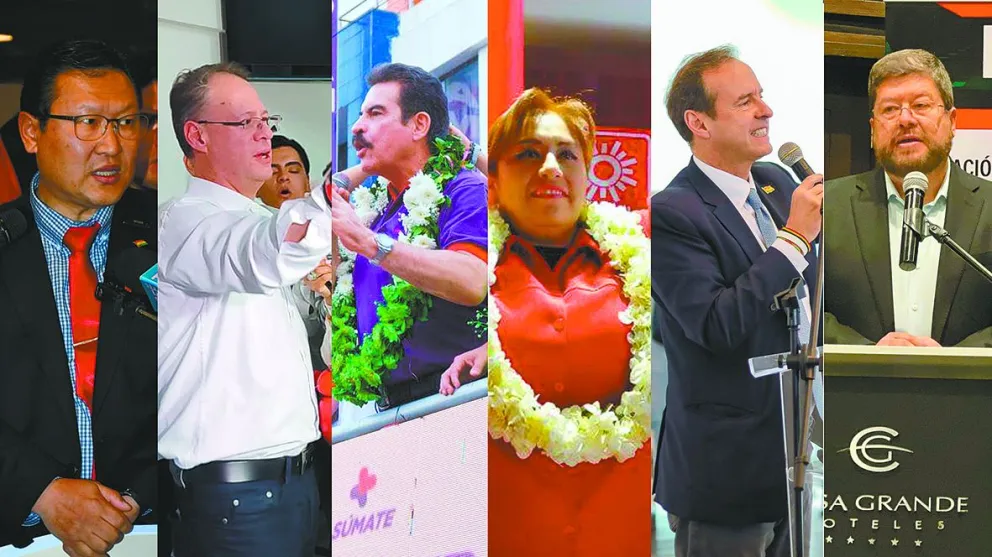
Several candidates stood out for their controversial proposals. Photo: Composition
Election promises are starting to emerge from those who are still just presidential pre-candidates. But which of these are actually tangible and feasible? Experts consulted by Visión 360 agree that economic proposals will dominate the electoral agenda, because in the current situation, “the economy is the central issue.”
Candidates’ offers revolve around how long it would take to reverse the crisis; the number of jobs they promise to create; the setting of fixed fuel prices for five years; and even the downsizing of the state—proposals being made in the midst of Bolivia’s ongoing crisis.
In April, the International Monetary Fund forecasted that Bolivia’s economy would grow by only 1.1%, and that inflation would reach 15.1%. The World Bank projected GDP growth of 1.2%.
“Bolivia’s situation is marked by one thing: the economic crisis, a crisis Bolivia hasn’t seen since the 1980s (…). So, in light of this and the upcoming elections, this is what we’re seeing: the economic crisis, the economic situation, and the economic proposals will set the agenda. Why? Because the economy is the central point of everything,” political analyst Paul Coca told Visión 360.
Fernando Romero, president of the Departmental College of Economists of Tarija, pointed out that what matters is not the promises themselves but fulfilling them. He said implementing the proposals will depend on the number of seats the winning candidate secures in the Plurinational Legislative Assembly (ALP).
“In politics, anything is possible; making proposals costs nothing, the real issue is delivering. Starting a rescue process in 100 days isn’t very feasible; it’s difficult and costly over a long period. But all economic measures greatly depend on political matters—whether the ALP is taken completely or partially, that would help a lot,” he stated.
The proposals
After the Bolivian National Action Party (Pan-Bol) confirmed Ruth Nina as its presidential candidate, she pledged to create 5,000 jobs per month if elected, which translates to an average of 161 jobs per day. Altogether, if the promise materializes, it would mean 300,000 jobs over a five-year term.
On the same subject, former president Jorge Tuto Quiroga, from the Libre alliance, proposed on April 15 to generate 750,000 jobs in five years to “save Bolivia from MAS, save the economy, and restore the country’s stability.”
Manfred Reyes Villa, candidate for APB-Súmate, promised during his campaign that if he wins the election, he will set the price of fuels (gasoline and diesel) at five bolivianos without subsidies—a price he said will be guaranteed for five years. Currently, a liter of regular gasoline costs 3.74 bolivianos and diesel costs 3.72 bolivianos (media reports have noted that on the black market, the price of gasoline has sometimes exceeded 10 bolivianos per liter).
Another widely publicized proposal comes from Unidad’s candidate, Samuel Doria Medina, who said he would restore dollar and fuel supplies to Bolivia within 100 days.
Candidate Rodrigo Paz went even further, claiming that 100 days wouldn’t even be needed—he could achieve that in a single day. “We don’t have 100 days; it’s in a day, dammit, that we’re going to change the country,” declared the senator on April 22.
Back in 2024, former president Evo Morales proposed increasing the Renta Dignidad and offering a mid-year second bonus. “If we win the elections, we’re going to create at least a new bonus mid-year, to celebrate the Andean Amazon New Year, on June 21,” Morales said on November 25 last year.
Another highly noted proposal—voiced by candidates like Tuto Quiroga, Jaime Dunn, and Samuel Doria Medina—is to “shrink the state” by reducing the number of ministries and public servants and shutting down loss-making state companies, among other measures.
Commenting on the topic, sociologist Gonzalo Rojas Ortuste said it was “disheartening” and “discouraging” to see so many people who “see themselves as presidential material” and believe this is their chance to “get a piece” within the Legislative Branch.
“I’m struck by how many people see themselves as presidential material or think this is their opportunity to get a share in the potential political spoils, viewing politics as a business, not as a service. It’s a very disheartening and discouraging situation,” he argued.
Feasibility
Many of the proposals launched by candidates need to be evaluated for feasibility, said Coca, who emphasized the challenge parties face in justifying each of their proposals in “plain language” for the public.
“Of the proposals being made, how many will the population believe? Because people know full well that some proposals are absurd and impossible to fulfill. How many of these parties are willing to justify their proposals technically, materially, legally—and most importantly, in plain terms so people can understand?” Coca argued.
Romero said a strong Legislative Assembly would be key to implementing any government plan.
“I think it’s a pretty complex scenario for any pre-candidate. Once they take office, it’ll be very hard to implement any plan in any area if they don’t have a strong Assembly,” he said.
Serious or popular
Some of the most controversial proposals have come from candidates like Korean-Bolivian Chi Hyun Chung, who in 2020, while running with the Frente Para la Victoria (FPV), promised that if elected president, he would build a Las Vegas-like city in the Uyuni Salt Flats, and even proposed creating a Bolivian “martial art” inspired by the tinku dance.
“The country needs technical and serious proposals—and then there are popular proposals that get certain sectors talking and gain support. But those popular proposals aren’t necessarily what the country needs. What the country really needs is a complete economic reengineering. That’s the key issue,” argued Coca.
Along those lines, Gonzalo Rojas added that “these outrageous proposals—such as the salt flats one—could be interesting if framed as a way to boost tourism potential.”
Another proposal that drew significant attention came from Nueva Generación Patriótica (NGP), whose leader said that, if elected president, he would support the death penalty for “the corrupt.” However, a proposal like that would require a constitutional reform.
In this regard, Coca emphasized that no matter how “interesting” a proposal may be, it must be concretely evaluated according to what the country urgently needs right now.
“There are proposals and candidates that will endure simply because they’re popular. For example, someone out there proposed the death penalty for corrupt officials. It’s an interesting topic for discussion, but it’s not something the country urgently needs to be debating right now—whether someone should be executed or not,” he concluded.
The first 100 days: the Government’s “roadmap”
The first 100 days of the incoming administration will define the path the new government will take. Political analyst Paul Coca believes this period serves as a kind of “roadmap,” as it reveals what the government intends to do economically and politically.
“The first 100 days are what we call the roadmap days of a new government, because you can always see in those first 100 days what a new government plans to do with the country (…). Those 100 days are when the government’s roadmap and materialized proposals become clear. The question is: what will the government do in those first 100 days?” the analyst asked.
Meanwhile, Fernando Romero said all the candidates want to be “saviors” with their proposals, but that actually implementing a plan can be very difficult—mainly because they don’t know what condition the public institutions will be in when they take over.
“Everyone wants to be the savior and propose things people want to hear. That’s why everyone is promising dollars and fuels. But their plans are hard to execute, because in reality they don’t know what shape the public institutions will be in. You can’t go solely by financial statements or the information you can access.”
In that regard, the economist added: “Some plans or policies will work or won’t work, but it will all depend on politics—on the consensus and dialogue that exists with the opposition and various social sectors that obviously don’t align with a government that’s not socialist,” he concluded.
Additionally, the measures taken by the next government will not only depend on consensus in the legislature but also on the existence of legal certainty and a new legal framework that enables the implementation of the proposed policies and decisions.
For now, proposals are surfacing, even though the Supreme Electoral Tribunal (TSE) has yet to set the official date for presidential candidate registration for the general elections scheduled for August 17 of this year.
Points of view
Paul Coca, analyst: “Everything focuses on the economy”
Job quality is tied to the economy. The laws the new parliament will implement are tied to the economy, due to the country’s economic situation. Jobs, income, people’s stability, even their emotional stability—all of it is tied to the country’s economic situation.
So those are factors that we must always identify and consolidate accordingly. That’s why party proposals are focused on this.
Samuel Doria Medina talks about 100 days. Rodrigo Paz says not 100, but one day. Jaime Dunn wants to downsize the state. Ruth Nina promises 5,000 jobs a month. So obviously, everyone is focusing on the economic issue, just in case.
That’s extremely important, beyond the proposals themselves. The key point is this: the economic issue is already the main focus. And all the proposals are moving in that direction.
Tuto, Samuel, Rodrigo Paz, Jaime Dunn agree that the State needs to be downsized, perfect, it needs to be downsized.
However, the question here is whether downsizing the State will be enough or not to economically stabilize the country.
Gonzalo Rojas, sociologist: “Result of deinstitutionalization”
It is the result of the disarticulation, the deinstitutionalization of political life. Masismo has taken over the political spectrum to such an extent and has impoverished it in the name of representing the country in more popular, ethnic terms, and it has been exercising those functions for such a long time.
Furthermore, in the face of an opposition that was initially also hit, but later found a modus vivendi that would generate the least possible concern. Meanwhile, the country has been disarticulated in many areas and has even lost the few traits of positive identity we had built.
I am struck by the number of people who feel they are presidential material or think this is an opportunity to get a share of the potential political spoils, seeing politics as a business, not as a service.
So it’s a very discouraging, very uninspiring picture; but here we are, we must think that there will come a time when people will begin to become aware of the seriousness of the crisis that is beginning to show itself, and we are hearing voices even from the popular sector talking in terms of making the economy more transparent. It’s a set of very big challenges overall.
The proposals
- Doria The pre-candidate from the Unidad group announced the return of dollars and fuels within 100 days and even “an end to centralism.”
- Manfred The Mayor of Cochabamba and candidate from Súmate proposed gasoline and diesel at five bolivianos for five years.
- Jhonny Jhonny Fernández proclaimed his candidacy in El Alto and announced he would give away laptops in schools.
- Pan-Bol Ruth Nina announced her candidacy on Monday, April 28, and proposed the creation of five thousand jobs per month.
- State This is one of the most widespread proposals among candidates like Tuto, Doria Medina, Rodrigo Paz, and Jaime Dunn. It would entail closing ministries, reducing staff, cutting salaries, and digitizing the bureaucracy.
Por Paulo Lizárraga, Visión 360:
Analista político dice que la situación de Bolivia “está marcada por la crisis económica”
Las promesas vertidas por los aspirantes van desde gasolina a Bs 5 hasta la creación de miles de empleos e incluso el retorno de dólares al país en 100 días.
Varios candidatos destacaron por sus polémicas propuestas. Foto: Composición
Comienzan a pulular las promesas electorales por parte de los todavía precandidatos a la Presidencia. Sin embargo, ¿cuáles de estas son realmente tangibles y pasibles a ser realidad? Expertos consultados por Visión 360 coinciden en que las propuestas económicas son las que marcarán la agenda electoral, porque es la economía, en la situación actual, “el punto central de todo”.
Las ofertas de los aspirantes se centran en el tiempo para revertir la crisis; la cantidad de empleos que se promete generar; el establecimiento de un precio fijo, durante cinco años, de los combustibles y hasta el achicamiento del Estado, propuestas que se lanzan en medio de la crisis por la que atraviesa Bolivia.
En abril, el Fondo Monetario Internacional pronosticó que la economía boliviana solo crecerá a una tasa de 1,1% y que la inflación alcanzará un 15,1%; por su lado, el Banco Mundial proyectó una tasa del PIB del 1,2%.
“La situación de Bolivia está marcada por un detalle: la crisis económica, una crisis que Bolivia no había visto desde los 80 (…). Entonces, frente a eso y a un escenario de elecciones, nos encontramos con lo siguiente: La crisis económica, la situación económica y las propuestas económicas son las que van a marcar agenda. ¿Por qué? Porque es la economía el punto central de todo”, expresó a Visión 360 el analista político Paul Coca.
El presidente del Colegio Departamental de Economistas de Tarija, Fernando Romero, indicó que lo importante no son las promesas, sino el cumplirlas. Afirmó que la puesta en marcha de esas propuestas estará en función de la bancada que el aspirante ganador logre en la Asamblea Legislativa Plurinacional (ALP).
“En política todo es posible; proponer no cuesta nada, el tema es cumplir. No es tan factible tratar de iniciar un proceso de salvación en 100 días, es muy difícil y costoso por un largo tiempo. Pero dependen mucho todas las medidas económicas del tema político, es decir si es que se va a asumir la ALP de forma total o parcial, eso ayudaría bastante”, sostuvo.
Las ofertas
Luego de que el Partido de Acción Nacional Boliviano (Pan-Bol) confirmara que Ruth Nina será su candidata a la Presidencia, esta comprometió que, de llegar a la Presidencia, creará 5.000 empleos mensuales, lo que significa un promedio de 161 puestos de trabajo por día. En suma, de concretarse esa oferta, se generarían 300 mil empleos en cinco años de mandato.
En tanto, sobre el mismo asunto, el expresidente Jorge Tuto Quiroga, de la alianza Libre, planteó el 15 de abril generar 750 mil empleos en cinco años, para “salvar a Bolivia del MAS, salvar la economía, devolverle la estabilidad al país”.
En el caso de Manfred Reyes Villa, candidato por APB-Súmate, comprometió en su campaña que, en el caso de ganar las elecciones, establecerá que los combustibles (gasolina y diésel) tengan un costo de cinco bolivianos sin subvención, oferta que sostuvo estará garantizada por cinco años. En la actualidad, el litro de gasolina especial vale 3,74 bolivianos y el litro de diésel tiene un costo de 3,72 bolivianos (reportes de prensa dieron cuenta que en el “mercado negro” el costo de la gasolina llegó a sobrepasar, en su momento, la barrera de los 10 bolivianos el litro).
Otra de las propuestas más difundidas es la del candidato de la agrupación Unidad, Samuel Doria Medina, de lograr que, en 100 días, Bolivia vuelva a contar con dólares y carburantes.
El candidato Rodrigo Paz, aún más optimista, indicó que 100 días no serían necesarios y que en un día podría lograrse tal cometido. “Nosotros no tenemos 100 días; es en un día, carajo, que vamos a cambiar la Patria”, exclamó el senador el 22 de abril.
Ya en 2024, el expresidente Evo Morales planteó un aumento a la Renta Dignidad y ofertó un segundo aguinaldo, a pagarse a medio año. “Si ganamos las elecciones, vamos a crear por lo menos un nuevo aguinaldo a medio año, como motivo del año nuevo andino amazónico, el 21 de junio”, propuso Morales el 25 de noviembre del año pasado.
Otra propuesta muy señalada, por candidatos como Tuto Quiroga, Jaime Dunn o Samuel Doria Medina, es la de “achicar el Estado”, mediante la reducción de ministerios y de funcionarios públicos, cierre de empresas deficitarias, entre otras medidas.
Consultado sobre el tema, el sociólogo Gonzalo Rojas Ortuste expresó que ve como “poco alentador” y “desestimulante” que haya tanta gente que se “sienta presidenciable” y crea tener la oportunidad para “tener una cuota” al interior del Órgano Legislativo.
“A mí me impresiona la cantidad de gente que se siente presidenciable o cree que es una oportunidad para tener una cuota dentro del reparto potencial en la política, pensando en la política como negocio, no como servicio; entonces es un conjunto muy desestimulante, muy poco alentador”, argumentó.
Factibilidad
De todas las propuestas lanzadas por los candidatos, varias deben ser puestas en evaluación, para ver su factibilidad, afirmó Coca, quien remarcó el reto que tendrán los partidos para justificar técnica y materialmente cada una de sus ofertas “en facilito” para la gente.
“Las propuestas que se lanzan, ¿cuántas de ellas serán creíbles por la población? Porque la población sabe muy bien que hay propuestas descabelladas que no se pueden cumplir. ¿Cuántos de estos partidos que lanzan las propuestas están dispuestos a justificar técnica, materialmente, jurídicamente y, lo más importante, en facilito para que la población entienda?”, argumentó Coca.
Romero sostuvo que una Asamblea Legislativa fuerte permitirá la aplicación de cualquier tipo de plan de Gobierno.
“Creo que es un escenario bastante complejo para cualquier precandidato, que cuando asuma el Gobierno le va a costar mucho aplicar cualquier tipo de plan de Gobierno, en cualquier área, si no tiene una Asamblea fuerte”, argumentó.
Serio o popular
Incluso existen las propuestas más controversiales. El candidato coreano-boliviano Chi Hyun Chung prometió en 2020, cuando fue candidato por el Frente Para la Victoria (FPV), que en caso de ser electo presidente, haría construir una ciudad de similar impacto a la de Las Vegas, Nevada (EEUU), en el Salar de Uyuni, e incluso anunció la creación de un “arte marcial” boliviano, inspirado en la danza del tinku.
“Las propuestas técnicas y serias, que son las que el país necesita, y por otro lado las propuestas populares para que la gente, algunos sectores hablen de esas propuestas populares y que tengan apoyo, pero esas propuestas populares que no son necesariamente lo que el país necesita. El país necesita una reingeniería económica en todos los sentidos. Ese es el detalle importante”, argumentó Coca.
En ese sentido, Gonzalo Rojas agregó que “estas propuestas descabelladas, alguna por ejemplo la del salar podría ser un motivo de una propuesta interesante en términos de potenciar su perfil turístico”.
Otra de las propuestas que llamó poderosamente la atención es la de Nueva Generación Patriótica (NGP), cuyo líder anunció que, en el caso de llegar a la Presidencia, avalaría la pena de muerte para “los corruptos”. Sin embargo, una propuesta de ese tipo requeriría para concretarse una reforma de la Constitución.
En ese marco, Coca destacó que, por muy “interesante” que sea una propuesta, es necesario evaluarla concretamente, con lo que el país necesita atender con urgencia en esta coyuntura.
“Hay propuestas y hay candidatos que van a quedar porque son populares. Por ejemplo, ese es un detalle importante. Alguien por ahí proponía pena de muerte a corruptos. Es un tema interesante para discutirlo, pero no es algo que el país con urgencia necesite en este momento discutir si se tiene que matar a alguien o no”, finalizó.
Los primeros 100 días: la “hoja de ruta” del Gobierno
Los primeros 100 días del Gobierno entrante serán los que definan el camino que tomará la nueva gestión de gobierno. El analista político Paul Coca sostiene que este intervalo de la gestión juega una suerte de “hoja de ruta”, porque el Gobierno deja entrever lo que hará con el país, en relación con la toma de medidas económicas y políticas.
“Los primeros 100 días son los que se llaman los días de la hoja de ruta del nuevo Gobierno, porque cualquier nuevo Gobierno siempre se puede ver qué es lo que va a hacer con el país en los primeros 100 días (…). Los primeros 100 días son aquellos en los que se ve qué va a hacer un Gobierno en esos primeros 100 días como hoja de ruta, como medidas, como la propuesta materializada. La pregunta es ¿qué van a hacer los gobernantes en los primeros 100 días?”, cuestionó el analista.
Por su parte, Fernando Romero afirmó que todos los candidatos buscan ser los “salvadores” con sus propuestas, pero que llegado el momento ejecutar un plan trazado puede ser muy difícil, debido a que no saben en qué estado recibirán las instancias públicas.
“Todos quieren ser salvadores y dar medidas para tratar y proponer lo que la gente quiere escuchar o desea. Por eso todo el mundo promete dólares, carburantes, pero para sus planes es muy difícil. Porque en realidad no sabe cómo va a recibir las instancias públicas. Uno no se puede guiar solo por estados financieros, o por lo que puede obtener información”.
En ese marco, el economista agregó: “Varios de los planes o políticas van a dar o no ser efectivas, pero todo va a depender de lo político, de los consensos y el diálogo que exista con la oposición y distintos sectores sociales que no son afines obviamente a un Gobierno diferente al socialismo”, finalizó.
Por otro lado, las medidas que vayan a ser tomadas por el siguiente Gobierno no solo dependerán de consensos en el Legislativo, sino también de la existencia de seguridad jurídica y un marco normativo nuevo que viabilice la aplicación de las nuevas determinaciones y políticas.
De momento, las propuestas afloran, cuando el Tribunal Supremo Electoral (TSE) aún no habilitó la fecha para la inscripción oficial de los candidatos a la Presidencia, con miras a los comicios generales del 17 de agosto de este año.
Puntos de vista
Paul Coca, analista: “Todo se enfoca en lo económico”
El tema de la calidad del trabajo es vía economía. El tema de las leyes que vaya a aplicar el nuevo Parlamento es vía economía, por la situación económica. El tema del trabajo, los ingresos, la estabilidad de las personas, la estabilidad emocional de las personas es vía la situación económica del país.
Entonces, esos son detalles que tenemos que establecer y consolidar en todo momento de manera respectiva. Por eso es que las propuestas de los partidos están enfocadas a eso.
Samuel Doria Medina habla de 100 días, Rodrigo Paz dice que en un día, y no 100 días. Jaime Dunn dice achicar el Estado. Ruth Nina promete 5.000 empleos al mes. Entonces, obviamente, todos están enfocándose en el tema económico, por si acaso.
Eso es algo de suma importancia más allá de las propuestas. Exactamente lo que pasa es lo siguiente. El punto neurálgico de todo ya es esto. Va a ser el tema económico, y todas las propuestas van en ese sentido.
Tuto, Samuel, Rodrigo Paz, Jaime Dunn coinciden en que hay que achicar el Estado, perfecto, hay que achicarlo.
Sin embargo, acá la pregunta es si achicar el Estado ¿será suficiente o no para estabilizar económicamente el país?
Gonzalo Rojas, sociólogo: “Resultado de la desinstitucionalización”
Es el resultado de la desarticulación, la desinstitucionalización de la vida política. El masismo ha copado, de tal modo, el espectro político y lo ha empobrecido en aras de representar al país en términos más populares, étnicos, y como ha estado tanto tiempo ejerciendo esas funciones.
Además, ante una oposición que en principio también ha sido golpeada, pero también después ha encontrado un modus vivendi que genere la menor preocupación posible. Entre tanto, el país se ha ido desarticulando en muchos ámbitos y perdiendo incluso los pocos rasgos de identidad positiva que hemos construido.
A mí me impresiona la cantidad de gente que se siente presidenciable o cree que es una oportunidad para tener una cuota dentro del reparto potencial en la política, pensando en la política como negocio, no como servicio.
Entonces es un conjunto muy desestimulante, muy poco alentador; pero en eso estamos, hemos de pensar que habrá un momento en que también la gente va a ir tomando conciencia, ante la gravedad de la crisis que se empieza a manifestar y escuchamos voces incluso del ámbito popular en términos de sincerar la economía. Es un conjunto de desafíos muy grandes en general.
Las propuestas
- Doria El precandidato por la agrupación Unidad anunció el retorno de dólares y carburantes en 100 días y hasta “terminar con el centralismo”.
- Manfred El Alcalde de Cochabamba y candidato de Súmate propuso gasolina y diésel a cinco bolivianos por cinco años.
- Jhonny Jhonny Fernández se proclamó en El Alto y anunció que regalaría computadoras portátiles en las escuelas.
- Pan-Bol Ruth Nina anunció su candidatura el lunes 28 de abril y anunció la creación de cinco mil empleos por mes.
- Estado Esta es una de las propuestas más generalizadas por candidatos como Tuto, Doria Medina, Rodrigo Paz y Jaime Dunn. Ello implicará el cierre de ministerios, reducción de funcionarios, sueldos y digitalización de la burocracia.

 Bolivian Thoughts | Pensamientos Bolivianos (Bilingual/Bilingüe)