
By Mirna Echave Mallea, Vision 360:
Learn about the 12 provisions issued for the protection of the jaguar and its habitat
The Agro-Environmental Court ordered the protection of the jaguar and its habitat by establishing various measures and mandating concrete actions, such as the drafting of regulations and protocols related to the protection of the species Panthera onca.
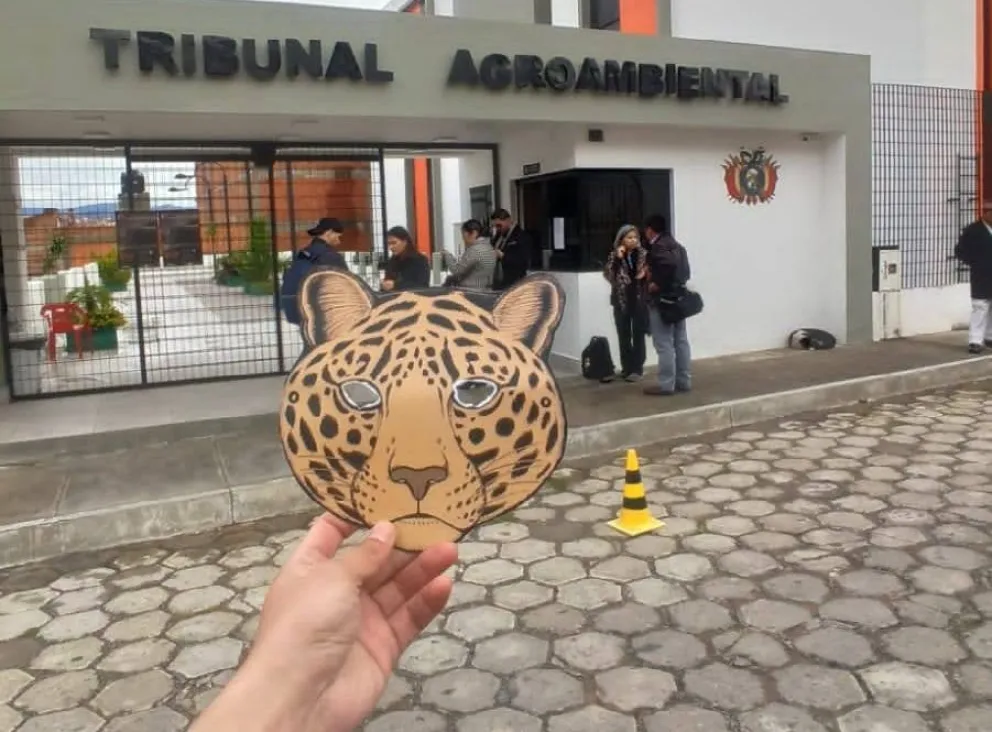
The Agro-Environmental Court in Sucre. Photo: Amigos de la Naturaleza
In the first public hearing on preventive precautionary measures in defense of a species—the jaguar (Panthera onca)—the Agro-Environmental Court issued a resolution with 12 provisions and mechanisms aimed at its protection.
Among the most important points of this ruling, promoted by deputy María René Álvarez, were the declaration of an environmental pause prohibiting burnings and slash-and-burn practices, the creation of a specific fund, zero tolerance for hunting and trafficking of this species, and protection for defenders.
These are the provisions:
- Orders the Ombudsman’s Office, Attorney General’s Office, Public Prosecutor’s Office, Police, Ministry of Justice, among others, to adopt within 10 days protection measures to prevent attacks, threats, or intimidation against human rights defenders in environmental matters.
- The Ombudsman’s Office must, within 30 days, draft a National Plan for the recognition, protection, and promotion of the rights of environmental defenders and their families, with a gender, generational, intercultural, intersectional, and territorial approach.
- The Ministry of Environment and Water, in coordination with autonomous governments and entities such as SERNAP, ABT, and GAIOCS, must, within 6 months, develop and implement management plans to mitigate human-wildlife conflicts, with an intercultural and gender-based approach and the participation of indigenous peoples.
- Urges the Full Chamber of the Supreme Court of Justice to initiate and process with maximum speed and priority any extradition process related to crimes against biodiversity and linked to transnational organized crime.
- The Ministry of Environment and Water must, based on technical and scientific reports, manage within 6 months the update of the conservation status of the jaguar in the Red Book of Wild Vertebrate Fauna of Bolivia.
- Urges the Plurinational Legislative Assembly to pass a law ordering the creation of a National Jaguar Conservation Fund (Panthera onca).
- Orders the Ministry of Environment and Water to immediately and in coordination implement a zero-tolerance policy on illegal wildlife trafficking at all airports in the country, with emphasis on international routes and high-risk borders, adopting the standards of the Buckingham Palace Protocol (United for Wildlife Declaration), using risk profiles applicable to wildlife trafficking.
- The Ministry of Environment and Water must develop, strengthen, and approve the “National Jaguar Conservation Plan with a 10-year horizon (2025–2035)” within 6 months, in coordination with autonomous governments and in accordance with ecological corridors identified by WCS and WWF.
- Mandates an ecological pause on burnings and slash-and-burn practices throughout the national territory. The immediate suspension of all burning authorizations issued by the ABT is reaffirmed.
- Mandates an ecological pause for extractive anthropogenic activities within national, departmental, municipal, and indigenous protected areas that impact the jaguar’s biological corridor and conservation units.
- The Ministry of Environment and Water, along with the Forest and Environmental Protection Police (Pofoma), the Public Prosecutor’s Office, and designated representatives of the Scientific Community, must draft an “Interinstitutional Guide for Access and Scientific Analysis of Seized Biological Evidence” within 120 days from notification.
- The Ministry of Education must update and strengthen curricular content and educational materials across all subsystems (regular education, alternative education, teacher training) with emphasis on the three global, national, and regional crises: biodiversity conservation, climate change, and pollution.
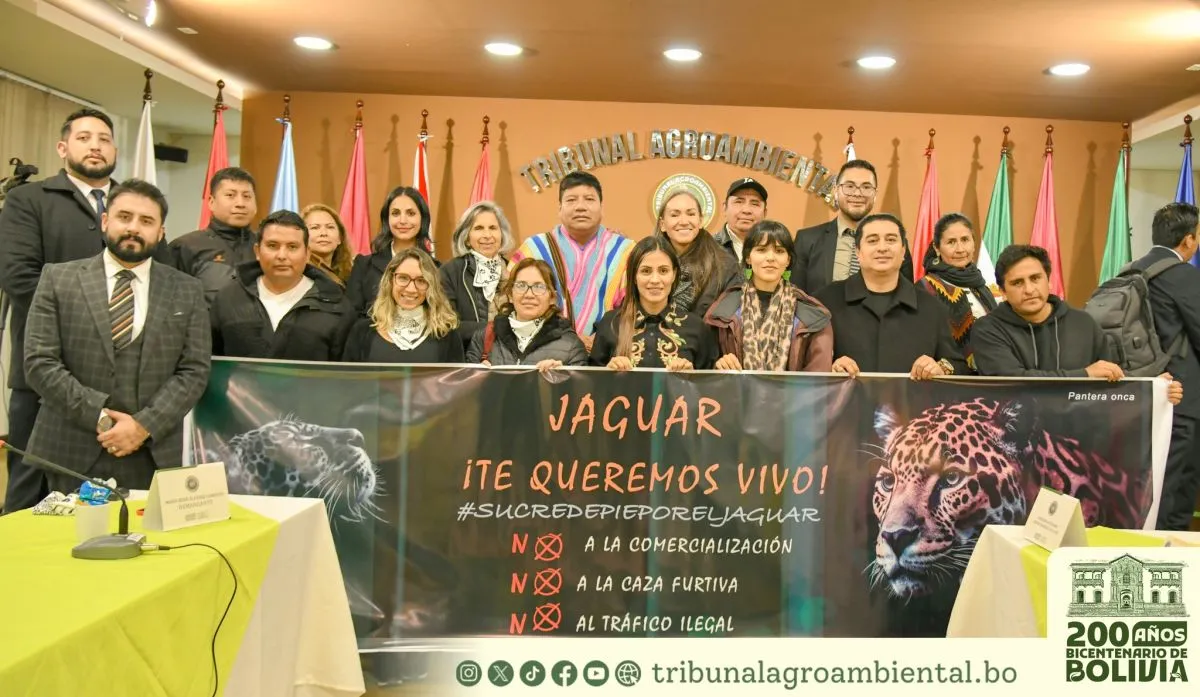
The public hearing, which lasted more than five hours, was composed of the president of the Agro-Environmental Court and magistrates Richard Cristhian Méndez Rosales, Víctor Hugo Claure, Roxana Chávez, and Rocío Vásquez, and was attended by representatives of institutions defending the environment and biodiversity.
Por Mirna Echave Mallea, Vision 360:
Conozca las 12 disposiciones emitidas para la protección del jaguar y de su hábitat
El Tribunal Agroambiental ordenó la protección al jaguar y de su hábitat estableciendo diferentes medidas y ordenando acciones concretas, como la elaboración de normas y protocolos relacionados a la protección de la especie pantera onca.
El Tribunal Agroambiental en Sucre. Foto: Amigos de la Naturaleza
En la primera audiencia pública sobre medidas cautelares preventivas en defensa de una especie, el jaguar (pantera onca), el Tribunal Agroambiental emitió una resolución con 12 disposiciones y mecanismos orientados a su salvaguarda.
Entre los puntos más importantes de este dictamen, impulsado por la diputada María René Álvarez, se definió la pausa ambiental, con la prohibición de quemas y chaqueos, la creación de un fondo específico, tolerancia cero a la caza y tráfico de esta especie y la protección a los defensores.
Estas son las disposiciones:
- Ordena a la Defensoría del Pueblo, Procuraduría General del Estado, Ministerio Público, Policía, Ministerio de Justicia entre otras, que en un plazo de 10 días adopten medidas de protección para prevenir ataques, amenazas o intimidaciones contra defensores de derechos humanos en asuntos ambientales.
- La Defensoría del Pueblo debe elaborar en 30 días un Plan Nacional de reconocimiento, protección y promoción de los derechos de defensores ambientales y sus familias, con enfoque de género, generacional, intercultural, interseccional y territorial.
- El Ministerio de Medio Ambiente y Agua, en coordinación con gobiernos autónomos y entidades como el SERNAP, ABT y GAIOCS, debe elaborar e implementar, en 6 meses, planes de manejo para mitigar conflictos humano-vida silvestre, con enfoque intercultural y de género y participación de pueblos indígenas originarios.
- Se exhorta a la Sala Plena del Tribunal Supremo de Justicia que todo proceso de extradición vinculado a delitos contra la biodiversidad y con nexos a la delincuencia organizada transnacional, se inicien y tramiten con máxima celeridad y prioridad.
- El Ministerio de Medio Ambiente y Agua, debe gestionar con base a informes técnico-científico, en plazo de 6 meses la actualización de la categoría de conservación del jaguar en el Libro Rojo de Fauna Silvestre de Vertebrados de Bolivia.
- Se exhorta a la Asamblea Legislativa Plurinacional aprobar una ley que disponga la creación de un Fondo Nacional de Conservación del Jaguar (Panthera onca).
- Se ordena al Ministerio de Medio Ambiente y Agua, de forma inmediata y coordinada implementar una política de tolerancia cero al tráfico ilegal de vida silvestre en todos los aeropuertos del país, con énfasis en rutas y fronteras internacionales de mayor riesgo, adoptar los estándares del Protocolo de Buckingham Palace (Declaración United for Wildlife), utilizando perfiles de riesgo aplicable al tráfico de vida silvestre.
- El Ministerio de Medio Ambiente y Agua, debe elaborar, reforzar y aprobar el “Plan Nacional para la Conservación del Jaguar con un horizonte a 10 años (2025-2035) en un plazo de 6 meses, en coordinación con gobiernos autónomos y conforme a los corredores ecológicos identificados por WCS y WWF.
- Disponer la pausa ecológica por quemas y chaqueos en todo el territorio nacional. Se ratifica la suspensión inmediata de todas las autorizaciones de quemas emitidas por la ABT.
- Se dispone pausa ecológica para actividades antrópicas extractivas dentro de áreas protegidas nacionales, departamentales, municipales e indígenas, con incidencia en el corredor biológico del jaguar y sus unidades de conservación.
- El Ministerio de Medio Ambiente y Agua, junto a la Policía Forestal y Preservación del Medio Ambiente (Pofoma) y el Ministerio Público y representantes designados de la Comunidad Científica, elaboren una “Guía Interinstitucional para el Acceso y Análisis Científico de Evidencia Biológica Decomisada” en 120 días a partir de la notificación.
- El Ministerio de Educación deberá actualizar y reforzar los contenidos curriculares y materiales educativos en todos los subsistemas (educación regular, alternativa, formación de maestros) con énfasis en las tres crisis mundiales, nacionales y regionales: Conservación de la biodiversidad; Cambio climático y Contaminación.
La audiencia pública, que se prolongó por más de cinco horas, estuvo conformada por el presidente del Tribunal Agroambiental, y los magistrados Richard Cristhian Méndez Rosales, Víctor Hugo Claure, Roxana Chávez y Rocío Vásquez, y asistieron representantes de instituciones defensoras del medio ambiente y la biodiversidad.

 Bolivian Thoughts | Pensamientos Bolivianos (Bilingual/Bilingüe)