
By Rocío Lloret Céspedes – La Región, Erbol:
TANIA BALTAZAR
‘The Situation of Wild Animals Is Desperate, and the Solution Is Not to Rescue Them and Take Them to Custody Centers’
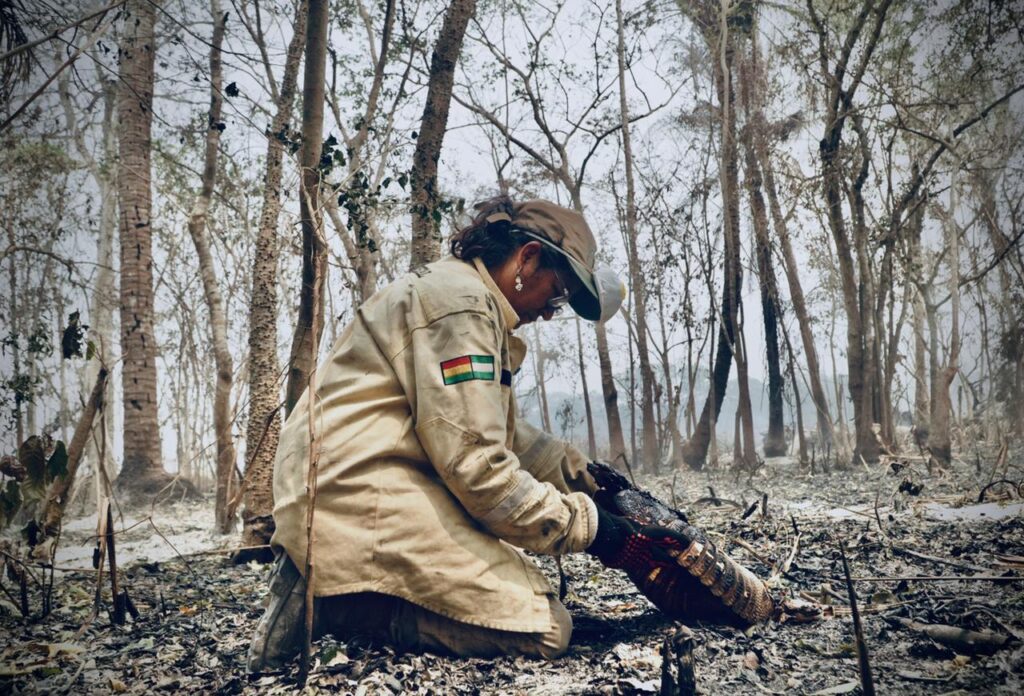
Baltazar in Guarayos during the wildlife rescue. Photo: Courtesy of CIWY
When Tania Baltazar—Nena, as she prefers to be called—talks about her “babies,” she envisions faces, gazes, and movements. Her memory is filled with stories of pain, anger, and helplessness. Because when she refers to her “babies,” she is actually talking about the nearly 600 animals under the care of Comunidad Inti Wara Yassi (CIWY) at two sanctuaries: Parque Ambue Ari (Santa Cruz) and Jacj Cuisi (La Paz). These include monkeys, birds, jaguars, pumas, and ocelots. All of them have a tragic past. All have been victims of illegal hunting, the pet trade, and, in recent years, forest fires.
“When an animal arrives and cannot be returned to the wild—which is the case for most—it becomes a lifelong responsibility,” Baltazar tells La Región. That responsibility can last for the 18-year lifespan of a jaguar (Panthera onca), for example—a challenge custody centers must face alone. While the State regulates them through the Ministry of Environment and Water (MMyA), financial support is self-managed.
Recently, CIWY won the Biodiversity Conservation Award granted by the BBVA Foundation “for more than three decades of rescuing, caring for, and conserving wild animals that have fallen victim to illegal trafficking.” In this interview, its co-founder and president reveals a little-known reality about custody centers.
La Región (LR): What is the current situation of CIWY following last year’s forest fires? Because we see that custody centers no longer only receive animals that are victims of trafficking and the pet trade but also of fire.
Nena Baltazar (NB): Yes, we are feeling the consequences of the fires. We have received 70 animals. We managed to save most of them, but others had to be put to rest because they arrived with severe burns.
Then there is another stage after the fires when more wildlife starts appearing in homes (in affected areas). The people who go to extinguish the fires or who simply see these animals arriving at their homes end up keeping them as pets. In just the last three months, we have received six spider monkeys. After surviving the fires or losing their mothers, they ended up as pets, and once they grew up, people didn’t know what to do with them, so they handed them over to us.

At least 70 animals were rescued during the 2024 forest fires.
LR: What do we mean when we say an animal will stay in a custody center? What does that mean economically?
NB: When an animal arrives and stays with us because it cannot be returned to the wild—which is the case for most—it becomes a lifelong responsibility. That animal needs food, a proper enclosure (space), and care.
Right now, we have over 600 animals, including jaguars, pumas, ocelots, gray cats, spider monkeys, capuchins, and various bird species. In addition, we are protecting nearly 1,000 hectares of jungle, preserving the habitat of many more species that still live in the wild.
To give you an idea, just building an enclosure for a jaguar to have proper conditions costs us around $25,000. This is for a space that allows it to move within captivity in an environment as close as possible to its natural habitat.
For feeding the big cats alone, we spend nearly 10,000 bolivianos (about $1,500 at the official exchange rate) per week. And that doesn’t include the fact that meat, their primary food, has become more expensive. Then there are medications and wages for the staff who work with them.
And this is for life—a jaguar can live 15, 18, or even 20 years. We have jaguars that have been with us for 18 years. Without the support of people, donations, and volunteers, this would be impossible.

The sanctuaries remain closed to the public to provide the animals with an environment as close as possible to their natural habitat, ensuring their well-being and tranquility.
LR: And now fire must be added to that situation…
NB: We have been dealing with wildfires for almost ten years. In 2023, the fire reached Jacj Cuisi, our center in San Buenaventura (La Paz), a place where no one expected fires like the ones we experienced. Many animals had to be rescued there. But last year was even worse—every year, the situation worsens.
In Ambue Ari, last year, firefighters, in coordination with the Guarayos municipality, were bringing in animals that were burned, dead, charred, or injured. Some we were able to save, but unfortunately, others we couldn’t. It was emotionally devastating. I will never forget a completely burned sloth that couldn’t even move but was still alive. Its eyes were filled with fear and panic, and only when we gave it a sedative did it finally rest.
The situation for wildlife is desperate, and the solution is not just rescuing animals and taking them to custody centers because that comes with a cost. Instead, policies against wildfires must be implemented, and both authorities and the public need to understand that we cannot endure another fire like last year’s.
We are doing the work the State should be doing, yet there is no support—not even during the fires. We have to find more resources to pay for fuel to transport firefighters, cover their expenses, and move the rescued animals.

The fire not only ravages forests but also affects wildlife, leaving animals defenseless against the flames.
LR: And what is the situation regarding wildlife trafficking?
NB: There are laws, but wildlife trafficking continues. People buy animals “out of pity,” but they need to realize that they are encouraging the illegal wildlife trade.
For example, in the San Buenaventura area, in northern La Paz, we have seen both wildlife trafficking and the consumption of monkey meat. Indigenous communities, according to the law, can hunt for subsistence, but they are not allowed to sell wildlife.
In recent days, we have received three reports from families who have monkeys in captivity and don’t know what to do with them now that they have grown.
LR: So these are animals that cannot return to their natural habitat? I ask because public opinion often questions your work.
NB: Sometimes people think that when an animal is taken to a rescue center, it will eventually be released. However, from the moment that animal is taken from its habitat, it suffers irreversible harm. We have macaws whose wings were cut off down to the bone, so they will never be able to fly again. Many animals that arrive at our sanctuaries have heartbreaking stories, and another critical aspect we must address is their psychological recovery from the trauma they have endured.
We once had a blind puma that had been beaten on the head, causing it to lose 90% of its vision. Could that animal ever return to the wild?

“All the animals that arrive at the sanctuary receive immediate specialized care to save their lives. The work of volunteers is essential in their recovery process.”
LR: Where does the funding to maintain the sanctuaries come from? Do you offer guided tours?
NB: No, our sanctuaries, both Ambue Ari and Jacj Cuisi, are not open to tourists—only to volunteers. We want the animals to be as close to their natural habitat as possible, in a peaceful environment without the stress of visitors. Our main focus is ensuring they recover 100%. However, people can come and volunteer for a minimum of two weeks. There is a different fee for Bolivian citizens and for foreigners.
The work involves everything—cleaning, support, assisting CIWY staff such as veterinarians, etc. People can also help simply by spreading awareness or making a donation.
To become a volunteer, you only need to be over 18 and have a passion for helping animals—there’s no upper age limit. It’s a life-changing experience that makes you see things differently because there is so much to be done.
[If you want to help, you can do it in two ways: buying souvenirs and/or sponsoring a rescued animal, are CIWY links]
Por Rocío Lloret Céspedes – La Región, Erbol:
TANIA BALTAZAR
‘La situación de los animales silvestres es desesperante y la solución no es rescatarlos y llevarlos a centros de custodia’
Baltazar en Guarayos, durante el rescate de fauna silvestre. Foto: gentileza CIWY
Cuando Tania Baltazar —Nena, como prefiere que la llamen— habla de sus “bebés”, imagina rostros, miradas, movimientos. Por su memoria pasan historias de dolor, rabia e impotencia. Porque cuando se refiere a sus “bebés”, en realidad habla de casi 600 animales que tiene la Comunidad Inti Wara Yassi (CIWY) en custodia, en dos santuarios: Parque Ambue Ari (Santa Cruz) y Jacj Juisi (La Paz). Son monos, aves, jaguares, pumas, ocelotes. Todos con una tragedia por detrás. Todos provenientes de la caza ilegal, el mascotismo y, en los últimos años, víctimas de incendios forestales.
“Cuando llega un animal y no puede ser devuelto a la naturaleza, que es en la mayoría de los casos, es una responsabilidad para toda la vida”, dice Baltazar a La Región. Esa responsabilidad puede durar los 18 años de vida que, por ejemplo, alcanza un jaguar (Panthera onca); un desafío que los centros de custodia asumen en solitario. Porque si bien el Estado los regula, mediante el Ministerio de Medio Ambiente y Agua (MMyA), el aporte económico es autogesionado.
Hace poco, CIWY ganó el Premio a la Conservación de la Biodiversidad que otorga la Fundación BBVA, “por más de tres décadas de rescate, cuidado y conservación de animales salvajes tras su caída en redes de tráfico ilegal”. En esta entrevista, su cofundadora y presidenta, cuenta una realidad poco conocida de los centros de custodia.
La Región (LR) ¿Cuál es la situación actual de CIWY tras los incendios forestales del año pasado? Porque vemos que los centros de custodia, ya no solo reciben animales víctimas de tráfico y mascotismo, sino también del fuego.
Nena Baltazar (NB) Sí, estamos sintiendo las consecuencias de los incendios. Nos han llegado 70 animales. Logramos sacar adelante a la mayoría, pero a otros hemos tenido que hacerlos descansar porque llegaron muy quemados.
Luego hay otra etapa, posterior a los incendios, cuando empieza a aparecer más fauna silvestre en las casas (de las zonas de incendios). Entonces la gente que va a apagar los incendios o que simplemente los ve que llegan a sus casas, se los quedan de mascotas. Solo estos últimos tres meses hemos recibido seis monos araña, que luego de ser víctimas de incendios o de perder a sus madres han quedado como mascotas, y una vez que crecieron, no supieron qué hacer con ellos y nos los entregaron.
Al menos 70 animales fueron rescatados durante los incendios forestales de 2024.
LR ¿De qué hablamos cuando decimos que un animal estará en un centro de custodia?, ¿qué significa eso a nivel económico?
NB Cuando llega un animal y se queda con nosotros, porque no puede ser devuelto a la naturaleza, que es en la mayoría de los casos; es una responsabilidad para toda la vida. Ese animal necesita alimentarse, necesita un recinto adecuado (espacio), necesita cuidados.
Ahorita tenemos más de 600 animales, entre jaguares, pumas, ocelotes, gatos grises, monos arañas, capuchinos y diferentes especies de aves. Pero aparte estamos cuidando casi mil hectáreas de selva, protegiendo el hábitat de muchas especies más que están en vida natural.
Para que te des una idea, solo un recinto para que un jaguar tenga buenas condiciones, nos sale como 25 mil dólares. Estamos hablando de un espacio para que pueda desplazarse en cautiverio, lo más cercano a su hábitat natural.
En la alimentación de los félidos, por ejemplo, gastamos casi 10 mil bolivianos (US$ 1500, a tasa de cambio oficial) a la semana. Ello sin contar que la carne, su principal alimento, ha subido. Después, los medicamentos, el pago del personal que trabaja.
Y es toda la vida, un jaguar llega a vivir 15, 18, 20 años. Tenemos jaguares que están ya 18 años con nosotros. Si no fuera por el apoyo de las personas, donaciones y los voluntarios, sería imposible.
Los santuarios permanecen cerrados al público con el objetivo de ofrecer a los animales un entorno que se asemeje lo más posible a su hábitat natural, garantizando su bienestar y tranquilidad.
LR Y ahora hay que sumar el fuego a ese panorama…
NB Hace ya casi 10 años estamos sufriendo los incendios. En 2023, el fuego entró a Jacj Cuisi, el centro que tenemos en San Buenaventura (La Paz), un lugar donde nadie esperaba incendios como los que hemos pasado. Ahí ha empezado a haber muchos animales que hemos tenido que rescatar. Pero el año pasado fue peor. O sea, cada año va aumentando más y más.
En Ambue Ari, el año pasado los bomberos, en coordinación con el municipio de Guarayos, rescataban animales y los traían quemados, muertos, calcinados o heridos. A algunos los pudimos salvar, pero a otros, lamentablemente, no. Fue bastante duro emocionalmente. Nunca olvidaré a un oso perezoso totalmente quemado, que no podía ni moverse y estaba vivo. Su mirada era de miedo, de susto y simplemente cuando le pusimos un calmante, descansó.
La situación de la vida silvestre es desesperante y la solución no es rescatar animales y llevarlos a los centros de custodia, porque implica un gasto. Entonces, hay que ver políticas contra los incendios, y que tanto autoridades como la población entendamos de que no podemos aguantar otro incendio más como el del año pasado.
Nosotros estamos haciendo el trabajo que el Estado debería hacer y no hay ningún tipo de apoyo, ni siquiera en los incendios. Nosotros tenemos que buscar más recursos para pagar incluso la gasolina para transportar a los bomberos, los viáticos y para transportar los animales rescatados.
El fuego no solo arraza con los bosques sino que también afecta a la fauna que queda indefensa ante las llamas.
LR ¿Y cuál la situación del tráfico de fauna?
NB Hay leyes, pero sigue habiendo tráfico de vida silvestre. La gente compra un animalito, “por pena”, pero tiene que darse cuenta que está fomentando el tráfico de vida silvestre.
Por ejemplo, por la parte de San Buenaventura, el norte de La Paz, hemos visto tráfico y consumo de carne de mono. Los indígenas, según la ley, pueden cazar para el consumo, pero no para para vender.
En estos últimos días, tenemos tres denuncias de familias que tienen monos en cautiverio y no saben qué hacer con ellos, porque crecieron.
LR ¿Se trata entonces de animales que no pueden volver a su hábitat? Consulto porque muchas veces la opinión pública cuestiona su trabajo.
NB A veces la gente piensa que cuando se lleva a un animal a un centro de rescate, lo vamos a liberar. Sin embargo, desde el momento que a ese animal lo han sacado de su hábitat, le han hecho daño de por vida. Tenemos parabas a las que les han cortado las alas desde el hueso, por lo que nunca más van a poder volar. A nuestros santuarios llegan animales con historias muy fuertes y esa es otra parte que hay que recuperar: la psicológica, por los traumas que sufren.
Tuvimos un puma ciego al que le dieron golpes en su cabeza y perdió el 90% de su visión. ¿Podría ese animal volver a la selva?
“Todos los animales que llegan al santuario reciben atención especializada inmediata para salvar sus vidas. El trabajo de los voluntarios es fundamental en su proceso de recuperación.”
LR ¿De dónde sale el dinero para mantener los santuarios? ¿De visitas guiadas?
NB No, nuestros santuarios, tanto en Ambue Ari como Jacj Cuisi, no son abiertos a turistas, solo al voluntariado, porque queremos que los animales estén lo más cerca posible a su hábitat, tranquilos, sin estrés de las visitas y todo eso. Trabajamos más que todo para que ellos puedan recuperarse al 100 por ciento. Pero sí pueden venir y hacer voluntariado dos semanas como mínimo. Eso tiene un costo para ciudadanos bolivianos y otro para extranjeros.
El trabajo es hacer de todo, limpieza, apoyo, ayudar al personal de CIWY, como veterinarios, etc. Y también se puede simplemente difundir el mensaje o hacer llegar una donación
Para ser voluntario solo se necesita tener más de 18 años y tener pasión para ayudar a los animales, no hay límite de edad. Es una experiencia que te cambia la vida y te hace ver las cosas de una manera diferente, porque hay mucho por hacer.
[Si quieres ayudar, puedes hacerlo de dos maneras, comprar souvenirs y/o apadrinar a un animal rescatado, son links de CIWY]

 Bolivian Thoughts | Pensamientos Bolivianos (Bilingual/Bilingüe)