
By ANA, Erbol:
Toad-headed turtle lays eggs in captivity: its reproductive cycle will be studied
ENVIRONMENTAL NEWS AGENCY
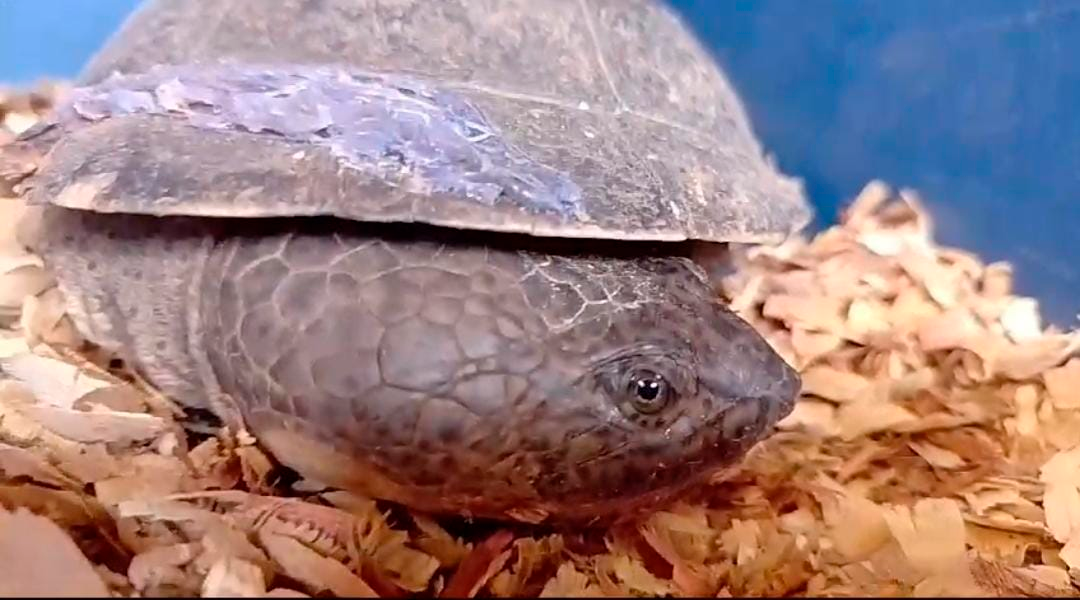
On a day of heavy rain in the city of Trinidad, a toad-headed turtle was found and rescued after being severely injured, with a piece of its shell missing. After undergoing successful surgery and while in the rehabilitation process, it laid eggs in captivity. This will allow researchers to study its reproductive cycle and other previously unknown aspects in Bolivia.
A distress call from a resident of the El Recreo neighborhood on March 9 alerted volunteers to the presence of the injured turtle. Rescuers, doctors Andrés Moreno and Ángelo Velarde, arrived at the scene despite the heavy rain battering the city.
The specimen was immediately taken to the home of Dr. Marcos Greminger Céspedes, where the specialist provided first aid. Hours later, he successfully performed surgery on the turtle at the Teaching Hospital of the Faculty of Animal Sciences at the Autonomous University of Beni, assisted by seventh-semester students from the Veterinary Medicine and Animal Science program.

Photos: L. Varga/ANA | Videos: M. Greminger/ANA
Run over or bitten
“We are treating this chelonian; unfortunately, it appears to have been run over or bitten. Look, a piece of its shell is missing. Today (March 9), when doctors Moreno and Velarde handed it over to me after rescuing it, we administered a painkiller to the turtle so it wouldn’t feel too much pain from the surgery we performed. We cleaned the area before sealing the shell, applied a drying agent inside, and will then proceed with sealing,” said Greminger Céspedes while recording a video, treating the animal, and explaining the surgical procedure to the Environmental News Agency (ANA).
The toad-headed turtle is scientifically known as Mesoclemmys vanderhaegei and belongs to the Chelidae family. In Bolivia, it is commonly called “peta.” It is a freshwater aquatic species that primarily inhabits rivers, streams, lakes, lagoons, and ponds. The toad-headed turtle is a chelonian, as chelonians are an order of reptiles that includes all turtles. In Bolivia, they are mainly found in the departments of Beni, Pando, and La Paz.
This specimen was rescued from the El Recreo neighborhood, located outside the first ring road. In front of it is the Teniente Jorge Henrich Arauz Airport. Around this area near the airport, there are many ecological nesting sites, and the drainage channels of the city of Trinidad flow toward the Ibare River.
Scientific Contribution
According to the professor, researcher, and volunteer rescuer, this scientific contribution will provide bibliographic references to study the turtle’s reproductive system, the number of eggs it lays, the incubation period, the hatching time, and the phenotypic characteristics of the animal—whether it is male or female, as temperature determines the sex.
“Look at this gift from God, allowing us to have this experience. The turtle laid eggs in captivity and successfully laid six eggs. We lost one—it was the first one she laid. Her instinct led her to try to dig at the moment she laid the first egg, and she most likely damaged it. That’s why today, from this little paradise called Beni, we will have technical and scientific data,” said an emotional Greminger Céspedes to ANA.
Transplantation
The transplantation of the toad-headed turtle’s eggs took place on March 22, 2025. “Great care must be taken when handling them. Look, we have finished the transplant. The eggs must be strategically positioned according to the cardinal points. Let’s not forget that temperature determines the sex, which is why they must be placed following the conditions where they naturally lay their eggs. Look, this is like a ravine, a strategic location because the nest needs to be warmed from sunrise until sunset.”
Greminger Céspedes states that he is fully committed to scientific research and that “this study will soon be global news.” Now, it is just a matter of waiting for the results.
“Unfortunately, there are not many studies on their reproduction, especially in the department of Beni. No research has been conducted on this species here. Don’t forget, I am a specialist in the reproduction of river turtles, particularly the Unifilis and Podocnemis expansa species,” he concluded.
Por ANA, Erbol:
Tortuga cabeza de sapo desova en cautiverio: se conocerá su ciclo reproductivo
AGENCIA DE NOTICIAS AMBIENTALES
En un día de lluvia copiosa en la ciudad de Trinidad se dio el hallazgo y rescate de una tortuga cabeza de sapo que se encontraba mal herida faltándole un pedazo de su caparazón. Fue operada exitosamente, encontrándose en su proceso de rehabilitación puso huevos en cautiverio, esto permitirá conocer su ciclo reproductivo, entre otros aspectos que se desconocían en Bolivia.
Una llamada de auxilio de una vecina desde el barrio El Recreo, el pasado 9 de marzo, alertó a los voluntarios sobre la presencia de esta tortuga herida. Allí llegaron los rescatistas, los doctores Andrés Moreno y Ángelo Velarde a pesar de la lluvia fuerte que azotaba a la ciudad.
De inmediato llevaron al espécimen hasta la casa del doctor Marcos Greminger Céspedes donde el especialista le brinda los primeros auxilios; horas después la operó con éxito en el Hospital Escuela de la Facultad de Ciencias Pecuarias de la Universidad Autónoma del Beni, siendo asistido por estudiantes de séptimo semestre de la carrera de Medicina, Veterinaria y Zootecnia.
Fotos L Varga/ANA y vídeos M Greminger/ANA
Atropellada o mordida
“Estamos procediendo a curar este quelonio, lamentablemente parece que fue atropellado o mordido, miren falta un pedazo de caparazón. Hoy (9 de marzo) cuando me lo entregaron los doctores Moreno y Velarde, lo recuperaron hemos procedido a poner un analgésico a la tortuga, para que no le duela mucho la operación que le hemos hecho. Limpiamos antes de sellar el caparazón, vamos a poner secante adentro para después proceder a sellar”, dijo Greminger Céspedes, mientras graba un video, va curando al animal y explica el procedimiento quirúrgico que siguió a la Agencia de Noticias Ambientales (ANA).
La tortuga cabeza de sapo es conocida con el nombre científico de (Mesoclemmys vanderhaegei), esta especie pertenece a la familia Chelidae. Es también llamada comúnmente como peta en Bolivia. Es acuática de aguas dulces y habita principalmente en ríos, arroyos, lagos, lagunas y estanques. La cabeza de sapo es un quelonio, ya que los quelonios son un orden de reptiles que incluye a todas las tortugas. En Bolivia habitan principalmente en los departamentos de Beni, Pando y La Paz.
Este espécimen fue rescatado del barrio El Recreo, que está afuera del primer anillo de circunvalación. Al frente está el Aeropuerto Teniente Jorge Henrich Arauz. Por este sector de la terminal aérea hay muchos nidos ecológicos, pasan los canales de desagüe de la ciudad de Trinidad que va al río Ibare.
Aporte científico
Según el docente e investigador y rescatista voluntario, gracias este aporte científico se podrá contar con bibliografía para conocer el aparato reproductor de la tortuga, cuántos huevos ponen, cuántos días incuban, cuánto tardan en eclosionar y se verá las características fenotípicas del animal, si es macho o hembra; la temperatura es la que define el sexo.
“Miren este regalo que nos da papá Dios, de poder tener esta experiencia la tortuga puso huevos en cautiverio, logró desovar seis huevos, uno perdimos ha sido el primero que puso; ya que su instinto la ha llevado en el momento que largó el primer huevo a querido cavar en ese instante más que seguro dañó el primer huevo. Es por eso que hoy en día vamos a tener datos técnicos científicos desde este rinconcito de paraíso llamado Beni”, precisó emocionado Greminger Céspedes a ANA.
Trasplante
El trasplante de los huevo de la tortuga cabeza de Sapo fue el 22 de marzo de 2025. “Hay que tener mucho cuidado en la manipulación. Miren ya terminamos de trasplantar. Tiene que estar situado estratégicamente orientado por los puntos cardinales, no olvidemos que la temperatura define el sexo; es por eso que se tiene que sembrar, según las características donde ellos desovan. Miren esto es como un barranco que es un lugar estratégico, porque tiene que calentar el nido en el momento que nazca el sol hasta llegar al ocaso”.
Greminger Céspedes dice que está plenamente para hacer ciencia y “esta investigación pronto será noticia mundial”. Ahora solo queda esperar los resultados.
“Lamentablemente no se tiene muchos estudios sobre su reproducción, peor en el departamento del Beni, no se han hecho estudios de esta especie, no se olviden soy especialista en reproducción de tortugas de río tanto de la especie Unifilis y Podocnemis expansa”, concluyó.

 Bolivian Thoughts | Pensamientos Bolivianos (Bilingual/Bilingüe)