
By Gina Baldivieso, EFE, Brujula Digital:
An ode to the father of the “t’ilinchos,” the iconic ceramic miniatures
“Walter Melendres Quiso. The great master ceramist” is the name of the exhibit inaugurated at the National Museum of Ethnography and Folklore.

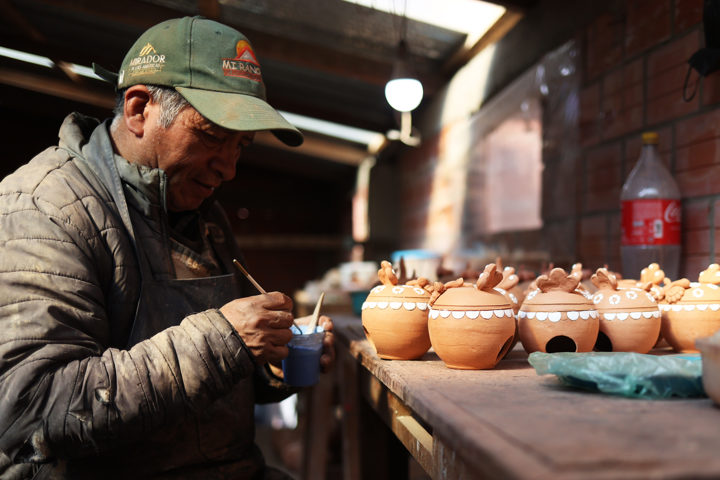
The Aymara ceramist Walter Melendres poses in his workshop in El Alto. Photo: EFE
The tireless work of Aymara ceramist Walter Melendres, creator of the iconic “t’ilinchos,” miniature figures that depict Andean daily life and are exported to the United States and Europe, is showcased in an exhibition that marks the beginning of a series of tributes to the “Great Masters” of Bolivia’s roots.
“Walter Melendres Quiso. The Great Master Ceramist” is the name of the exhibit inaugurated at the National Museum of Ethnography and Folklore (Musef). The museum’s director, Elvira Espejo, explained to EFE that this exhibition launches the “Great Masters of Our Roots” series.
“This theme invites us to reflect on all the masters we are losing over time because formal education has not valued their knowledge and skills,” Espejo remarked.
The director noted that they chose to begin this series of tributes with Melendres due to his indigenous roots. The ceramist comes “from a community that has not forgotten” its own language and has “a strong connection” to its land. Additionally, his renowned “t’ilinchos” have reached countries in Europe and North America.
“For me, these individuals are important because they are not only part of the community, but he has been able to cross borders. And when you cross borders, you become the Bolivian flag that gives visibility to your country and your territory,” she emphasized.
To Espejo, Melendres is not just an artisan; “he is a master artist of roots who connects” the knowledge learned from his ancestors “and brings it into the present day.”
Origins
The master was born in 1960 in the community of Khunkhu Liki Liki, a land once home to the ancient Tiwanaku culture, now part of the municipality of Jesús de Machaca in the Altiplano of La Paz.
Melendres shared with EFE that he learned ceramic figure-making from his grandfather at the age of five, starting by modeling animals he observed in his community, such as sheep, llamas, or cows.
As a teenager, he learned to make replicas of Tiwanaku ceramics and, over time, honed his techniques.
At 19, he took responsibility for his eight siblings after the death of their parents.
“At 23, we created the small business with the little figurines made in the province, without knowing that we could export them,” he explained.
Those “little figurines” are the charming “t’ilinchos,” small figures of indigenous people and animals, no more than four centimeters tall, with large eyes, smiling faces, and brightly colored outfits.
“My inspirations have always been our culture, the one we live in the province,” he noted.
“T’ili” Master
The name “t’ilinchos” came from a customer’s question: “You’re short in stature, and these are tiny. So, in Aymara, what do they call you because you’re short?” The answer was “t’ili,” and the rest is history.
His first international market was Germany, where he was invited to a fair in Frankfurt.
“There, we exhibited our products and gained wholesale clients” who still buy from him “to this day.” He also exports to other countries such as Italy, the United States, Peru, Chile, Japan, France, and Spain, among others.
His workshop is currently in the city of El Alto, neighboring La Paz, but the clay he uses as raw material comes from Jesús de Machaca.
Creating a figure of a cat, cow, or turtle takes him between two to three minutes, using nothing more than his hands to shape the figure and a pointed tool to carve the face and some features.
Melendres has diversified his enterprise. In addition to “t’ilinchos,” he makes vases, mosaics, tables, murals, jewelry, tableware, and art pieces.
The exhibition at Musef features around fifty pieces reflecting the evolution of his art, along with texts and photographs narrating his story and a video showcasing his work.
At 64, Melendres is committed to passing on his knowledge so that others can learn to work with clay to make a living, convinced that “there is a lot of potential for Bolivians because the raw material is right there in the ground.”
Por Gina Baldivieso, EFE, Brújula Digital:
Una oda al padre de los “t’ilinchos”, las icónicas miniaturas de cerámica
“Walter Melendres Quiso. El gran maestro ceramista” es el nombre de la muestra inaugurada en el Museo Nacional de Etnografía y Folclore.
El ceramista aimara Walter Melendres posa en su taller en El Alto. Foto: EFE
El trabajo incansable del ceramista aimara Walter Melendres, creador de los icónicos “t’ilinchos”, las figuras en miniatura que plasman la cotidianidad andina y que se exportan a Estados Unidos y Europa, se refleja en una exposición que abre una serie de homenajes a los “Grandes maestros” de las raíces de Bolivia.
“Walter Melendres Quiso. El gran maestro ceramista” es el nombre de la muestra inaugurada en el Museo Nacional de Etnografía y Folclore (Musef), cuya directora, Elvira Espejo, explicó a EFE que con esta exposición, esa entidad inaugura la línea “Grandes maestros de nuestras raíces”.
“Es un tema que convoca a todas las maestras y maestros que estamos perdiendo a lo largo del tiempo porque la educación formal no ha valorizado” sus saberes y conocimientos, señaló Espejo.
La directora comentó que decidieron iniciar esta serie de homenajes con Melendres por sus raíces indígenas, ya que el ceramista proviene “de una comunidad que no ha olvidado” su propia lengua y tiene “una fuerte conexión” con su tierra, pero además porque sus afamados “t’ilinchos” han llegado a países de Europa y Norteamérica.
“Para mí estas personas son importantes porque no solamente son de la comunidad, sino que él ha podido traspasar fronteras y cuando traspasas fronteras eres la bandera boliviana que das visibilidad a tu país, a tu territorio”, valoró.
Para Espejo, Melendres no es solamente un artesano, “es un maestro artista de raíz que conecta” sus conocimientos aprendidos de sus ancestros “y los lleva hacia la actualidad”.
Origen
El maestro nació en 1960 en la comunidad Khunkhu Liki Liki, un territorio donde existió la milenaria cultura tiahuanacota en el que actualmente se encuentra el municipio de Jesús de Machaca, en el Altiplano de La Paz.
El ceramista contó a EFE que aprendió de su abuelo a hacer figuras en cerámica desde sus cinco años, cuando comenzó modelando animales que veía en su comunidad, como ovejas, llamas o vacas.
Siendo adolescente, aprendió a hacer réplicas de las cerámicas tiahuanacotas y con el paso del tiempo fue perfeccionando sus técnicas.
A sus 19 años, se hizo cargo de sus ocho hermanos después de que murieron sus padres.
“Con 23 años creamos la pequeña empresa con los muñequitos que se hacen en la provincia, pero esto sin saber que podíamos exportar”, explicó.
Esos “muñequitos” son los simpáticos “t’ilinchos”, unas pequeñas figuras de indígenas y animales, de no más de cuatro centímetros, con ojos grandes, rostros sonrientes y colores vivos en sus indumentarias.
“Mis inspiraciones han sido siempre nuestra cultura que vivimos en la provincia”, señaló.
Maestro “t’ili”
El nombre “t’ilinchos” surgió ante la pregunta de una cliente que le dijo: “Tú eres de estatura baja, estos son chiquititos. A ver, en aimara, ¿qué te dicen porque eres de baja estatura”. La respuesta fue “t’ili” y el resto es historia.
Su primer mercado en el exterior fue Alemania, a donde llegó invitado a una feria en Fráncfort.
“Ahí exponemos nuestros productos y conseguimos clientes mayoristas” que le siguen comprando “hasta ahora”, y también exporta a oras naciones como Italia, Estados Unidos, Perú, Chile, Japón, Francia y España, entre otras.
Su taller actualmente está en la ciudad de El Alto, vecina de La Paz, pero la materia prima que usa, la arcilla, proviene de Jesús de Machaca.
Hacer una figura de gato, vaca o tortuga le toma entre dos a tres minutos empleando nada más que sus manos para modelar la efigie y un instrumento puntiagudo para ponerle el rostro y algunos rasgos.
Melendres ha diversificado su emprendimiento, pues además de los ‘t’ilinchos’, también hace vasijas, mosaicos, mesas, murales, joyas, vajilla y obras de arte.
La exposición en el Musef consta de medio centenar de piezas que reflejan la evolución de su arte, además de textos y fotografías que narran su historia y un video que muestra cómo es su trabajo.
A sus 64 años, Melendres está empeñado en transmitir sus conocimientos para que otra gente aprenda a trabajar la arcilla para subsistir, convencido de que “hay harto futuro para los bolivianos, porque está en el suelo la materia prima”.

 Bolivian Thoughts | Pensamientos Bolivianos (Bilingual/Bilingüe)