
By Sergio Mendoza, El Deber:
Blue-throated macaws return to their origins in an attempt to save their species
Thirteen birds that arrived almost two months ago from the United States are awaiting their turn in the town of Loreto, in the Beni department, to become the salvation of their species
In the municipality of Loreto, located south of the Beni department, 13 blue-throated macaws that arrived nearly two months ago from the United States are waiting for their chance to save their species. Their parents, or perhaps their grandparents, were taken from their natural habitat several decades ago to be sold abroad for up to $5,000 each—a lucrative business that, combined with other human actions, has drastically reduced the population of these unique parrots to a dire count of just 350 individuals.
Their small numbers and the risks they face place these birds in “critically endangered” status, meaning they are at risk of disappearing entirely from the wild, says Rafael Mounzón, director of the Conservation Foundation for Bolivian Parrots (CLB), as we head in a “surubí” boat to the custody center the organization operates in Loreto, 25 kilometers from Trinidad.
There are three levels used to classify the risk of a species disappearing before it becomes completely extinct, Mounzón explains: endangered, critically endangered, and extinct in the wild. A fourth level would be total extinction. In the case of the blue-throated macaws, “we’re one step away from them disappearing from the wild,” he states.
These parrots are endemic to Bolivia, specifically to the Beni region; that is, they do not exist and cannot exist naturally in any other part of the world due to their behavior and dietary habits. They do not build their nests but instead use natural holes formed in trees to lay their eggs, and their primary diet consists of motacú and totaí, fruits of Amazonian palms.
The presence of the 350 birds still surviving in Beni (although some estimate the number to be as high as 500) has been recorded in municipalities such as Santa Ana, Santa Rosa, San Ramón, and Loreto. The latter is the most monitored by the aforementioned foundation due to its accessibility and the creation of the Gran Moxos Municipal Protected Area, which was established in 2017 as a necessary measure to protect the habitat of the blue-throated macaw and other endangered species.
The 13 birds currently in quarantine, awaiting authorization from the National Agricultural Health and Food Safety Service (Senasag) to be moved to other areas of the custody center, were originally 14. They arrived in late September from the United States after also undergoing a quarantine process to prevent any undesirable contagion. It is known that a male parrot drowned, possibly while eating.
Mounzón explains that blue-throated macaws are known to have a single mate for life, which can be as long as a human’s lifespan.
It is believed that these birds returning to their origins are descendants of those originally trafficked abroad. Although their genes carry the ability to survive in this jungle environment—with temperatures exceeding 30 degrees Celsius, mosquitoes swarming like vampires, and all kinds of natural predators—these macaws will not be released. Due to their life in captivity, they are not considered capable of thriving outside a cage, where they are provided daily shelter and food. However, it is possible that their descendants might succeed.
“This is something exceptional. Nothing like this has ever been done—repatriating, reproducing, and releasing. This would be the first project carried out in this way,” says Mounzón. For now, the macaws are not permitted to have offspring, even in captivity, in accordance with safety protocols.
Omar Osco, the General Director of Biodiversity and Protected Areas, noted that the foundation’s plan to increase the existing blue-throated macaw population with offspring bred in captivity has not yet been approved, although he acknowledged there is a “good chance” it will be.
He explained that this decision will depend on a thorough evaluation of the costs and benefits of pursuing this idea, as in some cases, simply preserving the birds already living in the wild to ensure they continue reproducing proves more advantageous than releasing new specimens born in captivity.
U.S. Support Was Key
Since August of this year, the U.S. Animal and Plant Health Inspection Service has worked alongside Senasag to develop a protocol for the repatriation of blue-throated macaws moving forward.
“Our Animal and Plant Health Inspection Service has collaborated with Senasag in Bolivia and the Ministry of Environment and Water to ensure these animals return with the necessary certifications and health guarantees. These 14 birds repatriated from the U.S. can make a significant contribution to increasing the number of blue-throated macaws in Beni, their only natural habitat in the world,” said Debra Hevia, Chief of Mission at the U.S. Embassy in Bolivia.
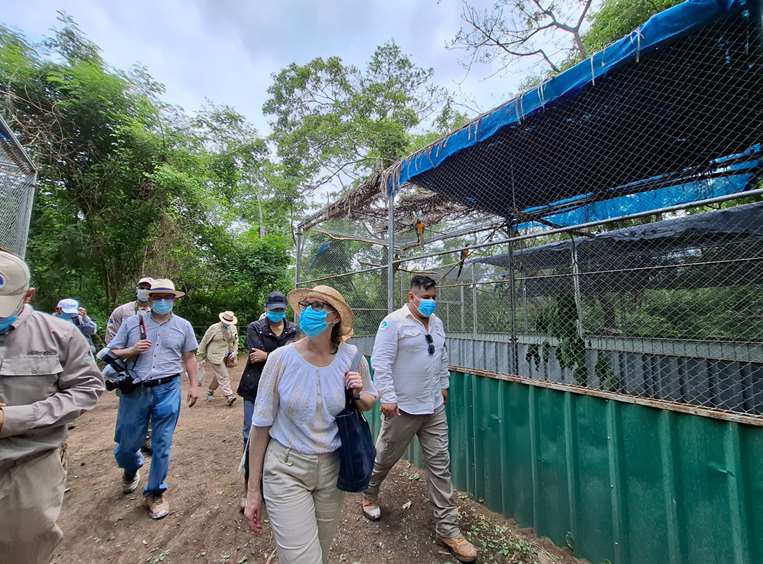
Hevia visited the custody center in Loreto on November 17 as part of a series of events marking Beni’s anniversary. After observing the birds that arrived from the United States, Hevia expressed her happiness at “seeing the birds healthy and safe, adapting to Beni after being raised in captivity.”
The macaws’ journey back to their place of origin began with a quarantine in Florida, United States, where they underwent health and even genetic testing to avoid inbreeding problems during reproduction. To make this a reality, the governments of Bolivia and the United States signed an agreement in late August that paves the way for future “repatriations” with permanent requirements.
Por Sergio Mendoza, El Deber:
Parabas barba azul vuelven a sus orígenes, en un intento para salvar su especie
Unas 13 aves que llegaron hace casi dos meses desde Estados Unidos aguardan su turno en la población beniana de Loreto para ser la salvación de su especie
En el municipio de Loreto, al sur del departamento del Beni, 13 parabas barba azul que llegaron hace casi dos meses desde Estados Unidos aguardan su turno para ser la salvación de su especie. Sus padres, o quizás sus abuelos, fueron secuestrados de su hogar endógeno hace ya varias décadas para ser vendidas hasta por $us 5.000 la pieza en el extranjero, un lucrativo negocio que sumado a otras acciones humanas ha mermado la población de estos loros únicos, orillándolos a la paupérrima cifra de 350 individuos.
Su reducido número y los riesgos que enfrentan ponen a estas aves en “peligro de extinción crítico”, o riesgo de desaparecer por completo de la naturaleza, dice Rafael Mounzón, director de la Fundación de Conservación Loros Bolivia (CLB), mientras nos dirigimos en un ‘surubí’ hacia el centro de custodia que esta organización tiene en el municipio de Loreto, a 25 kilómetros de Trinidad.
Existen tres niveles para clasificar el riesgo de desaparición de una especie antes de que ésta se extinga por completo, explica Mounzón: peligro de extinción, peligro de extinción crítico, y extinto en la naturaleza. Un cuarto nivel sería extinto por completo. Así que en el caso de las parabas barba azul, “estamos a un paso de que desaparezcan de la naturaleza”, afirma.
Estos loros son endémicos de Bolivia, más precisamente del Beni; es decir, que no existen ni pueden existir en otro rincón del mundo en estado natural debido a su comportamiento y hábitos alimenticios. No fabrican sus nidos, sino que aprovechan hoyos naturales que se forman en los árboles para poner sus huevos, y comen principalmente motacú y totaí, frutos de palmeras amazónicas.
La presencia de las 350 aves que aún sobreviven en el Beni (aunque algunos dicen que llegan a 500) ha sido registrada en municipios como Santa Ana, Santa Rosa, San Ramón, y Loreto. Éste último es el más monitoreado por la mencionada fundación debido a las facilidades de acceso y a la creación del Área Municipal Protegida Gran Moxos, que en 2017 surgió como una necesidad de proteger el hábitat de la barba azul y otras especies en peligro.
Las 13 aves que permanecen en cuarentena, a la espera de la autorización del Servicio Nacional de Sanidad Agropecuaria e Inocuidad Alimentaria (Senasag) para su traslado a otras áreas del centro de custodia, solían ser 14. Llegaron a fines de septiembre desde Estados Unidos, después de pasar también por un proceso de cuarentena que evite cualquier contagio indeseado. Se tiene conocimiento de que un loro macho se ahogó, quizás con el alimento.
Mounzón explica que las barba azul son conocidas por tener una sola pareja para toda su vida, que puede ser tan larga como la de un ser humano.
Se cree que estas aves que regresaron a sus orígenes son descendientes de las que fueron originalmente traficadas al extranjero. Aunque la capacidad de sobrevivir en este entorno selvático -con temperaturas superiores a los 30 grados, mosquitos que acechan como vampiros, y toda clase de depredadores naturales- está en sus genes, estas parabas no serán liberadas. Por su vida de reclusión no se las cree aptas para desarrollarse si no es dentro de una jaula, donde tienen refugio y alimento diario. Pero es posible que sus descendientes sí lo logren.
“Esto es algo excepcional, nunca se ha repatriado algo, se ha reproducido, y se ha liberado. Este sería el primer proyecto que se realiza de esta forma”, dice Mounzón. Por el momento, a las parabas no se les tiene permitido tener progenie ni siquiera para que permanezcan en cautiverio, de acuerdo a protocolos de seguridad.
El director general de Biodiversidad y Áreas Protegidas, Omar Osco, señaló que aún no se aprobó el plan de la fundación de acrecentar la población existente de barbas azules con crías engendradas en cautiverio, aunque reconoce que existe una “buena posibilidad” de que esto así ocurra.
En este sentido, dependerá de una evaluación minuciosa de los costos y beneficios de seguir esta idea, ya que en algunos casos la sola preservación de las aves que ya están en libertad para que continúen reproduciéndose resulta más provechosa que liberar nuevos especímenes que nacieron en cautiverio, explica Osco.
El apoyo de EEUU fue clave
Desde agosto de este año, el Servicio de Inspección Sanitaria de Animales y Plantas de los Estados Unidos trabajó junto al Senasag en un protocolo que permita la repatriación de parabas barba azul de aquí en adelante.
“Nuestro Servicio de Inspección Sanitaria de Animales y Plantas ha colaborado con Senasag en Bolivia y con el Ministerio de Medio Ambiente y Agua para que estos animales regresen con los certificados necesarios y las garantías de salud. Estas 14 aves que hemos repatriado de EEUU pueden hacer un gran trabajo al aumentar el número de parabas barba azul en el Beni, que es su único hábitat natural en el mundo”, manifestó Debra Hevia, jefa de Misión de la Embajada de Estados Unidos en Bolivia.
Hevia realizó una visita al centro de custodia en Loreto el 17 de noviembre, como parte de una serie de encuentros en el marco del aniversario del Beni. Después de observar a las aves que llegaron desde el país del norte, Hevia manifestó su alegría “de ver a las aves sanas y salvas adaptándose al Beni, después de ser criadas en cautiverio”.
La travesía de las parabas para volver a su lugar de origen comenzó con una cuarentena en Florida, Estados Unidos, donde se les realizaron análisis sanitarios e incluso genéticos para evitar problemas endogámicos al momento de la reproducción. Para que esto se haga realidad, los gobiernos de Bolivia y Estados Unidos firmaron a fines de agosto un acuerdo que abre la puerta a futuras “repatriaciones” con requisitos permanentes.

 Bolivian Thoughts | Pensamientos Bolivianos (Bilingual/Bilingüe)