
El Diario:
- The blockades create a negative image of the country abroad, in addition to causing economic losses, and it ranks 165th, according to the Heritage Foundation.
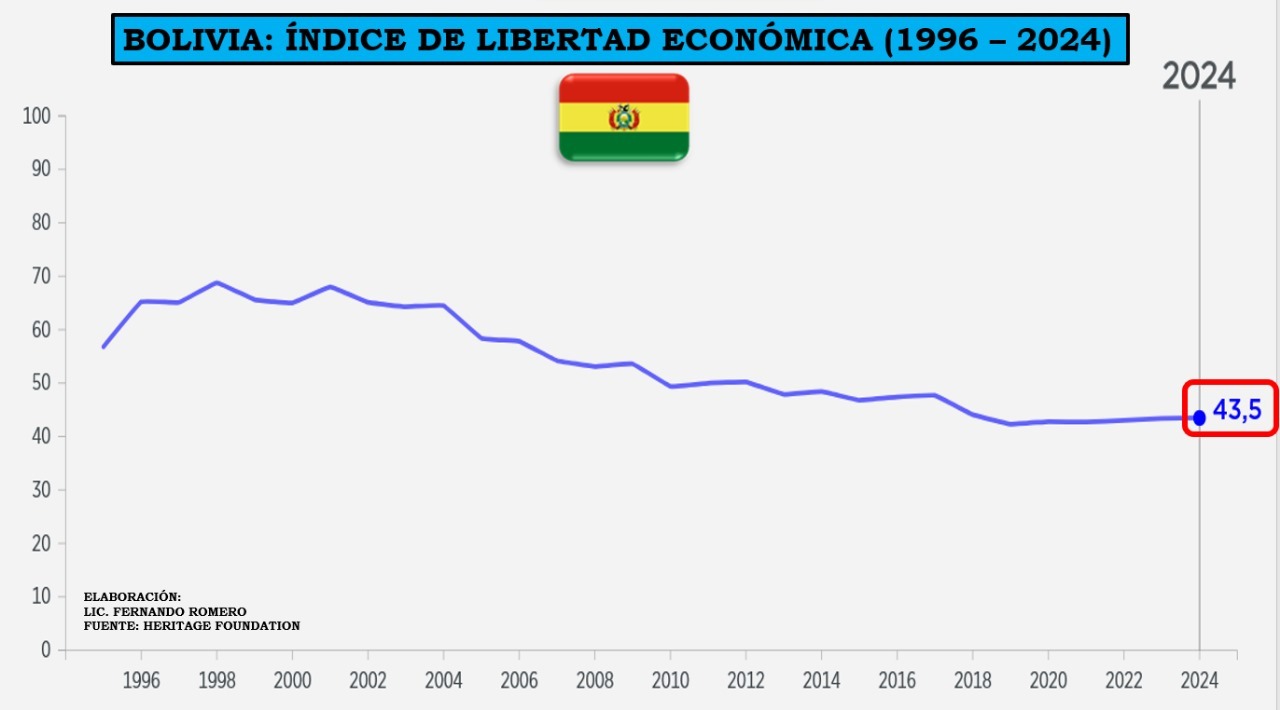
According to the Economic Freedom Index, Bolivia continues its “free fall,” ranking 165th out of 176 evaluated countries, with Singapore at the top and North Korea at the bottom.
Although the Heritage Foundation’s data was published in June of this year, it should be noted that given the current situation in the country, the indicator would likely be worse, with the lowest rating.
In recent years, Bolivia’s position in Economic Freedom has not seen positive changes; rather, it has continued to decline, and its inclusion as a BRICS member will not alter this trend.
“Downward trend,” says Fernando Romero, president of the Departmental College of Economists of Tarija, regarding Bolivia’s ranking in economic freedom, attributing it to the country’s economic and political situation, which has caused the loss of this indicator.
He anticipates that in the next measurement in 2025, the decline in economic freedom will likely be more pronounced, as the country’s ongoing conflicts do not help improve the situation of the Bolivian economy.
He also recalled that, unlike in the past, when blockades were due to economic demands like fuel price hikes and rising household costs, the recent protests have shifted dramatically towards personal issues.
Such measures restrict economic freedom, as they hinder travel, goods transportation, and only result in the loss of agricultural products, Romero reflected. On social media, producers lamented the government’s inaction, blaming them for the loss of their products on the roads.
The lack of governance creates uncertainty among citizens, as they cannot predict whether they will be able to transport products to markets or harvest crops a month from now, Romero emphasized, noting the significant impact blockades have on economic activity.
The projected 2025 rating will be more negative due to ongoing issues in the national economy, and suggests that surpassing Venezuela and Cuba in economic freedom will be challenging.
BRICS
On the other hand, last Monday, Bolivia was admitted as a member of BRICS, an acronym for the founding countries (Brazil, Russia, China, India, and South Africa), along with 12 other populist and socialist-leaning nations.
Financial consultant Jaime Dunn stated in an interview with digital media that Bolivia’s inclusion in the economic bloc is driven more by political considerations than economic ones, bolstered by President Luis Arce’s offer of cheap raw materials.
Meanwhile, Romero argues that joining BRICS is unlikely to significantly benefit the national economy, noting that Bolivia will only be a member and never a full partner of the bloc, as the leadership remains with China, Russia, and Brazil, who make unilateral decisions.
The acceptance aims to expand political influence to challenge capitalism and advance a new world order, including a financial system independent of the dollar.
“Keep in mind, Bolivia will never be a full BRICS partner. We will supply cheap raw materials and incur debt, fostering political and economic dependence,” he warned.
If one observes, all current member countries are populist, leftist, socialist, or communist, and mostly poor.
Economist Gonzalo Chávez Álvarez tweeted from his account @GonzaloCHavezA that “although Bolivia has not yet joined BRICS, Arce is offering our natural resources on a silver platter. The foreign policy remains ideological, marked by improvisation and desperation.”
Indicators
Heritage Foundation published the Economic Freedom Index in June, evaluating 176 countries. Singapore ranks first with 83.5 points, and North Korea last with 2.9 points.
Bolivia scored 43.5 points, 0.1 points higher than in 2023, placing it 165th worldwide and 30th in the Americas, ahead of Venezuela and Cuba.
Among the evaluated aspects, the Tax Burden received the highest score (86.9), while Fiscal Health received the lowest (7.2). “Analyzing the period from 1995 to 2024, we achieved the highest index in 1998 with 68.6 points. Since then, it has dropped by 37%,” Romero recounted.
The trend over nearly 30 years has been a decline in the index. Less freedom, less investment, and economic growth, compounded by limited governance and ongoing political conflicts, he concluded.
BRICS represents almost 50% of the world’s population, around 3 billion people, a significant market; it has resources to lend money to poor countries and can provide scientific and technical advice.
However, Bolivia may face a trade deficit, offering only raw materials, while China exports manufactured goods, leading to economic and political dependence.
El Diario:
- Los bloqueos provocan mala imagen del país en el exterior, además de pérdidas económicas y ocupa el puesto 165, según Heritage Foundation.
De acuerdo al Índice de Libertad Económica, Bolivia sigue en “caída libre” ocupando el puesto 165 de 176 países evaluados, mientras que Singapur se coloca en el primer lugar y en el último se encuentra Corea del Norte.
A pesar que los datos de la fundación Heritage Foundation, fueron publicados en junio de la presente gestión, cabe recordar que el indicador, con la actual situación del país sería más complicado y con la peor calificación.
En los últimos años, la posición del país en Libertad Económica no sufrió cambios positivos, más todo lo contrario, fue descendiendo y no cambiará nada con su inclusión como miembros de los BRICS, recientemente.
“Tendencia decreciente”, sostiene el presidente del Colegio Departamental de Economistas de Tarija, Fernando Romero, al señalar la situación del país en el ranking de libertad económica, y añade que obedece a la situación económica y política que vive el país en la pérdida de este indicador.
Adelantó que en la próxima medición del 2025, probablemente la caída de la libertad económica será más prominente, pues la conflictividad que vive el país no ayuda a mejorar la situación de la economía boliviana.
Además recordó que como nunca, los bloqueos que se registraron en el pasado obedecían a exigencias económicas, como alza de carburantes, el alza de los precios de la canasta familiar y recientemente a la falta de dólares, sin embargo, ahora la protesta giró 360 grados al implementar la medida radical por temas personales.
Ese tipo de medida coarta la libertad económica, ya que uno no puede viajar de un lugar a otro, llevar mercadería, y sólo provoca la pérdida de productos agropecuarios, reflexionó Romero. En las redes sociales, los productores lamentaron que las autoridades de Gobierno no hagan su trabajo y por su culpa pierdan sus productos en el camino.
La falta de gobernabilidad provoca incertidumbre en la ciudadanía, pues uno no sabe si de aquí a un mes podré transportar los productos a los mercados o vas a poder cosechar, resaltó a tiempo de indicar que los bloqueos afectan notablemente a la actividad económica.
La calificación en 2025 se estima que será más negativa con todo lo que pasa en la economía nacional, proyecta y señala que será difícil superar a Venezuela y Cuba, que tienen la peor libertad económica.
BRICs
Por otra parte, el pasado lunes Bolivia fue admitido como miembro de los BRICS, acrónico de los países fundadores (Brasil, Rusia, China e India y Sudáfrica), junto a otras 12 naciones de corte popular y socialista.
Al respecto, el consultor financiero Jaime Dunn en entrevista con medios digitales, señala que la inclusión de Bolivia en el bloque económico obedece a temas políticos que económicos, además por el ofrecimiento de materias primas baratas por el presidente Luis Arce.
Mientras Romero asegura que formar parte de los BRICS no cree que ayude mucho a la economía nacional, además es sólo miembro, ya que jamás será socio pleno del bloque, ya que el manejo del bloque está en manos de China, Rusia y Brasil, que toman decisiones unilaterales.
La aceptación sólo busca ampliar su presencia política para ir contra el capitalismo y avanzar en un nuevo orden mundial, avanzar en un nuevo sistema financiero, sin la presencia del dólar.
“Por si acaso, hay que meterse en la cabeza, que Bolivia jamás será socio pleno de los BRICS. Daremos materias primas baratas y nos endeudaran para generar dependencia política y económica”, alertó.
Si, uno se fija, todos los países ahora miembros son populistas, de izquierda, socialistas y comunistas, sobre todo pobres.
Mientras el analista económico Gonzalo Chávez Álvarez escribió en su cuenta @GonzaloCHavezA que “aunque Bolivia aún no entró a los BRICS, Arce ofrece, en bandeja de plata, nuestros recursos naturales. Prevalece la política exterior del alineamiento ideológico y de la improvisación y desesperación”.
Indicadores
Heritage Foundation ha publicado, en junio, el Índice de Libertad Económica, de 176 países evaluados, Singapur ocupa el 1er lugar con 83.5 puntos y el último Corea del Norte, con 2.9 puntos.
Bolivia obtuvo 43.5 puntos, 0.1 puntos más que el 2023. Esto la ubica dentro del ranking mundial en el puesto 165, de todo el continente americano en el puesto 30, antes de Venezuela y Cuba.
Dentro de los aspectos evaluados, la Carga Fiscal presenta la nota más alta (86.9) y la Salud Fiscal la más baja (7.2). “Haciendo un análisis desde 1995 al 2024, tuvimos el índice más alto en 1998 con 68.6 puntos. Desde ese año, hasta la fecha, el mismo cayó en un 37%”, recapituló Romero.
La tendencia en los casi últimos 30 años es a la baja del índice. Menos libertad, menos inversión y crecimiento económico, lo cual se agudiza con la poca gobernabilidad y conflictos políticos vigentes, sentenció.
Los BRICS casi tienen el 50% de la población mundial, 3.000 millones de personas, un marcado importante; tiene recursos para prestar dinero a los países pobres; pueden asesorar en el ámbito científico y técnico.
Sin embargo, Bolivia puede enfrentar un déficit comercial, ya que sólo ofrece materias primas, frente a China, que vende productos manufacturados; pero también dependencia económica y política.
https://www.eldiario.net/portal/2024/10/26/bolivia-en-caida-libre-en-libertad-economica/

 Bolivian Thoughts | Pensamientos Bolivianos (Bilingual/Bilingüe)