
By Alissya Guerrero, Brújula Digital:
Work by Bolivian artist Enrique Arnal is part of the permanent collection at MoMA in New York
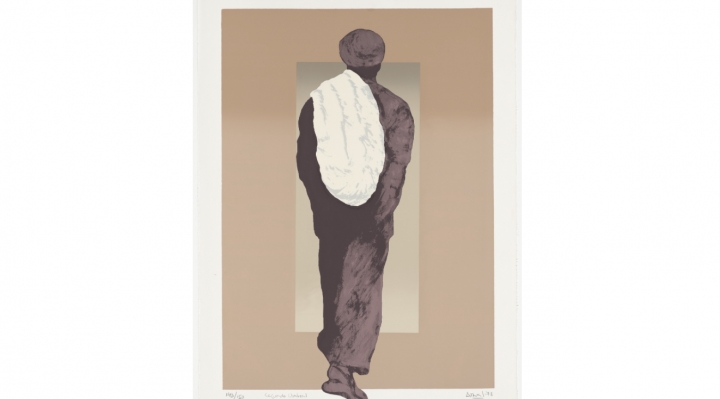
Second Threshold by Enrique Arnal. Photo: MoMA
The painting “Second Threshold” by Bolivian artist Enrique Arnal has been incorporated into the permanent collection of the Museum of Modern Art (MoMA) in New York, marking a significant milestone for Bolivian art on the international stage.
This work, dating from 1978, depicts the figure of an “aparapita” from a series of paintings dedicated to the Aymara porter.
In an interview with Brújula Digital, Matías Arnal, the renowned painter’s son, shared that the piece was initially acquired by the Container Corporation of America, an entity known for its vast art collection. The corporation later donated the work to MoMA.
Enrique Arnal, a Bolivian artist born in Catavi, Potosí, in 1932 and who passed away in Washington, D.C., in April 2016, began painting at the age of 22. His first solo exhibition took place in Cusco, Peru, in 1954. Throughout his career, Arnal exhibited in galleries in cities such as Buenos Aires, Washington, Caracas, Bonn, Montevideo, and others. He also directed the ‘Arca’ Gallery in La Paz between 1968 and 1970.
Matías mentioned that when his father fell ill with cancer in 2015, he made numerous efforts with art institutions, including MoMA, Reina Sofía, and several others, to have one of his father’s works included in their collections. Unfortunately, it was not achieved at that time. However, it was always a goal.
“I was with friends. They asked me who my father was, and I told them he was a Bolivian artist. I Googled ‘Enrique Arnal’ to access my father’s website, but I saw a link to MoMA, and that’s when we realized that this American corporation had donated his work to MoMA,” Matías said, recounting how he found out that his father’s work had reached this renowned art gallery.
Arnal created over 1,200 works throughout his career. His main inspiration was Bolivia, and although his works evolved over time, they always maintained a foundation in figurative painting.
“What my father always mentioned was that he wanted his art to reflect the journey from the local to the universal, art that could be appreciated by an audience, like those who visit MoMA,” Matías added.
Arnal, whose father worked as an administrator in a mine in Potosí and whose mother painted mainly as a hobby, decided to study architecture in Chile. However, midway through his studies, he realized that his true passion was painting. He decided to make it his profession, initially self-taught. Due to his potential, he secured scholarships and studied at the International City of the Arts in Paris, France, in 1996.
“He actually studied in Chile, where another Bolivian artist, Fernando Montes, had an art studio. My father then started painting with him in his studio, and that’s where he developed a deeper love for painting and realized that’s what he wanted to do,” Matías said.
His love for art led him to receive awards such as the Grand Prize in painting at the Murillo Salon for the work ‘Zampoñas y charangos’ (LP, 1955); Second Prize in painting at the Murillo Salon for the work ‘Paisaje con luna’ (LP, 1957); First Prize in painting at the Murillo Salon for the work ‘Mujer’ (LP, 1958); First Prize in drawing at the Murillo Salon for the work ‘Gallo’ (LP, 1961); First Prize from the UTO (Oruro, 1965); and the ‘Lifetime Achievement’ Award at the Murillo Salon (LP, 2007).
Matías, the only son among Arnal’s five children, recalls when his father took him to some art classes taught by fellow Bolivian artist Keiko González. He left very excited, telling his dad how much he enjoyed it. However, Arnal advised him “never to do it as a profession; if he wanted to do it, he should do it as a hobby, because having lived the experience of being an artist in Bolivia, he considered it to be a very difficult and tough profession, even for someone already recognized in the art world.”
On November 14, a book on the life and art of Enrique Arnal will be presented at the Art Museum of the Organization of American States (OAS) in Washington, D.C. The event will highlight the Bolivian painter’s career and provide an in-depth look at his contributions to art, celebrating his legacy through this publication.
BD/AGT
Por Alissya Guerrero, Brújula Digital:
Obra del artista boliviano Enrique Arnal forma parte de la colección permanente de MoMA en Nueva York
Segundo Umbral obra de Enrique Arnal. Foto: MoMA
La pintura “Segundo Umbral” del artista boliviano Enrique Arnal fue incorporada a la colección permanente del Museo de Arte Moderno (MoMA) en Nueva York, un hito significativo para el arte boliviano en el ámbito internacional.
Esta obra, que data de 1978, ilustra la figura de un “aparapita” de una serie de pinturas que tenía dedicadas al cargador aymara.
En una entrevista con Brújula Digital, Matías Arnal, hijo del reconocido pintor, comentó que la pieza fue adquirida inicialmente por el Container Corporation of America, una entidad conocida por su vasta colección de arte. Posteriormente, la obra fue donada al MoMA por esta corporación.
Enrique Arnal, artista boliviano nacido en Catavi, Potosí, en 1932 y fallecido en Washington, EE.UU., en abril de 2016, comenzó a pintar a sus 22 años. Su primera exposición individual tuvo lugar en Cuzco, Perú, en 1954. A lo largo de su carrera, Arnal expuso en galerías de ciudades como Buenos Aires, Washington, Caracas, Bonn, Montevideo y otras. Además, dirigió la Galería ‘Arca’ en La Paz entre 1968 y 1970.
Matías indicó que, cuando su padre se enfermó de cáncer en 2015, realizó numerosas gestiones con instituciones de arte, incluyendo MoMA, Reina Sofía y varias otras, para que incluyeran una obra de su padre en sus colecciones. Lamentablemente, en ese momento no se logró. Sin embargo, siempre fue una meta.
“Yo estaba con amigos. Me preguntaron quién era mi padre y yo les dije que era un artista boliviano. Puse en Google ‘Enrique Arnal’ para entrar a la página web de mi padre, pero vi que había un enlace al MoMA, y entonces nos dimos cuenta de que esta corporación americana había donado su obra al MoMA”, dijo Matías, al comentar cómo se enteró que la obra de su padre llegó a esta reconocida galería de arte.
Arnal creó más de 1,200 obras a lo largo de su carrera. Su principal inspiración fue Bolivia, y aunque sus obras evolucionaron con el tiempo, siempre mantuvo una base en la pintura figurativa.
“Lo que siempre me mencionaba mi padre era que lo que él quería reflejar de su arte era el que sea de lo local a lo universal, que sea arte que pueda ser digerido por un público, como el que va al MoMA”, añadió Matías.
Arnal, cuyo padre trabajaba como administrador en una mina en Potosí y cuya madre pintaba principalmente como pasatiempo, decidió estudiar arquitectura en Chile. Sin embargo, a mitad de carrera se dio cuenta de que su verdadera pasión era la pintura. Decidió convertirla en su profesión, inicialmente de manera autodidacta. Debido a su potencial, consiguió becas y estudió en la Ciudad Internacional de las Artes de París, Francia, en 1996.
“En realidad, él estudió en Chile, donde estaba otro artista boliviano, Fernando Montes, quien tenía un estudio de arte. Luego, mi padre empezó a pintar con él en su estudio, y ahí es donde adquirió más amor por la pintura y se dio cuenta de que eso era lo que él quería hacer”, comenta Matías.
Su amor por el arte le llevó a obtener reconocimientos como el Gran Premio en pintura del Salón Murillo con la obra ‘Zampoñas y charangos’ (LP, 1955); Segundo Premio en pintura del Salón Murillo con la obra ‘Paisaje con luna’ (LP, 1957); Primer Premio en pintura del Salón Murillo con la obra ‘Mujer’ (LP, 1958); Primer Premio en dibujo del Salón Murillo con la obra ‘Gallo’ (LP, 1961); Primer Premio de la UTO (Oruro, 1965); Premio ‘A la obra de vida’ del Salón Murillo (LP, 2007).
Matías, el único hijo varón de los cinco hijos de Arnal, recuerda cuando su padre lo llevó a unas clases de arte impartidas por el también artista boliviano Keiko González. Salió muy entusiasmado, diciéndole a su papá cuánto le había gustado. Sin embargo, Arnal le aconsejó que “nunca lo hiciera como profesión; si quería hacerlo, que lo hiciera como hobby, porque él, habiendo vivido la experiencia de ser artista en Bolivia, consideraba que era una profesión bastante difícil y dura, incluso para alguien ya destacado en el mundo del arte”.
El 14 de noviembre se realizará la presentación de un libro sobre la vida y el arte de Enrique Arnal en el Museo de Arte de la Organización de Estados Americanos (OEA) en Washington. El evento destacará la trayectoria del pintor boliviano y ofrecerá una visión detallada de su contribución al arte, celebrando su legado a través de la publicación.
BD/AGT

 Bolivian Thoughts | Pensamientos Bolivianos (Bilingual/Bilingüe)