
Excerpts from an article by/Extractos de un artículo de Cindy Soliz, Oh (Magazine), Los Tiempos:
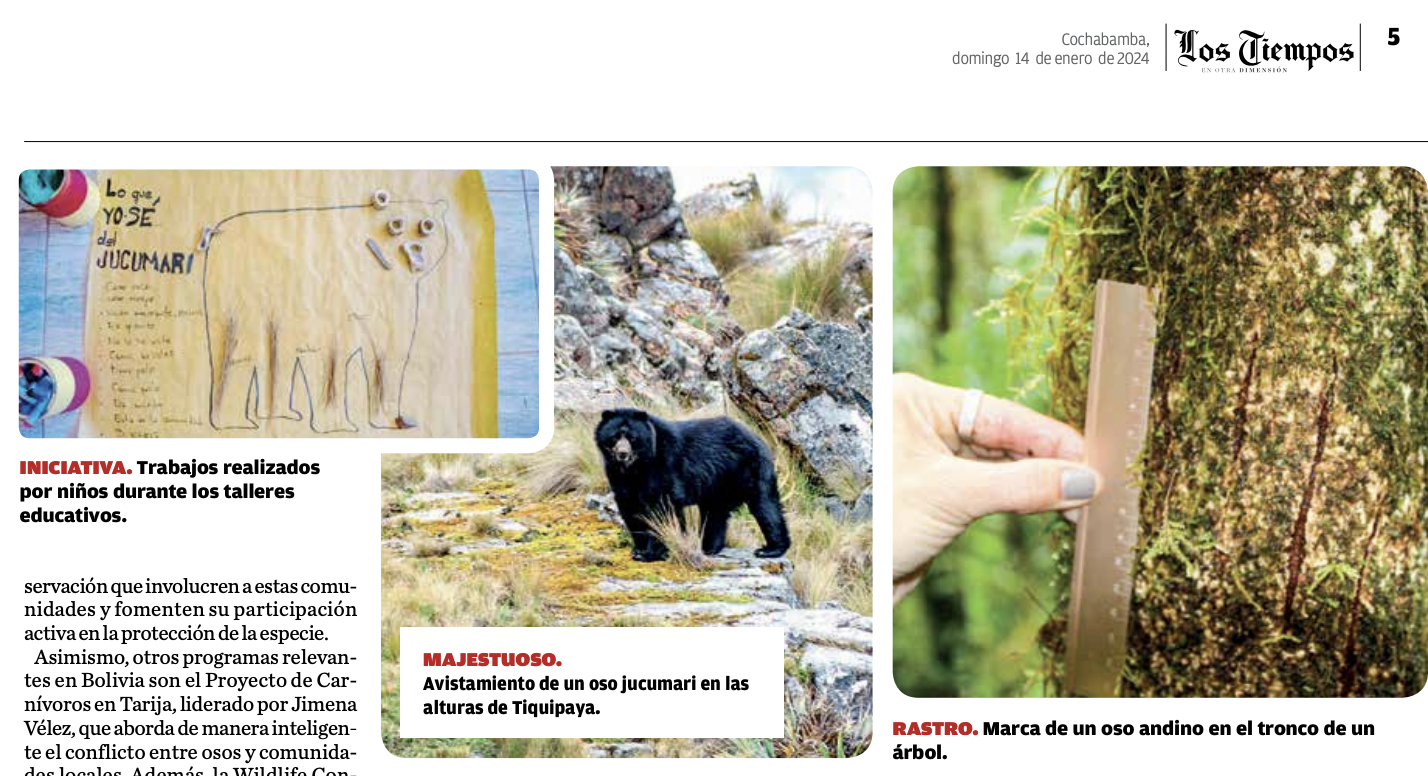
THE JUCUMARI, STALKED HABITAT
PROBLEMATIC. The expansion of the agricultural frontier and human growth are a serious threat to the habitat of this species. This causes significant loss of their natural environment, which is one of the biggest concerns for their survival.
…
MEASURES TO MITIGATE THE DANGER OF EXTINCTION
The critical situation of jucumaris bears requires a comprehensive approach that includes both individual measures and collective actions to prevent their extinction and restore their populations.
What strategies could be implemented to achieve this goal?
For Fuentes {Coordinator of the Jucumari Program at the NGO Vida Silvestre, Andrea Fuentes Arze], the individual approach focuses on education and raising awareness of the population. The understanding and dissemination of accurate information about the problems faced by these species is crucial. The lack of knowledge and empathy, recently exemplified in the case of an individual who took a bear without regard for its well-being, reflects the urgent need for education and awareness about the importance of preserving these creatures.
The specialist also indicated that collective measures require solid institutional support to activate effective actions. Protecting bear habitat is a priority; However, this implies the implementation of protection mechanisms that actively involve local communities that share territory with these species.
Government support at the municipal, national and international levels is essential to achieve legitimate coexistence between carnivores and local communities.
The coordination of efforts is the key to the preservation of these species. Despite having an action plan for the conservation of Andean bears, it will need stronger support from the government and municipalities to have a significant impact. Without this institutional support, the efforts of NGOs and foundations will be limited in their reach and effectiveness.
Continuing education is essential, both for local communities and urban populations, to foster a deeper connection to biodiversity and the importance of coexistence between humans and wildlife.
This includes understanding the ecological roles of bears and their influence on the balance of ecosystems.
The importance of education resonates strongly with this challenge. This is a problem of complex proportions that is not limited to rural communities, since ignorance about the problem persists in both urban and remote areas. Awareness must extend to all corners to properly address this dilemma.
“The recent incident with the young man who picked up a small bear exemplifies the urgent need for education. This act, although initially well-intentioned, could have sentenced the animal to a premature death,” said Fuentes. According to other experts such as Fuentes, who studies bears, the cub was not even a year old and, upon being separated from his mother, he was deprived of the crucial survival skills that are acquired during at least two years of coexistence. .
Regarding priority conservation areas, since 2014 there has been a crucial study called “Priority conservation units for the Andean bear” in Peru and Bolivia. This study identified seven key territorial extensions for the preservation of bears. One of them is the UCO Andes Centrales 5, in the northern region of Tiquipaya, where the Jucumari Program is carrying out its conservation efforts.
Society at large, whether in urban or rural areas, can contribute in various ways. Support businesses that support species conservation, such as projects that offer products with added value in terms of conservation, is vital. The dissemination of information, especially among families and children, can change perspective and encourage greater respect for nature.
EL JUCUMARI, HÁBITAT ACECHADO
PROBLEMÁTICA. La expansión de la frontera agrícola y el crecimiento humano son una grave amenaza para el hábitat de esta especie. Esto causa la pérdida significativa de su entorno natural, que es una de las mayores preocupaciones para su supervivencia.
…
MEDIDAS PARA MITIGAR EL PELIGRO DE EXTINCIÓN
La crítica situación de los osos jucumaris exige un abordaje integral que contemple tanto medidas individuales como acciones colectivas para evitar su extinción y restaurar sus poblaciones.
¿Qué estrategias podrían implementarse para lograr este objetivo?
Para Fuentes [Coordinadora del Programa Jucumari en la ONG Vida Silvestre, Andrea Fuentes Arze], el enfoque individual se centra en la educación y la sensibilización de la población. La comprensión y difusión de información precisa sobre la problemática que enfrentan estas especies es crucial. La falta de conocimiento y empatía, ejemplificada recientemente en el caso de un individuo que tomó a un oso sin considerar su bienestar, refleja la necesidad urgente de educación y conciencia sobre la importancia de preservar a estas criaturas.
La especialista también indicó que las medidas colectivas requieren un sólido apoyo institucional para activar acciones efectivas. Proteger el hábitat de los osos es prioritario; sin embargo, esto implica la implementación de mecanismos de protección que involucren activamente a las comunidades locales que comparten territorio con estas especies.
Un respaldo gubernamental a nivel municipal, nacional e internacional es esencial para lograr una coexistencia legítima entre carnívoros y comunidades locales.
La articulación de esfuerzos es la clave para la preservación de estas especies. A pesar de contar con un plan de acción para la conservación de los osos andinos, este necesitará de un respaldo más sólido del gobierno y los municipios para tener un impacto significativo. Sin este apoyo institucional, los esfuerzos de ONG y fundaciones se verán limitados en su alcance y efectividad.
La educación continua es fundamental, tanto para las comunidades locales como para las poblaciones urbanas, con el fin de fomentar una conexión más profunda con la biodiversidad y la importancia de la coexistencia entre los seres humanos y la vida silvestre.
Esto incluye comprender los roles ecológicos de los osos y su influencia en el equilibrio de los ecosistemas.
La importancia de la educación resuena de manera contundente en este desafío. Este es un problema de proporciones complejas que no se limita a las comunidades rurales, ya que la ignorancia sobre la problemática persiste tanto en zonas urbanas como en las áreas remotas. La conciencia debe extenderse a todos los rincones para abordar adecuadamente este dilema.
“El reciente incidente con el joven que tomó a un pequeño oso ejemplifica la necesidad urgente de educación. Este acto, aunque inicialmente bienintencionado, podría haber sentenciado al animal a una muerte prematura”, manifestó Fuentes. Según otros expertos como Fuentes, quien se dedica al estudio de osos, el cachorro no tenía ni un año y, al ser separado de su madre, quedó desprovisto de las habilidades de supervivencia cruciales que se adquieren durante al menos dos años de convivencia.
En cuanto a las áreas prioritarias de
conservación, desde 2014 se cuenta con un estudio crucial denominado “Unidades de conservación prioritarias para el oso andino” en Perú y Bolivia. Este estudio identificó siete extensiones territoriales clave para la preservación de los osos. Una de ellas es la UCO Andes Centrales 5, en la región norte de Tiquipaya, donde el Programa Jucumari está llevando a cabo sus esfuerzos de conservación.
La sociedad en general, ya sea en áreas urbanas o rurales, puede contribuir de diversas maneras. Apoyar negocios que respalden la conservación de especies, como los proyectos que ofrecen productos con un valor agregado en términos de conservación, es vital. La difusión de información, sobre todo entre las familias y los niños, puede cambiar la perspectiva y fomentar un mayor respeto hacia la naturaleza.
…
https://www.lostiempos.com/sites/default/files/edicion_online/oh_webb_14_0.pdf

 Bolivian Thoughts | Pensamientos Bolivianos (Bilingual/Bilingüe)