
Voces Que Cuentan, ANF:
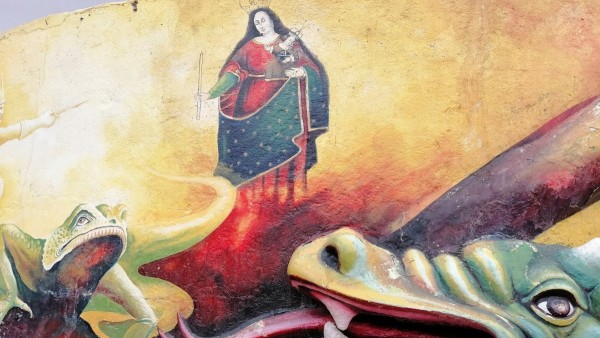
La Virgen del Socavón en Oruro.
According to history, the Urus dressed as devils to represent Huari who sent the plagues to Oruro and to thank the female image who saved them from the curse.
La Paz, December 15, 2023 (VQC).- The origin of the legend of the four plagues of Oruro dates back to pre-Columbian times, but continues to be part of the identity of the Oruro people. Thus, the Diablada’s costumes have ants, snakes, lizards and toads printed on them that represent the attempted destruction of the Urus people and are danced as a sign of gratitude to the female image that saved them from this curse.
According to legend, Huari was an evil deity who tried to subdue the Uru people by sending four plagues from the four cardinal points. However, a white-dressed Ñusta protected them from this condemnation.
To the south, first a gigantic viper appeared among the hills. “The Urus cried out for help to the Ñusta, now represented by the Virgin of the Socavón, and she with her sword divided the body of the snake and left it petrified. It is said that the hills, where the Faculty of Engineering is located, resemble to the divided reptile,” Graciela Torrez told Voces Que Cuentan.
In the West, Huari sent a huge lizard that was later decapitated. “There is a lagoon near Oruro in Cala Cala whose waters turn red at a certain time of day. Legend has it that this lagoon was formed with the blood of the decapitated lizard,” says the story that is captured at the foot of the monument to the Candila Virgin in Oruro.
The ant plague emerged from the lizard’s head and arrived from the east. However, they were converted into sand dunes and formed the sandy area that is in the city of El Pagador. Finally, from the North, a toad of colossal size arrived. But Ñusta turned him into stone with a slingshot.
As a sign of gratitude to the Ñusta, the urus dressed as devils representing Huari and on their costumes they carry symbols of the four plagues. This fact gave rise to the Diablada dance that currently represents the department of Oruro and is danced at the Carnival that was declared a Heritage Site by UNESCO. With the arrival of the Spanish colony, the image of the Ñusta merged with the Virgen de la Candelaria and which later became the Virgen del Socavón.
Según la historia, los urus se vistieron de diablos para representar a Huari quien envió las plagas a Oruro y para agradecer a la imagen femenina que los salvó de la maldición.
La Paz, 15 de diciembre de 2023 (VQC).- El origen de la leyenda de las cuatro plagas de Oruro se remonta a tiempos precolombinos, pero continúa formando parte de la identidad de los orureños. Es así que los trajes de la Diablada tienen estampados hormigas, serpientes, lagartos y sapos que representan el intento de destrucción del pueblo de los urus y que se baila como una señal de agradecimiento a la imagen femenina que los salvó de esta maldición.
Según la leyenda, Huari era una deidad maligna que intentó someter al pueblo Uru enviando cuatro plagas desde los cuatro puntos cardinales. Sin embargo, una Ñusta de vestimenta blanca los protegió de esta condena.
Por el Sur, primero apareció una gigantesca víbora entre los cerros. “Los Urus clamaron ayuda a la Ñusta, ahora representada por la Virgen del Socavón, y ella con su espada dividió el cuerpo de la serpiente y la dejó petrificada. Se dice que los cerros, por donde se encuentra la Facultad de Ingeniería, se asemejan al reptil dividido”, contó Graciela Torrez para Voces Que Cuentan.
Por el Oeste, Huari envió un enorme lagarto que luego fue decapitado. “Existe cerca de Oruro en Cala Cala una laguna cuyas aguas se enrojecen a cierta hora del día. La leyenda cuenta que esta laguna se formó con la sangre del lagarto decapitado”, refiere la historia que está plasmada a los pies del monumento a la Virgen Candila en Oruro.
La plaga de hormigas emergió de la cabeza del lagarto y llegó por el Este. Sin embargo, fueron convertidas en dunas de arena y formaron el arenal que está en la ciudad del Pagador. Finalmente, por el Norte, llegó un sapo de tamaño colosal. Pero la Ñusta con una honda lo convirtió en piedra.
En señal de agradecimiento a la Ñusta, los urus se vistieron de diablos representando a Huari y en sus trajes llevan símbolos de las cuatro plagas. Este hecho dio origen al baile de la Diablada que actualmente representa al departamento de Oruro y se baila en el Carnaval que fue declarado Patrimonio por la Unesco. Con la llegada de la colonia española, la imagen de la Ñusta se fusionó con la Virgen de la Candelaria y que luego se convirtió en la Virgen del Socavón.

 Bolivian Thoughts | Pensamientos Bolivianos (Bilingual/Bilingüe)